
Addison’s disease is an uncommon autoimmune disease, characterized by chronic and insufficient functioning of the outer layer of the adrenal gland. The adrenal glands are located atop each kidney and produce vital glucocorticoid hormones. Because of this chronic under-functioning of the adrenal glands, persons with Addison’s disease have a deficiency in the production of glucocorticoid hormones. Glucocorticoid hormones are involved in how the body utilizes and stores carbohydrates, protein, fat, and blood sugar.
The adrenal gland also plays a role in the immune response. A deficiency in glucocorticoid hormones causes an increase in the release of sodium and a decreased release of potassium in the urine, sweat, saliva, stomach, and intestines. These changes can cause low blood pressure and increased water excretion that can in some cases lead to severe dehydration.
Although there are many underlying factors in the development of adrenal insufficiencies, including the destruction of the adrenal cortex due to diseases such as tuberculosis, the growth of tumors, non-autoimmune diseases amyloidosis and adrenoleukodystrophy, and atrophy of the gland due to prolonged use of cortical steroids used in the treatment of other conditions and illnesses, most cases of Addison’s disease are thought to be autoimmune in nature.
Addison’s disease occurs when the adrenal glands do not produce enough (or any) of the hormones, cortisol, and aldosterone. These adrenal gland hormones are necessary for balancing water and energy in the body. Symptoms usually develop slowly over time and may include fatigue, loss of appetite, abdominal pain, and dark patches of skin. Sometimes symptoms occur suddenly causing a life-threatening condition called acute adrenal failure, also known as an acute adrenal crisis. Symptoms of an acute adrenal crisis include sudden weakness, pain, and fainting. The most common cause of Addison’s disease is an abnormal response of the body’s immune system. Injury to the adrenal gland can also cause Addison’s disease. Diagnosis is based on the symptoms, blood and urine tests that evaluate the adrenal function, and imaging studies. Treatment is focused on managing the symptoms and includes daily medications that replace the adrenal hormones. Treatment for an adrenal crisis may include int
Causes
Addison’s disease is caused by damage to your adrenal glands, resulting in not enough of the hormone cortisol and, often, not enough aldosterone as well. Your adrenal glands are part of your endocrine system. They produce hormones that give instructions to virtually every organ and tissue in your body.
Your adrenal glands are composed of two sections. The interior (medulla) produces adrenaline-like hormones. The outer layer (cortex) produces a group of hormones called corticosteroids. Corticosteroids include:
- Glucocorticoids. These hormones, which include cortisol, influence your body’s ability to convert food into energy, play a role in your immune system’s inflammatory response and help your body respond to stress.
- Mineralocorticoids. These hormones, which include aldosterone, maintain your body’s balance of sodium and potassium to keep your blood pressure normal.
- Androgens. These male sex hormones are produced in small amounts by the adrenal glands in both men and women. They cause sexual development in men, and influence muscle mass, sex drive (libido) and a sense of well-being in both men and women.
Primary adrenal insufficiency
When the cortex is damaged and doesn’t produce enough adrenocortical hormones, the condition is called primary adrenal insufficiency. This is most commonly the result of the body attacking itself (autoimmune disease). For unknown reasons, your immune system views the adrenal cortex as foreign, something to attack and destroy. People with Addison’s disease are more likely than others to have another autoimmune disease as well.
Other causes of adrenal gland failure may include:
- Tuberculosis
- Other infections of the adrenal glands
- Spread of cancer to the adrenal glands
- Bleeding into the adrenal glands. In this case, you may have an addisonian crisis without any previous symptoms.
Secondary adrenal insufficiency
The pituitary gland makes a hormone called adrenocorticotropic hormone (ACTH). ACTH in turn stimulates the adrenal cortex to produce its hormones. Benign pituitary tumors, inflammation and prior pituitary surgery are common causes of not producing enough pituitary hormone.
Too little ACTH can lead to too little of the glucocorticoids and androgens normally produced by your adrenal glands, even though your adrenal glands themselves aren’t damaged. This is called secondary adrenal insufficiency. Mineralocorticoid production is not affected by too little ACTH.
Most symptoms of secondary adrenal insufficiency are similar to those of primary adrenal insufficiency. However, people with secondary adrenal insufficiency don’t have hyperpigmentation and are less likely to have severe dehydration or low blood pressure. They’re more likely to have low blood sugar.
A temporary cause of secondary adrenal insufficiency occurs when people who take corticosteroids (for example, prednisone) to treat chronic conditions, such as asthma or arthritis, stop taking the corticosteroids all at once rather than tapering off.
Last updated: 2020-12-24
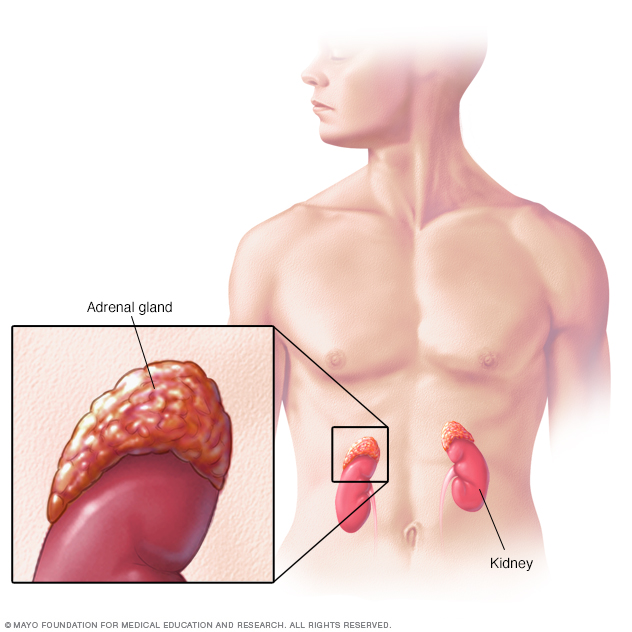
Adrenal Glands – Causes
Symptoms
Addison’s disease symptoms usually develop slowly, often over several months. Often, the disease progresses so slowly that symptoms are ignored until a stress, such as illness or injury, occurs and makes symptoms worse. Signs and symptoms may include:
- Extreme fatigue
- Weight loss and decreased appetite
- Darkening of your skin (hyperpigmentation)
- Low blood pressure, even fainting
- Salt craving
- Low blood sugar (hypoglycemia)
- Nausea, diarrhea or vomiting (gastrointestinal symptoms)
- Abdominal pain
- Muscle or joint pains
- Irritability
- Depression or other behavioral symptoms
- Body hair loss or sexual dysfunction in women
Acute adrenal failure (addisonian crisis)
Sometimes the signs and symptoms of Addison’s disease may appear suddenly. Acute adrenal failure (addisonian crisis) can lead to life-threatening shock. Seek emergency medical treatment if you experience the following signs and symptoms:
- Severe weakness
- Confusion
- Pain in your lower back or legs
- Severe abdominal pain, vomiting and diarrhea, leading to dehydration
- Reduced consciousness or delirium
In an addisonian crisis you will also have:
- Low blood pressure
- High potassium (hyperkalemia) and low sodium (hyponatremia)
| Medical Terms | Other Names |
Learn More:
HPO ID
|
|---|---|---|
| 100% of people have these symptoms | ||
| Decreased circulating cortisol level |
Low blood cortisol level
|
0008163 |
| 80%-99% of people have these symptoms | ||
| Abdominal pain |
Pain in stomach
[ more ] |
0002027 |
| Anorexia | 0002039 | |
| Constipation | 0002019 | |
| Diarrhea |
Watery stool
|
0002014 |
| Failure to thrive |
Faltering weight
[ more ] |
0001508 |
| Fatigue |
Tired
[ more ] |
0012378 |
| Hyperpigmentation of the skin |
Patchy darkened skin
|
0000953 |
| Increased circulating ACTH level |
High blood corticotropin levels
|
0003154 |
| Muscle weakness |
Muscular weakness
|
0001324 |
| Nausea and vomiting | 0002017 | |
| Weight loss | 0001824 | |
| 30%-79% of people have these symptoms | ||
| Androgen insufficiency | 0008226 | |
| Decreased circulating aldosterone level |
Low blood aldosterone level
|
0004319 |
| Decreased urinary potassium | 0012364 | |
| Hyperkalemia |
Elevated serum potassium levels
|
0002153 |
| Hyperkalemic metabolic acidosis | 0005976 | |
| Hyperuricemia |
High blood uric acid level
|
0002149 |
| Hyponatremia |
Low blood sodium levels
|
0002902 |
| Increased circulating renin level |
Elevated blood renin level
|
0000848 |
| Normocytic anemia | 0001897 | |
| Renal salt wasting |
Loss of salt in urine
|
0000127 |
| 5%-29% of people have these symptoms | ||
| Adrenal calcification | 0010512 | |
| Adrenal hypoplasia |
Small adrenal glands
|
0000835 |
| Arthralgia |
Joint pain
|
0002829 |
| Celiac disease | 0002608 | |
| Decreased female libido |
Decreased female sex drive
|
0030018 |
| Delayed puberty |
Delayed pubertal development
[ more ] |
0000823 |
| Dry skin | 0000958 | |
| Generalized bone demineralization | 0006462 | |
| Hashimoto thyroiditis | 0000872 | |
| Hypercalcemia |
High blood calcium levels
[ more ] |
0003072 |
| Hypoglycemia |
Low blood sugar
|
0001943 |
| Hypoparathyroidism |
Decreased parathyroid hormone secretion
|
0000829 |
| Orthostatic hypotension |
Decrease in blood pressure upon standing up
|
0001278 |
| Premature ovarian insufficiency |
Early menopause
[ more ] |
0008209 |
| Salt craving | 0030083 | |
| Seizure | 0001250 | |
| Sparse axillary hair |
Limited armpit hair
[ more ] |
0002215 |
| Type I diabetes mellitus |
Type 1 diabetes
[ more ] |
0100651 |
| Vertigo |
Dizzy spell
|
0002321 |
| Vitiligo |
Blotchy loss of skin color
|
0001045 |
| 1%-4% of people have these symptoms | ||
| Primary testicular failure | 0008720 | |
| Thiamine-responsive megaloblastic anemia | 0004860 | |
| Thymoma | 0100522 | |
| Percent of people who have these symptoms is not available through HPO | ||
| Abnormality of skin pigmentation |
Abnormal pigmentation
[ more ] |
0001000 |
| Abnormality of the cardiovascular system |
Cardiovascular abnormality
|
0001626 |
| Adrenal insufficiency | 0000846 | |
| Apnea | 0002104 | |
| Autosomal recessive inheritance | 0000007 | |
| Cyanosis |
Blue discoloration of the skin
|
0000961 |
| Feeding difficulties in infancy | 0008872 | |
| Vomiting |
Throwing up
|
0002013 |
When to see a doctor
See your doctor if you have common signs and symptoms of Addison’s disease, such as:
- Darkening areas of skin (hyperpigmentation)
- Severe fatigue
- Unintentional weight loss
- Gastrointestinal problems, such as nausea, vomiting and abdominal pain
- Lightheadedness or fainting
- Salt cravings
- Muscle or joint pains
Diagnosis
A diagnosis of Addison’s disease is suspected based upon a thorough clinical evaluation, a detailed patient history and identification of characteristic findings. Often a diagnosis is made incidentally during a routine exam when a blood test shows low levels of sodium or high levels of potassium. A diagnosis may be confirmed through a variety of specialized tests including the ACTH stimulation test, insulin-induced hypoglycemia test, and x-ray examination.
The ACTH stimulation test measures the amount of cortisol in the blood. During this test, adrenocorticohormone (ACTH) is injected into the body, stimulating the production of cortisol. If the test fails to stimulate adequate cortisol production, it indicates that the adrenal glands are damaged or not functioning properly.
The insulin-induced hypoglycemia test may be used to determine if the symptoms of Addison’s disease are due to problems with the pituitary gland. This test measures blood sugar (glucose) levels before and after the injection of fast-acting insulin, which should lead to a drop in glucose and a rise in cortisol.
X-ray imaging techniques such as computed tomography (CT scan) of the abdomen may be taken to check the size of the adrenal glands and to detect other signs of disease such as calcification of the adrenal glands. During a CT scan, a computer and x-rays are used to create a film showing cross-sectional images of an organ’s tissue structure.
Treatment
The treatment of Addison’s disease is directed toward the specific symptoms that are apparent in each individual. Treatment may require the coordinated efforts of a team of specialists. Individuals with Addison’s disease are treated by replacing the deficient steroid hormones (cortisol and aldosterone). Cortisol is replaced by the drug hydrocortisone and aldosterone is replaced by the drug fludrocortisone. The dosage of these drugs is different for each individual and the dosage may be increased during infection, trauma, surgery and other stressful situations to prevent an acute adrenal crisis. Individuals should be encouraged to increase their salt intake in their diets.
An adrenal crisis demands immediate hormonal investigation and intravenous (injected directly into a blood vessel) administration of high-dose hydrocortisone and fluid (salt water) and electrolyte replacement; a short-term course of other drugs called vasopressors may be needed to maintain blood pressure. Affected individuals should carry a card or wear a tag stating that they have Addison’s disease.
Complications
Addisonian crisis
If you have untreated Addison’s disease, you may develop an addisonian crisis as a result of physical stress, such as an injury, infection or illness. Normally, the adrenal glands produce two to three times the usual amount of cortisol in response to physical stress. With adrenal insufficiency, the inability to increase cortisol production with stress can lead to an Addisonian crisis.
An addisonian crisis is a life-threatening situation that results in low blood pressure, low blood levels of sugar and high blood levels of potassium. You will need immediate medical care.
People with Addison’s disease commonly have associated autoimmune diseases.
References

