
Star Apple/Chrysophyllum cainito is a tropical tree of the family Sapotaceae. It is native to the Isthmus of Panama, where it was domesticated. It has spread to the Greater Antilles and the West Indies and is now grown throughout the tropics, including Southeast Asia.[rx] It grows rapidly and reaches 20 meters in height. The leaves are evergreen, alternate, simple oval, entire, 5–15 cm long; the underside shines with a golden color when seen from a distance. The tiny flowers are purplish white and have a sweet fragrant smell. The tree is also hermaphroditic (self-fertile). It produces a strong odor.
| Star Apple Quick Facts | |
|---|---|
| Name: | Star Apple |
| Scientific Name: | Chrysophyllum cainito |
| Origin | Chrysophyllum cainito |
| Colors | Green turning yellowish-green or purplish-green or purple |
| Shapes | Obovoid-globose or oblate berry, 5–10 cm in diameter |
| Flesh colors | White and soft, jellylike flesh |
| Taste | Sweet and coconutty |
| Calories | 67.2 Kcal./cup |
| Major nutrients | Carbohydrate (11.27%) Vitamin C (10.11%) Vitamin B3 (7.11%) Iron (6.13%) Total dietary Fiber(5.05%) |
| Health benefits | Digestive Health, Lose Weight, Control Diabetes, Antioxidants, Rich in Vitamin C, Bones, Prevent Iron Deficiency Anemia, Medicinal Drugs |
Star Apple scientifically known as Chrysophyllum cainito is a tropical evergreen tree of the family Sapotaceae. It is native to the Greater Antilles in the Caribbean. It has spread to the lowlands of Central America and is now grown throughout the tropics, including Southeast Asia. Apart from star Apple, it is also known as Caimito, Golden Leaf Tree, Milk Fruit, Satin Leaf, Star apple, Star Plum, West Indian Star Apple, Abiaba, Cainito, pomme de lait, Estrella and aguay. The tree produces a very popular fruit as well as having a wide range of local medicinal uses and a good quality wood. It is widely cultivated in tropical regions for its fruit, and is often grown as an ornamental garden fruit crop. As an ornamental it is mainly appreciated for its foliage, which is bright blue-green above and coppery beneath, making an attractive contrast when stirred by the wind.
Plant
Star apple is an Evergreen erect tree, 8–20 m tall grown successfully in a range of tropical or near-tropical areas. It is grown in a warm, humid atmosphere with relatively high temperatures throughout the year. It prefers fertile, well-drained soils, including the low and high-pH sandy soils and the high-pH, rocky, calcareous soils found in south Florida. The tree has a trunk of 60 cm diameter and a dense, broad crown. Its trunk is usually straight, cylindrical, but often fluted or spurred at the base; buttresses are small or absent; bark surface is rough, irregularly fissured, and brown and exudes white gummy latex. Young twigs are reddish-brown and pubescent.
Leaf
Leaves are alternate, elliptic or oblong-elliptic, 5–15 cm long, slightly leathery, rich green and glossy on the upper surface, and coated with persistent reddish-brown silky indumentum on the underside when mature imparting a golden bronze color to the underside, though they are silvery when young.
Flower
Flowers are bisexual, fasciculate with 5–35 clustered, small and inconspicuous, yellowish-white flowers. The calyx is 5-lobed; lobes are ovate with obtuse to rounded apex and hairy within. Corolla is 5-lobed with ovate and glabrous lobes. Stamens are 5 along with deltoid filaments and ovoid anthers.
Fruit
Fruit is an obovoid-globose or oblate berry, 5–10 cm in diameter, green turning yellowish-green or purplish-green or purple. Skin is thick, leathery, smooth-surfaced, somewhat glossy, dull purple in some varieties, light green in others with white and soft, jellylike flesh, and a gummy latex. The pulp is white, soft, and milky surrounding 6 to 11 seeds. The seeds are contained in rubbery seed cells, and each seed is surrounded by a gelatinous pulp. When the fruit is cut transversely, the seed cells are seen to radiate outwardly from a central core, producing a star-shaped pattern. Seeds are 3–10, flattened obovoid, about 2 cm × 1 cm × 0.5 cm, purplish-black, with a chartaceous testa and an adaxial scar. The Flesh contains a small amount of milky juice which is somewhat fibrous, sweet mild, and pleasing tasting. Avoid eating the skin, as it is bitter and full of unpleasant latex.
History
Star apple is probably native to the Greater Antilles in the Caribbean. It is extensively cultivated in tropical Central, South America, and the Caribbean – Cayman Islands, Cuba, Dominican Republic, Haiti, Jamaica, and Puerto Rico. Now it is also cultivated throughout the tropics and subtropics in Florida, Taiwan, India, Thailand, the Philippines, Vietnam, Malaysia, Indonesia, and Northern Australia.
Nutritional value
Apart from their sweet and coconutty taste, star apple is a good source of nutrients, vitamins, and minerals. Consuming 100 grams of star apple offers 14.65 g of Carbohydrate, 9.1 mg of Vitamin C (Ascorbic acid), 1.137 mg of Vitamin B3 (Niacin), 0.49 mg of Iron,1.92 g of Total Dietary Fiber, 0.049 mg of Vitamin B1, 1.52 g of protein, 0.038 mg of Vitamin B2 and 18.95 mg Phosphorus. Moreover many Amino acids 0.004 g of Tryptophan, 0.022 g of Lysine, and 0.002 g of Methionine are also found in 100 grams of Star apple.
Star apple varieties
1. Purple star apple
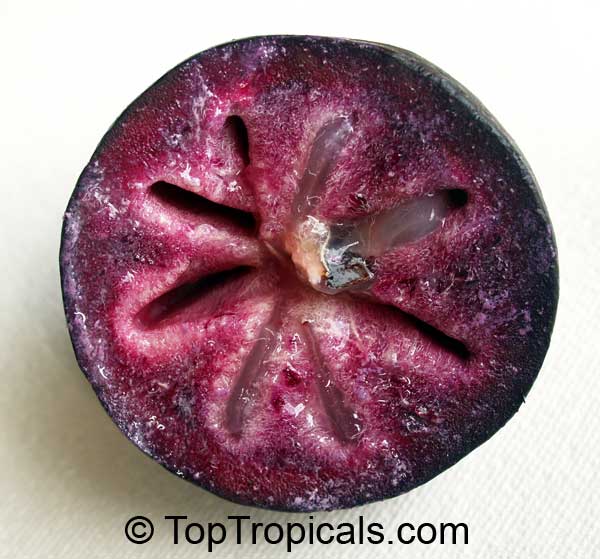 Purple star apples have thick skin attached to a rind. The rind of this fruit is usually a dark purple color, and the pulp ranges from a light purplish color to white. The dark purple fruit is 6-12.5mm thick and has soft white milky sweet pulp.
2. Green star apple
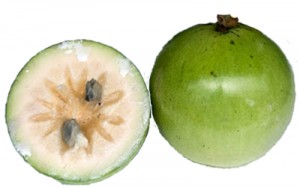
Green star apple has thinner skin and rind. The rind and pulp of this fruit are both a milky white color. The leathery skin in green fruit is white and it is 3-5 mm thick with soft and sweet pulp.
Nutritional value of Star Apple
Calories 67.2 Kcal.
| Proximity | Amount | % DV |
|---|---|---|
| Water | 82.05 g | N/D |
| Energy | 67.2 Kcal | N/D |
| Protein | 1.52 g | 3.04% |
| Ash | 0.53 g | N/D |
| Carbohydrate | 14.65 g | 11.27% |
| Total dietary Fiber | 1.92 g | 5.05% |
| Minerals | Amount | % DV |
|---|---|---|
| Calcium, Ca | 12.35 mg | 1.24% |
| Iron, Fe | 0.49 mg | 6.13% |
| Phosphorus, P | 18.95 mg | 2.71% |
| Vitamins | Amount | % DV |
|---|---|---|
| Water-soluble Vitamins | ||
| Vitamin B1 (Thiamin) | 0.049 mg | 4.08% |
| Vitamin B2 (Riboflavin) | 0.038 mg | 2.92% |
| Vitamin B3 (Niacin) | 1.137 mg | 7.11% |
| Vitamin C (Ascorbic acid) | 9.1 mg | 10.11% |
| Amino acids | Amount | % DV |
|---|---|---|
| Tryptophan | 0.004 g | 0.91% |
| Lysine | 0.022 g | 0.66% |
| Methionine | 0.002 g | N/D |
| Others | Amount | % DV |
|---|---|---|
| Carotene | 0.021 mg | N/D |
*Above mentioned Percent Daily Values (%DVs) are based on 2,000 calorie diet intake. Daily values (DVs) may be different depending upon your daily calorie needs. Mentioned values are recommended by the U.S. Department of Agriculture. They are not rxharuun.com recommendations. Calculations are based on average age of 19 to 50 years and weigh 194 lbs. Source: https://hort.purdue.edu/
Health benefits of Star Apple
An Apple star offers 5 percent of the daily recommended values of important vitamins, such as vitamin C and vitamin A. It is a wonderful source of calcium, providing you with 10 percent of the daily recommended value of the mineral. The consumption of calcium-rich foods, such as star apple, helps strengthen bones and teeth and also reduces the symptoms of premenstrual syndrome such as abdominal bloating and cramps. Apple star is rich in phosphorus, another mineral bone healthy. So now check out a few health benefits of Apple Star for Health.
1. Digestive Health
Star apple is a wonderful source of dietary fiber and thus the fruit is able to keep your digestive system in good health. Fiber adds bulk to your bank, makes it soft, and eliminates it easily through the intestines. Normalizing your bowel movements, fiber star apple helps to get rid of constipation as well as other digestive problems. It also helps prevent the most dangerous health problems such as cancer of the colon.
2. Rich in Vitamin C
Vitamin C is a water-soluble nutrient that is essential to support several important functions in the human body. This vitamin acts as an antioxidant and is responsible for the production of collagen, healing wounds, protecting the heart, improving immune health, enhancing vision, and decreasing blood sugar levels in diabetics, and more. The antioxidant properties of vitamin C neutralize the harmful effects of free radicals and help prevent many fatal diseases like cancer and heart disease. It also helps to delay the aging process. Since the human body cannot make vitamin C itself, it is important to consume this nutrient-rich food. Apple star is one of those foods that have a high content of vitamin C.
3. Control Diabetes
Another important benefit of the star apple is that it helps control sugar levels in the blood and thus is an ideal food for people suffering from diabetes. It was found that the star apple fiber helps keep the blood sugar under control. This fruit is also rich in antioxidants that protect the body against health problems like diabetes, cancer, and heart problems.
4. Prevent Iron Deficiency Anemia
Iron deficiency anemia is a common type of anemia that occurs due to insufficient amounts of mineral iron in the body. Iron is essential for your body to produce hemoglobin, a protein molecule in red blood cells which is responsible for carrying oxygen from the lungs to all parts of the body. Iron deficiency anemia is frequently characterized by symptoms like fatigue, weakness, shortness of breath, rapid heartbeat, headache, dizziness, and loss of appetite. This condition can be corrected by taking iron supplements or consuming foods with high iron content like apple stars, green leafy vegetables, etc.
5. Lose Weight
Being a fruit low fat and calories, the star apple is one of the best food choices to include in a weight loss diet. Furthermore, the high amount of dietary fiber in fruit improves its satiety and makes you feel more complete for long periods of time. This helps prevent over-eating, which is very important when you are trying to lose weight.
6. Bones
Calcium and phosphorus are two very important minerals necessary for the development of strong teeth and bones. A proper balance of these minerals is needed by the body to maintain good bone health and to prevent numerous bone diseases. The star apple is a good source of calcium and phosphorus and thus is considered a fruit bone.
7. Medicinal Drugs
In fruit, other plant parts such as seeds, leaves, and bark are also used as natural remedies for the treatment of various diseases. The cooking of the leaves or bark is used in the Philippines to treat dysentery and diarrhea. According to a survey, the shell of the star apple tree has traditionally been used to treat malaria and yellow fever. The leaves have emollient properties and are used for the treatment of stomach pain, diarrhea, and skin rash. In Western Nigeria, the cotyledons of the star apple seeds are used for the preparation of ointments for the treatment of vaginal and skin infections.
8. Antioxidants
According to a survey, the star apple consists of an alkaloid known as elegance, which shows a powerful antimicrobial activity. This compound has also been found to possess antioxidants and anti-inflammatory. The star apple seeds have been used in the preparation of ointments that are designed to fight infections. Researchers also found that the star apple tree leaves exhibit strong antibacterial activity against common bacteria.
How to Eat
- Sweet fleshy ripe fruit mesocarp is edible and delicious.
- Ripe fruit is consumed fresh or preferably chilled, is cut in half, and the flesh spooned out and eaten.
- It is used as an ingredient of ice cream and sherbet.
- In Jamaica, it is occasionally made into preserves.
- Skin and rind are not edible and have bitter latex.
- An emulsion of the slightly bitter seed kernels is used to make an imitation of milk of almonds.
Traditional uses and benefits of Star Apple
- Ripe fruit is consumed to treat inflammation in laryngitis, pneumonia, and hemorrhage or is cooked and used as antipyretic in traditional folkloric medicine in tropical America and the Caribbean.
- It is taken as a remedy for diabetes mellitus, and a decoction is gargled to relieve angina.
- Decoction of the fruit rind, or of the leaves, is taken as a pectoral.
- Undersides of leaves are grated and applied as a poultice to a wound and a leaf decoction is taken orally for hypoglycemia.
- Bark, latex, and seeds have medicinal uses.
- Decoction of the tannin-rich, astringent bark is taken as a tonic and stimulant and is drunk to stop diarrhea, dysentery, and hemorrhage, and also used as a treatment for gonorrhea and “catarrh of the bladder”.
- Bitter, pulverized seed is combined in water and consumed as a tonic, diuretic, and febrifuge.
- Latex of the tree is applied on abscesses and, when dried and powdered, it is utilized as a potent vermifuge.
- It is taken as a diuretic, febrifuge, and remedy for dysentery.
- Decoction of the bark is given for dysentery in Mexico.
- Infusion of bark is tonic and refreshing in Costa Rica.
- Dried latex is used as antihelminthic.
- In certain countries, fruit is used for diabetes.
- Bitter seed is sometimes used as a tonic, for diarrhea and fevers.
- Fruit is eaten for inflammation in laryngitis and pneumonia.
- Decoction of leaves used for hypertension in Ivory Costa.
- Leaf decoction is used for diabetes.
- The unripe fruit is used for intestinal problems in Venezuela.
- Decoction of bark is used as tonic and stimulant: use for diarrhea, dysentery, hemorrhages, and treatment of gonorrhea.
- Cubans in Miami started to use the leaf decoction for cancer treatment.
- Bark latex is used as resolutive on abscesses and as a potent vermifuge when dried and powdered in Brazil.
- A poultice of grated leaves applied to wounds.
- Leaf decoction is used for hypoglycemic.
- Fruit is used for treating fever and hemorrhage.
Other Facts
- Reddish-brown wood is appropriate for general indoor construction purposes, such as planking, light framing, flooring, interior trim, cladding, paneling lining, shelving, balustrades, and partitioning.
- It is also appropriate for inlaying, carving, joinery, moldings, light tool handles, furniture, and cabinet making.
- Good-quality veneer and plywood can be obtained from the tree.
- The mature branches are used as a medium to grow orchids.
- The tree is extensively appreciated as an ornamental.
- The bark also yields tannin.
- Latex from the bark has been used as an adulterant of gutta-percha.
References
- https://www.ncbi.nlm.nih.gov/pmc/articles/PMC3649719/
- https://www.ncbi.nlm.nih.gov/pmc/articles/PMC6315720/
- https://www.ncbi.nlm.nih.gov/pmc/articles/PMC3419346/
- https://www.ncbi.nlm.nih.gov/books/NBK11795/
- https://www.ncbi.nlm.nih.gov/pmc/articles/PMC5291486/
- https://fruits.edpsciences.org/articles/fruits/abs/2012/05/fruits120033/fruits120033.html
- http://www.fao.org/3/cb2395en/CB2395EN.pdf
- https://www.fao.org/in-action/inpho/crop-compendium/fruits-vegetables/en/
- https://www.fao.org/3/cb2395en/online/src/html/fruit-and-vegetables.html
- http://www.fao.org/3/cb2395en/CB2395EN.pdf
- https://en.wikipedia.org/wiki/Fruit
- https://en.wikipedia.org/wiki/List_of_food_plants_native_to_the_Americas
- https://en.wikipedia.org/wiki/List_of_culinary_fruits
- https://www.hsph.harvard.edu/nutritionsource/what-should-you-eat/vegetables-and-fruits/
- https://www.betterhealth.vic.gov.au/health/healthyliving/fruit-and-vegetables
- https://www.cdc.gov/healthyweight/healthy_eating/fruits_vegetables.html
- https://www.botanical-online.com/en/botany/fruits-types-characteristics
- https://www.fda.gov/food/laboratory-methods-food/mpm-v-9-fruits-and-fruit-products-v-51-v-78
- https://www.fda.gov/food/food-labeling-nutrition/nutrition-information-raw-fruits-vegetables-and-fish
- https://onlinelibrary.wiley.com/doi/abs/10.1111/mcn.12208
- http://news.discovery.com/earth/
- https://www.cabi.org/isc/datasheet/
- https://www.science.org/
- https://plants.ces.ncsu.edu/plants/
- https://www.sciencedirect.com/topics/agricultural-and-biological-sciences/fruit-vegetable
- https://www.researchgate.net/publication/
- https://www.ams.usda.gov/grades-standards/fruits
- https://www.aphis.usda.gov/aphis/resources/traveler/intl-travel/fruits-vegetables/fruits-vegetables
- https://snaped.fns.usda.gov/seasonal-produce-guide
- https://www.nass.usda.gov/Publications/Highlights/2015/FruitsNutsBerries_AgCensusHighlights.pdf
- https://plants.usda.gov/home/plantProfile?
- https://www.fs.fed.us/wildflowers/ethnobotany/food/nuts.shtml
- https://downloads.usda.library.cornell.edu/usda-esmis/files/zs25x846c/sf269213r/6t054c23t/ncit0521.pdf
- https://agr.wa.gov/departments/business-and-marketing-support/farm-to-school-toolkit/
- https://health.gov/sites/default/files/2020-01/DGA2000.pdf
- https://www.farmers.gov/archived/cfap2/specialty
- https://www.hsph.harvard.edu/nutritionsource/
- https://www.foodsafety.gov/food-safety-charts/food-safety-during-power-outage
- https://clinicaltrials.gov/ct2/show/
- https://botany.org/home/careers-jobs/careers-in-botany/what-is-botany.html
- https://www.healthbenefitstimes.com/category/fruits
- http://www.hear.org/pier/species/
- https://www.itis.gov/servlet/SingleRpt/SingleRpt?
- http://www.theplantlist.org/tpl1.1/record/
- https://www.fs.fed.us/database/feis/plants/tree/
- https://www.itis.gov/servlet/SingleRpt/SingleRpt?
- https://eol.org/pages/
- http://www.fruitsinfo.com/Star-Apple-Exotic-fruits.php
- http://2beingfit.com/star-apple-caimito-health-benefits-uses-nutrition/
- http://theindianvegan.blogspot.com/2013/02/all-about-star-apple.html
- https://hort.purdue.edu/newcrop/morton/star_apple.html
- http://healthyass.com/health-benefits-apple-star/
- https://en.wikipedia.org/wiki/Chrysophyllum_cainito
- http://plants.usda.gov/core/profile?symbol=chca10
- http://www.stuartxchange.org/Caimito.html
- http://ntbg.org/plants/plant_details.php?plantid=11871
- http://www.worldagroforestry.org/treedb/AFTPDFS/Chrysophyllum_cainito.PDF
- http://edis.ifas.ufl.edu/hs309
- http://uses.plantnet-project.org/en/Chrysophyllum_cainito_(PROSEA)
- http://tropical.theferns.info/viewtropical.php?id=Chrysophyllum+cainito
- http://www.plantnames.unimelb.edu.au/Sorting/Chrysophyllum.html
- https://npgsweb.ars-grin.gov/gringlobal/taxonomydetail.aspx?id=10405http://davesgarden.com/guides/pf/go/67640/
- https://www.itis.gov/servlet/SingleRpt/SingleRpt?search_topic=TSN&search_value=23811#null

