
Citrus australasica, the Australian finger lime or caviar lime, is a thorny understorey shrub or small tree of lowland subtropical rainforest and rainforest in the coastal border region of Queensland and New South Wales, Australia.
It has edible fruits which are under development as a commercial crop.[rx][rx]
| Finger Lime Quick Facts | |
|---|---|
| Name: | Finger Lime |
| Scientific Name: | Citrus australasica |
| Origin | Lowland subtropical rain forest and rainforest in the coastal border region of Queensland and New South Wales, Australia |
| Colors | Green to pinkish red to reddish-black |
| Shapes | Slightly rough, thin, but durable |
| Flesh colors | Green, yellow or pinkish-red |
| Taste | Tart with some astringency and bitterness |
| Health benefits | Increased Immunity to Infections, Delayed Aging of the Skin, Healthy Teeth and Gums, Boosted Eye Health and Vision, Defense against Age-Related Diseases, Lowered Blood Pressure, Reduced Risk of Iron-Deficiency Anemia, |
Finger Lime or caviar lime, scientifically known as Citrus australasica, are very small, uniquely-shaped fruits that are classified as micro citrus and belong to the Rutaceae (Rue family), which includes all forms of citrus fruits. According to the Swingle system, it is not part of the genus citrus but in a related genus Microcitrus. The plant is native to lowland subtropical rainforest and rainforests in the east coast of Australia, ranging mainly from southeast Queensland to northeast New South Wales in tropical to subtropical rainforest communities. Apart from Finger Lime, it is also known as Australian Finger Lime, Finger Lime, Native Finger Lime, Queensland Finger, and Sauvage Lime.
Sometimes it is also known as “citrus caviar” due to the fact that it packs a lot of juice-filled vesicles, resembling caviar. It has edible fruits which are under development as a potential new commercial crop. Popular varieties include the Alstonville variety, which is green and seedless, Judy’s Everbearing, which is a light green to pink-skinned fruit with a pale rose pulp, Pink Ice which has ruby-brown skin with rose-colored pulp, and the Purple Viola and Jali red, sharing the same ruby pulp and skin.
Plant Description
Finger Lime is a medium to large armed, thorny understorey shrub or small tree that grows about 2–7 m (6 ft. 7 in–23 ft. 0 in) tall with spines up to 25 mm long. The plant is found growing in a wide range of soils in tropical and subtropical rain forest communities and in dry and subtropical lowlands. The plant prefers deep loamy soils with adequate irrigation. Soil should be nutrient-rich, with high levels of organic matter with slightly acidic soil.
Leaves
Leaves are small, glabrous, obovate to elliptic or more or less rhombic, 1–5 cm long by 3–25 mm wide, with notched apex, cuneate base, margins often crenate towards the apex, oil glands numerous, aromatic when crushed and borne on 1–3 mm wingless petioles. New growth is purple in color and one-quarter inch wide.
Flower
Flowers buds are small and pink in color on short peduncles 1–3 mm long. The flowers are bisexual and have 6–9 mm long white oblong petals, short 1.5 mm long, free concave sepals, and numerous stamens (20–25) with white filaments and yellow anthers, stout ovary with 5–7 locules with 8–16 ovules in each locule. Flowers are white and pink during the main flowering season of February to April.
Fruit
Fertile flowers are followed by cylindrical, fusiform, finger-shaped, 4–8 cm (1.6–3.1 in) long and roughly the size of an average person’s index finger and sometimes slightly curved. The skin of the finger lime is usually a greenish-black to very dark purple and thin, but durable. Once the fruit is cut open the tiny round juice vesicles will slowly seep out of the fruit without squeezing, and resemble what we like to call “citrus caviar”. The round vesicles are usually a clear green but can be very light pink. The juice is very tart, much like a Mexican lime. Although the tree produces fruit year-round, the main fruiting season in California is November-December when the fruit falls off in your hand. Australian finger lime is reported to fetch approximately 40-50 dollars per pound. The fruits are technically edible, but this is not commonly done. Its most common use is as a garnish or flavor component in culinary creations. Since it is very sour and is probably best used for cooking, jams, garnishes, sauces and drinks.
Health benefits of Finger Lime
Without further argument, let’s take a look at some of the benefits that finger lime offers:
1. Increased Immunity to Infections
One of the most abundant nutrients found in finger lime is vitamin C. Everybody is well-aware that this nutrient helps make the immune system strong, therefore making the body less prone to attacking bacteria and viruses. Particularly when it’s the season of the flu or any other upper respiratory tract infection, eating finger limes can be beneficial.
2. Delayed Aging of the Skin
Vitamin C found abundantly in finger Lime is very good at is keeping your skin looking young and beautiful. That’s because it zaps free radicals that damage skin cells, causing the acceleration of skin aging. Vitamin C also encourages the production of collagen, a type of protein that helps keep at bay the formation of wrinkles by making your skin elastic.
3. Healthy Teeth and Gums
Scurvy is a health condition caused by vitamin C deficiency. It is characterized by gums that are swollen and bleeding. Since it is your gums that support and nourish your pearly whites, keeping them healthy is vital. If one of your best assets is your smile, always consume finger limes and other food sources of scurvy-fighting vitamin C.
4. Boosted Eye Health and Vision
Finger Lime also consists of a wonderful amount of vitamin A. As you may already know, vitamin A is essential for keeping the eyes as well as your vision in optimum shape. Being a powerful antioxidant, vitamin A safeguards your peepers from those damaging free radicals that can cause eye diseases and loss of vision.
5. Defense against Age-Related Diseases
Vitamin E can also be found in finger lime. Just like vitamins A and C, this nutrient has outstanding antioxidant properties. Several types of research have shown that it is something that is very good at preventing an assortment of health problems that are related to aging. Some of them include diseases of the joints, brain, nerves, and heart.
6. Lowered Blood Pressure
Finger lime consists of a good amount of potassium, too. Medical experts say that this mineral helps lower blood pressure as it encourages the blood vessels to become wider. Keeping the blood pressure within the normal range can help in lowering heart disease risk, so consider including potassium-containing foods like finger limes in your diet regularly.
7. Reduced Risk of Iron-Deficiency Anemia
You can get decent amounts of iron in every serving of finger lime. The said mineral is essential for the production of RBCs — short for red blood cells. RBCs are the ones that enable the blood to carry oxygen throughout your body. Consuming finger limes and other iron-containing foods can help lower your risk of iron deficiency anemia.
Culinary uses of Finger Lime
- The globular juice vesicles have been likened to “lime caviar”, which can be used as a garnish or added to various recipes.
- Fresh vesicles have the effect of a burst of gassy tangy flavor as they are chewed.
- Fruit juice is acidic and similar to that lime.
- Marmalade and pickles are also made from finger lime.
- Finger lime peel can be dried and used as a flavoring spice.
- Finger Lime can also be used in dressings, jams, and sauces, cordials, and cocktails.
- It can substitute for ordinary lemon or lime, wherever they are used.
- Freeze Dried Finger Lime is also an interesting addition to dukkah.
- The pulp can be gently squeezed from the skin and garnished over tacos, grain bowls, tofu, green salads, fruit salads, or sprinkled over sliced avocado or melons with sea salt and served as a snack.
- Pulp also compliments seafood such as grilled salmon, oyster shooters, seared scallops, sushi, nigiri, and ceviche.
- Finger limes can be incorporated into marmalades and desserts including cheesecake, ice cream, cookies, cakes, and cream puffs.
- They are also popularly used as a floating garnish on cocktails and spirits such as mojitos, margaritas, martinis, and gin fizz.
Finger Lime Tart with Coconut Cream
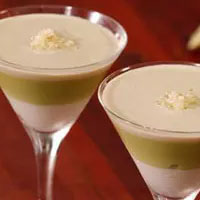
Ingredients
- 1 cup cashews
- 50 ml agave
- ¼ tsp. salt
- 1/2 cup coconut milk
- 50 ml lemons
- 1/4 cup coconut oil
Lime filling
- 1 ½ cups lime juice
- 1 ¼ cups agave
- 5 cups avocado
- 1/2 tsp. salt
- ¼ cup fragrance-free coconut oil
Coconut cream
- 1 cup cashews
- 200 ml agave syrup
- 1 cup coconut cream
- 5 cups coconut milk
Garnish
- 4 finger limes
Directions
To make base
- Place a few macadamia halves into each glass.
- Blend all base ingredients in a high-powered food processor or blender until cashews have turned into a smooth cream. Pour mixture into glasses and place in the freezer to set.
To make the lime filling
- Combine all lime filling ingredients in a high-powered food processor and blend till your heart’s content and the mix is smooth and creamy. No chunks my friends, no chunks. This is serious business. Taste and adjust if need be, as produce is always very different. If you want your filling to be sweeter, add more agave nectar. Less sweet, more avocado. More acidic, add lime juice, less acidic, more avocado.
- Grab your glasses out of the freezer and spoon the mousse over the top of the base. Tap it on the bench to even out the layer and remove air bubbles. Return to the freezer to chill.
To make coconut cream
- Blend all coconut cream ingredients in a high-powered food processor or blender until cashews have turned into a smooth cream. Pour mixture on top of the lime filling and return glasses to the freezer.
Garnish
- Once the coconut cream has set a little, you can cut the end of your finger lime and squeeze out the gorgeous little lime capsules. Place half a teaspoon of finger lime in the middle of each lime tart glass.
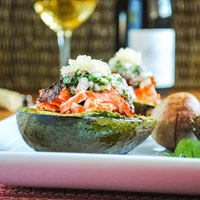
Grilled salmon stuffed avocado with finger limes
Ingredients
- 1 lb Wild Sockeye Salmon
- 3 teaspoons Williams Sonoma Potlatch Season Rub
- 2 large Avocados, halved with seed removed
- 1/2 lime, juiced
- 1 tablespoon olive oil
- 2 teaspoons rice wine vinegar
- 1 teaspoon pure raw honey
- 3 tablespoon Shallot, finely diced
- 1/4 cup cilantro, chopped
- Citrus beads from 6 Finger Limes
- salt and pepper to taste
Directions
- Prepare grill for medium-high direct heat
- Season the salmon with the potlatch seasoning
- Place salmon on the grill and cook 4 minutes per side. Remove from grill and set aside.
- While the salmon is resting drizzle the Avocado halves with olive oil, lime juice, and a pinch of salt. Place on the grill flesh side down. Cook 5-7 minutes until charred but not too mushy. Remove Avocados from the grill and set them aside
- Whisk lime juice, olive oil, rice wine vinegar, honey, shallot, and cilantro together. Add a pinch of salt.
- Remove the citrus beads from the finger limes into a small bowl
- Stuff the Avocado halves with flaked salmon and top with the cilantro and shallot mixture.
- Top with a teaspoon of the finger lime citrus bead and serve.
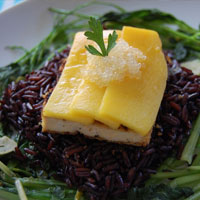
Garlic-Chili Tofu with Finger lime Caviar and Black Rice
Ingredients
- 1 cup Hinode Black Rice
- 1-3/4 cup Vegetable Broth
- 1 kg Extra Firm Tofu
- 3 Tablespoons Olive Oil
- 2 cloves garlic, crushed or grated
- 1/2 tsp. cayenne pepper
- juice of one lime
- 1/2 tsp. salt
- 1/4 tsp. pepper
- 1 mango or pineapple, thinly sliced
- 1 finger lime (usually found in a plastic container in produce)
- 1 teaspoon coconut oil
- 1 clove garlic, sliced
- 2 cups mixed greens (spinach, beet greens, etc.)
Direction
- Place 1 cup of rice in a saucepan. Add 1 3/4 cups of vegetable broth bring to a boil and stir. Reduce heat and simmer covered for 45 minutes, or until moisture is absorbed. Remove from heat and let stand covered for 5 minutes.
- While the rice is simmering, you can marinate the tofu. Cut the tofu into 2″x 2″ x 1/2″ thick slices and gently press between kitchen towels to remove excess liquid. See my tofu tutorial for more tips. In a Ziploc bag, add the prepped tofu, olive oil, grated garlic, cayenne, lime, salt, and pepper. Marinate for about 1/2 an hour or overnight. Remove the tofu from the Ziploc bag and bake on a rack in the toaster oven at 350 degrees, 15 minutes, turning them halfway through.
- In a small skillet, heat the coconut oil on medium-high heat, sauté the garlic and the greens for 1 to 2 minutes and remove from heat.
- Assemble on a platter: Arrange the greens, then add the rice (you can form the rice into a ramekin and then turn it upside down on the greens), then top with baked tofu, and then garnish with mango slices and finger lime caviar.
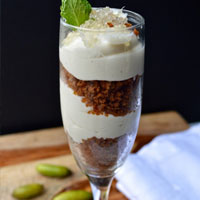
Finger Lime Mojito Cheesecake Trifle
Ingredients
- 1 stick of unsalted butter
- 20-25 Biscoff cookies, crushed
- 1 1/2 bars vanilla white chocolate (90-gram bars)
- 3/4 cup sugar
- 1/4 cup water
- zest and juice from 3 limes
- 1/4 cup white rum (water can be substituted)
- 1 cup fresh mint leaves, torn and bruised a little with a mortar and pestle plus more for garnish
- 2 blocks cream cheese
- 8 ounces mascarpone cheese
- 2 finger limes
Directions
- Combine the sugar and water in a saucepan over medium heat. Stirring until the sugar is dissolved.
- Bring to a boil and reduce heat to low and simmer for 5 minutes.
- Remove from heat; add the mint leaves, lime juice and zest, and rum or water and cover. Allow steeping for 20 minutes.
- Place the white chocolate in a heatproof bowl over a pot of simmering water and stir until melted.
- Beat the cream cheese and mascarpone until smooth.
- Strain the syrup and add the melted chocolate and blend to combine. Set aside.
- Combine the crushed biscuits and melted butter and stir.
- Divide half the mixture between 6 glasses and press into the base or layer in a small trifle bowl.
- Top with half the cheesecake mixture.
- Repeat this process once more.
- Refrigerate for 1 hour to set.
- Slice finger limes down the side and gently dig out the beads and top trifle mixture.
- When ready to serve top with a dollop of cream, mint leaves lime garnish.
Finger lime full moon Crab Dumpling
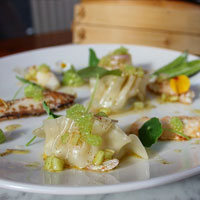
Ingredients
- 1 large fresh crab (approx. 1.5 lbs.)
- 1 teaspoon powdered Lemon Myrtle (another “bush tucker” ingredient)
- 1 shallot onion (sliced thin)
- 1 tablespoon fresh ginger (chopped thin)
- 1 tablespoon white wine vinegar
- 3 tablespoons olive oil
- 1 small Lebanese cucumber (peeled, de-seeded)
- Salt and pepper to taste
- 1 tablespoon butter
- 1 pack of dumpling skins (Asian supermarket or grocer)
- 1 leek
- 2 finger limes (check specialty stores or the internet)
- Ice cubes to cool down crab
Direction
- Bring the water and salt to a hard boil
- Thinly slice the leek during this time and prepare a small saucepan to cook it in, just enough to melt it down but still a little crunchy.
- Once the water is boiling, dip in crab and cook for 11 min.
- Prepare a bowl of cold water, ice, and a pinch of salt for cooling the crab
- Peel, de-seed, and cut the cucumber into small cubes around 2-3 mm
- Combine shallot, vinegar, olive oil, salt, pepper, lemon myrtle, cucumber, and ginger in a bowl
- Cool the crab for 5 min, and then remove the top of the crab from the back up toward the eyes. You should feel a little resistance, but it will come right off
- Clean all the stuff inside with running water
- Cut through down the center with a sharp knife
- Remove claws, discard the back one
- Lightly crush the front one and remove meat
- For the body, you will see small cavity with bright white flesh. When you push on it, it will squeeze out
References
- https://www.ncbi.nlm.nih.gov/pmc/articles/PMC3649719/
- https://www.ncbi.nlm.nih.gov/pmc/articles/PMC6315720/
- https://www.ncbi.nlm.nih.gov/pmc/articles/PMC3419346/
- https://www.ncbi.nlm.nih.gov/books/NBK11795/
- https://www.ncbi.nlm.nih.gov/pmc/articles/PMC5291486/
- https://fruits.edpsciences.org/articles/fruits/abs/2012/05/fruits120033/fruits120033.html
- http://www.fao.org/3/cb2395en/CB2395EN.pdf
- https://www.fao.org/in-action/inpho/crop-compendium/fruits-vegetables/en/
- https://www.fao.org/3/cb2395en/online/src/html/fruit-and-vegetables.html
- http://www.fao.org/3/cb2395en/CB2395EN.pdf
- https://en.wikipedia.org/wiki/Fruit
- https://en.wikipedia.org/wiki/List_of_food_plants_native_to_the_Americas
- https://en.wikipedia.org/wiki/List_of_culinary_fruits
- https://www.hsph.harvard.edu/nutritionsource/what-should-you-eat/vegetables-and-fruits/
- https://www.betterhealth.vic.gov.au/health/healthyliving/fruit-and-vegetables
- https://www.cdc.gov/healthyweight/healthy_eating/fruits_vegetables.html
- https://www.botanical-online.com/en/botany/fruits-types-characteristics
- https://www.fda.gov/food/laboratory-methods-food/mpm-v-9-fruits-and-fruit-products-v-51-v-78
- https://www.fda.gov/food/food-labeling-nutrition/nutrition-information-raw-fruits-vegetables-and-fish
- https://onlinelibrary.wiley.com/doi/abs/10.1111/mcn.12208
- http://news.discovery.com/earth/
- https://www.cabi.org/isc/datasheet/
- https://www.science.org/
- https://plants.ces.ncsu.edu/plants/
- https://www.sciencedirect.com/topics/agricultural-and-biological-sciences/fruit-vegetable
- https://www.researchgate.net/publication/
- https://www.ams.usda.gov/grades-standards/fruits
- https://www.aphis.usda.gov/aphis/resources/traveler/intl-travel/fruits-vegetables/fruits-vegetables
- https://snaped.fns.usda.gov/seasonal-produce-guide
- https://www.nass.usda.gov/Publications/Highlights/2015/FruitsNutsBerries_AgCensusHighlights.pdf
- https://plants.usda.gov/home/plantProfile?
- https://www.fs.fed.us/wildflowers/ethnobotany/food/nuts.shtml
- https://downloads.usda.library.cornell.edu/usda-esmis/files/zs25x846c/sf269213r/6t054c23t/ncit0521.pdf
- https://agr.wa.gov/departments/business-and-marketing-support/farm-to-school-toolkit/
- https://health.gov/sites/default/files/2020-01/DGA2000.pdf
- https://www.farmers.gov/archived/cfap2/specialty
- https://www.hsph.harvard.edu/nutritionsource/
- https://www.foodsafety.gov/food-safety-charts/food-safety-during-power-outage
- https://clinicaltrials.gov/ct2/show/
- https://botany.org/home/careers-jobs/careers-in-botany/what-is-botany.html
- https://www.healthbenefitstimes.com/category/fruits
- http://www.hear.org/pier/species/
- https://www.itis.gov/servlet/SingleRpt/SingleRpt?
- http://www.theplantlist.org/tpl1.1/record/
- https://www.fs.fed.us/database/feis/plants/tree/
- https://www.itis.gov/servlet/SingleRpt/SingleRpt?
- https://www.itis.gov/servlet/SingleRpt/SingleRpt?search_topic=TSN&search_value=506393#null
- https://davesgarden.com/guides/pf/go/165097/
- https://plants.usda.gov/core/profile?symbol=MIAU4
- https://en.wikipedia.org/wiki/Citrus_australasica
- https://www.anbg.gov.au/gnp/interns-2013/citrus-australasica.html
- http://www.theplantlist.org/tpl1.1/record/kew-2724025
- https://npgsweb.ars-grin.gov/gringlobal/taxonomydetail.aspx?24247
- https://gd.eppo.int/taxon/CIDAC

