
Reading and Reading Disorders

Patient Tools

Read, save, and share this guide

Use these quick tools to make this medical article easier to read, print, save, or share with a family member.

Patient Mode

Understand this article easily

Switch between simple English and easy Bangla patient notes. This is for education and does not replace a doctor consultation.

Reading is an important skill for communication, education, and most types of work. Reading disorders interfere with people’s ability to read and affect how they learn to read. NICHD conducts and supports a variety of research aimed at understanding the process of reading, the mechanisms...

For severe symptoms, danger signs, pregnancy, child illness, or sudden worsening, seek urgent medical care.

বাংলা রোগী নোট এখনো যোগ করা হয়নি। পোস্ট এডিটরে “RX Bangla Patient Mode” বক্স থেকে সহজ বাংলা সারাংশ যোগ করুন।

এই তথ্য শিক্ষা ও সচেতনতার জন্য। এটি ডাক্তারি পরীক্ষা, রোগ নির্ণয় বা প্রেসক্রিপশনের বিকল্প নয়।

Article Summary

Reading is an important skill for communication, education, and most types of work. Reading disorders interfere with people’s ability to read and affect how they learn to read. NICHD conducts and supports a variety of research aimed at understanding the process of reading, the mechanisms of reading disorders, and the best ways to help people who struggle with reading. About Reading and Reading Disorders Reading...

Key Takeaways

  • This article explains About Reading and Reading Disorders in simple medical language.
  • This article explains How does reading work? in simple medical language.
  • This article explains Phonemic Awareness in simple medical language.
  • This article explains The Alphabetic Principle and Phonics in simple medical language.
Educational health guideWritten for patient understanding and clinical awareness.
Reviewed content workflowUse writer and reviewer profiles for stronger trust.
Emergency safety firstUrgent warning signs are highlighted below.

Seek urgent medical care if you notice

These warning signs are general safety guidance. Local emergency numbers and clinical judgment should always come first.

  • Severe symptoms, breathing difficulty, fainting, confusion, or rapidly worsening illness.
  • New weakness, severe pain, high fever, or symptoms after a serious injury.
  • Any symptom that feels urgent, unusual, or unsafe for the patient.
1

Emergency now

Use emergency care for severe, sudden, rapidly worsening, or life-threatening symptoms.

2

See a doctor

Book a professional medical evaluation if symptoms persist, worsen, recur often, affect daily activities, or occur in a high-risk patient.

3

Learn safely

Use this article to understand possible causes, tests, treatment options, prevention, and questions to ask your clinician.

Before reading

RX Patient Tools

Use these quick guides before reading the article, or return to them when you need help preparing questions for a doctor.

Start here Choose the right pathway for symptoms, reports, medicines, or urgent warning signs. Disease article roadmap Read this topic step by step: meaning, symptoms, warning signs, diagnosis, treatment, prevention, and follow-up. Treatment planner Prepare questions about treatment choices, benefits, risks, side effects, and follow-up. Family & caregiver guide Organize symptoms, reports, medicines, questions, and follow-up safely. Nutrition & diet guide Prepare food, hydration, supplement, and medicine-timing questions safely. Prevention guide Organize risk factors, protective habits, screening, and warning signs. Recovery guide Prepare a safe plan for activity, rehabilitation, warning signs, and follow-up.
Definition

Reading is an important skill for communication, education, and most types of work. Reading disorders interfere with people’s ability to read and affect how they learn to read. NICHD conducts and supports a variety of research aimed at understanding the process of reading, the mechanisms of reading disorders, and the best ways to help people who struggle with reading.

About Reading and Reading Disorders

Reading is the process by which a person gets information from written symbols such as letters, characters, and words. A person can read using sight or touch, such as when a vision-impaired person reads braille. Reading disorders occur when a person has trouble reading words or understanding what they read.

How does reading work?

Reading is a complex, multipart process.1,2,3,4,5  View a slideshow that explains the process.
Reading and Reading Disorders

Spoken words are made up of smaller pieces of sound—called phonemes.

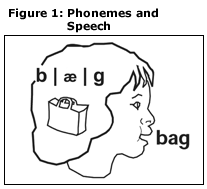
The English language has about 40 phonemes. When someone says a word, the sound comes out as one continuous stream (Figure 1). The brain must be able to separate the sound into pieces. For example, the word “bag” has three phonemes—/b//æ/, and /g/.

Understanding that words are made up of individual sounds is a key part of learning to read. An important skill that helps readers is called phonemic awareness, which refers to the ability to identify and manipulate (or work with) the individual sounds that make up a spoken word.

Phonemes make up spoken words, and words only make sense when these phonemes are combined in a particular order. Phonemic awareness can be taught and learned using activities such as rhyming games.

Another way to teach and learn this awareness is to work with single phonemes in spoken words, such as identifying the first sound in cat as /k/. Part of this learning is also realizing that a change to a single sound or phoneme can change the meaning of the word. For example, changing the /g/ in bag to a /t/ gives us the word bat, which has a different meaning from bag.
Reading and Reading Disorders

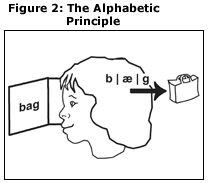
In alphabetic languages such as English, another part of learning to read is understanding that letters of the alphabet stand for sounds or phonemes. A phoneme can correspond to one letter or a group of letters. This knowledge is called the alphabetic principle (Figure 2).

When students use the letter-sound pairings to sound out printed words, it is called phonics. This requires learning to pair their knowledge of the sounds in words (phonemic awareness) with their skill at recognizing letters.

To better understand phonics, think about how you read a made-up word like “blit” or “fratchet.” Even though you don’t know the made-up word or what it means, you can read it by figuring out what sounds the letters make. Then you can sound it out and pronounce it.

Phonemic awareness and phonics skills help readers sound out new words.

Knowing that a word has meaning is an important part of learning to read. The words we know are called our vocabulary.

Learning vocabulary starts very early in life. Infants and toddlers look at what you are talking about and say their first words to get what they need or want. As toddlers grow, they learn more and more words. By the time they start to sound out words to read, most children can recognize many of the words they are sounding out. They know they have heard those words before, and they know what the words mean. This is why having a good vocabulary is so important to reading.

As a reader continues to develop phonics skills, a specific reading skill called fluency also improves. Fluency goes beyond just pronouncing or knowing words. It includes many parts:

  • Being able to read quickly
  • Reading words accurately
  • Saying words and sentences with feeling
  • Stressing the right word or phrase so a sentence sounds natural and conveys the correct meaning

Understanding the information that words and sentences communicate is another important part of reading. This is called comprehension. Comprehension is the main goal of learning to read. There are many ways to improve comprehension:

  • Building vocabulary. Readers with a bigger vocabulary can recognize more words and better understand the overall meaning of the text.
  • Understanding the structure and organization of text. Readers who know what to expect can better comprehend what they are reading.
  • Understanding different types of texts. Teachers can give students strategies or guidelines for understanding a newspaper, a fiction book, a textbook, or a menu.

Such strategies teach students to ask and answer questions about what they are reading, summarize paragraphs and stories, and draw conclusions from the information.

These skills are the foundation for understanding science, history, social studies, math, and the many other subjects students will study throughout their education.

What is the best way to teach children to read?

The NICHD-led National Reading Panel, formed by Congress in the late 1990s, reviewed decades of research about reading and reading instruction to determine the most effective teaching methods. The panel found that specific instruction in the major parts of reading (phonemic awareness, phonics, fluency, vocabulary, and comprehension) is the best approach to teaching most children to read. Instruction should also be systematic (well-planned and consistent) and clear. These findings on reading instruction are still relevant today.

There are multiple ways to teach and learn reading. Some methods work better than others, and some readers learn better from one method than they do from another. Reading aloud is considered the best way for caregivers to prepare a child to learn to read.1

The panel’s analysis showed that the best approaches to reading instruction have the following elements:2

  • Explicit instruction in phonemic awareness
  • Systematic phonics instruction
  • Methods to improve fluency
  • Ways to enhance comprehension

What are reading disorders?

Reading disorders occur when a person has trouble reading words or understanding what they read. Dyslexia is one type of reading disorder. It generally refers to difficulties reading individual words and can lead to problems understanding text.

Most reading disorders result from specific differences in the way the brain processes written words and text.1 Usually, these differences are present from a young age. But a person can develop a reading problem from an injury to the brain at any age.

People with reading disorders often have problems recognizing words they already know and understanding text they read. They also may be poor spellers. Not everyone with a reading disorder has every symptom.

Reading disorders are not a type of intellectual or developmental disorder, and they are not a sign of lower intelligence or unwillingness to learn.

People with reading disorders may have other learning disabilities, too, including problems with writing or numbers. Visit our topic on learning disabilities for more information about these problems.

Types of Reading Disorders

Dyslexia is the most well-known reading disorder. It specifically impairs a person’s ability to read. Individuals with dyslexia have normal intelligence, but they read at levels significantly lower than expected. Although the disorder varies from person to person, there are common characteristics: People with dyslexia often have a hard time sounding out words, understanding written words, and naming objects quickly.1

Most reading problems are present from the time a child learns to read. But some people lose the ability to read after a stroke or an injury to the area of the brain involved with reading.2 This kind of reading disorder is called alexia.

Hyperlexia is a disorder where people have advanced reading skills but may have problems understanding what is read or spoken aloud. They may also have cognitive or social problems.3,4

Other people may have normal reading skills but have problems understanding written words.5

Reading disorders can also involve problems with specific skills:

  • Word decoding. People who have difficulty sounding out written words struggle to match letters to their proper sounds.
  • Fluency. People who lack fluency have difficulty reading quickly, accurately, and with proper expression (if reading aloud).
  • Poor reading comprehension. People with poor reading comprehension have trouble understanding what they read.

What are the symptoms of reading disorders?

People with reading disorders often have different combinations of symptoms.

Symptoms can include:1,2,3

  • Problems sounding out words
  • Difficulty recognizing sounds and the letters that make up those sounds
  • Poor spelling
  • Slow reading
  • Problems reading out loud with correct expression
  • Problems understanding what was just read

How are reading disorders diagnosed?

Providers usually use a series of tests to diagnose a reading disorder. They assess a person’s memory, spelling abilities, visual perception, and reading skills. Family history, a child’s history of response to the instruction, and other assessments might also be involved.1

Although NICHD studies reading and reading disorders, the institute is not involved with setting definitions or guidelines for diagnosing reading disorders.

The U.S. Department of Education offers services and assistance for people with reading disorders through its Office of Special Education Programs (OSEP).

OSEP also supports the Center for Parent Information & Resources, which can help parents learn about their children’s reading or other learning disorders. The center helps parents find professionals to assist with children’s treatment and education. It also provides information about the laws and policies related to education for a child with a reading disorder or learning disability. Each state has a Parent Training and Information Center. Find a center near you.

The organization Understood Reading and Reading Disorders provides resources to parents, families, and educators to understand and support children with reading or other learning challenges, including steps to take after a child is diagnosed with dyslexia

What causes reading disorders?

Reading disorders involve specific, brain-based difficulties in learning to recognize and decipher printed words. There is no single known cause at this time.1

Environmental factors—such as children’s experiences in the classroom or whether they were read to often as preschoolers—can play a significant role in reading ability.

In addition, research suggests that difficulty with reading may be linked to a person’s genes. This finding means that reading disorders can pass from one generation to the next. For example, some cases of reading disorders are associated with a change in genes that play a role in prenatal brain development.1

What are common treatments for reading disorders?

The best treatment strategy for a reading disorder depends on the needs of the individual. In general, teachers with special training provide the most effective instruction. The instruction should be intensive. And the earlier children receive help, the better the results.

Reading disorders cannot be “cured.” But with proper instruction, people with these disorders can overcome specific problems, learn to read, and improve fluency and comprehension.1

There is no single treatment for reading disorders. The following sources provide reliable information about the many treatment options available:

Read more about educational treatments for children with reading disorders and other types of learning disabilities at NICHD’s Learning Disabilities A to Z webpage.


  1. Snowling, M. J., & Hulme, C. (2012). Interventions for children’s language and literacy difficulties. International Journal of Language & Communication Disorders47(1), 27–34. Retrieved August 21, 2019, from https://www.ncbi.nlm.nih.gov/pmc/articles/PMC3429860/
  2. Hulme, C., & Snowling, M. J. (2016). Reading disorders and dyslexia. Current Opinion in Pediatrics28(6), 731–735. Retrieved August 21, 2019, from https://www.ncbi.nlm.nih.gov/pmc/articles/PMC5293161/
  3. Hamilton, S. S., & Glascoe, F. P. (2006). Evaluation of children with reading difficulties. American Family Physician74(12), 2079-2086. Retrieved February 20, 2020, from http://www.aafp.org/afp/2006/1215/p2079.html Reading and Reading Disorders
  4. International Dyslexia Association. (n.d.). Definition of dyslexia. Retrieved August 2, 2019, from https://dyslexiaida.org/definition-of-dyslexia/ Reading and Reading Disorders
  5. International Dyslexia Association. (n.d.). Frequently asked questions. Retrieved August 13, 2019, from https://dyslexiaida.org/frequently-asked-questions-2/ Reading and Reading Disorders
  6. Hulme, C., & Snowling, M. J. (2016). Reading disorders and dyslexia. Current Opinion in Pediatrics28(6), 731–735. Retrieved August 21, 2019, from https://www.ncbi.nlm.nih.gov/pmc/articles/PMC5293161/
  7. Hulme, C., & Snowling, M. J. (2016). Reading disorders and dyslexia. Current Opinion in Pediatrics28(6), 731–735. Retrieved August 19, 2019, from https://www.ncbi.nlm.nih.gov/pmc/articles/PMC5293161/
  8. Cherney, L. R. (2004). Aphasia, alexia, and oral reading. Topics in Stroke Rehabilitation, 11(1), 22–36. Retrieved February 21, 2020, from https://www.ncbi.nlm.nih.gov/pubmed/?term=14872397
  9. Ostrolenk, A., Forgeot d’Arc, B., Jelenic, P., Samson, F., & Mottron, L. (2017). Hyperlexia: Systematic review, neurocognitive modelling, and outcome. Neuroscience and Biobehavioral Reviews, 79, 134–149. Retrieved August 19, 2019, from https://www.ncbi.nlm.nih.gov/pubmed/28478182
  10. American Speech-Language-Hearing Association. (n.d.). Disorders of reading and writing. Retrieved August 19, 2019, from https://www.asha.org/Practice-Portal/Clinical-Topics/Written-Language-Disorders/Disorders-of-Reading-and-Writing/ Reading and Reading Disorders
  11. Landi, N., & Ryherd, K. (2017). Understanding specific reading comprehension deficit: A review. Language and Linguistics Compass, 11(2), e12234. Retrieved August 19, 2019, from https://www.ncbi.nlm.nih.gov/pmc/articles/PMC6051548/
  12. Handler, S. M., & Fierson, W. M. (2011). Learning disabilities, dyslexia, and vision. Pediatrics, 127(3), e818–e856.
  13. National Reading Panel. (2000). Teaching children to read: An evidence-based assessment of the scientific research literature on reading and its implications for reading instruction. NIH Pub. No. 00-4769. Retrieved August 19, 2019, from https://www.nichd.nih.gov/publications/pubs/nrp/smallbook
  14. Eunice Kennedy Shriver National Institute of Child Health and Human Development. (2019). National reading panel publications. Retrieved September 16, 2019, from https://www.nichd.nih.gov/about/org/der/branches/cdbb/nationalreadingpanelpubs


Doctor visit helper

Prepare before seeing a doctor

A simple rural-patient checklist to help you explain symptoms clearly, ask better questions, and avoid unsafe self-treatment.

Safety note: This is not a prescription or diagnosis. For severe symptoms, pregnancy danger signs, children with serious illness, chest pain, breathing difficulty, stroke-like weakness, or major injury, seek urgent care.

Which doctor may help?

Start with a registered doctor or the nearest qualified health center.

What to tell the doctor

  • Write when the problem started and how it changed.
  • Bring old prescriptions, investigation reports, and current medicines.
  • Write allergies, pregnancy status, diabetes, kidney/liver disease, and major past illnesses.
  • Bring one family member if the patient is weak, elderly, confused, or a child.

Questions to ask

  • What is the most likely cause of my symptoms?
  • Which danger signs mean I should go to hospital quickly?
  • Which tests are necessary now, and which can wait?
  • How should I take medicines safely and what side effects should I watch for?
  • When should I come for follow-up?

Tests to discuss

  • Vital signs: temperature, pulse, blood pressure, oxygen saturation
  • Basic physical examination by a clinician
  • CBC, urine test, blood sugar, or imaging only when clinically needed

Avoid these mistakes

  • Do not use antibiotics, steroid tablets/injections, or strong painkillers without proper medical advice.
  • Do not hide pregnancy, kidney disease, ulcer, allergy, or blood thinner use.
  • Do not delay emergency care when danger signs are present.

Medicine safety and first-aid guide

This section is for patient education only. It does not replace a doctor, pharmacist, or emergency care.

Safe first steps

  • Rest, drink safe water, and observe symptoms carefully.
  • Keep a written note of symptoms, duration, temperature, medicines already taken, and allergy history.
  • Seek medical care quickly if symptoms are severe, worsening, or unusual for the patient.

OTC medicine safety

  • For mild pain or fever, ask a registered pharmacist or doctor before using common over-the-counter pain/fever medicines.
  • Do not combine multiple pain medicines without advice, especially if you have kidney disease, liver disease, stomach ulcer, asthma, pregnancy, or take blood thinners.
  • Do not give adult medicines to children unless a qualified clinician advises it.

Avoid these mistakes

  • Do not start antibiotics without a proper medical decision.
  • Do not use steroid tablets or injections casually for quick relief.
  • Do not delay emergency care because of home remedies.

Get urgent help if

  • Severe symptoms, confusion, fainting, breathing difficulty, chest pain, severe dehydration, or sudden weakness need urgent medical care.
Medicine names, dose, and timing must be decided by a qualified clinician or pharmacist after checking age, pregnancy, allergy, other diseases, and current medicines.

For rural patients and family caregivers

Patient health record and symptom diary

Write your symptoms, medicines already taken, test results, and questions before visiting a doctor. This note stays on your device unless you print or copy it.

Doctor to discuss: Doctor / qualified healthcare provider
Tests to discuss with doctor
  • Basic vital signs: temperature, pulse, blood pressure, oxygen level if needed
  • Relevant blood, urine, imaging, or specialist tests only after clinical assessment
Questions to ask
  • What is the most likely cause of my symptoms?
  • Which warning signs mean I should go to emergency care?
  • Which tests are really needed now?
  • Which medicines are safe for my age, pregnancy status, allergy, kidney/liver/stomach condition, and current medicines?

Emergency warning signs such as chest pain, severe breathing difficulty, sudden weakness, confusion, severe dehydration, major injury, or loss of bladder/bowel control need urgent medical care. Do not wait for online information.

Safe pathway to proper treatment

Care roadmap for: Reading and Reading Disorders

Use this simple roadmap to understand the next safe steps. It is educational and does not replace examination by a doctor.

Go to emergency care if you notice:
  • Severe or rapidly worsening symptoms
  • Breathing difficulty, chest pain, fainting, confusion, severe weakness, major injury, or severe dehydration
Doctor / service to discuss: Qualified healthcare provider; specialist depends on symptoms and examination.
  1. Step 1

    Check danger signs first

    If danger signs are present, seek emergency care and do not wait for online information.

  2. Step 2

    Record the symptom story

    Write when symptoms started, severity, medicines already taken, allergies, pregnancy status, and test results.

  3. Step 3

    Visit a qualified clinician

    A doctor, nurse, or qualified healthcare provider can examine you and decide which tests or treatment are needed.

  4. Step 4

    Do only useful tests

    Do tests after clinical assessment. Avoid unnecessary tests, random antibiotics, or repeated medicines without diagnosis.

  5. Step 5

    Follow up and return early if worse

    If symptoms worsen, new warning signs appear, or treatment is not helping, return for review quickly.

Rural patient practical tips
  • Take a written symptom diary and all previous prescriptions/test reports.
  • Do not hide medicines already taken, even herbal or over-the-counter medicines.
  • Ask which warning signs mean urgent referral to hospital.

This roadmap is for education. A real diagnosis and treatment plan requires history, examination, and clinical judgment.

RX Patient Help

Ask a health question safely

Write your symptom story. A health professional or site editor can review it before any answer is prepared. This box is not for emergency care.

Emergency first: Severe chest pain, breathing trouble, unconsciousness, stroke signs, severe injury, heavy bleeding, or rapidly worsening symptoms need urgent local medical care now.

Frequently Asked Questions

About Reading and Reading Disorders Reading is the process by which a person gets information from written symbols such as letters, characters, and words. A person can read using sight or touch, such as when a vision-impaired person reads braille. Reading disorders occur when a person has trouble reading words or understanding what they read. How does reading work?

Reading is a complex, multipart process.1,2,3,4,5  View a slideshow that explains the process.

Phonemic Awareness Spoken words are made up of smaller pieces of sound—called phonemes. The English language has about 40 phonemes. When someone says a word, the sound comes out as one continuous stream (Figure 1). The brain must be able to separate the sound into pieces. For example, the word “bag” has three phonemes—/b/, /æ/, and /g/. Understanding that words are made up of individual sounds is a key part of learning to read. An important skill that helps readers is called phonemic awareness, which refers to the ability to identify and manipulate (or work with) the individual sounds that make up a spoken word. Phonemes make up spoken words, and words only make sense when these phonemes are combined in a particular order. Phonemic awareness can be taught and learned using activities such as rhyming games. Another way to teach and learn this awareness is to work with single phonemes in spoken words, such as identifying the first sound in cat as /k/. Part of this learning is also realizing that a change to a single sound or phoneme can change the meaning of the word. For example, changing the /g/ in bag to a /t/ gives us the word bat, which has a different meaning from bag. The Alphabetic Principle and Phonics In alphabetic languages such as English, another part of learning to read is understanding that letters of the alphabet stand for sounds or phonemes. A phoneme can correspond to one letter or a group of letters. This knowledge is called the alphabetic principle (Figure 2). When students use the letter-sound pairings to sound out printed words, it is called phonics. This requires learning to pair their knowledge of the sounds in words (phonemic awareness) with their skill at recognizing letters. To better understand phonics, think about how you read a made-up word like “blit” or “fratchet.” Even though you don’t know the made-up word or what it means, you can read it by figuring out what sounds the letters make. Then you can sound it out and pronounce it. Phonemic awareness and phonics skills help readers sound out new words. Vocabulary Knowing that a word has meaning is an important part of learning to read. The words we know are called our vocabulary. Learning vocabulary starts very early in life. Infants and toddlers look at what you are talking about and say their first words to get what they need or want. As toddlers grow, they learn more and more words. By the time they start to sound out words to read, most children can recognize many of the words they are sounding out. They know they have heard those words before, and they know what the words mean. This is why having a good vocabulary is so important to reading. Fluency As a reader continues to develop phonics skills, a specific reading skill called fluency also improves. Fluency goes beyond just pronouncing or knowing words. It includes many parts: Being able to read quickly Reading words accurately Saying words and sentences with feeling Stressing the right word or phrase so a sentence sounds natural and conveys the correct meaning Comprehension Understanding the information that words and sentences communicate is another important part of reading. This is called comprehension. Comprehension is the main goal of learning to read. There are many ways to improve comprehension: Building vocabulary. Readers with a bigger vocabulary can recognize more words and better understand the overall meaning of the text. Understanding the structure and organization of text. Readers who know what to expect can better comprehend what they are reading. Understanding different types of texts. Teachers can give students strategies or guidelines for understanding a newspaper, a fiction book, a textbook, or a menu. Such strategies teach students to ask and answer questions about what they are reading, summarize paragraphs and stories, and draw conclusions from the information. These skills are the foundation for understanding science, history, social studies, math, and the many other subjects students will study throughout their education. What is the best way to teach children to read?

The NICHD-led National Reading Panel, formed by Congress in the late 1990s, reviewed decades of research about reading and reading instruction to determine the most effective teaching methods. The panel found that specific instruction in the major parts of reading (phonemic awareness, phonics, fluency, vocabulary, and comprehension) is the best approach to teaching most children to read. Instruction should also be systematic (well-planned and consistent) and clear. These findings on reading instruction are still relevant today. There are multiple ways…

What are reading disorders?

Reading disorders occur when a person has trouble reading words or understanding what they read. Dyslexia is one type of reading disorder. It generally refers to difficulties reading individual words and can lead to problems understanding text. Most reading disorders result from specific differences in the way the brain processes written words and text.1 Usually, these differences are present from a young age. But a person can develop a reading problem from an injury to the brain at any age. People…

Types of Reading Disorders Dyslexia is the most well-known reading disorder. It specifically impairs a person’s ability to read. Individuals with dyslexia have normal intelligence, but they read at levels significantly lower than expected. Although the disorder varies from person to person, there are common characteristics: People with dyslexia often have a hard time sounding out words, understanding written words, and naming objects quickly.1 Most reading problems are present from the time a child learns to read. But some people lose the ability to read after a stroke or an injury to the area of the brain involved with reading.2 This kind of reading disorder is called alexia. Hyperlexia is a disorder where people have advanced reading skills but may have problems understanding what is read or spoken aloud. They may also have cognitive or social problems.3,4 Other people may have normal reading skills but have problems understanding written words.5 Reading disorders can also involve problems with specific skills: Word decoding. People who have difficulty sounding out written words struggle to match letters to their proper sounds. Fluency. People who lack fluency have difficulty reading quickly, accurately, and with proper expression (if reading aloud). Poor reading comprehension. People with poor reading comprehension have trouble understanding what they read. What are the symptoms of reading disorders?

People with reading disorders often have different combinations of symptoms. Symptoms can include:1,2,3 Problems sounding out words Difficulty recognizing sounds and the letters that make up those sounds Poor spelling Slow reading Problems reading out loud with correct expression Problems understanding what was just read

How are reading disorders diagnosed?

Providers usually use a series of tests to diagnose a reading disorder. They assess a person’s memory, spelling abilities, visual perception, and reading skills. Family history, a child’s history of response to the instruction, and other assessments might also be involved.1 Although NICHD studies reading and reading disorders, the institute is not involved with setting definitions or guidelines for diagnosing reading disorders. The U.S. Department of Education offers services and assistance for people with reading disorders through its Office of Special…

What causes reading disorders?

Reading disorders involve specific, brain-based difficulties in learning to recognize and decipher printed words. There is no single known cause at this time.1 Environmental factors—such as children’s experiences in the classroom or whether they were read to often as preschoolers—can play a significant role in reading ability. In addition, research suggests that difficulty with reading may be linked to a person’s genes. This finding means that reading disorders can pass from one generation to the next. For example, some cases…

What are common treatments for reading disorders?

The best treatment strategy for a reading disorder depends on the needs of the individual. In general, teachers with special training provide the most effective instruction. The instruction should be intensive. And the earlier children receive help, the better the results. Reading disorders cannot be “cured.” But with proper instruction, people with these disorders can overcome specific problems, learn to read, and improve fluency and comprehension.1 There is no single treatment for reading disorders. The following sources provide reliable information…
