How to check memory usage on a VPS

Patient Tools

Read, save, and share this guide

Use these quick tools to make this medical article easier to read, print, save, or share with a family member.

Article Summary

GNU/Linux-based operating systems come with a very large number of utilities to monitor the workflow of your host. Most of them are available via SSH access, visual interfaces for web servers may also provide tools to display it in a more visually appealing way. How to check memory usage on a VPS GNU/Linux-based operating systems come with a very large number of utilities to monitor...

Educational health guideWritten for patient understanding and clinical awareness.
Reviewed content workflowUse writer and reviewer profiles for stronger trust.
Emergency safety firstUrgent warning signs are highlighted below.

Seek urgent medical care if you notice

These warning signs are general safety guidance. Local emergency numbers and clinical judgment should always come first.

  • Severe symptoms, breathing difficulty, fainting, confusion, or rapidly worsening illness.
  • New weakness, severe pain, high fever, or symptoms after a serious injury.
  • Any symptom that feels urgent, unusual, or unsafe for the patient.
1

Emergency now

Use emergency care for severe, sudden, rapidly worsening, or life-threatening symptoms.

2

See a doctor

Book a professional medical evaluation if symptoms persist, worsen, recur often, affect daily activities, or occur in a high-risk patient.

3

Learn safely

Use this article to understand possible causes, tests, treatment options, prevention, and questions to ask your clinician.

GNU/Linux-based operating systems come with a very large number of utilities to monitor the workflow of your host. Most of them are available via SSH access, visual interfaces for web servers may also provide tools to display it in a more visually appealing way.

How to check memory usage on a VPS

GNU/Linux-based operating systems come with a very large number of utilities to monitor the workflow of your host. Most of them are available via SSH access, visual interfaces for web servers may also provide tools to display it in a more visually appealing way.

Command-line tools are available with most GNU/Linux-based servers. They also usually provide the most detailed insight.

Our VPS hosting plans are also provided with access to the SolusVM control panel, which allows you to check different stats from within it, no matter the software installed on the actual server, and if you have cPanel installed, it also comes with a few additional tools.

1. SolusVM

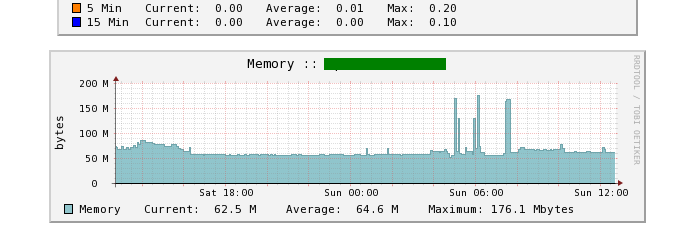
The SolusVM control panel has a variety of monitoring and management tools. It also allows you to check resource usage of your VPS. You can log into your SolusVM control panel, click Manage next to your VPS and then select the Statistics tab.

You will see a number of graphs, memory usage can be checked in the Memory table:
How to check memory usage on a VPS

For more details on the SolusVM control panel and its features, feel free to check this guide.

2. cPanel/WHM

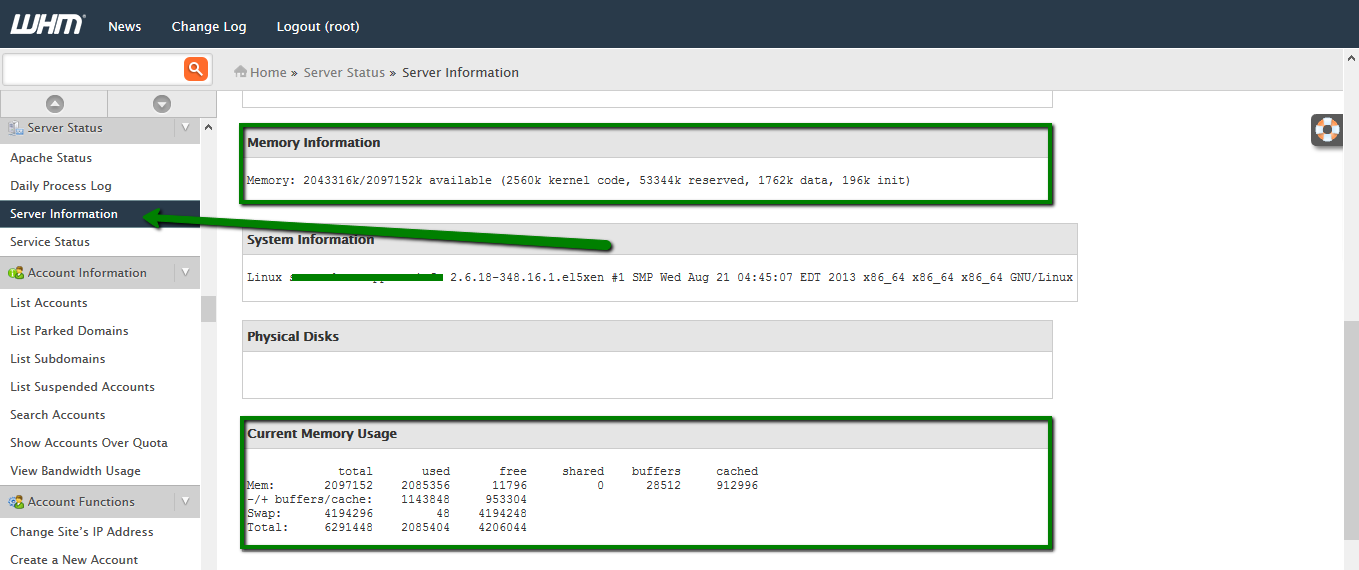
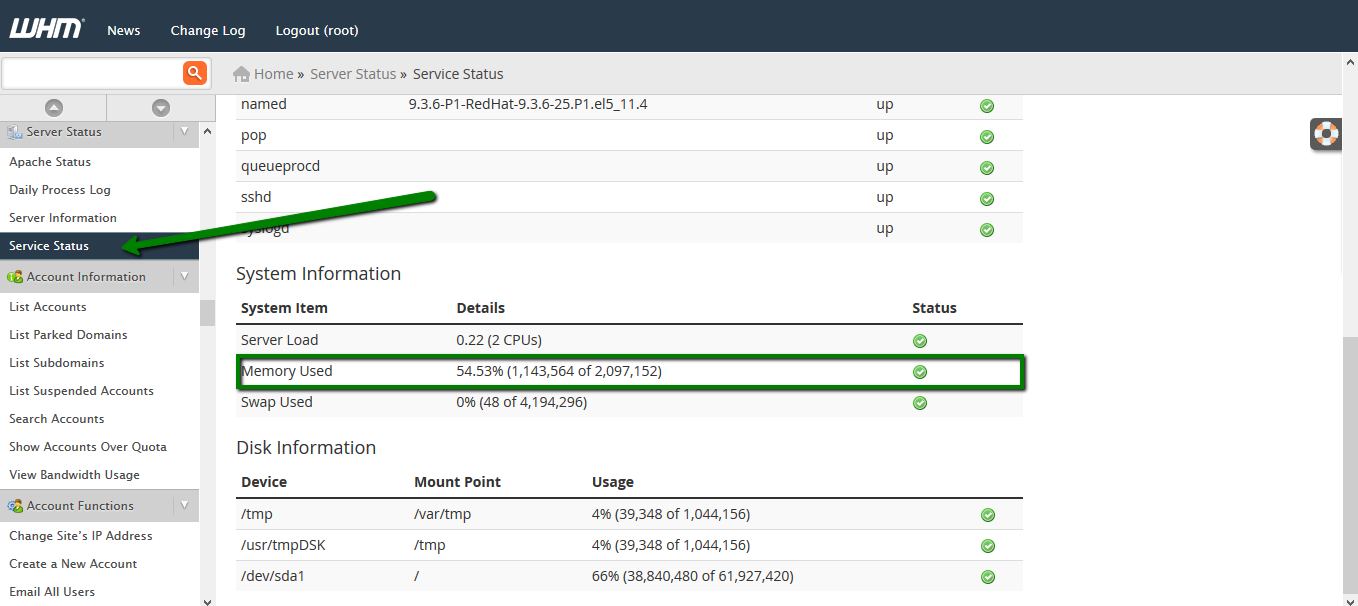
There are a few ways to check your memory usage in WHM or cPanel control panels. You may check the general overview of the server status via WHM > Server Information and WHM > Service Status, which also includes information about memory usage. For your reference:
How to check memory usage on a VPS

How to check memory usage on a VPS

3. SSH Tools

There is a variety of different common SSH tools that can provide memory-related information. Further, we will provide a few most common and useful tools, which would be present in pretty much any GNU/Linux system.

free

This tool is one of the most basic, simple and fast ways to check overall memory usage via the command line. Its purpose is to show the amount of free memory available in the system: both physical and swap memory, and any buffers used by kernel. When you run this command, you will see something like this:

How to check memory usage on a VPS

Here are the columns displayed:

Total: specifies the actual amount of physical RAM and swap available in the system
      Used: shows how much is currently used by the system and its processes
      Free: shows the amount of memory that is not occupied at the moment
      Sharedbuffers and cache: shows the amount of memory used by kernel for particular purposes, such as shared between different processes or allocated to cache.

There is one nuance you would want to take into account when analyzing the output of the free command. You might occasionally notice very small values for Mem line in the free column. Does it mean there is no free RAM in the system? In most cases, it actually does not since Linux-based systems often use cache for many processes to speed up and optimize program performance. Only free memory is used for cache, and the system can always clear and replace the content of the memory used for cache if there is such a need per requests of other running processes, so it does not actually have any negative impact on the performance.

So, the memory currently occupied by the cache is technically not free, but practically can be freed at any moment. If you would like to check how much memory is actually available for processes in your system, take a look at -/+ buffers/cache line, free column. This field displays the amount of technically free memory plus currently cached and buffered memory, therefore, it is a more accurate representation of memory currently available for new processes if such a need arises.

Free command has a few parameters that may be useful. By default, the command displays the output shown in the screenshot. If you add -m or -g after the command, you will get the stats displayed in MB or GB correspondingly. In the modern versions of the free tool you can also use -h, and the tool will automatically use the most convenient units, like this:

How to check memory usage on a VPS

vmstat

This tool displays information about the current virtual memory usage: processes, memory, paging, disks and CPU statistics. When running this command, you will see three lines, first describing the particular sections of the table, second specifies the values displayed, third provides the actual stats at the moment of checking. If you need to check the usage from time to time, you can also add two numbers after the command to specify the delay in seconds between each check and the number of overall checks (if not specified, the checks are infinite until you end the process). Here is an example of the output:

How to check memory usage on a VPS

The first two lines provide the information on the organization of the table.

Procs shows information about processes: r means the number of processes running or waiting for run time, b means processes sleeping.

Memory section: swpd shows virtual memory used, free shows idle memory, buff and cache display memory allocated to buffers and cache correspondingly.

Two values in the swap section display amounts of data swapped to (si) and from (so) disk per second. Two values in the IO section show Input/Output stats for the drive: received from (bi) and sent to (bo) it.

In the system section in stands for interrupts per second, and cs is the abbreviation for context switches.

CPU shows percentages of processor usage:

us: usage by user-launched code as opposed to system processes
sy: usage by the actual system kernel
id: idle CPU time
wa: time spent waiting for Input/Output
st: time stolen from a virtual machine

This tool also provides another way to structure this information. Feel free to use the -s parameter to display stats:
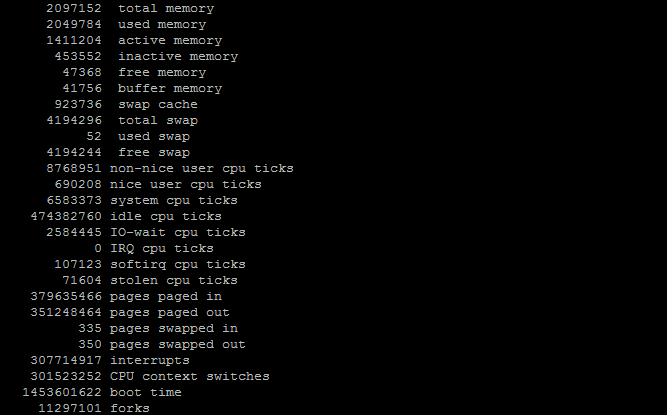
How to check memory usage on a VPS

ps

By default, this tool shows the processes currently launched and additional information on them. Here is an example of the output:

How to check memory usage on a VPS

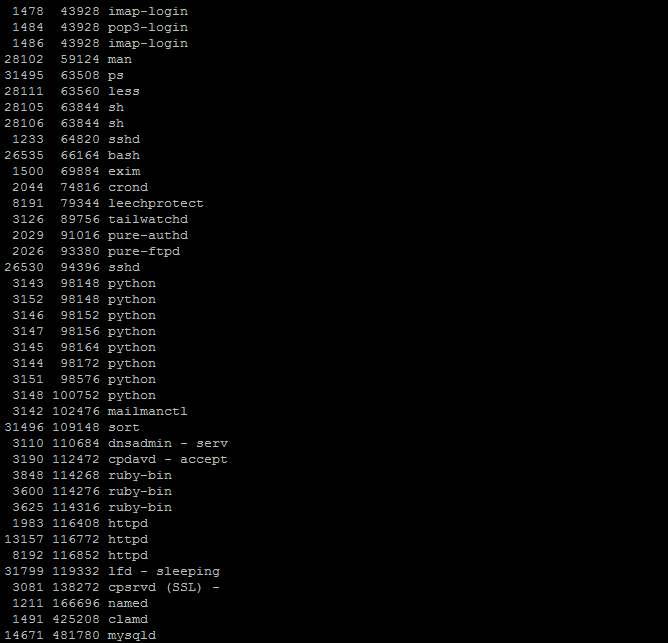
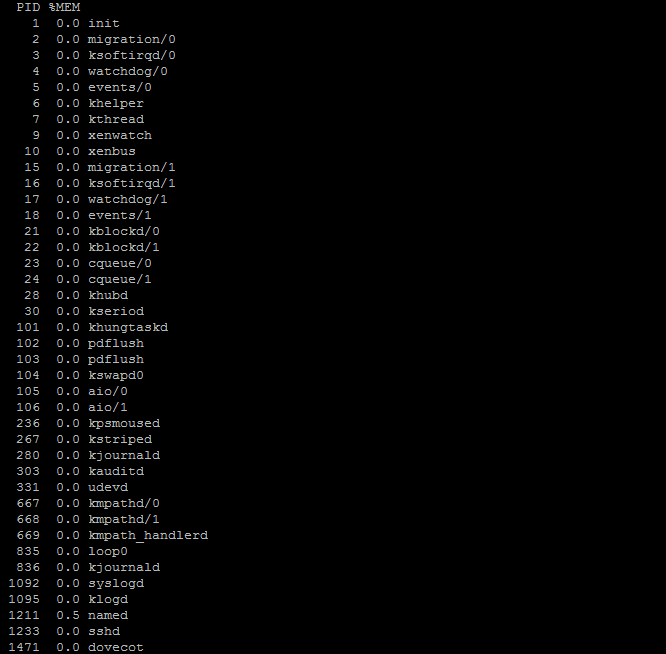
The output does not show any memory-related information, only the processes ran by the actual user starting the command. The real strength of this tool lies in its parameters. For instance, you can use -e to display processes of all users, -o to display data in a custom format and list a value like vsz in the formatting to display the size of virtual memory allocated for the process (expressed in kilobytes), or pmem to display percentage memory usage by a particular process. So, for ps -eo pid,pmem,comm= the output may be something like this:
How to check memory usage on a VPS

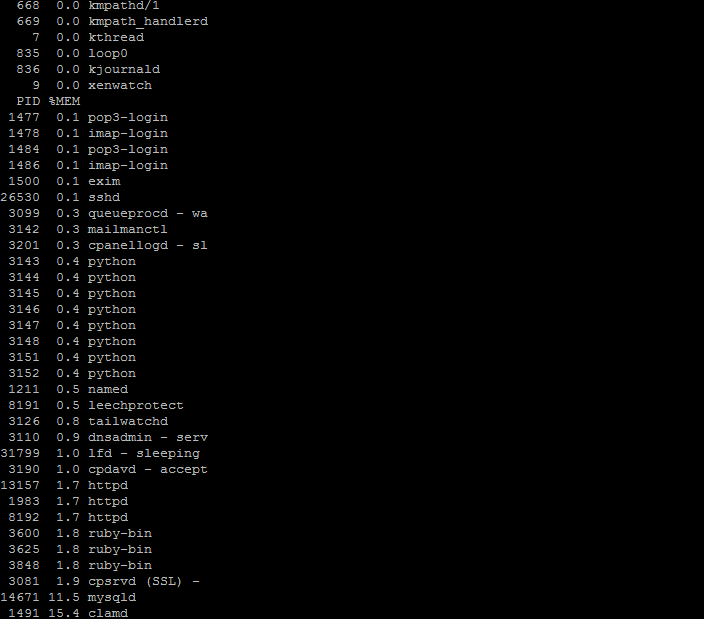
Here are a few examples with combining ps tool and standard sort tool to display the output of the command in a more usable way:

ps -eo pid,pmem,comm= | sort -n -k 2
How to check memory usage on a VPS

ps -eo pid,vsz,comm= | sort -n -k 2

How to check memory usage on a VPS

This will display the processes run by users (which the current shell is allowed to check) in a user-defined format (process ID, memory usage, command name), and also sorted by the amount of memory used.

top, htop

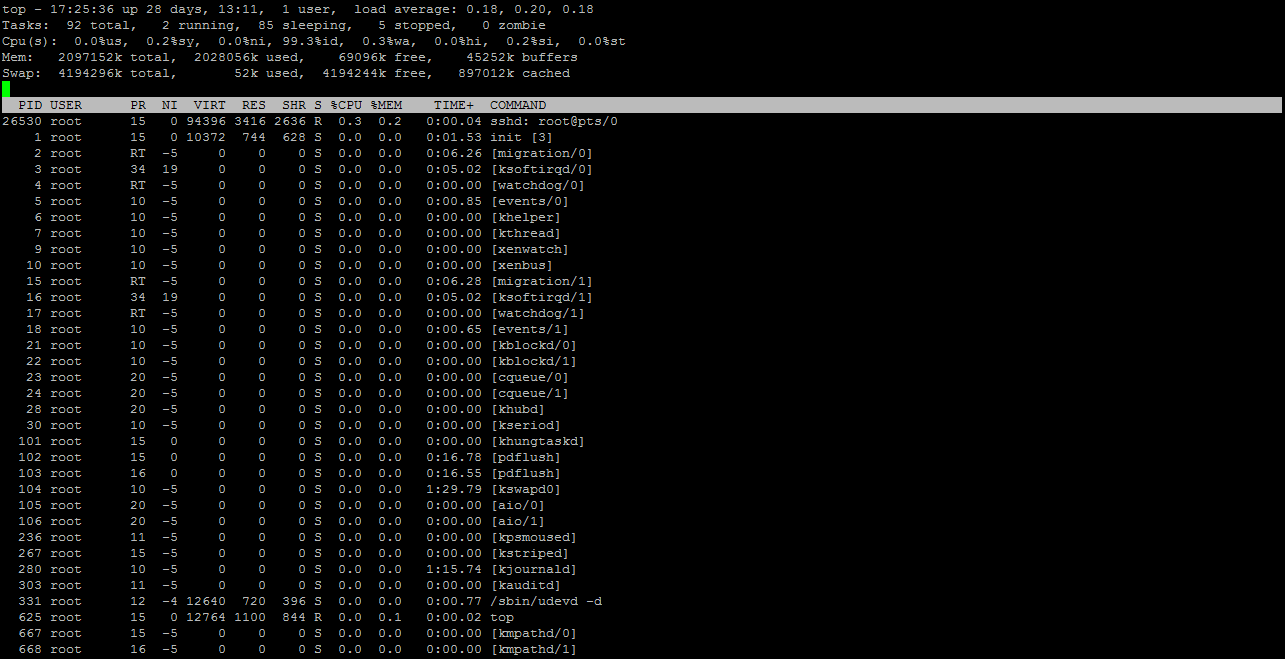
When you need to monitor resource usage of your system in real time, it is better to use tools that natively support constantly refreshing output of data, or even an interactive interface to modify the current workflow of the system. The output of the commands also includes information about memory usage and allows to sort through processes in different ways.

The output of memory-related sections of the tools is similar to the output of the free tool.

top
How to check memory usage on a VPS

You can use h or ? to bring up the help menu and the q key to quit the program. PageUp and PageDown scroll through the output. The m key shows or hides memory-related information. Shift + M sorts the processes by memory usage.

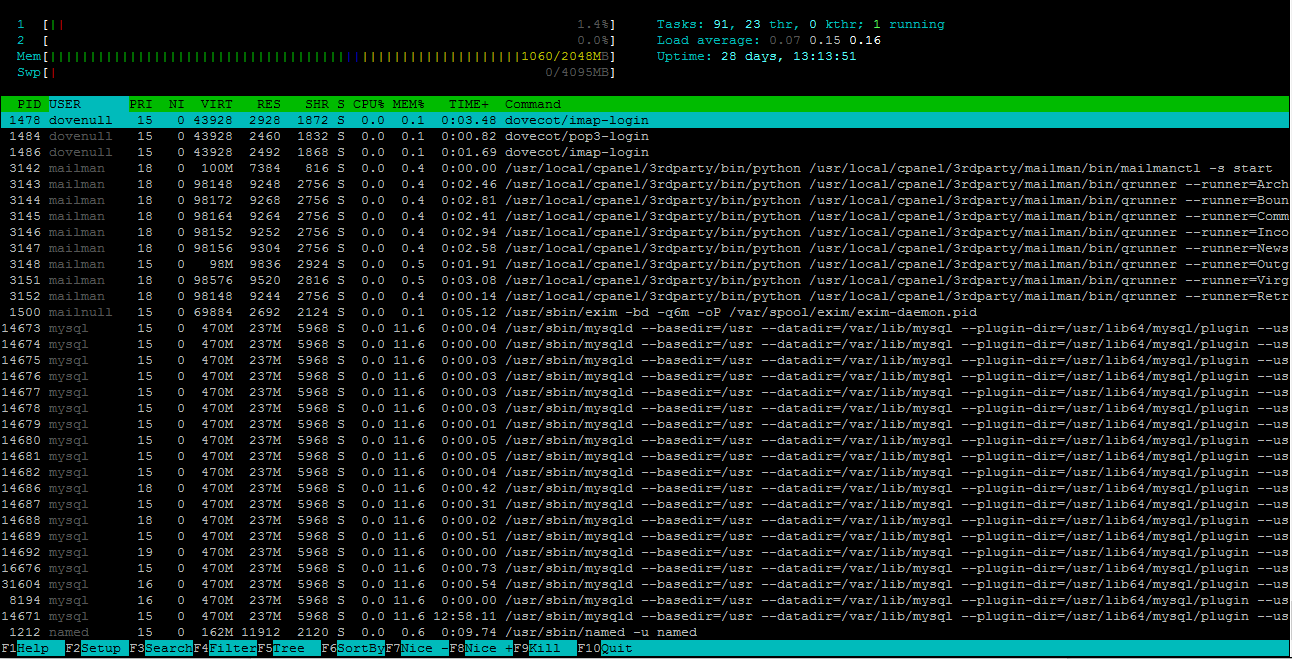
htop
How to check memory usage on a VPS

Once again, feel free to use h or ? to see the list of keys used by the tool, and Shift + M sorts the processes by memory usage, but you can also use F1-F10 menus you can see at the bottom to access different more visual ways of controlling processes in your system.

That’s it!

Patient safety assistant

Check your symptom safely

Hi, I am RX Symptom Navigator. I can help you understand what to read next and what warning signs need care.
Warning: Do not use this in emergencies, pregnancy, severe illness, or as a substitute for a doctor. For children or teens, use with a parent/guardian and clinician.
A rural-friendly guide: warning signs, when to see a doctor, related articles, tests to discuss, and OTC safety education.
1 Symptom 2 Severity 3 Safe guidance
First safety question

Is there chest pain, breathing trouble, fainting, confusion, severe bleeding, stroke-like weakness, severe injury, or pregnancy danger sign?

Choose quickly

Browse by body area
Start here: Write or select a symptom. The guide will show warning signs, doctor guidance, diagnostic tests to discuss, OTC safety education, and related RX articles.

Important: This tool is educational only. It cannot diagnose, treat, or replace a doctor. OTC information is not a prescription. In an emergency, contact local emergency services or go to the nearest hospital.

Doctor visit helper

Prepare before seeing a doctor

A simple rural-patient checklist to help you explain symptoms clearly, ask better questions, and avoid unsafe self-treatment.

Safety note: This is not a prescription or diagnosis. For severe symptoms, pregnancy danger signs, children with serious illness, chest pain, breathing difficulty, stroke-like weakness, or major injury, seek urgent care.

Which doctor may help?

Start with a registered doctor or the nearest qualified health center.

What to tell the doctor

  • Write when the problem started and how it changed.
  • Bring old prescriptions, investigation reports, and current medicines.
  • Write allergies, pregnancy status, diabetes, kidney/liver disease, and major past illnesses.
  • Bring one family member if the patient is weak, elderly, confused, or a child.

Questions to ask

  • What is the most likely cause of my symptoms?
  • Which danger signs mean I should go to hospital quickly?
  • Which tests are necessary now, and which can wait?
  • How should I take medicines safely and what side effects should I watch for?
  • When should I come for follow-up?

Tests to discuss

  • Vital signs: temperature, pulse, blood pressure, oxygen saturation
  • Basic physical examination by a clinician
  • CBC, urine test, blood sugar, or imaging only when clinically needed

Avoid these mistakes

  • Do not use antibiotics, steroid tablets/injections, or strong painkillers without proper medical advice.
  • Do not hide pregnancy, kidney disease, ulcer, allergy, or blood thinner use.
  • Do not delay emergency care when danger signs are present.

Medicine safety and first-aid guide

This section is for patient education only. It does not replace a doctor, pharmacist, or emergency care.

Safe first steps

  • Rest, drink safe water, and observe symptoms carefully.
  • Keep a written note of symptoms, duration, temperature, medicines already taken, and allergy history.
  • Seek medical care quickly if symptoms are severe, worsening, or unusual for the patient.

OTC medicine safety

  • For mild pain or fever, ask a registered pharmacist or doctor before using common over-the-counter pain/fever medicines.
  • Do not combine multiple pain medicines without advice, especially if you have kidney disease, liver disease, stomach ulcer, asthma, pregnancy, or take blood thinners.
  • Do not give adult medicines to children unless a qualified clinician advises it.

Avoid these mistakes

  • Do not start antibiotics without a proper medical decision.
  • Do not use steroid tablets or injections casually for quick relief.
  • Do not delay emergency care because of home remedies.

Get urgent help if

  • Severe symptoms, confusion, fainting, breathing difficulty, chest pain, severe dehydration, or sudden weakness need urgent medical care.
Medicine names, dose, and timing must be decided by a qualified clinician or pharmacist after checking age, pregnancy, allergy, other diseases, and current medicines.

For rural patients and family caregivers

Patient health record and symptom diary

Write your symptoms, medicines already taken, test results, and questions before visiting a doctor. This note stays on your device unless you print or copy it.

Doctor to discuss: Doctor / qualified healthcare provider
Tests to discuss with doctor
  • Basic vital signs: temperature, pulse, blood pressure, oxygen level if needed
  • Relevant blood, urine, imaging, or specialist tests only after clinical assessment
Questions to ask
  • What is the most likely cause of my symptoms?
  • Which warning signs mean I should go to emergency care?
  • Which tests are really needed now?
  • Which medicines are safe for my age, pregnancy status, allergy, kidney/liver/stomach condition, and current medicines?

Emergency warning signs such as chest pain, severe breathing difficulty, sudden weakness, confusion, severe dehydration, major injury, or loss of bladder/bowel control need urgent medical care. Do not wait for online information.

Safe pathway to proper treatment

Patient care roadmap

Use this simple roadmap to understand the next safe steps. It is educational and does not replace examination by a doctor.

Go to emergency care if you notice:
  • Severe or rapidly worsening symptoms
  • Breathing difficulty, chest pain, fainting, confusion, severe weakness, major injury, or severe dehydration
Doctor / service to discuss: Qualified healthcare provider; specialist depends on symptoms and examination.
  1. Step 1

    Check danger signs first

    If danger signs are present, seek emergency care and do not wait for online information.

  2. Step 2

    Record the symptom story

    Write when symptoms started, severity, medicines already taken, allergies, pregnancy status, and test results.

  3. Step 3

    Visit a qualified clinician

    A doctor, nurse, or qualified healthcare provider can examine you and decide which tests or treatment are needed.

  4. Step 4

    Do only useful tests

    Do tests after clinical assessment. Avoid unnecessary tests, random antibiotics, or repeated medicines without diagnosis.

  5. Step 5

    Follow up and return early if worse

    If symptoms worsen, new warning signs appear, or treatment is not helping, return for review quickly.

Rural patient practical tips
  • Take a written symptom diary and all previous prescriptions/test reports.
  • Do not hide medicines already taken, even herbal or over-the-counter medicines.
  • Ask which warning signs mean urgent referral to hospital.

This roadmap is for education. A real diagnosis and treatment plan requires history, examination, and clinical judgment.

RX Patient Help

Ask a health question safely

Write your symptom story. A health professional or site editor can review it before any answer is prepared. This box is not for emergency care.

Emergency first: Severe chest pain, breathing trouble, unconsciousness, stroke signs, severe injury, heavy bleeding, or rapidly worsening symptoms need urgent local medical care now.

Frequently Asked Questions

Is this article a replacement for a doctor?

No. It is educational content only. Patients should consult a qualified clinician for diagnosis and treatment.

When should I seek urgent care?

Seek urgent care for severe symptoms, rapidly worsening condition, breathing difficulty, severe pain, neurological changes, or any emergency warning sign.

References

Add references, clinical guidelines, textbooks, journal articles, or trusted medical sources here. You can edit this area from the RX Article Professional Blocks panel.