
Ewing sarcoma (ES) is a highly malignant tumor composed of small round cells. The origin of this tumor was unclear until recently, when electron microscopic and immunohistochemical analyses suggested that it is of neurogenic origin [1–3]. ES tumors often express a balanced translocation involving the EWS gene on chromosome 22 and a member of the ETS family of transcription factors [4, 5]. With the development of diagnostic radiological techniques such as magnetic resonance imaging (MRI), extraskeletal masses can be depicted clearly and the tumor area can be accurately evaluated. Due to improvements in intensive chemotherapy, the prognosis of ES patients has improved markedly [6–16]. The current chemotherapy protocols used to treat ES include various combinations of the following six drugs: doxorubicin (DOX), cyclophosphamide (CPM), vincristine (VCR), actinomycin-D (ACT-D), ifosfamide (IFO), and etoposide (ETO). Local ES lesions are usually treated via surgical excision or radiotherapy, or a combination of both. In cases in which surgical excision is not possible due to the large size of the tumor, its anatomical location, or the fact that the acquired surgical margin is not sufficient to achieve local control, pre- or postoperative radiotherapy is usually selected [14].
Ewing sarcoma is a type of tumor that forms in bone or soft tissue.
Ewing sarcoma is a type of tumor that forms from a certain kind of cell in bone or soft tissue. Ewing sarcoma may be found in the bones of the legs, arms, feet, hands, chest, pelvis, spine, or skull. Ewing sarcoma also may be found in the soft tissue of the trunk, arms, legs, head, neck, retroperitoneum (area in the back of the abdomen behind the tissue that lines the abdominal wall and covers most of the organs in the abdomen), or other areas.
Ewing sarcoma is most common in adolescents and young adults (teens through mid-20s).
Ewing sarcoma has also been called peripheral primitive neuroectodermal tumor, Askin tumor (Ewing sarcoma of the chest wall), extraosseous Ewing sarcoma (Ewing sarcoma in tissue other than bone), and Ewing sarcoma family of tumors.
Undifferentiated round cell sarcoma may also occur in the bone or soft tissue.
Undifferentiated round cell sarcoma usually occurs in the bones or the muscles that are attached to bones and that help the body move. There are three types of undifferentiated round cell sarcoma that are treated like Ewing sarcoma:
-
Undifferentiated round cell sarcoma with BCOR-CCNB3 rearrangements. This type of bone tumor usually forms in the pelvis, arms, or legs. It may spread to other parts of the body. In this type of round cell sarcoma, the BCOR gene is joined to the CCNB3 gene. To diagnose round cell sarcoma, the tumor cells are checked for this gene change.
-
Undifferentiated round cell sarcoma with CIC-DUX4 rearrangements. This type of soft tissue tumor usually forms in the trunk, arms, or legs. It is most common in males and in young adults between 21 and 40 years of age. In this type of round cell sarcoma, the CIC gene is joined to the DUX4 gene. To diagnose round cell sarcoma, the tumor cells are checked for this gene change.
-
Undifferentiated round cell sarcoma with CIC-NUTM1 rearrangements. This type of soft tissue tumor usually forms in the central nervous system, but it can also form in the trunk. It is most common in younger patients.
Signs and symptoms of Ewing sarcoma include swelling and pain near the tumor.
These and other signs and symptoms may be caused by Ewing sarcoma or by other conditions. Check with your child’s doctor if your child has any of the following:
-
Pain and/or swelling, usually in the arms, legs, chest, back, or pelvis.
-
A lump (which may feel soft and warm) in the arms, legs, chest, or pelvis.
-
Fever for no known reason.
-
A bone that breaks for no known reason.
Tests that examine the bone and soft tissue are used to diagnose and stage Ewing sarcoma.
Procedures that make pictures of the bones and soft tissues and nearby areas help diagnose Ewing sarcoma and show how far cancer has spread. The process used to find out if cancer cells have spread within and around the bones and soft tissues or to other parts of the body is called staging.
To plan treatment, it is important to know whether the cancer has spread to other parts of the body. Tests and procedures to detect, diagnose, and stage Ewing sarcoma are usually done at the same time.
The following tests and procedures may be used to diagnose or stage Ewing sarcoma:
-
Physical exam and health history: An exam of the body to check general signs of health, including checking for signs of disease, such as lumps or anything else that seems unusual. A history of the patient’s health habits and past illnesses and treatments will also be taken.
-
MRI (magnetic resonance imaging): A procedure that uses a magnet, radio waves, and a computer to make a series of detailed pictures of areas inside the body, such as the area where the tumor formed. This procedure is also called nuclear magnetic resonance imaging (NMRI).

Magnetic resonance imaging (MRI) of the abdomen. The child lies on a table that slides into the MRI scanner, which takes pictures of the inside of the body. The pad on the child’s abdomen helps make the pictures clearer.
-
CT scan (CAT scan): A procedure that makes a series of detailed pictures of areas inside the body, such as the area where the tumor formed or the chest, taken from different angles. The pictures are made by a computer linked to an x-ray machine. A dye may be injected into a vein or swallowed to help the organs or tissues show up more clearly. This procedure is also called computed tomography, computerized tomography, or computerized axial tomography.

Computed tomography (CT) scan of the abdomen. The child lies on a table that slides through the CT scanner, which takes x-ray pictures of the inside of the abdomen.
-
PET scan (positron emission tomography scan): A procedure to find malignant tumor cells in the body. A small amount of radioactive glucose (sugar) is injected into a vein. The PET scanner rotates around the body and makes a picture of where glucose is being used in the body. Malignant tumor cells show up brighter in the picture because they are more active and take up more glucose than normal cells do. A PET scan and a CT scan are often done at the same time. If there is any cancer, this increases the chance that it will be found.
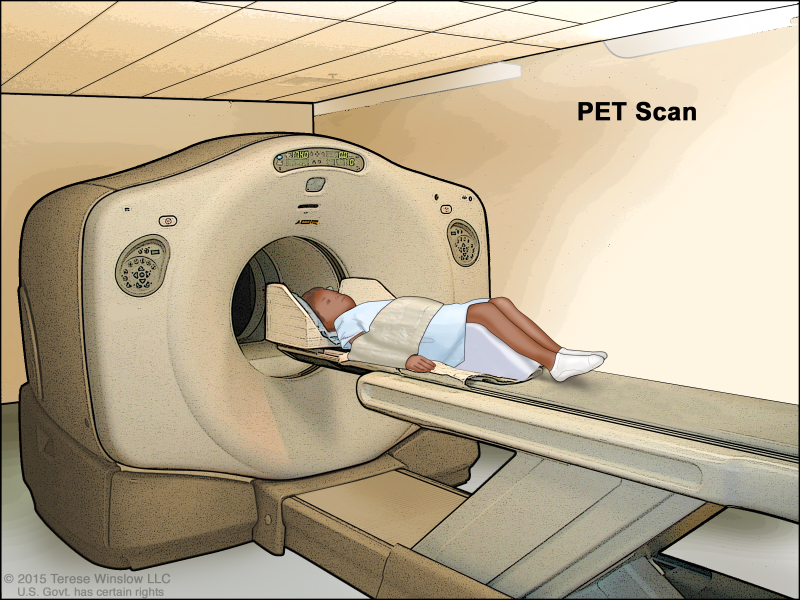
Positron emission tomography (PET) scan. The child lies on a table that slides through the PET scanner. The head rest and white strap help the child lie still. A small amount of radioactive glucose (sugar) is injected into the child’s vein, and a scanner makes a picture of where the glucose is being used in the body. Cancer cells show up brighter in the picture because they take up more glucose than normal cells do.
-
Bone scan: A procedure to check if there are rapidly dividing cells, such as cancer cells, in the bone. A very small amount of radioactive material is injected into a vein and travels through the bloodstream. The radioactive material collects in the bones with cancer and is detected by a scanner.

Bone scan. A small amount of radioactive material is injected into the child’s vein and travels through the blood. The radioactive material collects in the bones. As the child lies on a table that slides under the scanner, the radioactive material is detected and images are made on a computer screen.
-
Bone marrow aspiration and biopsy: The removal of bone marrow and a small piece of bone by inserting a hollow needle into the hipbone. Samples are removed from both hipbones. A pathologist views the bone marrow and bone under a microscope to see if the cancer has spread.
-
X-ray: An x-ray is a type of energy beam that can go through the body and onto film, making a picture of areas inside the body, such as the chest or the area where the tumor formed.
- Complete blood count (CBC): A procedure in which a sample of blood is drawn and checked for the following:
- -The number of red blood cells, white blood cells, and platelets.
- -The amount of hemoglobin (the protein that carries oxygen) in the red blood cells.
- -The portion of the blood sample made up of red blood cells.
-
Blood chemistry studies: A procedure in which a blood sample is checked to measure the amounts of certain substances, such as lactate dehydrogenase (LDH), released into the blood by organs and tissues in the body. An unusual (higher or lower than normal) amount of a substance can be a sign of disease.
%20of%20the%20abdomen&p=BOOKS&id=554641_CDR0000775532.jpg "Ewing Sarcoma - Causes, Symptoms, Treat,ment")
%20scan%20of%20the%20abdomen&p=BOOKS&id=554641_CDR0000775531.jpg "Ewing Sarcoma - Causes, Symptoms, Treat,ment")
%20scan&p=BOOKS&id=554641_CDR0000775456.jpg "Ewing Sarcoma - Causes, Symptoms, Treat,ment")


A biopsy is done to diagnose Ewing sarcoma.
Tissue samples are removed during a biopsy so they can be viewed under a microscope by a pathologist to check for signs of cancer. It is helpful if the biopsy is done at the same center where treatment will be given.
-
Needle biopsy: For a needle biopsy, tissue is removed using a needle. This type of biopsy may be done if it’s possible to remove tissue samples large enough to be used for testing.
-
Incisional biopsy: For an incisional biopsy, a sample of tissue is removed through an incision in the skin.
-
Excisional biopsy: The removal of an entire lump or area of tissue that doesn’t look normal.
The specialists (pathologist, radiation oncologist, and surgeon) who will treat the patient usually work together to decide the best site to place the needle or biopsy incision. The selection of the biopsy site is important. A biopsy site that is not properly selected may result in more extensive surgery to remove the tumor or a larger area that is treated with radiation therapy.
If there is a chance that the cancer has spread to nearby lymph nodes, one or more lymph nodes may be removed and checked for signs of cancer.
The following tests may be done on the tissue that is removed:
-
Cytogenetic analysis: A laboratory test in which the chromosomes of cells in a sample of tissue are counted and checked for any changes, such as broken, missing, rearranged, or extra chromosomes. Changes in certain chromosomes may be a sign of cancer. Cytogenetic analysis is used to help diagnose cancer, plan treatment, or find out how well treatment is working.
-
Immunohistochemistry: A laboratory test that uses antibodies to check for certain antigens (markers) in a sample of a patient’s tissue. The antibodies are usually linked to an enzyme or a fluorescent dye. After the antibodies bind to a specific antigen in the tissue sample, the enzyme or dye is activated, and the antigen can then be seen under a microscope. This type of test is used to help diagnose cancer and to help tell one type of cancer from another type of cancer.
-
Flow cytometry: A laboratory test that measures the number of cells in a sample, the percentage of live cells in a sample, and certain characteristics of the cells, such as size, shape, and the presence of tumor (or other) markers on the cell surface. The cells from a sample of a patient’s blood, bone marrow, or other tissue are stained with a fluorescent dye, placed in a fluid, and then passed one at a time through a beam of light. The test results are based on how the cells that were stained with the fluorescent dye react to the beam of light.
Certain factors affect prognosis (chance of recovery).
The factors that affect prognosis are different before and after treatment.
Before any treatment is given, prognosis depends on:
-
Whether the tumor has spread to lymph nodes or distant parts of the body.
-
Where in the body the tumor started.
-
Whether the tumor formed in the bone or in soft tissue.
-
How large the tumor is when the tumor is diagnosed.
-
Whether the tumor has caused any broken bones.
-
Whether the LDH level in the blood is higher than normal.
-
Whether the tumor has certain gene changes.
-
Whether tumor DNA has been found in the blood.
-
Whether the patient is younger than 15 years.
-
The patient’s sex.
-
Whether the patient has had treatment for a different cancer.
-
Whether the tumor has just been diagnosed or has recurred (come back).
After treatment is given, prognosis is affected by:
-
Whether the tumor was completely removed by surgery.
-
Whether the tumor responded to chemotherapy or radiation therapy.
If the cancer recurs after initial treatment, prognosis depends on:
-
Whether the cancer came back more than two years after the initial treatment.
-
Whether the cancer came back where it first formed or in other parts of the body.
Stages of Ewing Sarcoma
The results of diagnostic and staging tests are used to find out if cancer cells have spread.
The process used to find out if cancer has spread from where it began to other parts of the body is called staging. There is no standard staging system for Ewing sarcoma. The results of the tests and procedures done to diagnose and stage Ewing sarcoma are used to describe the tumors as localized or metastatic.
Ewing sarcoma is described as localized, metastatic, or recurrent.
Ewing sarcoma is described as localized, metastatic, or recurrent.
Localized Ewing sarcoma
The cancer is found in the bone or soft tissue where it began and may have spread to nearby tissue, including nearby lymph nodes.
Metastatic Ewing sarcoma
Cancer has spread from the bone or soft tissue where it began to other parts of the body. In Ewing tumor of bone, cancer most often spreads to the lung, other bones, and bone marrow.
Recurrent Ewing sarcoma
The cancer has recurred (come back) after it has been treated. Cancer may come back in the bone or soft tissue where it began or in another part of the body.
There are three ways that cancer spreads in the body.
Cancer can spread through tissue, the lymph system, and the blood:
-
Tissue. The cancer spreads from where it began by growing into nearby areas.
-
Lymph system. The cancer spreads from where it began by getting into the lymph system. The cancer travels through the lymph vessels to other parts of the body.
-
Blood. The cancer spreads from where it began by getting into the blood. The cancer travels through the blood vessels to other parts of the body.
Cancer may spread from where it began to other parts of the body.
When cancer spreads to another part of the body, it is called metastasis. Cancer cells break away from where they began (the primary tumor) and travel through the lymph system or blood.
-
Lymph system. The cancer gets into the lymph system, travels through the lymph vessels, and forms a tumor (metastatic tumor) in another part of the body.
-
Blood. The cancer gets into the blood, travels through the blood vessels, and forms a tumor (metastatic tumor) in another part of the body.
The metastatic tumor is the same type of cancer as the primary tumor. For example, if Ewing sarcoma spreads to the lung, the cancer cells in the lung are actually Ewing sarcoma cells. The disease is metastatic Ewing sarcoma, not lung cancer.
metastasis: how cancer spreads
Many cancer deaths are caused when cancer moves from the original tumor and spreads to other tissues and organs. This is called metastatic cancer. This animation shows how cancer cells travel from the place in the body where they first formed to other parts of the body.
Treatment
There are different types of treatment for children with Ewing sarcoma.
Different types of treatments are available for children with Ewing sarcoma. Some treatments are standard (the currently used treatment), and some are being tested in clinical trials. A treatment clinical trial is a research study meant to help improve current treatments or obtain information on new treatments for patients with cancer. When clinical trials show that a new treatment is better than the standard treatment, the new treatment may become the standard treatment.
Because cancer in children and adolescents is rare, taking part in a clinical trial should be considered. Some clinical trials are open only to patients who have not started treatment.
Children with Ewing sarcoma should have their treatment planned by a team of health care providers who are experts in treating cancer in children.
Treatment will be overseen by a pediatric oncologist, a doctor who specializes in treating children with cancer. The pediatric oncologist works with other health care providers who are experts in treating children with Ewing sarcoma and who specialize in certain areas of medicine. These may include the following specialists:
-
Pediatrician.
-
Surgical oncologist or orthopedic oncologist.
-
Radiation oncologist.
-
Pediatric nurse specialist.
-
Social worker.
-
Rehabilitation specialist.
-
Psychologist.
Four types of standard treatment are used:
Chemotherapy
Chemotherapy is a cancer treatment that uses drugs to stop the growth of cancer cells, either by killing the cells or by stopping them from dividing. When chemotherapy is taken by mouth or injected into a vein or muscle, the drugs enter the bloodstream and can reach cancer cells throughout the body (systemic chemotherapy). Combination chemotherapy is treatment using more than one anticancer drug.
Systemic combination chemotherapy is part of the treatment for all patients with Ewing tumors. It is often the first treatment given and lasts for about 6 to 12 months. Chemotherapy is often given to shrink the tumor before surgery or radiation therapy and to kill any tumor cells that may have spread to other parts of the body.
Radiation therapy
Radiation therapy is a cancer treatment that uses high-energy x-rays or other types of radiation to kill cancer cells or keep them from growing. External radiation therapy uses a machine outside the body to send radiation toward the area of the body with cancer.
Radiation therapy is used when the tumor cannot be removed by surgery or when surgery to remove the tumor will affect important body functions or the way the child will look. It may be used to make the tumor smaller and decrease the amount of tissue that needs to be removed during surgery. It may also be used to treat any tumor that remains after surgery and tumors that have spread to other parts of the body.
Surgery
Surgery is usually done to remove cancer that is left after chemotherapy or radiation therapy. When possible, the whole tumor is removed by surgery. Tissue and bone that are removed may be replaced with a graft, which uses tissue and bone taken from another part of the patient’s body or a donor. Sometimes an implant, such as artificial bone, is used.
After the doctor removes all the cancer that can be seen at the time of the surgery, some patients may be given chemotherapy or radiation therapy after surgery to kill any cancer cells that are left. Treatment given after the surgery, to lower the risk that the cancer will come back, is called adjuvant therapy.
High-dose chemotherapy with stem cell rescue
High doses of chemotherapy are given to kill cancer cells. Healthy cells, including blood-forming cells, are also destroyed by the cancer treatment. Stem cell transplant is a treatment to replace the blood-forming cells. Stem cells (immature blood cells) are removed from the blood or bone marrow of the patient or a donor and are frozen and stored. After the patient completes chemotherapy, the stored stem cells are thawed and given back to the patient through an infusion. These reinfused stem cells grow into (and restore) the body’s blood cells. Chemotherapy with stem cell rescue is used to treat localized and recurrent Ewing sarcoma.
New types of treatment are being tested in clinical trials.
This summary section describes treatments that are being studied in clinical trials. It may not mention every new treatment being studied.
Targeted therapy
Targeted therapy is a type of treatment that uses drugs or other substances to attack cancer cells. Targeted therapies usually cause less harm to normal cells than chemotherapy or radiation therapy do. Types of targeted therapies used to treat Ewing sarcoma include the following:
-
Monoclonal antibody therapy: This treatment uses antibodies made in the laboratory from a single type of immune system cell. These antibodies can identify substances on cancer cells or normal substances that may help cancer cells grow. The antibodies attach to the substances and kill the cancer cells, block their growth, or keep them from spreading. Monoclonal antibodies are given by infusion. They may be used alone or to carry drugs, toxins, or radioactive material directly to cancer cells. Ganitumab is a monoclonal antibody being studied to treat metastatic Ewing sarcoma.
-
Kinase inhibitor therapy: This treatment blocks a protein needed for cancer cells to divide. Cabozantinib is a kinase inhibitor being studied to treat recurrent Ewing sarcoma.
-
NEDD8-activating enzyme (NAE) inhibitor therapy: NAE inhibitors are drugs that attach to NAE and stop the cancer cells from dividing. Pevonedistat is an NAE inhibitor being studied to treat recurrent Ewing sarcoma.
Immunotherapy
Immunotherapy is a treatment that uses the patient’s immune system to fight cancer. Substances made by the body or made in a laboratory are used to boost, direct, or restore the body’s natural defenses against cancer. This type of cancer treatment is also called biotherapy or biologic therapy.
-
Immune checkpoint inhibitor therapy: This treatment blocks certain proteins made by some immune system cells, such as T cells, and some cancer cells. These proteins help keep immune responses in check and can keep T cells from killing cancer cells. When these proteins are blocked, the “brakes” on the immune system are released and T cells are able to kill cancer cells better. Nivolumab and ipilimumab are types of immune checkpoint inhibitors being studied to treat recurrent Ewing sarcoma.
immune checkpoint inhibitors
Immunotherapy uses the body’s immune system to fight cancer. This animation explains one type of immunotherapy that uses immune checkpoint inhibitors to treat cancer.
-
CAR T-cell therapy: This treatment changes the patient’s T cells (a type of immune system cell) so they will attack certain proteins on the surface of cancer cells. T cells are taken from the patient and special receptors are added to their surface in the laboratory. The changed cells are called chimeric antigen receptor (CAR) T cells. The CAR T cells are grown in the laboratory and given to the patient by infusion. The CAR T cells multiply in the patient’s blood and attack cancer cells. CAR T-cell therapy is being studied to treat recurrent Ewing sarcoma.
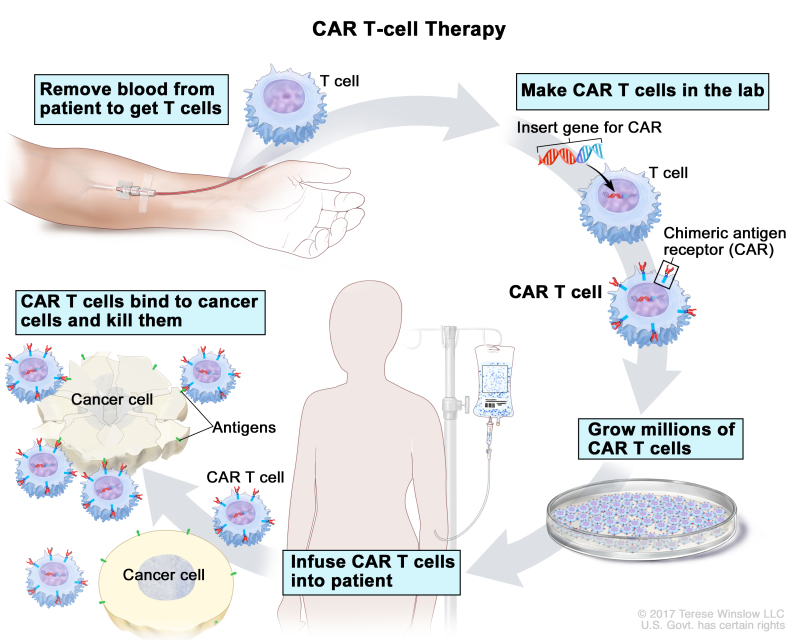
CAR T-cell therapy. A type of treatment in which a patient’s T cells (a type of immune cell) are changed in the laboratory so they will bind to cancer cells and kill them. Blood from a vein in the patient’s arm flows through a tube to an apheresis machine (not shown), which removes the white blood cells, including the T cells, and sends the rest of the blood back to the patient. Then, the gene for a special receptor called a chimeric antigen receptor (CAR) is inserted into the T cells in the laboratory. Millions of the CAR T cells are grown in the laboratory and then given to the patient by infusion. The CAR T cells are able to bind to an antigen on the cancer cells and kill them.

Treatment for Ewing sarcoma may cause side effects.
Side effects from cancer treatment that begin after treatment and continue for months or years are called late effects. Late effects of cancer treatment may include the following:
-
Physical problems.
-
Changes in mood, feelings, thinking, learning, or memory.
-
Second cancers (new types of cancer). Patients treated for Ewing sarcoma have an increased risk of acute myeloid leukemia and myelodysplastic syndrome. There is also an increased risk of sarcoma in the area treated with radiation therapy.
Some late effects may be treated or controlled. It is important to talk with your child’s doctors about the effects cancer treatment can have on your child.
Patients may want to think about taking part in a clinical trial.
For some patients, taking part in a clinical trial may be the best treatment choice. Clinical trials are part of the cancer research process. Clinical trials are done to find out if new cancer treatments are safe and effective or better than the standard treatment.
Many of today’s standard treatments for cancer are based on earlier clinical trials. Patients who take part in a clinical trial may receive the standard treatment or be among the first to receive a new treatment.
Patients who take part in clinical trials also help improve the way cancer will be treated in the future. Even when clinical trials do not lead to effective new treatments, they often answer important questions and help move research forward.
Patients can enter clinical trials before, during, or after starting their cancer treatment.
Some clinical trials only include patients who have not yet received treatment. Other trials test treatments for patients whose cancer has not gotten better. There are also clinical trials that test new ways to stop cancer from recurring (coming back) or reduce the side effects of cancer treatment.
Clinical trials are taking place in many parts of the country. Information about clinical trials supported by NCI can be found on NCI’s clinical trials search webpage. Clinical trials supported by other organizations can be found on the ClinicalTrials.gov website.
Follow-up tests may be needed.
Some of the tests that were done to diagnose the cancer or to find out the stage of the cancer may be repeated. Some tests will be repeated in order to see how well the treatment is working. Decisions about whether to continue, change, or stop treatment may be based on the results of these tests.
Some of the tests will continue to be done from time to time after treatment has ended. The results of these tests can show if your child’s condition has changed or if the cancer has recurred (come back). These tests are sometimes called follow-up tests or check-ups.
Treatment of Localized Ewing Sarcoma
Standard treatments for newly diagnosed localized Ewing sarcoma include:
-
Chemotherapy.
-
Surgery and/or radiation therapy.
-
High-dose chemotherapy with stem cell rescue.
Use our clinical trial search to find NCI-supported cancer clinical trials that are accepting patients. You can search for trials based on the type of cancer, the age of the patient, and where the trials are being done.
Treatment of Metastatic Ewing Sarcoma
Standard treatments for newly diagnosed metastatic Ewing sarcoma include:
-
Chemotherapy.
-
Surgery.
-
Radiation therapy.
Use our clinical trial search to find NCI-supported cancer clinical trials that are accepting patients. You can search for trials based on the type of cancer, the age of the patient, and where the trials are being done.
Treatment of Recurrent Ewing Sarcoma
There is no standard treatment for recurrent Ewing sarcoma but treatment options may include the following:
-
Combination chemotherapy.
-
Radiation therapy to bone tumors, as palliative therapy to relieve symptoms and improve the quality of life.
-
Radiation therapy that may be followed by surgery to remove tumors that have spread to the lungs.
-
High-dose chemotherapy with stem cell rescue.
Treatment options being studied for recurrent Ewing sarcoma include the following:
-
Checking a sample of the patient’s tumor for certain gene changes. The type of targeted therapy that will be given to the patient depends on the type of gene change.
-
Targeted therapy with a tyrosine kinase inhibitor (cabozantinib).
-
Immunotherapy with an immune checkpoint inhibitor (nivolumab or ipilimumab).
-
CAR T-cell therapy.
-
Targeted therapy with an NEDD8-activating enzyme inhibitor (pevonedistat) and chemotherapy.
-
A clinical trial of a new type of targeted therapy.
Use our clinical trial search to find NCI-supported cancer clinical trials that are accepting patients. You can search for trials based on the type of cancer, the age of the patient, and where the trials are being done.

