
Average Weight/Most everyone has at some point tried to lose weight, or at least known somebody who has. This is largely due to the perception of an “ideal” body weight, which is often based on what we see promoted through various media such as social media, TV, movies, magazines, etc. Although ideal body weight (IBW) today is sometimes based on perceived visual appeal, IBW was actually introduced to estimate dosages for medical use, and the formulas that calculate it are not at all related to how a person looks at a given weight. It has since been determined that the metabolism of certain drugs is more based on IBW than it is total body weight. Today, IBW is also used widely throughout sports, since many sports classify people based on their body weight.
Note that IBW is not a perfect measurement. It does not consider the percentages of body fat and muscle in a person’s body. This means that it is possible for highly fit, healthy athletes to be considered overweight based on their IBW. This is why IBW should be considered with the perspective that it is an imperfect measure and not necessarily indicative of health, or a weight that a person should necessarily strive toward; it is possible to be over or under your “IBW” and be perfectly healthy.
How much a person should weigh is not an exact science. It is highly dependent on each individual. Thus far, there is no measure, be it IBW, body mass index (BMI), or any other that can definitively state how much a person should weigh to be healthy. They are only references, and it’s more important to adhere to making healthy life choices such as regular exercise, eating a variety of unprocessed foods, getting enough sleep, etc. than it is to chase a specific weight based on a generalized formula.
That being said, many factors can affect the ideal weight; the major factors are listed below. Other factors include health conditions, fat distribution, progeny, etc.
What’s the Average Weight for Women?
How much does the average American woman weigh?
The average American woman 20 years old and up weighs 170.6 poundsTrusted Source and stands at 63.7 inches (almost 5 feet, 4 inches) tall.
And the average waist circumference? It’s 38.6 inches.
These numbers may or may not be surprising to you. The Centers for Disease Control and Prevention (CDC)Trusted Source has reported that some 39.8 percent of adults in the United States are obese, based on data through 2016.
For women, this breaks downTrusted Source as follows:
| Age group (years) | Percent considered overweight or obese | Percent considered obese |
| 20-34 | 59.6 | 34.8 |
| 35-44 | 67.7 | 43.4 |
| 45-54 | 69.5 | 42.9 |
| 55-64 | 74.5 | 48.2 |
| 65-74 | 75.6 | 43.5 |
| 75 and up | 67.4 | 32.7 |
As of 2016, the average weights for women in different age groups were trusted Source:
| Age group (years) | Average weight (pounds) |
| 20-39 | 167.6 |
| 40-59 | 176.4 |
| 60 and older | 166.5 |
How do Americans compare to the rest of the world?
People in North America have the highest average body mass in the world, according to a 2012 study. More than 70 percent of the population falls into the overweight-to-obese ranges.
People in Asia, on the other hand, have the lowest body mass. Specifically, the average body mass index (BMI) for Japan in 2005 was just 22.9. In comparison, the average BMI in the United States was 28.7.
If you need another way to look at it, 1 ton of body mass represents 12 North American adults. In Asia, 1 ton represents 17 adults.
The percentages of people worldwide who are considered overweight are listed below
| Region | Percent considered overweight |
| Asia | 24.2 |
| Europe | 55.6 |
| Africa | 28.9 |
| Latin America and the Caribbean | 57.9 |
| North America | 73.9 |
| Oceania | 63.3 |
| World | 34.7 |
How are weight ranges determined?
Your height, sex, and fat, and muscle composition all factor into your ideal weight. There are various tools to help you figure out your number. BMI, one of the most popular tools, uses a formula that involves your height and weight.
To calculate your BMI, divide your weight in pounds by your height in inches squared. Then multiply that result by 703. You can also plug this information into an online calculator Trusted Source.
Once you know your BMI, you can determine where it falls:
- Underweight: anything under 18.5
- Healthy: anything between 18.5 and 24.9
- Overweight: anything between 25.0 and 29.9
- Obese: anything above 30.0
Although this method offers a good starting point, your BMI may not always be the most accurate measure of your ideal weight. Why? It goes back to factors such as frame size, muscle composition, and age.
Athletes, for example, may weigh more due to high muscle mass and get an overweight result. Older adults, on the other hand, tend to store more fat than younger adults.
It’s important to note that BMI for children and teens trusted Source is given as a percentile. Their heights and weights are constantly changing. As a result, it’s most useful to look at their BMIs in relationship to the BMIs of other children who are the same age and sex.
For example, a 13-year-old girl who is 5 feet tall and weighs 100 pounds has a BMI of 19.5. However, her BMI would be expressed as “at the 60th percentile” for 13-year-old girls. This means her weight is greater than that of 60 percent of her peers, placing her in the healthy range.
Even with its limitations, your BMI can be a good starting place when looking at your overall health. To see where your BMI falls, take a look at this chart to find your ideal weight by height.
| Height in feet and inches | Healthy weight in pounds (or BMI 18.5–24.9) |
| 4’10” | 91–119 |
| 4’11” | 94–123.5 |
| 5’ | 97–127.5 |
| 5’1” | 100–132 |
| 5’2” | 104–136 |
| 5’3” | 107–140.5 |
| 5’4” | 110–145 |
| 5’5” | 114–149.5 |
| 5’6” | 118–154 |
| 5’7” | 121–159 |
| 5’8” | 125–164 |
| 5’9” | 128–168.5 |
| 5’10” | 132–173.5 |
| 5’11” | 136–178.5 |
| 6’ | 140–183.5 |
| 6’1” | 144–189 |
| 6’2” | 148–194 |
| 6’3” | 152–199 |
For the most accurate measure of whether you’re at an ideal weight, you may consider visiting your doctor for specialized tests, such as:
- skinfold thickness tests, which mostly use calipers (these can also be performed by personal trainers)
- densitometry, which uses underwater weighing
- bioelectrical impedance analysis (BIA), which uses a device to measure the flow of electrical current in the body
The fitness organization American Council on Exercise (ACE) uses the following classification system for female body fat percentage:
| Classification | Body fat percentage (%) |
| Athletes | 14–20 |
| Fitness | 21–24 |
| Acceptable/Average | 25–31 |
| Obese | 32 and up |
Our easy to read optimum height to weight ratio charts, cover newborn babies to teenage girls and boys, and will give you a general idea of whether you are of average weight for your age and height without using complicated percentile graphs, however, please keep in mind the following:
- 1 – Height and weight ratio charts are not truly accurate measures or indicators, especially for young children and teenagers. Height to weight charts for girls and boys represent only a rough average and should be used in conjunction with a BMI calculator for kids.
- 2 – Young children and teenagers often have growth spurts during their growing years. During puberty your body will grow faster than at any other time in your life. On average, girls commence puberty around ages 10 to 11 and end puberty around 15 to 17 years old; boys start puberty around age 11 to 12 and end around 16 to 17 years of age (Wikipedia). During this period it is quite possible to gain and lose weight rapidly, as well as add inches to their heights seemingly overnight. This is particularly so in many adolescent girls who often experience dramatic changes in weight, bone composition, height, and body fat distribution – especially through their pubescent years.
- 3 – Every baby, child, and teenager is different in the way they mature and grow during their teen years. Dieting for teens is not recommended as quite often you will find they will simply “grow out” of their “baby fat” as they mature into young adults. Your pediatrician or family physician is really the best person to consult if you are worried about your childs height to weight ratio as a doctor can use a medical growth chart to keep track of your progress as you mature.
*Our height to weight chart now displays both Metric and Imperial measurements; Pounds/Kilograms and Inches/Centimeters.
| Babies to Teens Height to Weight Ratio Table | ||
|---|---|---|
|
|
|
| Average Height to Weight Ratio for Girls
Female Babies – 0 to 11 Months |
||
| Age | Weight | Length |
| 0 mth | 7.3 lb (3.3 kg) | 19.4″ (49.2 cm) |
| 1 mth | 9.6 lb (4.3 kg) | 21.2″ (53.8 cm) |
| 2 mth | 11.7 lb (5.3 kg) | 22.1″ (56.1 cm) |
| 3 mth | 13.3 lb (6.0 kg) | 23.6″ (59.9 cm) |
| 4 mth | 14.6 lb (6.6 kg) | 24.5″ (62.2 cm) |
| 5 mth | 15.8 lb (7.1 kg) | 25.3″ (64.2 cm) |
| 6 mth | 16.6 lb (7.5 kg) | 25.9″ (64.1 cm) |
| 7 mth | 17.4 lb (7.9 kg) | 26.5″ (67.3 cm) |
| 8 mth | 18.1 lb (8.2 kg) | 27.1″ (68.8 cm) |
| 9 mth | 18.8 lb (8.5 kg) | 27.6″ (70.1 cm) |
| 10 mth | 19.4 lb (8.8 kg) | 28.2″ (71.6 cm) |
| 11 mth | 19.9 lb (9.0 kg) | 28.7″ (72.8 cm) |
| Female Toddlers – 12 to 23 Months | ||
| Age | Weight | Length |
| 12 mth | 20.4 lb (9.2 kg) | 29.2″ (74.1 cm) |
| 13 mth | 21.0 lb (9.5 kg) | 29.6″ (75.1 cm) |
| 14 mth | 21.5 lb (9.7 kg) | 30.1″ (76.4 cm) |
| 15 mth | 22.0 lb (9.9 kg) | 30.6″ (77.7 cm) |
| 16 mth | 22.5 lb (10.2 kg) | 30.9″ (78.4 cm) |
| 17 mth | 23.0 lb (10.4 kg) | 31.4″ (79.7 cm) |
| 18 mth | 23.4 lb (10.6 kg) | 31.8″ (80.7 cm) |
| 19 mth | 23.9 lb (10.8 kg) | 32.2″ (81.7 cm) |
| 20 mth | 24.4 lb (11 kg) | 32.6″ (82.8 cm) |
| 21 mth | 24.9 lb (11.3 kg) | 32.9″ (83.5 cm) |
| 22 mth | 25.4 lb (11.5 kg) | 33.4″ (84.8 cm) |
| 23 mth | 25.9 lb (11.7 kg) | 33.5″ (85.1 cm) |
| Female Children – 2 to 12 Years | ||
| Age | Weight | Height |
| 2 yrs | 26.5 lb (12.0 kg) | 33.7″ (85.5 cm) |
| 3 yrs | 31.5 lb (14.2 kg) | 37.0″ (94 cm) |
| 4 yrs | 34.0 lb (15.4 kg) | 39.5″ (100.3 cm) |
| 5 yrs | 39.5 lb (17.9 kg) | 42.5″ (107.9 cm) |
| 6 yrs | 44.0 lb (19.9 kg) | 45.5″ (115.5 cm) |
| 7 yrs | 49.5 lb (22.4 kg) | 47.7″ (121.1 cm) |
| 8 yrs | 57.0 lb (25.8 kg) | 50.5″ (128.2 cm) |
| 9 yrs | 62.0 lb (28.1 kg) | 52.5″ (133.3 cm) |
| 10 yrs | 70.5 lb (31.9 kg) | 54.5″ (138.4 cm) |
| 11 yrs | 81.5 lb (36.9 kg) | 56.7″ (144 cm) |
| 12 yrs | 91.5 lb (41.5 kg) | 59.0″ (149.8 cm) |
| Teenage Girls – 13 to 20 Years | ||
| Age | Weight | Height |
| 13 yrs | 101.0 lb (45.8 kg) | 61.7″ (156.7 cm) |
| 14 yrs | 105.0 lb (47.6 kg) | 62.5″ (158.7 cm) |
| 15 yrs | 115.0 lb (52.1 kg) | 62.9″ (159.7 cm) |
| 16 yrs | 118.0 lb (53.5 kg) | 64.0″ (162.5 cm) |
| 17 yrs | 120.0 lb (54.4 kg) | 64.0″ (162.5 cm) |
| 18 yrs | 125.0 lb (56.7 kg) | 64.2″ (163 cm) |
| 19 yrs | 126.0 lb (57.1 kg) | 64.2″ (163 cm) |
| 20 yrs | 128.0 lb (58.0 kg) | 64.3″ (163.3 cm) |
| Average Height to Weight Ratio for Boys
Male Babies – 0 to 11 Months |
||
| Age | Weight | Length |
| 0 mth | 7.4 lb (3.3 kg) | 19.6″ (49.8 cm) |
| 1 mth | 9.8 lb (4.4 kg) | 21.6″ (54.8 cm) |
| 2 mth | 12.3 lb (5.6 kg) | 23.0″ (58.4 cm) |
| 3 mth | 14.1 lb (6.4 kg) | 24.2″ (61.4 cm) |
| 4 mth | 15.4 lb (7 kg) | 25.2″ (64 cm) |
| 5 mth | 16.6 lb (7.5 kg) | 26.0″ (66 cm) |
| 6 mth | 17.5 lb (7.9 kg) | 26.6″ (67.5 cm) |
| 7 mth | 18.3 lb (8.3 kg) | 27.2″ (69 cm) |
| 8 mth | 19.0 lb (8.6 kg) | 27.8″ (70.6 cm) |
| 9 mth | 19.6 lb (8.9 kg) | 28.3″ (71.8 cm) |
| 10 mth | 20.1 lb (9.1 kg) | 28.8″ (73.1 cm) |
| 11 mth | 20.8 lb (9.4 kg) | 29.3″ (74.4 cm) |
| Male Toddlers – 12 to 23 Months | ||
| Age | Weight | Length |
| 12 mth | 21.3 lb (9.6 kg) | 29.8″ (75.7 cm) |
| 13 mth | 21.8 lb (9.9 kg) | 30.3″ (76.9 cm) |
| 14 mth | 22.3 lb (10.1 kg) | 30.7″ (77.9 cm) |
| 15 mth | 22.7 lb (10.3 kg) | 31.2″ (79.2 cm) |
| 16 mth | 23.2 lb (10.5 kg) | 31.6″ (80.2 cm) |
| 17 mth | 23.7 lb (10.7 kg) | 32.0″ (81.2 cm) |
| 18 mth | 24.1 lb (10.9 kg) | 32.4″ (82.2 cm) |
| 19 mth | 24.6 lb (11.2 kg) | 32.8″ (83.3 cm) |
| 20 mth | 25.0 lb (11.3 kg) | 33.1″ (84 cm) |
| 21 mth | 25.5 lb (11.5 kg) | 33.5″ (85 cm) |
| 22 mth | 25.9 lb (11.7 kg) | 33.9″ (86.1 cm) |
| 23 mth | 26.3 lb (11.9 kg) | 34.2″ (86.8 cm) |
| Male Children – 2 to 12 Years | ||
| Age | Weight | Height |
| 2 yrs | 27.5 lb (12.5 kg) | 34.2″ (86.8 cm) |
| 3 yrs | 31.0 lb (14.0 kg) | 37.5″ (95.2 cm) |
| 4 yrs | 36.0 lb (16.3 kg) | 40.3″ (102.3 cm) |
| 5 yrs | 40.5 lb (18.4 kg) | 43.0″ (109.2 cm) |
| 6 yrs | 45.5 lb (20.6 kg) | 45.5″ (115.5 cm) |
| 7 yrs | 50.5 lb (22.9 kg) | 48.0″ (121.9 cm) |
| 8 yrs | 56.5 lb (25.6 kg) | 50.4″ (128 cm) |
| 9 yrs | 63.0 lb (28.6 kg) | 52.5″ (133.3 cm) |
| 10 yrs | 70.5 lb (32 kg) | 54.5″ (138.4 cm) |
| 11 yrs | 78.5 lb (35.6 kg) | 56.5″ (143.5 cm) |
| 12 yrs | 88.0 lb (39.9 kg) | 58.7″ (149.1 cm) |
| Male Teens – 13 to 20 Years) | ||
| Age | Weight | Height |
| 13 yrs | 100.0 lb (45.3 kg) | 61.5″ (156.2 cm) |
| 14 yrs | 112.0 lb (50.8 kg) | 64.5″ (163.8 cm) |
| 15 yrs | 123.5 lb (56.0 kg) | 67.0″ (170.1 cm) |
| 16 yrs | 134.0 lb (60.8 kg) | 68.3″ (173.4 cm) |
| 17 yrs | 142.0 lb (64.4 kg) | 69.0″ (175.2 cm) |
| 18 yrs | 147.5 lb (66.9 kg) | 69.2″ (175.7 cm) |
| 19 yrs | 152.0 lb (68.9 kg) | 69.5″ (176.5 cm) |
| 20 yrs | 155.0 lb (70.3 kg) | 69.7″ (177 cm) |
Printable Height/Weight Chart for Girls from Baby to Teenage Years
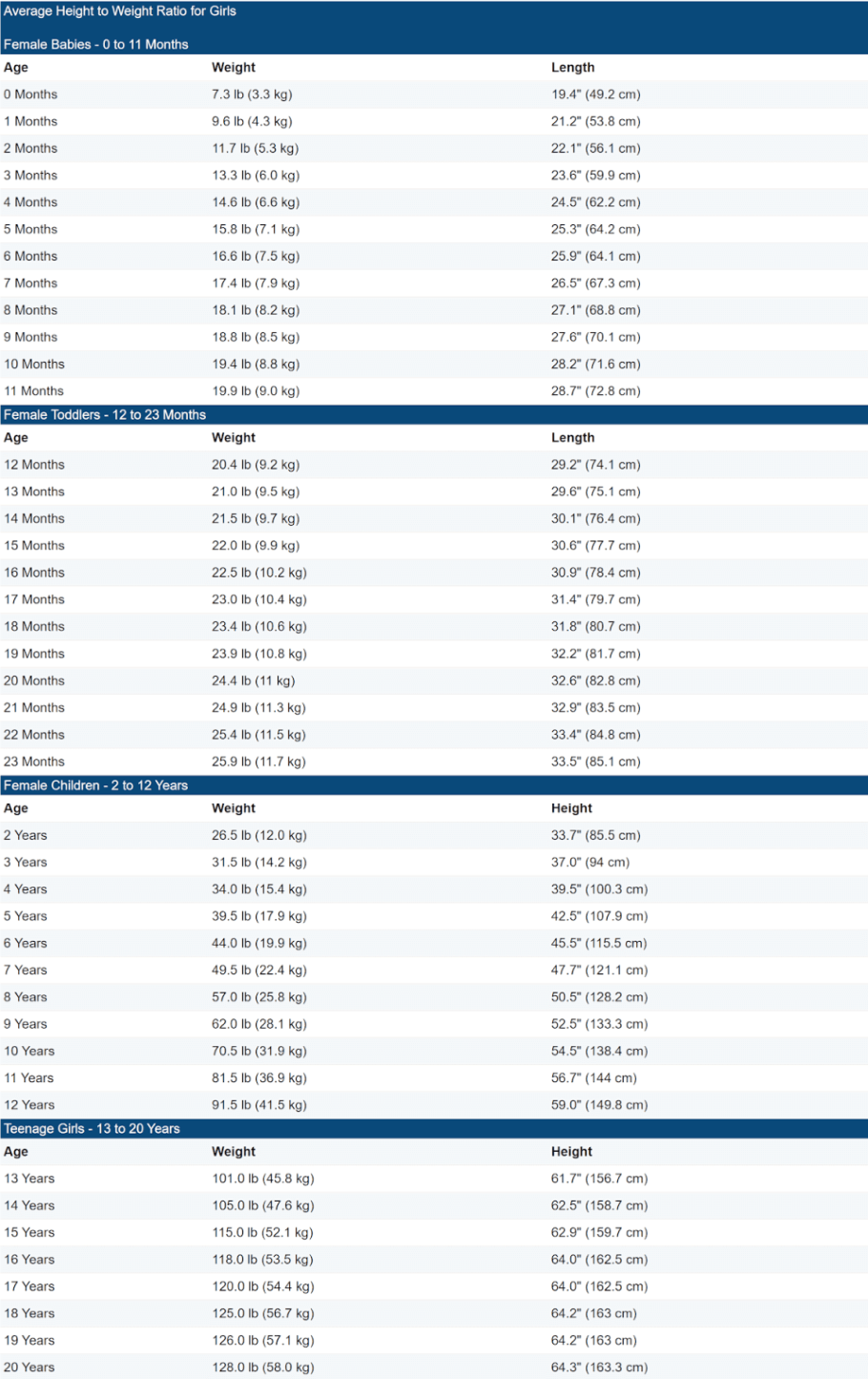
Printable youth height to weight ratio chart for girls from baby to teens.
Printable Height/Weight Chart for Boys from Baby to Teenage Youth
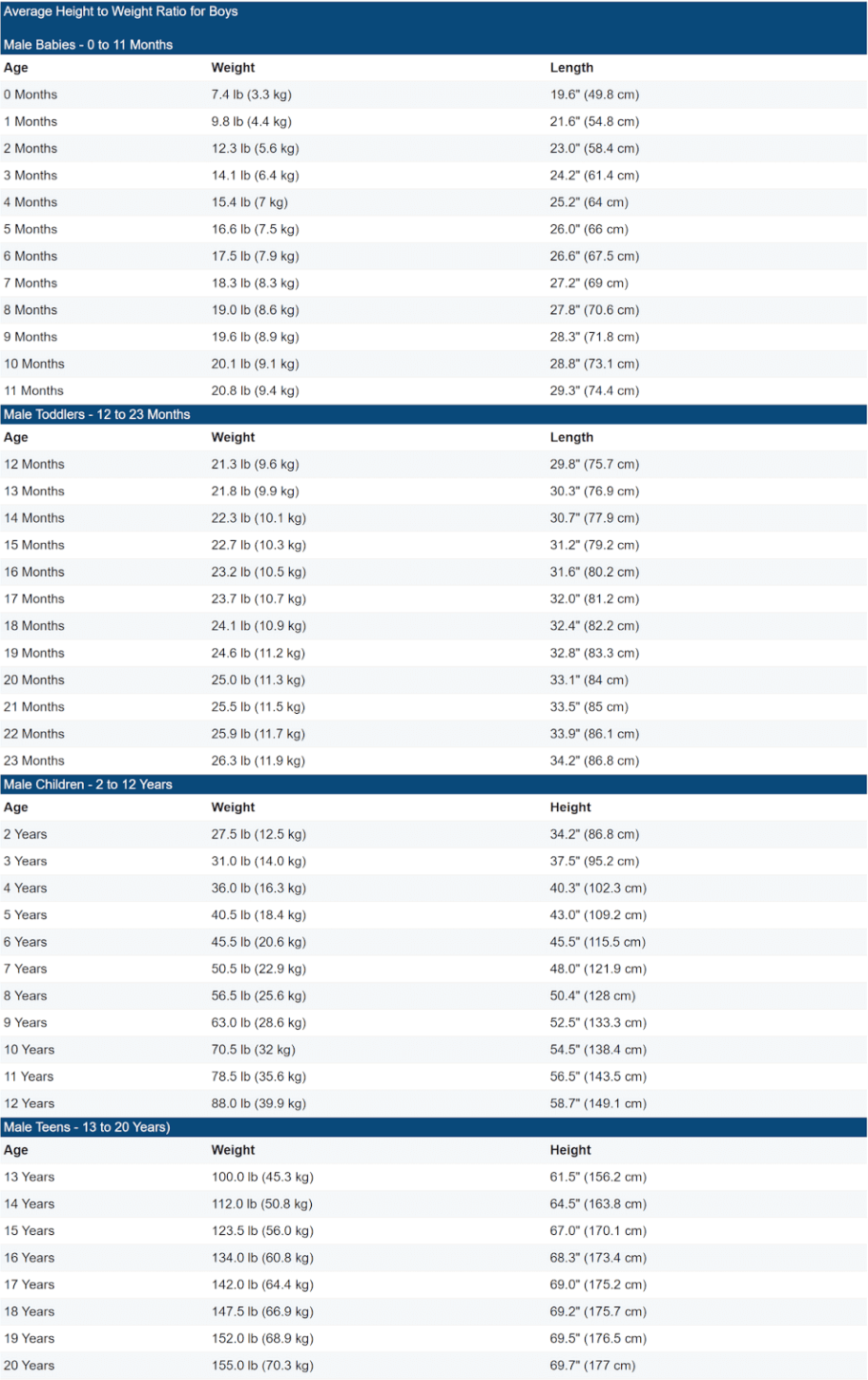
Printable youth height to weight ratio chart for boys from baby to teens.
*Information and data for above growth charts sourced from The World Health Organization (WHO), Gerontology Research Center (National Institutes of Health (NIH), USA), and the U.S. Centers for Disease Control and Prevention (CDC).
Waist-to-hip ratio
Your waist-to-hip ratio is another good indicator of whether or not you’re at a healthy weight. To calculate this ratio, you should first take your measurements at your natural waist and at the widest part of your lower body.
According to the World Health Organization (WHO), women should have a maximum waist-to-hip ratio of 0.85.
A waist-to-hip ratio over 1.0 puts women at risk for health conditions associated with visceral fat, or belly fat. These conditions include breast cancer, heart disease, stroke, and type 2 diabetes.
The waist-to-hip ratio may not be the most accurate metric for some subsets of people, including children and people with a BMI over 35.
How can you manage your weight?
Keeping your weight within the healthy range can take hard work, but it’s well worth the effort. Not only will you potentially feel your best, but you’ll also prevent medical conditions tied to obesity.
They include:
- high blood pressure
- coronary artery disease (CAD)
- type 2 diabetes
- heart disease
Consider taking the advice below if you need to lose a few pounds to get to your ideal weight. These key steps can help you get there.
Decrease your portion sizes
A quarter of your plate should contain a palm-sized portion of lean protein, such as salmon or chicken breast. Another quarter of your plate should hold a fist-sized portion of whole grain, such as brown rice or quinoa. The last half of your plate should be piled with vegetables, such as kale, broccoli, and bell peppers.
Try waiting a while
If you’re still hungry after you’ve completed your whole meal, wait 20 minutes before digging into that second helping. Even then, try eating fresh fruits and vegetables before reaching for desserts.
Eat regularly
Eat breakfast and don’t skip meals. Your body needs consistent nutrition throughout the day to run at its best. Without the proper fuel, you won’t feel well and your body won’t work efficiently.
Munch on more fiber
Women should be taking in 21 to 25 grams of fiber each day. If you’re having trouble in this area, add foods such as whole-grain bread and cereals to your diet. Whole-wheat pasta, rice, and beans are other good options. The idea here is that fiber fills you up quickly, ultimately curbing your appetite.
Get moving
The current recommendations for weekly exerciseTrusted Source are 150 minutes a week of moderate physical activity, such as walking or yoga, or 75 minutes a week of more vigorous activity, such as running or cycling.
Drink more water
Women should be getting 11.5 cups of fluids each day. Water is best and lowest in calories, but any beverage — including tea, coffee, and sparkling water — counts toward your daily hydration goal.
What’s the takeaway?
Weight alone doesn’t tell how healthy you are. Eating well, exercising, staying hydrated, and getting good sleep are all important, no matter your size.
If you do need to shed a few pounds, start by setting a realistic goal with your doctor or by determining the appropriate BMI or weight for your frame. From there, create a plan with the help of your doctor or dietitian and set goals that you can work toward.
References

