
L5 Lumbar Radiculopathy patients will often complain of acute back pain, which radiates down the lateral leg, into the foot. On examination, there may be a reduction in muscle strength with big toe extension (extensor hallucis longus), foot eversion, inversion, toe extension, and foot dorsiflexion. Chronic L5 radiculopathy can cause atrophy of the extensor digitorum brevis (the marker of L5 radiculopathy in EMG) as well as the tibialis anterior of the anterior leg. If severe enough, L5 radiculopathy can cause weakness in leg abduction when the gluteus minimus and medius are affected.[1]
Lumbosacral Radiculopathy is the clinical term used to describe a predictable constellation of symptoms occurring secondary to mechanical and/or inflammatory cycles compromising at least one of the lumbosacral nerve roots. Patients can present with radiating pain, numbness/tingling, weakness, and gait abnormalities across a spectrum of severity. Depending on the nerve root(s) affected, patients can present with these symptoms in predictable patterns affecting the corresponding dermatome or myotome. [rx]
Causes of L5 Lumbar Radiculopathy
The noxious stimulus of a spinal nerve creates ectopic nerve signals that are perceived as pain, numbness, and tingling along the nerve distribution. Lesions of the intervertebral discs and degenerative disease of the spine are the most common causes of lumbosacral radiculopathy. However, any process that causes irritation of the spinal nerves can cause radicular symptoms. The differential diagnosis for lumbosacral radiculopathy should include (but is not limited to) the following:
Degenerative conditions of the spine (most common causes)
-
Spondylolisthesis: in the degenerative setting, this occurs as a result of a pathologic cascade including intervertebral disc degeneration, ensuing intersegmental instability, and facet joint arthropathy
- Spinal stenosis
- Adult isthmic spondylolisthesis is typically caused by an acquired defect in the par interarticularis
-
Pars defects (i.e. spondylolisis) in adults are most often secondary to repetitive microtrauma
-
Trauma (e.g. burst fractures with bony fragment retropulsion)
-
Clinicians should recognize spinal fractures can occur in younger, healthy patient populations secondary to high-energy injuries (e.g. MVA, fall from height) or secondary low energy injuries and spontaneous fractures in the elderly populations, including any patient with osteoporosis
-
Associated hemorrhage from the injury can result in a deteriorating clinical and neurologic exam
Benign or malignant tumors
-
Metastatic tumors (most common)
-
Primary tumors
-
Ependymoma
-
Schwannoma
-
Neurofibroma
-
Lymphoma
-
Lipomas
-
Paraganglioma
-
Ganglioneuroma
-
Osteoblastoma
Infection
-
Osteodiscitis
-
Osteomyelitis
-
Epidural abscess
-
Fungal infections (e.g. Tuberculosis)
-
Other infections: lyme disease, HIV/AIDS-defining ilnesses, Herpes zoster (HZ)
Vascular conditions
-
Hemangioblastoma, aterior-venous malformations (AVM)[rx]
Symptoms of L5 Lumbar Radiculopathy
The primary signs and symptoms of
- LDH is radicular pain – sensory abnormalities, and weakness in the distribution of one or more lumbosacral nerve roots [rx, rx]. Focal paresis, restricted trunk flexion, and increases in leg pain with straining, coughing, and sneezing are also indicative [rx, rx]. Patients frequently report increased pain when sitting, which is known to increase disc pressure by nearly 40% [rx].
- Pain that is relieved with sitting for forwarding flexion – is more consistent with lumbar spinal stenosis (LSS), as the latter motion increases disc pressure by 100–400% and would likely increase pain in isolated LDH [rx]. Rainville et al. recently compared signs of LDH with LSS and found that LSS patients are more likely to have increased medical comorbidities, lower levels of disability and leg pain, abnormal Achilles reflexes, and pain primarily in the posterior knee [rx].
The type and location of your symptoms depend on the location and direction of the herniated disc, and the amount of pressure on nearby nerves. A herniated disc may cause no pain at all. Or, it can cause any of the following symptoms:
- Numbness or tingling – People who have a herniated disk often have radiating numbness or tingling in the body part served by the affected nerves.
- Weakness – Muscles served by the affected nerves tend to weaken. This can cause you to stumble, or affect your ability to lift or hold items.
- Pain in the neck, back, low back, arms, or legs
- Inability to bend or rotate the neck or back
- Numbness or tingling in the neck, shoulders, arms, hands, hips, legs, or feet
- Weakness in the arms or legs
- Limping when walking
- Increased pain when coughing, sneezing, reaching, or sitting
- Inability to stand up straight; being “stuck” in a position, such as stooped forward or leaning to the side
- Difficulty getting up from a chair
- Inability to remain in 1 position for a long period of time, such as sitting or standing, due to pain
- Pain that is worse in the morning
- This is a sharp, often shooting pain that extends from the buttock down the back of one leg. It is caused by pressure on the spinal nerve.
- Numbness or a tingling sensation in the leg and/or foot
- Weakness in the leg and/or foot
- Loss of bladder or bowel control. This is extremely rare and may indicate a more serious problem called cauda equina syndrome. This condition is caused by the spinal nerve roots being compressed.
Diagnosis of L5 Lumbar Radiculopathy
History and Physical
Obtaining a history from the patient should focus on the onset of pain, presence or absence of radicular symptoms, and any inciting injuries or traumas. The clinician should thoroughly investigate for the presence (or absence) of the following clinical parameters:
-
Postural-specific influences on back pain/symptoms (e.g. flexing forward, lying supine)
-
Quantify ability to ambulate without symptoms
-
History of prior symptoms, injuries, or surgeries
-
Presence of weakness and/or numbness/tingling
-
Systemic symptoms, illnesses, unintentional weight loss, or recent travel locations
A disc herniation at the L5/S1 level can have two overlapping presentations:
-
L5 at the L5/S1 level, a disc herniation far laterally into the left/right neural foramen would compress the L5 nerve, resulting in weakness of hip abduction muscles, ankle dorsiflexion (anterior tibialis muscle) and/or extension of the great toe (extensor hallucis longus muscle).
-
S1 at the L5/S1 level, a disc herniation centrally into the canal would compress the S1 nerve, resulting in weakness of ankle plantar flexion (gastrocnemius muscle).
Special Tests
- Lasègue’s Test
- Slump Test
- Muscle Weakness or Paresis
- Reflexes
- Hyperextension Test The patient needs to passively mobilize the trunk over the full range of extension, while the knees stay extended. The test indicates that the radiant pain is caused by disc herniation if the pan deteriorates.
- Manual Testing and Sensory Testing Look for hypoaesthesia, hypoalgesia, tingling, or numbness.
Lab Values
- RBS
- Serum creatinine
-
ESR and CRP – These are inflammatory markers that should be obtained If a chronic inflammatory condition is suspected (rheumatoid arthritis, polymyalgia rheumatic, seronegative spondyloarthropathy). These can also be beneficial if an infectious etiology is suspected.
-
CBC with differential – Useful to obtain in instances when infection or malignancy is suspected.
Radiological Imaging
- X-rays – The first test typically performed and one that is very accessible at most clinics and outpatient offices. Three views (AP, lateral, and oblique) views help assess the overall alignment of the spine as well as for the presence of any degenerative or spondylotic changes. These can be further supplemented with lateral flexion and extension views to assess for the presence of instability. If imaging demonstrates an acute fracture, this requires additional investigation using a CT scan or MRI. If there is a concern for atlantoaxial instability, the open mouth (odontoid) view may assist in diagnosis.
- CT Scan – This imaging is the most sensitive test to examine the bony structures of the spine. It can also show calcified herniated discs or any insidious process that may result in bony loss or destruction. In patients that are unable to or are otherwise ineligible to undergo an MRI, CT myelography can be used as an alternative to visualize a herniated disc.
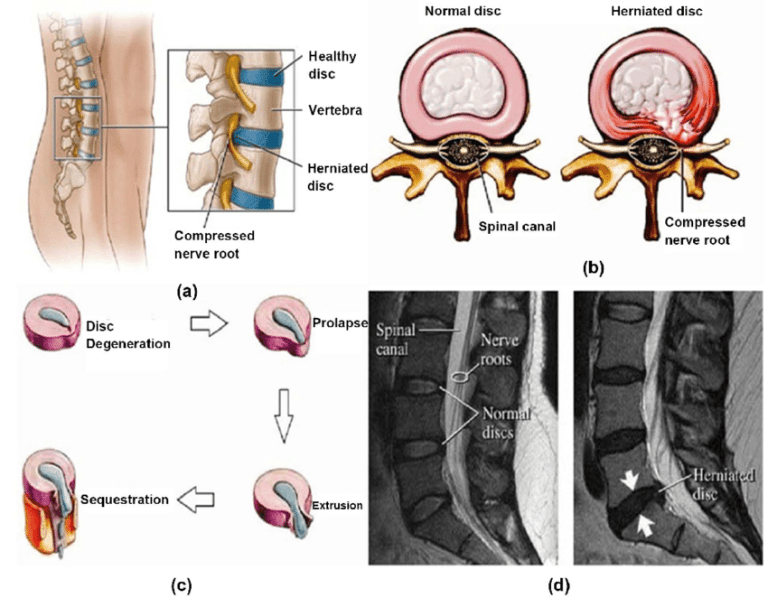
- MRI – The preferred imaging modality and the most sensitive study to visualize a herniated disc, as it has the most significant ability to demonstrate soft-tissue structures and the nerve as it exits the foramen.
- Electrodiagnostic testing – (Electromyography and nerve conduction studies) can be an option in patients that demonstrate equivocal symptoms or imaging findings as well as to rule out the presence of a peripheral mononeuropathy. The sensitivity of detecting cervical radiculopathy with electrodiagnostic testing ranges from 50% to 71%.[rx]
- The straight leg raise test – With the patient lying supine, the examiner slowly elevates the patient’s led at an increasing angle, while keeping the leg straight at the knee joint. The test is positive if it reproduces the patient’s typical pain and paresthesia.[rx]
- The contralateral (crossed) straight leg raise test – As in the straight leg raise test, the patient is lying supine, and the examiner elevates the asymptomatic leg. The test is positive if the maneuver reproduces the patient’s typical pain and paresthesia. The test has a specificity greater than 90%.
- Myelography – An X-ray of the spinal canal following the injection of contrast material into the surrounding cerebrospinal fluid spaces will reveal the displacement of the contrast material. It can show the presence of structures that can cause pressure on the spinal cord or nerves, such as herniated discs, tumors, or bone spurs.
- Transcranial Magnetic Stimulation (TMS) – The presence and severity of myelopathy can be evaluated by means of transcranial magnetic stimulation (TMS), a neurophysiological method that measures the time required for a neural impulse to cross the pyramidal tracts, starting from the cerebral cortex and ending at the anterior horn cells of the cervical, thoracic, or lumbar spinal cord. This measurement is called the central conduction time (CCT).
- Electromyography and nerve conduction studies (EMG/NCS) – measure the electrical impulses along with nerve roots, peripheral nerves, and muscle tissue. Tests can indicate if there is ongoing nerve damage, if the nerves are in a state of healing from a past injury, or if there is another site of nerve compression. EMG/NCS studies are typically used to pinpoint the sources of nerve dysfunction distal to the spine.
- Other Studies – Patients with equivocal studies may opt for a discography when conservative measures fail. Electrophysiological studies can be performed to evaluate and elucidate the nerve roots affected by the injured cervical disc.[rx][rx]
Treatment Of L5 Lumbar Radiculopathy
Patient Education
-
Use of hot or cold packs for comfort and to decreased inflammation
-
Avoidance of inciting activities or prolonged sitting/standing
-
Practicing good, erect posture
-
Engaging in exercises to increase core strength
-
Gentle stretching of the lumbar spine and hamstrings
-
Regular light exercises such as walking, swimming, or aromatherapy
-
Use of proper lifting techniques
Non-Pharmacological Treatment
Conservative Treatments – Acute cervical or lumber radiculopathies secondary to a herniated disc are typically managed with non-surgical treatments as the majority of patients (75 to 90%) will improve. Modalities that can be used include[rx][rx][rx]:
- Rest the area by avoiding any activity that causes worsening symptoms in the arms or legs.
- Stay active around the house, and go on short walks several times per day. The movement will decrease pain and stiffness and help you feel better.
- Apply ice packs to the affected area for 15 to 20 minutes every 2 hours.
- Sit in firm chairs. Soft couches and easy chairs may make your problems worse.
-
Deep tissue massage may be helpful
-
Acupuncture – In acupuncture, the therapist inserts fine needles into certain points on the body with the aim of relieving pain.
-
Reiki – Reiki is a Japanese treatment that aims to relieve pain by using specific hand placements.
-
Moxibustion – This method is used heat specific parts of the body (called “therapy points”) by using glowing sticks made of mugwort (“Moxa”) or heated needles that are put close to the therapy points.
-
Massages – Various massage techniques are used to relax muscles and ease tension.
-
Heating and cooling – This includes the use of hot packs and plasters, a hot bath, going to the sauna, or using an infrared lamp. Heat can also help relax tense muscles. Cold packs, like cold wraps or gel packs, are also used to help with irritated nerves.
-
Ultrasound therapy – Here the lower back is treated with sound waves. The small vibrations that are produced generate heat to relax body tissue.
-
Cervical Manipulation – There is limited evidence suggesting that cervical manipulation may provide short-term benefits for neck pain and cervicogenic headaches. Complications from manipulation are rare and can include worsening radiculopathy, myelopathy, spinal cord injury, and vertebral artery injury. These complications occur ranging from 5 to 10 per 10 million manipulations.
-
Lumbar Corset or Collar for Immobilization – In patients with acute neck pain, a short course (approximately one week) of collar immobilization may be beneficial during the acute inflammatory period.
- Traction – May be beneficial in reducing the radicular symptoms associated with disc herniations. Theoretically, traction would widen the neuroforamen and relieve the stress placed on the affected nerve, which, in turn, would result in the improvement of symptoms. This therapy involves placing approximately 8 to 12 lbs of traction at an angle of approximately 24 degrees of neck flexion over a period of 15 to 20 minutes.
Physical Therapy
- Exercising in water – can be a great way to stay physically active when other forms of exercise are painful. Exercises that involve lots of twisting and bending may or may not benefit you. Your physical therapist will design an individualized exercise program to meet your specific needs.
- Weight-training exercises – though very important, need to be done with proper form to avoid stress to the back and neck.
- Reduce pain and other symptoms – Your physical therapist will help you understand how to avoid or modify the activities that caused the injury, so healing can begin. Your physical therapist may use different types of treatments and technologies to control and reduce your pain and symptoms.
- Improve posture –If your physical therapist finds that poor posture has contributed to your herniated disc, the therapist will teach you how to improve your posture so that pressure is reduced in the injured area, and healing can begin and progress as rapidly as possible.
- Improve motion – Your physical therapist will choose specific activities and treatments to help restore normal movement in any stiff joints. These might begin with “passive” motions that the physical therapist performs for you to move your spine, and progress to “active” exercises and stretches that you do yourself. You can perform these motions at home and in your workplace to help hasten healing and pain relief.
- Improve flexibility – Your physical therapist will determine if any of the involved muscles are tight, start helping you to stretch them, and teach you how to stretch them at home.
- Improve strength – If your physical therapist finds any weak or injured muscles, your physical therapist will choose, and teach you, the correct exercises to steadily restore your strength and agility. For neck and back disc herniations, “core strengthening” is commonly used to restore the strength and coordination of muscles around your back, hips, abdomen, and pelvis.
- Improve endurance – Restoring muscular endurance is important after an injury. Your physical therapist will develop a program of activities to help you regain the endurance you had before the injury, and improve it.
- Learn a home program – Your physical therapist will teach you strengthening, stretching, and pain-reduction exercises to perform at home. These exercises will be specific for your needs; if you do them as prescribed by your physical therapist, you can speed your recovery.
Eat Nutritiously During Your Recovery
- All bones and tissues in the body need certain nutrients in order to heal properly and in a timely manner. Eating a nutritious and balanced diet that includes lots of minerals and vitamins are proven to help heal broken bones of all types. Therefore focus on eating lots of fresh produce (fruits and veggies), whole grains, lean meats, and fish to give your body the building blocks needed to properly repair your. In addition, drink plenty of purified water, milk, and other dairy-based beverages to augment what you eat.
- Broken bones need ample minerals (calcium, phosphorus, magnesium, boron) and protein to become strong and healthy again.
- Excellent sources of minerals/protein include dairy products, tofu, beans, broccoli, nuts and seeds, sardines, and salmon.
- Important vitamins that are needed for bone healing include vitamin C (needed to make collagen), vitamin D (crucial for mineral absorption), and vitamin K (binds calcium to bones and triggers collagen formation).
- Conversely, don’t consume food or drink that is known to impair bone/tissue healing, such as alcoholic beverages, sodas, most fast food items, and foods made with lots of refined sugars and preservatives.
Medication for the pain
There are a number of different medications for the relief of sciatic nerve pain (sciatica) caused by a slipped disc. Most of these are painkillers, but you can also use muscle relaxants and anti-inflammatory drugs. The following medications are the most commonly used. They are all available without a prescription when taken at a low dose:
-
Non-steroidal anti-inflammatory drugs (NSAIDs) – These painkillers belong to the same group of drugs as acetylsalicylic acid (ASA, the drug in medicines like “Aspirin”). NSAIDs that may be an option for the treatment of sciatica include diclofenac, ibuprofen and naproxen. They have a pain-relieving and anti-inflammatory effect.Because NSAIDs prevent blood from clotting to an extent, they can cause bleeding. The bleeding may be mild, such as a nosebleed or bleeding gums, but more serious bleeding can sometimes also occur, for example in the stomach or bowels.
-
Acetaminophen (paracetamol) – Acetaminophen (paracetamol) is also a painkiller, but it is not an NSAID. It is well tolerated and can be used as an alternative to NSAIDs – especially for people who do not tolerate NSAID painkillers because of things like stomach problems or asthma. But higher doses of acetaminophen can cause liver and kidney damage. For this reason, adults should follow the information on the package insert and make sure they do not take more than 4 grams (4,000 milligrams) of acetaminophen per day. This is the amount in, for example, 8 tablets containing 500 milligrams each. It is not only important to take the right dose, but also to wait long enough between doses.
Some of the medication options have to be prescribed by a doctor. These include:
-
Opioids – Strong painkillers that may only be used under medical supervision. Opioids are available in many different strengths, and some are available in the form of a patch. Morphine, for example, is a very strong drug, while tramadol is a weaker opioid. These drugs may have a number of different side effects, some of which are serious. They range from nausea, vomiting, and constipation to dizziness, breathing problems and blood pressure fluctuation. Taking these drugs for a long time can lead to habitual use and physical dependence.
-
Steroids – Inflammation-reducing drugs that can be used to treat various diseases systemically. It is called a systemic treatment if the medication spreads throughout the entire body. This happens when it is taken as a tablet, injected into a muscle or given through a drip (infusion). Systemic steroids can soothe inflammation and relieve pain. They can also increase the risk of certain medical problems, including stomach ulcers, osteoporosis, infections, skin problems, glaucoma and glucose metabolism disorders.
-
Muscle relaxants – Sedatives that also relax the muscles. Like other psychotropic medications, they can cause fatigue and drowsiness, and affect your ability to drive. Muscle relaxants can also affect the functioning of your liver and cause gastrointestinal (stomach and bowel) complications. Benzodiazepines such as tetrazepam may lead to dependency if they are taken for longer than two weeks.
-
Anticonvulsants – These medications are typically used to treat epilepsy, but some are approved for treating nerve pain (neuralgia). Their side effects include drowsiness and fatigue. This can affect your ability to drive.
-
Antidepressants – These drugs are usually used for treating depression. Some of them are also approved for the treatment of pain. Possible side effects include nausea, dry mouth, low blood pressure, irregular heartbeat and fatigue.
Anticonvulsants and antidepressants are typically not used unless the symptoms last for a longer period of time or the painkillers don’t provide enough relief.
Manual therapy and treatments based on physical stimuli
The treatment options for sciatica following a slipped disc also include manual therapy and treatments based on physical stimuli. Manual treatment may include massages and special techniques for relaxing tense muscles or locked joints. Treatments based on physical stimuli use warming and cooling methods to relieve pain. These treatments are also called passive therapies because patients don’t have to actively participate. Common treatments include:
-
Massages – Various massage techniques are used to relax muscles and ease tension.
-
Heating and cooling – This includes the use of hot packs and heating patches, a hot bath, going to the sauna or using an infrared lamp. Heat can also help relax tense muscles. Cold packs, like cold wraps or gel packs, are also used to help soothe irritated nerves.
-
Ultrasound therapy – Here the lower back is treated with sound waves. The small vibrations that are produced generate heat and relax the body tissue.
There is no overall proof that passive treatments speed up recovery from a slipped disc or relieve the pain especially well. But many people find that heat or massages are pleasant and relaxing.
Traditional Asian medicine
Treatment approaches based on traditional Asian medicine include:
-
Acupuncture – In acupuncture, the therapist inserts fine needles into certain points on the body. This is thought to relieve the pain.
-
Reiki – Reiki is a Japanese treatment that aims to relieve pain by using specific hand placements.
-
Moxibustion – This method is used to heat specific points on the body by placing heated needles or glowing sticks made of mugwort (“Moxa”) close to those points.
There are very few good-quality studies on these treatments, and there is no proof that they help to relieve pain. Acupuncture is the only approach for which there is weak evidence that it might relieve pain – although this relief has been shown to be unrelated to where the needles are placed on the body.
Injections near the spine
Injection therapy mainly uses local anesthetics and/or inflammation-reducing medications like steroids. These drugs are injected into the area immediately surrounding the affected nerve root. There are different ways of doing this:
-
In lumbar spinal nerve analgesia – the medication is injected directly at the point where the nerve root leaves the spinal canal. This has a numbing effect on the nerve root.
-
In lumbar epidural analgesia – the medication is injected into what is known as the epidural space (“epidural injection”). The epidural space surrounds the spinal cord and the spinal fluid in the spinal canal. This is also where the nerve roots are located. During this treatment, the spine is monitored using computer tomography or x-rays to make sure that the injection is placed at exactly the right spot.
Surgical techniques
The aim of surgery is to remove spinal disc tissue that is pushing on the nerve. The idea is to give the nerve more space so the inflammation can go down and the symptoms can go away. Various surgical techniques can be used when operating on a slipped disc:
-
Open discectomy (microdiscectomy) – “Open” discectomy is the most commonly performed type of surgery for a slipped disc. The damaged part of the spinal disc is removed and the surgeon is able to see the area being operated on using a microscope. People who have this microsurgical procedure are given a general anesthetic and have to stay in the hospital for a few days. The risks associated with this procedure include bleeding, nerve damage, and infections. A general anesthetic may lead to complications like breathing or circulation problems.
-
Endoscopic surgery – Endoscopic surgery – also called minimally invasive or keyhole surgery – uses very small instruments so only one small cut is needed. This is done to speed up recovery and prevent the formation of scars that may cause problems. In these procedures, an endoscope (a long, thin tube that has a light and camera at one end) is inserted through a small cut and pushed through to the spinal disc. The surgical instruments are all inserted through this cut under x-ray guidance. The risks associated with this procedure include bleeding, nerve damage, and inflammation.
-
Surgery on the nucleus (inner core) of the spinal disc – In these “indirect” procedures, the gel-like core of the spinal disc is removed to make the spinal disc smaller, which in turn reduces pressure on the pinched nerve. All of these procedures involve inserting an instrument into the spinal disc to reach the core. The core of the spinal disc can be removed using suction. This is called a percutaneous nucleosome. Another option is to vaporize the core using laser beams (laser discectomy).
References
- https://www.ncbi.nlm.nih.gov/books/NBK279469/
- https://www.ncbi.nlm.nih.gov/books/NBK279472/
- https://www.ncbi.nlm.nih.gov/books/NBK448072/
- https://www.ncbi.nlm.nih.gov/books/NBK448134/
- https://www.ncbi.nlm.nih.gov/books/NBK279471/
- https://www.ncbi.nlm.nih.gov/books/NBK459235/
- https://www.ncbi.nlm.nih.gov/books/NBK542307/
- https://www.ncbi.nlm.nih.gov/books/NBK470583/
- https://www.ncbi.nlm.nih.gov/books/NBK470388/
- https://www.ncbi.nlm.nih.gov/books/NBK430837/
- https://www.ncbi.nlm.nih.gov/books/NBK535373/
- https://www.ncbi.nlm.nih.gov/books/NBK546593/
- https://www.ncbi.nlm.nih.gov/books/NBK448072/
- https://www.ncbi.nlm.nih.gov/books/NBK459235/

