
PTE Syllabus – All About You Need To Know

Patient Tools

Read, save, and share this guide

Use these quick tools to make this medical article easier to read, print, save, or share with a family member.

Article Summary

PTE Syllabus - All About You Need To Know/Candidates who want to excel in their next PTE Exam should be aware of the latest PTE Exam syllabus. The PTE Exam syllabus mentioned below is for candidates looking to appear for their next PTE Exam. Here is the syllabus for the PTE Academic exam covering Speaking and Writing syllabus, Reading syllabus, and Listening Syllabus Highlights of PTE Exam Pattern Section-wise...

Key Takeaways

  • This article explains Highlights of PTE Exam Pattern in simple medical language.
  • This article explains Section-wise PTE 2020 Syllabus in simple medical language.
  • This article explains Types of Questions Covered in the PTE Syllabus in simple medical language.
  • This article explains Preparation tips for PTE Exam in simple medical language.
Educational health guideWritten for patient understanding and clinical awareness.
Reviewed content workflowUse writer and reviewer profiles for stronger trust.
Emergency safety firstUrgent warning signs are highlighted below.

Seek urgent medical care if you notice

These warning signs are general safety guidance. Local emergency numbers and clinical judgment should always come first.

  • Severe symptoms, breathing difficulty, fainting, confusion, or rapidly worsening illness.
  • New weakness, severe pain, high fever, or symptoms after a serious injury.
  • Any symptom that feels urgent, unusual, or unsafe for the patient.
1

Emergency now

Use emergency care for severe, sudden, rapidly worsening, or life-threatening symptoms.

2

See a doctor

Book a professional medical evaluation if symptoms persist, worsen, recur often, affect daily activities, or occur in a high-risk patient.

3

Learn safely

Use this article to understand possible causes, tests, treatment options, prevention, and questions to ask your clinician.

PTE Syllabus – All About You Need To Know/Candidates who want to excel in their next PTE Exam should be aware of the latest PTE Exam syllabus. The PTE Exam syllabus mentioned below is for candidates looking to appear for their next PTE Exam. Here is the syllabus for the PTE Academic exam covering Speaking and Writing syllabus, Reading syllabus, and Listening Syllabus

Highlights of PTE Exam Pattern

Section-wise PTE 2020 Syllabus

The Pearson Test of English (PTE Academic) assesses the written, spoken, skills of the candidates to ensure that they are capable of studying in the international environment, with a good grasp over the universal language of English. By scoring well in this test, students can assure the admission committee as well as the visa officers that they are capable of understanding the globally accepted official language while studying on the foreign land. A good score in the test also ensures that candidates would be able to represent their ideas, deliver presentations, work to gain international exposure, and basically function on the international front in front of foreign audiences. This helps the applicants ensure that they are ready to study amidst students from all over the world and international faculty members in the universal official language.

As an English language test, PTE is no exception and has a similar kind of Exam Pattern like other English language tests. It focusses on the 3 major sections of the language proficiency

  • Reading Section
  • Listening Section
  • Speaking and Writing Section 

The test goes this way

  • Question: Time to Reading the Text Prompt: The time duration of each prompt you get varies depending upon the length of the text. The length is measurable in words or sentences. You need to be active in this part.
  • Prepare for Answer: Time granted to Relax and Think: You do not have to immediately answer the question. On average, you get 10 to 15 seconds to prepare for each segment. You should relax and think for a while on how to answer.
  • Answer: Time for Action: This is the total time duration where you have to perform. The answers are recorded when you speak, saved as text when you write, and selected in options multiple-choice questions. 

Refer to the segment-wise description boxes given along with each section explaining the PTE Exam Pattern 2020 in detail:

  • Speaking and Writing
  • Reading
  • Listening

PTE Speaking and Writing Syllabus (77 to 93 minutes)

As the name implies, this section tests the candidate’s on the basis of their 2 major skills of communication, which are spoken and written skills. This section comprises of six small sections that test you on your promptness over speaking and writing the written test that you would get to read for the first time ever. The complete section is given time duration of 77 to 93 minutes and the time allotted to each segment is as follows:

Segments PatternTime Duration
Personal Introduction          55 seconds: 25 seconds for prompt, 30 seconds to record
Read Aloud30-40 seconds to prepare for reading out the text of 60 words
Repeat Sentence15 seconds: 3-9 seconds for prompt, 15 seconds to record
Describe Image25 seconds are granted to study the image as well as prepare your response on the same
Re-Tell Lecture90 seconds for prompt length, 10 seconds to prepare and 40 seconds to answer
Answer Short Question20 seconds: 3-9 seconds for prompt, 10 seconds to answer
Summarize Written Text10 minutes to answer to text prompt of 300 words
Essay20 minutes to answer to text prompt of 2-3 sentences

PTE Reading Syllabus (32 to 41 minutes)

This section tests the candidates on the basis of their ability to understand the written instructions in the language. The section further divided into 5 segments is 32 to 41 minutes long. Check out the segment-wise pattern for time distribution of this section:

Segments PatternTime Duration varies on the Length of the Text Prompt
Multiple Choice, Choose Single AnswerRead 300 words of text
Multiple Choice, Choose Multiple AnswersRead 300 words of text
Re-Order ParagraphsRead 150 words of text
Reading: Fill in the BlanksRead 80 words of text
Reading and Writing: Fill in the BlanksRead 300 words of text

PTE Listening Syllabus (45 to 57 minutes)

The listening section of the PTE Academic is stretched over 45 to 57 minutes of duration. This one is designed to determine the ability to understand spoken English by the candidate. Here, the student needs to ascertain that they carefully hear to the audio file played and retain what they heard. This section is divided into 8 segments and the time give to each segment is as follows.

Segments PatternTime Duration
Summarize Spoken Text60-90 seconds to retain  50-70 words, 10 minutes to write
Multiple Choice, Multiple Answer40-90 seconds for prompt
Fill in the Blanks30-60 seconds
Highlight Correct Summary30-90 seconds
Multiple Choice, Single Answer30-60 seconds
Select Missing Word20-70 seconds
Highlight Incorrect Words15-50 seconds
Write From Dictation3-5 seconds

Types of Questions Covered in the PTE Syllabus

The questions asked for the PTE Exam include the following

Reading:

  • Fill in the blanks
  • Multiple choice answers
  • Re-order paragraphs 

Listening:

  • Summarize
  • Multiple choice answers
  • Fill in the blanks
  • Write from dictation
  • Highlight incorrect words 

Speaking and Writing:

  • Personal introduction
  • Answer short questions
  • Re-tell lecture
  • Summarize
  • Read Aloud
  • Repeat sentence
  • Describe Image
  • Essay

Preparation tips for PTE Exam

Designed to verify the applicant’s English language skills, the standardized English language tests follow almost the same pattern. Hence, preparing for any one of these, you automatically are prepared for taking up any of the remaining two.

PTE Exam Pattern 2020

PTE General Exam Pattern

PTE General Exams are conducted in two categories: Speaking and Writing.

The written test is further divided into Listening, Reading Comprehension and Writing. 

PTE General Exam scores are calculated based on 6 levels of assessment: A1, A2, B1, B2, C1, and C2 which are based on the CEFR (The Common European Framework of Reference) grading system.

Individuals must acquire C1 or C2 level fluency to apply for being able to be accepted at universities or ministries abroad. However, not all universities accept PTE General as their entrance exam requirement as the scope of this exam is only limited to real-life communication. Also, the PTE General is not accepted for VISA purposes.

Few universities and ministries of the further mentioned countries accept PTE General Score for their entrance exam requirement – Argentina, Mexico, Spain, Switzerland, Colombia, Czech Republic, Ecuador, UK, Estonia, Ukraine, Greece Vietnam, Italy, Latvia, Lithuania, and Poland.

PTE Academic Exam Pattern

PTE Academic exam is divided into 3 categories namely Speaking & Writing, Reading and Listening.

PTE Exam SectionDuration
Speaking and Writing77 to 93 minutes
Reading32 to 41 minutes
Listening45 to 57 minutes

PTE Academic: Speaking and Writing (Part 1)

Duration: 77 to 93 minutes

  • Personal Introduction: You will be given around 25 seconds to read a prompt and prepare an answer. Further 30 seconds are allotted for recording your answer. You can only record your answer once. Scores are not noted for this however, the examiner will examine your answer and send a report to your desired institution at the time of university application submission.
  • Read Aloud: You have read the prompted sentence on the screen aloud and record the sentence as your answer within 35 seconds.
  • Repeat Sentence: You will hear a sentence. You will have to repeat the prompted sentence to complete your answer.
  • Describe Image: A graphical representation will be put up on your screen. You will have a few seconds to understand the image after which you have record your response by describing the image within 40 seconds.
  • Re-Tell lecture: The examiner will play a segment of an interview. An image may also be a part of the question. You will have to interpret, understand and record your answer within 1 minute.
  • Answer Short Question: You have to hear a recorded question and write down your answer is not more than one or a few words.
  • Summarize Written Text:  Read the passage, write down a summary of the passage in not more than a sentence. The task is expected to be completed within 10 minutes. Cut, Copy and Paste option is available therefore select the words you would like use in your sentence and formulate your answer quickly.
  • Essay: A brief paragraph is given for reference. Read the paragraph/s, understand it and compose an essay of 200 to 300 words. Cut, Copy, Paste is available.

PTE Academic: Reading (Part 2)

Duration: 32 to 41 minutes

  • Multiple Choice, Single Answer: Read the passage and answer the question by choosing one of the four given options.
  • Multiple Choice, Multiple Answer: Read the passage and answer the question by choosing two possible answers.
  • Re-order Paragraphs: Read the paragraph and rephrase or re-order the structure of the sentences.
  • Fill in the blanks: Read the paragraph and answer the question by placing the right option in the provided blanks.
  • Reading & Writing Fill in the blanks: Read through the paragraph and choose the right answer for the blanks.

PTE Academic: Listening (Part 3)

Duration: 45 to 57 minutes

  • Summarize Spoken Text: Listen to a segment of an interview or a recorded clip. Write down your answer by summarizing the concept of the recorded audio.
  • Multiple Choice, Multiple Answer: Listen to the audio. Choose two appropriate or possible answers to the question.
  • Fill in the blanks: Listen to the audio. Fill the blanks with your answer.
  • Highlight Correct Summary: Listen to the audio. Choose one sentence that is most closely related.
  • Multiple Choice, Single Answer: Listen to the audio. Choose one out of four options as your answer.
  • Select Missing Word: Listen to the entire audio. Identify the missing word and choose the correct answer from the given options.
  • Highlight Incorrect Words:  Listen to the audio. Read the paragraph or passage and identify the wrong words or incorrect words and replace them with correct words or right words.
  • Write from Dictation: Listen to the audio. Write your answer by determining the concept of the audio.

PTE 2020 Registration

For booking PTE Academic online, you need a valid ID, generally a passport. Candidates are also required to show that ID on the day of the exam else they will not be allowed to enter the PTE Test center

Steps to register PTE Academic online

  • Visit the official PTE Academic website.
  • Create your Pearson account by giving your personal details.
  • Once you complete the registration process, you will receive an email within 48 hours from Pearson with your login details.
  • The next step is to search for your nearest test center.
  • Also select a suitable time and date.
  • After selecting all your details like time, date, and slot you will be asked to proceed to the checkout button.
  • Then make payment and finalize your booking.

Other methods of registering for PTE

Apart from the much preferred online method of registering for the PTE exam, candidates can also register for the PTE Exam via phone. Indian students wanting to register for the PTE Exam can contact the PTE Academic testing body by dialing: 00080 0440 2020. (Operating hours: Monday to Friday 9:00 am – 6:00 pm local time; closed on local holidays.)

Know all about PTE Slot Booking

Candidates looking to appear for their PTE Academic exam would be required to create a Pearson account to register for their PTE Academic Slot Booking. On successful registration, candidates would receive an email within 48 hours with their login credentials. Candidates are required to read the handbook carefully available on the official website before booking the exam. 

PTE Exam Dates 2020

The exam is conducted throughout the year at the designated Test Centers across the country. These dates might vary from center to center. Students must search for the seats available on the Pearson PTE Academic website. Simply select the test centers closest to you, and click next. The website would prompt you to the calendar with the available dates.

PTE Exam Centres

Here is a list of PTE Academic Exam test centers for candidates looking to appear for their next PTE Academic Exam. Candidates are reminded to choose the exam test center that is most convenient for them to be able to perform their best on the day of the exam.

PTE Test Accommodations/ Special Arrangements

Committed to providing access for all individuals with disabilities, test accommodations also known as “special arrangements” or “reasonable adjustments” are made available by Pearson VUE to make the test assessable to everyone. Arrangements made possible include,

  • A separate testing room
  • Extra testing time
  • A Reader or Recorder

How do I request a test accommodation?

Candidates who require special arrangements need to specify their needs and how the disability is hindering them from performing their best under standard conditions. Candidates would have to provide documentation proof and apply weeks in advance for the conducting body to make the required arrangements. Candidates are required to apply for the request before they book their exam.

PTE Exam Pattern

PTE Academic Syllabus includes three sections – Speaking & Writing, Reading, and Listening. You get marked on these three sections and you get the PTE Academic total score as well. The PTE Exam Pattern mentioned below talks about the components of the PTE Academic Paper in detail for the benefit of the candidate. Candidates looking to appear for their PTE Academic Exam can check out the PTE Exam Pattern mentioned below. 
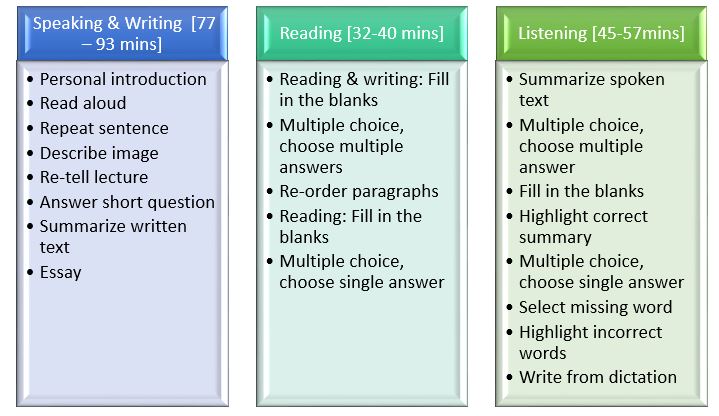
PTE Syllabus - All About You Need To Know

PTE Syllabus

It is important for candidates to understand the PTE Academic syllabus in order to appear for the exam. The PTE Academic is broadly divided into Speaking and Writing, Reading and Listening sections. Candidates can check out the detailed PTE Syllabus for each category below

Here is the detailed paper pattern

SectionDurationPTE Academic
Speaking & Writing77 – 93 minutesPersonal IntroductionRead AloudRepeat sentence Describe imageRe-tell lecture Answer short question Summarise written text (10 mins)Essay (20mins)
Reading32 – 41 minutesReading and Writing: Fill in the blanks Multiple choice, choose multiple answersRe-order paragraphsReading: Fill in the blanks Multiple choice, choose single answer A 10-minute break is optional
Listening45 – 57 minutesSummarise spoken text Multiple choice, choose multiple answers Fill the blanks Highlight the correct summaryMultiple choices, choose a single answer Select missing wordHighlight incorrect words Write from dictation

PTE Results and Score

PTE Academic Results are usually available online within five working days from the test date. The PTE Academic results are issued online. And can be accessed from your PTE Academic student account. First, you will receive an email within five working days with instructions on accessing the results online. After that, you need to follow the instructions to log in to your Pearson account.  You can share your results with the colleges and universities of your choice through your Pearson account.

PTE Academic Exam is scored on a scale of 10 – 90 where 10 is lowest, with increments of 1 point. Graded on the scale, the score showcase the person’s ability to read, speak, understand verbal instructions and write the English language. The scores are presented in a graph, giving an easy understanding of the candidate’s core skills in the language as well as improvement areas.

How to Access PTE Score

Candidates can access their PTE Academic scores via their online account. Candidates would receive an email notifying them about the availability of their scores. After receiving the notification, candidates would be required to log in to their Pearson VUE account that they created to book their tests and access their scores.

How to Send PTE Score Report?

Candidates who wish to send their score can do so via an online secure portal set up by PTE. Universities do not accept paper or PDF versions of PTE Academic score reports.

Steps to sending your PTE Score Report

  • Login to your account.
  • Click ‘View Score Reports’.
  • Click ‘Send Scores’.
  • Type the name of your chosen institution
  • Review your details then scroll down the page and click ‘Next’ and then ‘Next’ again to confirm

Rescoring the Score?

If candidates are unsatisfied with their PTE Score they can request a rescore. However, since the PTE Academic is a computer-scored test, the chance of an error is highly minimalized. Only spoken responses and open-ended written responses are rescored. Candidates can only request a rescore for their most recent PTE Academic Test and candidates are barred from requesting a rescore if they have already either scheduled another test or sent their score to an institution. In the event the score changes, the new score will replace the previous score and the original score report will be reissued to reflect the new score.

Who Accepts PTE Academic?

One of the most widely accepted exams, PTE Scores are accepted by some of the top universities and countries abroad. 

Colleges Accepting PTE

Candidates who have appeared for their PTE Academic Exam can choose from the huge number of colleges that accept PTE Scores.

  • MS Colleges Accepting PTE Academic scores
  • MBA Colleges Accepting PTE Academic scores

Countries Accepting PTE Score

Aspirants looking to pursue higher education in Australia, New Zealand, USA, UK, Canada, Ireland, Singapore, and Germany among many other countries are required to appear for the Pearson Test of English (PTE) Academic exam. One of the most widely accepted computer-based tests of English, PTE Academic is generally undertaken for studying abroad and immigration options. 

Eligibility Criteria

Before applying for Rajasthan PTET 2020, the candidates are required to follow some terms and conditions set by the governing authority. Check the eligibility criteria stated below.

For PTET Exam

  • Candidates with minimum 50% marks at the Bachelor‘s degree examination of any other University recognised as equivalent is eligible to apply for admission to B.Ed.
  • S.C., S.T., OBC, special backward classes as well as physically challenged and widow or divorcee women candidates of Rajasthan securing a minimum of 45% marks in aggregate in the Bachelors /Masters Degree level examination are eligible to apply for admission.

For Pre B.A. B.Ed/B.Sc B.Ed Exam 

  • Candidates who have passed 10+2 from any board/instituions with minimum 50% marks in case of general class are eligible to appear in Pre B.A. B.Ed/B.Sc B.Ed Exam.
  • Minimum 45% marks is required in case of S.C., S.T, OBC, special backward classes to appear in Pre B.A. B.Ed/B.Sc B.Ed Exam..

  NOTE : Out of the total number of applications who are eligible, the selection is first made against the reserved quota in proportion to the seats available in each faculty and if there are vacant seats the same will be transferred to the general category and is filled in from the merit list.

PTE Exam Preparation Tips

Often students start the preparation with either joining a coaching center or simply signing up for free practice tests. What a student forgets is that, like any exam, even language proficiency exams have to be dealt with a methodology. Here are a few study tips that would help you perform in the PTE Academic Exam. It is, however, important to note that no amount of tips, tricks or tools can outwit the dedication and efficiency of the practice. So, improve these skills and practice them over and over again to succeed.

What are the best PTE Books and Resources?

Candidates can prepare for their PTE Academic using a range of official course books. Candidates can choose from the below-mentioned study material to excel in their PTE test.

PTE Sample Paper

Practicing PTE Sample Papers are a good way to prepare for your upcoming PTE Academic Exam. Candidates are advised to solve multiple PTE Practice Papers for the benefit of the student. With the objective of enhancing your communication skills, the PTE Academic exam is designed to test your command over the English language. No high-level language proficiency is required to clear the exam, it rather checks your regular English communication, thereby helping you become expressive. Practicing each section separately with a relaxed and focused mind is advisable to fully absorb the subject matter and score well. 

What to expect on the test day?

Candidates are required to arrive at least 30 minutes before their test, to check-in and pass security. They should not forget to bring an acceptable ID, usually a passport for the smooth functioning of the exam formalities.

PTE Scholarships

With the availability of various Scholarships and education loans, students can finally make their dream come true. Scholarships are available on the official website of every college along with other fellowships and grants that are awarded to deserving students on a regular basis. Students can also opt for education loans from financial institutions for studying abroad.

PTE Results – Check PTE Academic Score here

After the completion of your PTE Academic exam, you will receive PTE Academic scores for each for the skill sections on a band range of 10 – 90. Along with that, you will also get an overall score. See the scoring pattern below to understand what does each range of score means – 

PTE Academic Score  Level Description 
Above 85 Can understand with ease virtually everything heard or read. Can summarize information from different spoken and written sources, reconstructing arguments and accounts in a coherent presentation. Can express him/herself spontaneously, very fluently and precisely, differentiating finer shades of meaning even in more complex situations.  
76 – 84 Can understand a wide range of demanding, longer texts and recognize implicit meaning. Can express him/herself fluently and spontaneously without much obvious searching for expressions. Can use language flexibly and effectively for social, academic and professional purposes. Can produce clear, well-structured, detailed text on complex subjects, showing controlled use of organizational patterns, connectors, and cohesive devices. 
59 – 75 Can understand the main ideas of complex text on both concrete and abstract topics, including technical discussions in his/her field of specialization. Can interact with a degree of oral fluency and spontaneity that makes regular interaction with native speakers quite possible without tendon. সহজ বাংলা: মাংসপেশি/টেনডনে টান।" data-rx-term="strain" data-rx-definition="A strain is injury to a muscle or tendon. সহজ বাংলা: মাংসপেশি/টেনডনে টান।">strain for either party. Can produce clear, detailed text on a wide range of subjects and explain a viewpoint on a topical issue giving the advantages and disadvantages of various options. 
51 – 58 Has sufficient command of the language to deal with most familiar situations, but will often require repetition and make many mistakes. Can deal with standard spoken language, but will have problems in noisy circumstances. Can exchange factual information on a familiar routine and non-routine matters within his/her field with some confidence. Can pass on a detailed piece of information reliably. Can understand the information content of the majority of recorded or broadcast material on topics of personal interest delivered in clear standard speech.  
43 – 58 Can understand the main points of clear standard input on familiar matters regularly encountered in work, school, leisure, etc. Can deal with most situations likely to arise whilst in an area where the language is spoken. Can produce simple connected text on topics, which are familiar or of personal interest. Can describe experiences and events, dreams, hopes, and ambitions and briefly give reasons and explanations for opinions and plans.  
30 – 42 Can understand sentences and frequently used expressions related to areas of most immediate relevance (e.g., very basic personal and family information, shopping, local geography, employment). Can communicate in simple and routine tasks requiring a simple and direct exchange of information on familiar and routine matters. Can describe in simple terms aspects of his/her background, immediate environment, and matters in areas of immediate need.  
10 – 29 Can understand and use familiar everyday expressions and very basic phrases aimed at the satisfaction of needs of a concrete type. Can introduce him/herself and others and can ask and answer questions about personal details such as where he/she lives, people he/she knows and things he/she has. Can interact in a simple way provided the other person talks slowly and clearly and is prepared to help.  

Countries that accept PTE scores

PTE is a popular English Proficiency test that is accepted in several countries and universities. The PTE exam score is considered for immigration and is also accepted for university admission purposes.

List of countries that accept PTE exam scores for immigration and admission purposes –

Argentina GreeceNetherlands
Austria Hungary New Zealand
AustraliaIndonesiaNigeria 
Belgium Iran Norway
BrazilIraq Oman
BulgariaIrelandPakistan
CanadaIsrael Philippines
ChinaItaly Poland
CyprusJapanRussia 
Czech Republic Jordan Singapore
DenmarkKoreaSlovenia
Egypt LatviaSomalia
EstoniaLithuaniaSouth Africa
Finland MalaysiaSpain
France USATaiwan
SwedenUK Thailand
SwitzerlandUAETurkey
VietnamUganda 
GermanyMalta 
Patient safety assistant

Check your symptom safely

Hi, I am RX Symptom Navigator. I can help you understand what to read next and what warning signs need care.
Warning: Do not use this in emergencies, pregnancy, severe illness, or as a substitute for a doctor. For children or teens, use with a parent/guardian and clinician.
A rural-friendly guide: warning signs, when to see a doctor, related articles, tests to discuss, and OTC safety education.
1 Symptom 2 Severity 3 Safe guidance
First safety question

Is there chest pain, breathing trouble, fainting, confusion, severe bleeding, stroke-like weakness, severe injury, or pregnancy danger sign?

Choose quickly

Browse by body area
Start here: Write or select a symptom. The guide will show warning signs, doctor guidance, diagnostic tests to discuss, OTC safety education, and related RX articles.

Important: This tool is educational only. It cannot diagnose, treat, or replace a doctor. OTC information is not a prescription. In an emergency, contact local emergency services or go to the nearest hospital.

Doctor visit helper

Prepare before seeing a doctor

A simple rural-patient checklist to help you explain symptoms clearly, ask better questions, and avoid unsafe self-treatment.

Safety note: This is not a prescription or diagnosis. For severe symptoms, pregnancy danger signs, children with serious illness, chest pain, breathing difficulty, stroke-like weakness, or major injury, seek urgent care.

Which doctor may help?

Start with a registered doctor or the nearest qualified health center.

What to tell the doctor

  • Write when the problem started and how it changed.
  • Bring old prescriptions, investigation reports, and current medicines.
  • Write allergies, pregnancy status, diabetes, kidney/liver disease, and major past illnesses.
  • Bring one family member if the patient is weak, elderly, confused, or a child.

Questions to ask

  • What is the most likely cause of my symptoms?
  • Which danger signs mean I should go to hospital quickly?
  • Which tests are necessary now, and which can wait?
  • How should I take medicines safely and what side effects should I watch for?
  • When should I come for follow-up?

Tests to discuss

  • Vital signs: temperature, pulse, blood pressure, oxygen saturation
  • Basic physical examination by a clinician
  • CBC, urine test, blood sugar, or imaging only when clinically needed

Avoid these mistakes

  • Do not use antibiotics, steroid tablets/injections, or strong painkillers without proper medical advice.
  • Do not hide pregnancy, kidney disease, ulcer, allergy, or blood thinner use.
  • Do not delay emergency care when danger signs are present.

Medicine safety and first-aid guide

This section is for patient education only. It does not replace a doctor, pharmacist, or emergency care.

Safe first steps

  • Avoid heavy lifting, sudden bending, and prolonged bed rest.
  • Use comfortable posture and gentle movement as tolerated.
  • Discuss physiotherapy, X-ray, or MRI only when clinically needed.

OTC medicine safety

  • For mild back pain, pain-relief medicine may be discussed with a doctor or pharmacist.
  • Avoid repeated painkiller use if you have kidney disease, stomach ulcer, uncontrolled blood pressure, or are taking blood thinners.

Avoid these mistakes

  • Do not start antibiotics without a proper medical decision.
  • Do not use steroid tablets or injections casually for quick relief.
  • Do not delay emergency care because of home remedies.

Get urgent help if

  • Back pain with leg weakness, numbness around private area, loss of urine/stool control, fever, cancer history, or major injury needs urgent care.
Medicine names, dose, and timing must be decided by a qualified clinician or pharmacist after checking age, pregnancy, allergy, other diseases, and current medicines.

For rural patients and family caregivers

Patient health record and symptom diary

Write your symptoms, medicines already taken, test results, and questions before visiting a doctor. This note stays on your device unless you print or copy it.

Doctor to discuss: Doctor / qualified healthcare provider
Tests to discuss with doctor
  • Basic vital signs: temperature, pulse, blood pressure, oxygen level if needed
  • Relevant blood, urine, imaging, or specialist tests only after clinical assessment
Questions to ask
  • What is the most likely cause of my symptoms?
  • Which warning signs mean I should go to emergency care?
  • Which tests are really needed now?
  • Which medicines are safe for my age, pregnancy status, allergy, kidney/liver/stomach condition, and current medicines?

Emergency warning signs such as chest pain, severe breathing difficulty, sudden weakness, confusion, severe dehydration, major injury, or loss of bladder/bowel control need urgent medical care. Do not wait for online information.

Safe pathway to proper treatment

Back pain care roadmap

Use this simple roadmap to understand the next safe steps. It is educational and does not replace examination by a doctor.

Go to emergency care if you notice:
  • New leg weakness, numbness around private area, or loss of bladder/bowel control
  • Back pain after major injury, fever, unexplained weight loss, cancer history, or severe night pain
Doctor / service to discuss: Orthopedic/spine specialist, physical medicine doctor, physiotherapist under guidance, or qualified clinician.
  1. Step 1

    Check danger signs first

    If danger signs are present, seek emergency care and do not wait for online information.

  2. Step 2

    Record the symptom story

    Write when symptoms started, severity, medicines already taken, allergies, pregnancy status, and test results.

  3. Step 3

    Visit a qualified clinician

    A doctor, nurse, or qualified healthcare provider can examine you and decide which tests or treatment are needed.

  4. Step 4

    Do only useful tests

    Discuss neurological examination first. X-ray or MRI may be needed only when red flags, injury, nerve weakness, or persistent severe symptoms are present.

  5. Step 5

    Follow up and return early if worse

    If symptoms worsen, new warning signs appear, or treatment is not helping, return for review quickly.

Rural patient practical tips
  • Take a written symptom diary and all previous prescriptions/test reports.
  • Do not hide medicines already taken, even herbal or over-the-counter medicines.
  • Ask which warning signs mean urgent referral to hospital.
  • Avoid forceful massage or bone-setting when there is weakness, injury, fever, or nerve symptoms.

This roadmap is for education. A real diagnosis and treatment plan requires history, examination, and clinical judgment.

RX Patient Help

Ask a health question safely

Write your symptom story. A health professional or site editor can review it before any answer is prepared. This box is not for emergency care.

Emergency first: Severe chest pain, breathing trouble, unconsciousness, stroke signs, severe injury, heavy bleeding, or rapidly worsening symptoms need urgent local medical care now.

Frequently Asked Questions

Highlights of PTE Exam PatternSection-wise PTE 2020 SyllabusThe Pearson Test of English (PTE Academic) assesses the written, spoken, skills of the candidates to ensure that they are capable of studying in the international environment, with a good grasp over the universal language of English. By scoring well in this test, students can assure the admission committee as well as the visa officers that they are capable of understanding the globally accepted official language while studying on the foreign land. A good score in the test also ensures that candidates would be able to represent their ideas, deliver presentations, work to gain international exposure, and basically function on the international front in front of foreign audiences. This helps the applicants ensure that they are ready to study amidst students from all over the world and international faculty members in the universal official language.As an English language test, PTE is no exception and has a similar kind of Exam Pattern like other English language tests. It focusses on the 3 major sections of the language proficiencyReading SectionListening SectionSpeaking and Writing Section The test goes this wayQuestion: Time to Reading the Text Prompt: The time duration of each prompt you get varies depending upon the length of the text. The length is measurable in words or sentences. You need to be active in this part.Prepare for Answer: Time granted to Relax and Think: You do not have to immediately answer the question. On average, you get 10 to 15 seconds to prepare for each segment. You should relax and think for a while on how to answer.Answer: Time for Action: This is the total time duration where you have to perform. The answers are recorded when you speak, saved as text when you write, and selected in options multiple-choice questions. Refer to the segment-wise description boxes given along with each section explaining the PTE Exam Pattern 2020 in detail:Speaking and WritingReadingListeningPTE Speaking and Writing Syllabus (77 to 93 minutes)As the name implies, this section tests the candidate’s on the basis of their 2 major skills of communication, which are spoken and written skills. This section comprises of six small sections that test you on your promptness over speaking and writing the written test that you would get to read for the first time ever. The complete section is given time duration of 77 to 93 minutes and the time allotted to each segment is as follows:Segments PatternTime DurationPersonal Introduction          55 seconds: 25 seconds for prompt, 30 seconds to recordRead Aloud30-40 seconds to prepare for reading out the text of 60 wordsRepeat Sentence15 seconds: 3-9 seconds for prompt, 15 seconds to recordDescribe Image25 seconds are granted to study the image as well as prepare your response on the sameRe-Tell Lecture90 seconds for prompt length, 10 seconds to prepare and 40 seconds to answerAnswer Short Question20 seconds: 3-9 seconds for prompt, 10 seconds to answerSummarize Written Text10 minutes to answer to text prompt of 300 wordsEssay20 minutes to answer to text prompt of 2-3 sentencesPTE Reading Syllabus (32 to 41 minutes)This section tests the candidates on the basis of their ability to understand the written instructions in the language. The section further divided into 5 segments is 32 to 41 minutes long. Check out the segment-wise pattern for time distribution of this section:Segments PatternTime Duration varies on the Length of the Text PromptMultiple Choice, Choose Single AnswerRead 300 words of textMultiple Choice, Choose Multiple AnswersRead 300 words of textRe-Order ParagraphsRead 150 words of textReading: Fill in the BlanksRead 80 words of textReading and Writing: Fill in the BlanksRead 300 words of textPTE Listening Syllabus (45 to 57 minutes)The listening section of the PTE Academic is stretched over 45 to 57 minutes of duration. This one is designed to determine the ability to understand spoken English by the candidate. Here, the student needs to ascertain that they carefully hear to the audio file played and retain what they heard. This section is divided into 8 segments and the time give to each segment is as follows.Segments PatternTime DurationSummarize Spoken Text60-90 seconds to retain  50-70 words, 10 minutes to writeMultiple Choice, Multiple Answer40-90 seconds for promptFill in the Blanks30-60 secondsHighlight Correct Summary30-90 secondsMultiple Choice, Single Answer30-60 secondsSelect Missing Word20-70 secondsHighlight Incorrect Words15-50 secondsWrite From Dictation3-5 secondsTypes of Questions Covered in the PTE SyllabusThe questions asked for the PTE Exam include the followingReading:Fill in the blanksMultiple choice answersRe-order paragraphs Listening:SummarizeMultiple choice answersFill in the blanksWrite from dictationHighlight incorrect words Speaking and Writing:Personal introductionAnswer short questionsRe-tell lectureSummarizeRead AloudRepeat sentenceDescribe ImageEssayPreparation tips for PTE ExamDesigned to verify the applicant’s English language skills, the standardized English language tests follow almost the same pattern. Hence, preparing for any one of these, you automatically are prepared for taking up any of the remaining two.PTE Exam Pattern 2020PTE General Exam PatternPTE General Exams are conducted in two categories: Speaking and Writing.The written test is further divided into Listening, Reading Comprehension and Writing. PTE General Exam scores are calculated based on 6 levels of assessment: A1, A2, B1, B2, C1, and C2 which are based on the CEFR (The Common European Framework of Reference) grading system.Individuals must acquire C1 or C2 level fluency to apply for being able to be accepted at universities or ministries abroad. However, not all universities accept PTE General as their entrance exam requirement as the scope of this exam is only limited to real-life communication. Also, the PTE General is not accepted for VISA purposes.Few universities and ministries of the further mentioned countries accept PTE General Score for their entrance exam requirement – Argentina, Mexico, Spain, Switzerland, Colombia, Czech Republic, Ecuador, UK, Estonia, Ukraine, Greece Vietnam, Italy, Latvia, Lithuania, and Poland.PTE Academic Exam PatternPTE Academic exam is divided into 3 categories namely Speaking & Writing, Reading and Listening.PTE Exam SectionDurationSpeaking and Writing77 to 93 minutesReading32 to 41 minutesListening45 to 57 minutesPTE Academic: Speaking and Writing (Part 1)Duration: 77 to 93 minutesPersonal Introduction: You will be given around 25 seconds to read a prompt and prepare an answer. Further 30 seconds are allotted for recording your answer. You can only record your answer once. Scores are not noted for this however, the examiner will examine your answer and send a report to your desired institution at the time of university application submission.Read Aloud: You have read the prompted sentence on the screen aloud and record the sentence as your answer within 35 seconds.Repeat Sentence: You will hear a sentence. You will have to repeat the prompted sentence to complete your answer.Describe Image: A graphical representation will be put up on your screen. You will have a few seconds to understand the image after which you have record your response by describing the image within 40 seconds.Re-Tell lecture: The examiner will play a segment of an interview. An image may also be a part of the question. You will have to interpret, understand and record your answer within 1 minute.Answer Short Question: You have to hear a recorded question and write down your answer is not more than one or a few words.Summarize Written Text:  Read the passage, write down a summary of the passage in not more than a sentence. The task is expected to be completed within 10 minutes. Cut, Copy and Paste option is available therefore select the words you would like use in your sentence and formulate your answer quickly.Essay: A brief paragraph is given for reference. Read the paragraph/s, understand it and compose an essay of 200 to 300 words. Cut, Copy, Paste is available.PTE Academic: Reading (Part 2)Duration: 32 to 41 minutesMultiple Choice, Single Answer: Read the passage and answer the question by choosing one of the four given options.Multiple Choice, Multiple Answer: Read the passage and answer the question by choosing two possible answers.Re-order Paragraphs: Read the paragraph and rephrase or re-order the structure of the sentences.Fill in the blanks: Read the paragraph and answer the question by placing the right option in the provided blanks.Reading & Writing Fill in the blanks: Read through the paragraph and choose the right answer for the blanks.PTE Academic: Listening (Part 3)Duration: 45 to 57 minutesSummarize Spoken Text: Listen to a segment of an interview or a recorded clip. Write down your answer by summarizing the concept of the recorded audio.Multiple Choice, Multiple Answer: Listen to the audio. Choose two appropriate or possible answers to the question.Fill in the blanks: Listen to the audio. Fill the blanks with your answer.Highlight Correct Summary: Listen to the audio. Choose one sentence that is most closely related.Multiple Choice, Single Answer: Listen to the audio. Choose one out of four options as your answer.Select Missing Word: Listen to the entire audio. Identify the missing word and choose the correct answer from the given options.Highlight Incorrect Words:  Listen to the audio. Read the paragraph or passage and identify the wrong words or incorrect words and replace them with correct words or right words.Write from Dictation: Listen to the audio. Write your answer by determining the concept of the audio.PTE 2020 RegistrationFor booking PTE Academic online, you need a valid ID, generally a passport. Candidates are also required to show that ID on the day of the exam else they will not be allowed to enter the PTE Test centerSteps to register PTE Academic onlineVisit the official PTE Academic website.Create your Pearson account by giving your personal details.Once you complete the registration process, you will receive an email within 48 hours from Pearson with your login details.The next step is to search for your nearest test center.Also select a suitable time and date.After selecting all your details like time, date, and slot you will be asked to proceed to the checkout button.Then make payment and finalize your booking.Other methods of registering for PTEApart from the much preferred online method of registering for the PTE exam, candidates can also register for the PTE Exam via phone. Indian students wanting to register for the PTE Exam can contact the PTE Academic testing body by dialing: 00080 0440 2020. (Operating hours: Monday to Friday 9:00 am - 6:00 pm local time; closed on local holidays.)Know all about PTE Slot BookingCandidates looking to appear for their PTE Academic exam would be required to create a Pearson account to register for their PTE Academic Slot Booking. On successful registration, candidates would receive an email within 48 hours with their login credentials. Candidates are required to read the handbook carefully available on the official website before booking the exam. PTE Exam Dates 2020The exam is conducted throughout the year at the designated Test Centers across the country. These dates might vary from center to center. Students must search for the seats available on the Pearson PTE Academic website. Simply select the test centers closest to you, and click next. The website would prompt you to the calendar with the available dates.PTE Exam CentresHere is a list of PTE Academic Exam test centers for candidates looking to appear for their next PTE Academic Exam. Candidates are reminded to choose the exam test center that is most convenient for them to be able to perform their best on the day of the exam.PTE Test Accommodations/ Special ArrangementsCommitted to providing access for all individuals with disabilities, test accommodations also known as “special arrangements” or “reasonable adjustments" are made available by Pearson VUE to make the test assessable to everyone. Arrangements made possible include,A separate testing roomExtra testing timeA Reader or RecorderHow do I request a test accommodation?Candidates who require special arrangements need to specify their needs and how the disability is hindering them from performing their best under standard conditions. Candidates would have to provide documentation proof and apply weeks in advance for the conducting body to make the required arrangements. Candidates are required to apply for the request before they book their exam.PTE Exam PatternPTE Academic Syllabus includes three sections - Speaking & Writing, Reading, and Listening. You get marked on these three sections and you get the PTE Academic total score as well. The PTE Exam Pattern mentioned below talks about the components of the PTE Academic Paper in detail for the benefit of the candidate. Candidates looking to appear for their PTE Academic Exam can check out the PTE Exam Pattern mentioned below. PTE SyllabusIt is important for candidates to understand the PTE Academic syllabus in order to appear for the exam. The PTE Academic is broadly divided into Speaking and Writing, Reading and Listening sections. Candidates can check out the detailed PTE Syllabus for each category belowHere is the detailed paper patternSectionDurationPTE AcademicSpeaking & Writing77 – 93 minutesPersonal IntroductionRead AloudRepeat sentence Describe imageRe-tell lecture Answer short question Summarise written text (10 mins)Essay (20mins)Reading32 – 41 minutesReading and Writing: Fill in the blanks Multiple choice, choose multiple answersRe-order paragraphsReading: Fill in the blanks Multiple choice, choose single answer A 10-minute break is optionalListening45 – 57 minutesSummarise spoken text Multiple choice, choose multiple answers Fill the blanks Highlight the correct summaryMultiple choices, choose a single answer Select missing wordHighlight incorrect words Write from dictationPTE Results and ScorePTE Academic Results are usually available online within five working days from the test date. The PTE Academic results are issued online. And can be accessed from your PTE Academic student account. First, you will receive an email within five working days with instructions on accessing the results online. After that, you need to follow the instructions to log in to your Pearson account.  You can share your results with the colleges and universities of your choice through your Pearson account.PTE Academic Exam is scored on a scale of 10 – 90 where 10 is lowest, with increments of 1 point. Graded on the scale, the score showcase the person’s ability to read, speak, understand verbal instructions and write the English language. The scores are presented in a graph, giving an easy understanding of the candidate’s core skills in the language as well as improvement areas.How to Access PTE ScoreCandidates can access their PTE Academic scores via their online account. Candidates would receive an email notifying them about the availability of their scores. After receiving the notification, candidates would be required to log in to their Pearson VUE account that they created to book their tests and access their scores.How to Send PTE Score Report?

Candidates who wish to send their score can do so via an online secure portal set up by PTE. Universities do not accept paper or PDF versions of PTE Academic score reports. Steps to sending your PTE Score Report Login to your account.Click 'View Score Reports'.Click 'Send Scores'.Type the name of your chosen institutionReview your details then scroll down the page and click 'Next' and then 'Next' again to confirm

Rescoring the Score?

If candidates are unsatisfied with their PTE Score they can request a rescore. However, since the PTE Academic is a computer-scored test, the chance of an error is highly minimalized. Only spoken responses and open-ended written responses are rescored. Candidates can only request a rescore for their most recent PTE Academic Test and candidates are barred from requesting a rescore if they have already either scheduled another test or sent their score to an institution. In the event the score…

Who Accepts PTE Academic?

One of the most widely accepted exams, PTE Scores are accepted by some of the top universities and countries abroad. 

Colleges Accepting PTECandidates who have appeared for their PTE Academic Exam can choose from the huge number of colleges that accept PTE Scores.MS Colleges Accepting PTE Academic scoresMBA Colleges Accepting PTE Academic scoresCountries Accepting PTE ScoreAspirants looking to pursue higher education in Australia, New Zealand, USA, UK, Canada, Ireland, Singapore, and Germany among many other countries are required to appear for the Pearson Test of English (PTE) Academic exam. One of the most widely accepted computer-based tests of English, PTE Academic is generally undertaken for studying abroad and immigration options. Eligibility CriteriaBefore applying for Rajasthan PTET 2020, the candidates are required to follow some terms and conditions set by the governing authority. Check the eligibility criteria stated below.For PTET ExamCandidates with minimum 50% marks at the Bachelor‘s degree examination of any other University recognised as equivalent is eligible to apply for admission to B.Ed.S.C., S.T., OBC, special backward classes as well as physically challenged and widow or divorcee women candidates of Rajasthan securing a minimum of 45% marks in aggregate in the Bachelors /Masters Degree level examination are eligible to apply for admission.For Pre B.A. B.Ed/B.Sc B.Ed Exam Candidates who have passed 10+2 from any board/instituions with minimum 50% marks in case of general class are eligible to appear in Pre B.A. B.Ed/B.Sc B.Ed Exam.Minimum 45% marks is required in case of S.C., S.T, OBC, special backward classes to appear in Pre B.A. B.Ed/B.Sc B.Ed Exam..  NOTE : Out of the total number of applications who are eligible, the selection is first made against the reserved quota in proportion to the seats available in each faculty and if there are vacant seats the same will be transferred to the general category and is filled in from the merit list.PTE Exam Preparation TipsOften students start the preparation with either joining a coaching center or simply signing up for free practice tests. What a student forgets is that, like any exam, even language proficiency exams have to be dealt with a methodology. Here are a few study tips that would help you perform in the PTE Academic Exam. It is, however, important to note that no amount of tips, tricks or tools can outwit the dedication and efficiency of the practice. So, improve these skills and practice them over and over again to succeed.What are the best PTE Books and Resources?

Candidates can prepare for their PTE Academic using a range of official course books. Candidates can choose from the below-mentioned study material to excel in their PTE test.

PTE Sample PaperPracticing PTE Sample Papers are a good way to prepare for your upcoming PTE Academic Exam. Candidates are advised to solve multiple PTE Practice Papers for the benefit of the student. With the objective of enhancing your communication skills, the PTE Academic exam is designed to test your command over the English language. No high-level language proficiency is required to clear the exam, it rather checks your regular English communication, thereby helping you become expressive. Practicing each section separately with a relaxed and focused mind is advisable to fully absorb the subject matter and score well. What to expect on the test day?

Candidates are required to arrive at least 30 minutes before their test, to check-in and pass security. They should not forget to bring an acceptable ID, usually a passport for the smooth functioning of the exam formalities.

References

Add references, clinical guidelines, textbooks, journal articles, or trusted medical sources here. You can edit this area from the RX Article Professional Blocks panel.
