
RX Patient Tools
Use these quick guides before reading the article, or return to them when you need help preparing questions for a doctor.
Ankle Muscle/Foot Muscle/The foot is an intricate structure of 26 bones, 33 joints, multiple muscles, tendons, ligaments, blood vessels, nerves, and lymphatics. The bones form two crossing arches of the foot. The muscles acting on the foot can be divided into two distinct groups; extrinsic and intrinsic muscles. The extrinsic muscles arise from the anterior, posterior, and lateral compartments of the leg. They are mainly responsible for actions such as eversion, inversion, plantarflexion, and dorsiflexion of the foot.
The longitudinal arch runs the length of the foot, and the transverse arch runs the width. The ankle joint is formed by the interaction of the foot and the lower leg, and the toes are on the far side of the foot. The bones of the foot are primarily held together by their fit with each other forming joints surrounded by joint capsules and connected by fibrous tissues known as ligaments. The muscles of the foot, along with a tough, sinewy tissue known as the plantar fascia, provide secondary support to the foot and the longitudinal arch. The foot has internal muscles that originate and insert in the foot and external muscles that begin in the lower leg and attach in various places on the bones of the foot. There are also fat pads in the foot to help with weight-bearing and absorbing impact.
Ankle Muscle – Origin, Insertion, Nerve Supply, Functions
To simplify the organization of the muscles, the following will break them up into those that act upon the foot and ankle and those classified as intrinsic.[rx][rx][rx]
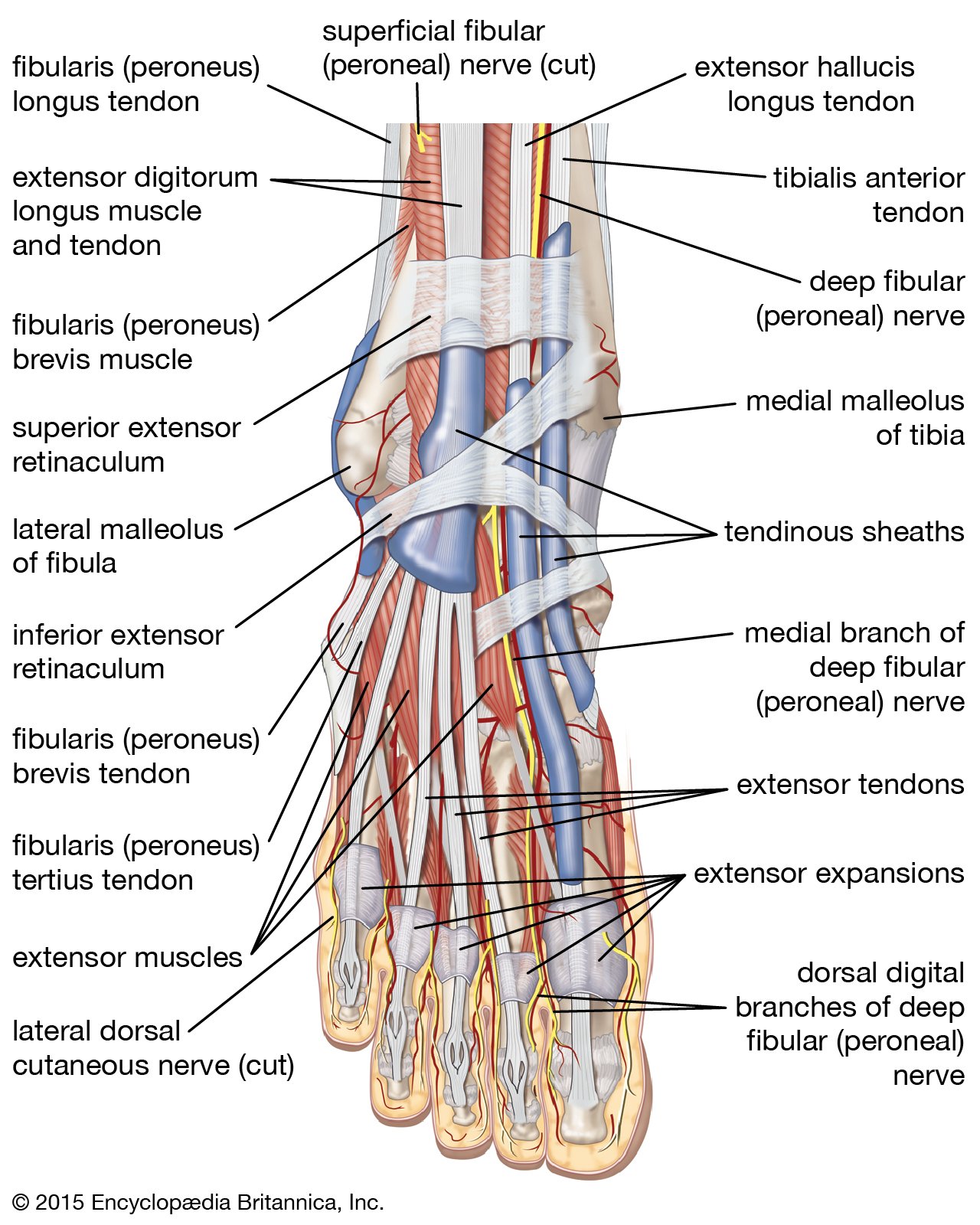
Foot Muscle – Origin, Insertion, Nerve Supply, Functions
BICEPS FEMORIS LONG HEAD
-
Origin: Common (conjoint) tendon from the superior medial quadrant of the posterior ischial tuberosity (with semitendinosus)
-
Insertion: Majority onto the fibular head; also the lateral collateral ligament of the knee and lateral tibial condyle
-
Action: Flexion of the knee, and lateral rotation of the tibia; extension of the hip joint
-
Innervation: Tibial nerve (a portion of the sciatic nerve)
-
Arterial Supply: Perforating (muscular) branches of profunda femoris artery, inferior gluteal artery, and the superior muscular branches of the popliteal artery
BICEPS FEMORIS SHORT HEAD
-
Origin: Lateral lip of linea aspera, the lateral intermuscular septum of the thigh, and lateral supracondylar ridge of femur
-
Insertion: Majority on the fibular head; and lateral collateral ligament of the knee, and lateral tibial condyle
-
Action: Flexion of the knee, and lateral rotation of the tibia
-
Innervation: Common peroneal nerve (a portion of the sciatic nerve)
-
Arterial Supply: Perforating (muscular) branches of profunda femoris artery, inferior gluteal artery, and the superior muscular branches of the popliteal artery
SEMIMEMBRANOSUS
-
Origin: Superior lateral aspect of the ischial tuberosity
-
Insertion: The posterior surface of the medial tibial condyle
-
Action: Extension of the hip, flexion of the knee, and medial rotation of the tibia (specifically with knee flexion)
-
Innervation: Tibial nerve (a portion of the sciatic nerve)
-
Arterial Supply: Perforating (muscular) branches of profunda femoris artery, inferior gluteal artery, and the superior muscular branches of the popliteal artery
SEMITENDINOSUS
-
Origin: The common (conjoint) tendon from the superior medial quadrant of the posterior ischial tuberosity (with biceps femoris long head)
-
Insertion: Superior aspect of the medial tibial shaft (into the distal portion of the pes anserinus along with the gracilus and sartorius muscles)
-
Action: Extension of the hip and flexion of the knee, medial rotation of the tibia (specifically with knee flexion)
-
Innervation: Tibial nerve (a portion of the sciatic nerve)
-
Arterial Supply: Perforating (muscular) branches of profunda femoris artery, inferior gluteal artery, and the superior muscular branches of the popliteal artery
Biceps Femoris: Short Head
-
Origin: Lateral lip of the linea aspera
-
Insertion: The fibular head and lateral condyle of the tibia
-
Function: Knee flexion and lateral rotation of the tibia
-
Innervation: Fibular (common peroneal) nerve
-
Vascular supply: Perforating branches of the deep femoral artery
Biceps Femoris: Long Head
-
Origin: Ischial tuberosity
-
Insertion: The fibular head and lateral condyle of the tibia
-
Function: Knee flexion, lateral rotation of the tibia, and hip extension
-
Innervation: Tibial nerve
-
Vascular supply: Perforating branches of the deep femoral artery
Semitendinosus
-
Origin: Lower, medial surface of the ischial tuberosity
-
Insertion: Medial tibia (pes anserinus)
-
Function: Knee flexion, hip extension and medial rotation of the tibia (with knee flexion)
-
Innervation: Tibial nerve
-
Vascular supply: Perforating branches of the deep femoral artery
Semimembranosus
-
Origin: Ischial tuberosity
-
Insertion: Medial tibial condyle
-
Function: Knee flexion, hip extension and medial rotation of the tibia (with knee flexion)
-
Innervation: Tibial nerve
-
Vascular supply: Perforating branches of the deep femoral artery
Foot and Ankle
Peroneus Longus
-
The peroneus longus is one of the three muscles that span the lateral leg – peroneus may also be interchanged with fibular, referring to the lateral bone of the lower leg running deep to the peroneal muscles
-
Origin: The peroneus longus muscle originates on the head of the fibula and the upper half of the fibular shaft – this muscle crosses the ankle joint and courses deep into the foot and passes into a groove of the cuboid bone.
-
Insertion: the posterolateral aspect of the medial cuneiform bone and the lateral portion of the base of the first metatarsal
-
Action: The peroneus longus acts to evert the foot, plantarflex the ankle and adds support to the transverse arch of the foot
-
Blood Supply: Anterior tibial artery
-
Innervation: Superficial peroneal nerve
Peroneus Brevis
-
The peroneus brevis is another of the three muscles spanning the lateral leg and may also be called fibularis brevis, referring to the fibula
-
Origin: The peroneus brevis originates on the inferior two-thirds of the lateral fibula and courses posteriorly to the lateral malleolus of the fibula ultimately
-
Insertion: The styloid process of the fifth metatarsal
-
Action: The primary action of the peroneus brevis is to evert the foot and plantar flex the ankle
-
Blood Supply: Peroneal artery
-
Innervation: The superficial peroneal nerve innervates the peroneus brevis muscle
Peroneus Tertius
-
The peroneus tertius is the third and final muscle of the lateral peroneus or fibular muscles
-
Origin: The peroneus tertius originates from the middle fibular shaft
-
Insertion: The dorsal surface of the fifth metatarsal
-
Action: Dorsiflex, evert, and abduct the foot
-
Blood Supply: The peroneus tertius primarily receives its blood supply from the anterior tibial artery
-
Innervation: Peroneus tertius innervation comes from the deep peroneal nerve, an innervation different than its similarly named peroneal counterparts
Anterior Tibialis
-
The anterior tibialis is the most prominent muscle in the anterior leg and is often visible during dorsiflexion of the foot
-
Origin: The lateral condyle of the tibia and the proximal half to two-thirds of the tibial shaft.
-
Insertion: Occurs after passing under the extensor retinaculum and is on the medial and plantar surfaces of the medial cuneiform and base of the 1st metatarsal.
-
Action: Dorsiflex the ankle and invert the hindfoot
-
Blood Supply: Anterior tibial artery
-
Innervation: Comes from the deep peroneal nerve
Posterior Tibialis
-
Origin: The superior two-thirds of the medial posterior surface of the tibia
-
Insertion: The tendon courses distally, splitting into two at the calcaneonavicular ligament, to insert on the tuberosity of the navicular bone (superficial slip) and the plantar surfaces of the metatarsals two to four (deep slip)
-
Action: The posterior tibialis is the primary inverter of the foot but also adducts, plantar flexes, and aides in supination of the foot
-
Blood Supply: Sural, peroneal, and posterior tibial arteries
-
Innervation: Tibial nerve
Extensor Digitorum Longus
-
Origin: Lateral tibial condyle and continues distally to split into four tendons after the level of the extensor retinaculum
-
Insertion: Dorsum of the middle and distal phalanges
-
Action: Extend the second through fifth digits and dorsiflex the ankle
-
Blood Supply: anterior tibial artery
-
Innervation: deep peroneal nerve
Flexor Digitorum Longus
-
Origin: Posterior surface of the tibia distal to the popliteal line
-
Insertion: Continues distally to split into four individual tendons which insert on the plantar surfaces of the bases of the second through fifth distal phalanges
-
Action: Flex the digits two through five and may aid in plantar flexion of the ankle
-
Blood Supply: Posterior tibial artery
-
Innervation: Tibial nerve
Flexor Hallucis Longus
-
Origin: inferior two-thirds of the posterior fibula
-
Insertion: The plantar surface of the base of the distal phalanx of the great toe
-
Action: Flex the great toe but may minimally supinate and plantar flex the ankle
-
Blood Supply: Peroneal and posterior tibial artery
-
Innervation: Tibial nerve
Gastrocnemius
-
The gastrocnemius is the most superficial calf muscle
-
Origin: femoral condyles
-
Insertion: thick Achilles tendon inserting on the calcaneus.
-
Action: Plantarflex the ankle.
-
Blood Supply: Sural branch of the popliteal artery
-
Innervation: Tibial nerve
Soleus
-
The soleus is the deep muscle of the posterior leg and makes up most of the bulk of the calf
-
Origin: Upper quarter of the posterior fibula and the middle third of the posterior tibial shaft
-
Insertion: The soleus eventually joins the gastrocnemius to for the Achilles tendon to insert on the calcaneus
-
Action: The action is to plantarflex the ankle
-
Blood Supply: Posterior tibial, peroneal, and sural arteries
-
Innervation: Tibial nerve
Intrinsic
Extensor Digitorum Brevis
-
Origin: Dorsal surface of the calcaneus
-
Insertion: The base of the proximal phalanx of digits two through four
-
Action: Extend the toes
-
Blood Supply: Dorsalis pedis
-
Innervation: Deep peroneal nerve
Dorsal Interosseus
-
The dorsal interossei muscles (3) exist between digits two through five – the two adjacent muscles form a central tendon and act to abduct the metatarsal-phalangeal joints and innervation comes from the lateral plantar nerve
Extensor Hallucis Brevis
-
Origin: Dorsal surface of the calcaneus
-
Insertion: The base of the proximal phalanx of the great toe
-
Action: Extend the great toe
-
Blood Supply: Dorsalis pedis.
-
Innervation: Deep peroneal nerve
Plantar/1st layer
Abductor Hallucis
-
Origin: Calcaneal tuberosity
-
Insertion: Base of the great toe and the proximal phalanx.
-
Action: Abduct the great toe
-
Blood Supply: Medial plantar artery
-
Innervation: Medial plantar nerve
Flexor Digitorum Brevis
-
Origin: Calcaneal tuberosity
-
Insertion: The middle phalanx of digits two thorugh five
-
Action: Flex the digits two through five
-
Blood Supply: Medial plantar artery
-
Innervation: Medial plantar nerve
Abductor Digiti Minimi
-
Origin: Calcaneal tuberosity
-
Insertion: Base of the fifth metatarsal
-
Action: Abduct the 5th digit
-
Blood Supply: Lateral plantar artery
-
Innervation: Lateral plantar nerve lateral plantar artery
2nd Layer
Quadratus Plantae
-
Origin: Plantar surface of the calcaneus
-
Insertion: Flexor digitorum longus tendon
-
Action: Help flex the distal phalanges
-
Blood Supply: Lateral plantar artery
-
Innervation: Llateral plantar nerve
Lumbricals
-
There are four muscles referred to as lumbricals in the foot
-
Origin: Flexor digitorum longus tendon
-
Insertion: Extensor digitorum longus tendon
-
Action: Flex the metatarsophalangeal joints and extend the interphalangeal joints
-
Blood Supply: Medial and lateral plantar arteries
-
Innervation: Medial and lateral plantar nerve
3rd layer
Flexor Hallucis Brevis
-
Origin: The cuboid and the lateral cuneiform
-
Insertion: Proximal phalanx of the great toe
-
Action: Flex the great toe
-
Blood Supply: Medial plantar artery
-
Innervation: Medial plantar nerve
Oblique and Transverse Head of Adductor Hallucis
-
The adductor hallucis has two heads, an oblique head, and a transverse head
-
Origin: The oblique head originates at the proximal ends of the metatarsals two thourgh four, and the transverse head originates via MTP ligaments of digits three through five
-
Insertion: inserts at the proximal phalanx of the great toe
-
Action: The primary action is to adduct the great toe
-
Blood Supply: First plantar metatarsal artery
-
Innervation: Deep branch of lateral plantar
Flexor Digiti Minimi Brevis
-
Origin: Base of the fifth metatarsal
-
Insertion: Proximal phalanx of the fifth metatarsal
-
Action: The primary action is to flex the fifth digit
-
Blood Supply: Lateral Plantar artery
-
Innervation: Lateral plantar nerve
4th layer
Plantar Interosseous
-
The plantar interossei (3)
-
Origin: medial aspect of the individual metatarsals of digits three through five
-
Insertion: The proximal phalanges
-
Action: Adduct the digits
-
Blood Supply: Plantar metatarsal artery
-
Innervation: Lateral plantar nerve
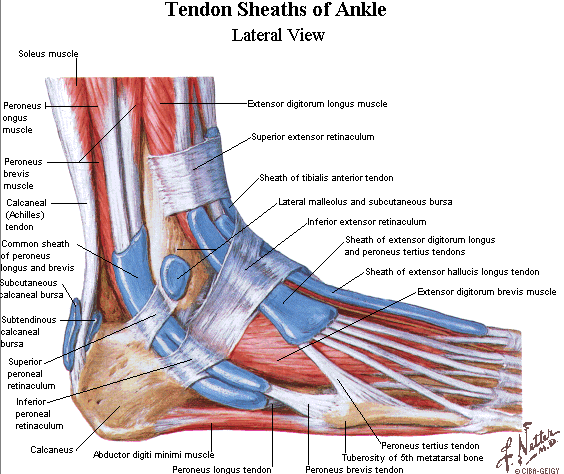
Blood Supply and Lymphatics of Lower Leg Muscle
The main arterial supply to the lower extremity is provided by the femoral artery. A continuation of the external iliac artery, the common femoral artery enters the thigh passing deep to the inguinal ligament. Once in the thigh, the femoral artery gives off the following branches:[rx]
-
The medial femoral circumflex artery
- The lateral femoral circumflex artery
- Femoral profunda (deep artery of the thigh) artery
-
Medial and Lateral femoral circumflex branches
-
The medial femoral circumflex artery is the predominant blood supply to the head (via the lateral epiphyseal artery)
-
-
First, second, and third perforating branches
-
Supply the medial thigh muscles
-
-
-
Superficial femoral artery
References
- https://www.ncbi.nlm.nih.gov/books/NBK534775/
- https://www.ncbi.nlm.nih.gov/books/NBK500008/
- https://www.ncbi.nlm.nih.gov/books/NBK538193/
- https://www.ncbi.nlm.nih.gov/books/NBK542215/
- https://www.ncbi.nlm.nih.gov/books/NBK513334/
- https://www.ncbi.nlm.nih.gov/books/NBK539705/
- https://www.ncbi.nlm.nih.gov/books/NBK535418/
- https://www.ncbi.nlm.nih.gov/books/NBK546688/
- https://www.ncbi.nlm.nih.gov/books/NBK537097/
- https://www.ncbi.nlm.nih.gov/books/NBK518984/
- https://www.ncbi.nlm.nih.gov/books/NBK532946/
- https://www.ncbi.nlm.nih.gov/books/NBK526084/
- https://www.ncbi.nlm.nih.gov/books/NBK541086/
- https://en.wikipedia.org/wiki/Sole_(foot)
- https://en.wikipedia.org/wiki/Foot

