
Smooth muscle is a type of muscle tissue that is used by various systems to apply pressure to vessels and organs. Smooth muscle is composed of sheets or strands of smooth muscle cells. These cells have fibers of actin and myosin which run through the cell and are supported by a framework of other proteins.
Smooth muscle cells (myocytes) are found in the walls of hollow organs, including the stomach, intestines, urinary bladder and uterus, and in the walls of passageways, such as the arteries and veins of the circulatory system, and the tracts of the respiratory, urinary, and reproductive systems. In the eyes, the ciliary muscle, a type of smooth muscle, dilate and contract the iris and alter the shape of the lens. In the skin, smooth muscle cells cause hair to stand erect in response to cold temperature or fear.[1]
Skeletal Muscle Fibers
Skeletal muscles are composed of striated subunits called sarcomeres, which are composed of the myofilaments actin and myosin.
Key Points
Muscles are composed of long bundles of myocytes or muscle fibers.
Myocytes contain thousands of myofibrils.
Each myofibril is composed of numerous sarcomeres, the functional contracile region of a striated muscle. Sarcomeres are composed of myofilaments of myosin and actin, which interact using the sliding filament model and cross-bridge cycle to contract.
Key Terms
sarcoplasm: The cytoplasm of a myocyte.
sarcoplasmic reticulum: The equivalent of the smooth endoplasmic reticulum in a myocyte.
sarcolemma: The cell membrane of a myocyte.
sarcomere: The functional contractile unit of the myofibril of a striated muscle.
Skeletal Muscle Fiber Structure
Myocytes, sometimes called muscle fibers, form the bulk of muscle tissue. They are bound together by perimysium, a sheath of connective tissue, into bundles called fascicles, which are in turn bundled together to form muscle tissue. Myocytes contain numerous specialized cellular structures which facilitate their contraction and therefore that of the muscle as a whole.
The highly specialized structure of myocytes has led to the creation of terminology which differentiates them from generic animal cells.
- Generic cell > Myocyte
- Cytoplasm > Sarcoplasm
- Cell membrane > Sarcolemma
- Smooth endoplasmic reticulum > Sarcoplasmic reticulum
Myocyte Structure
Myocytes can be incredibly large, with diameters of up to 100 micrometers and lengths of up to 30 centimeters. The sarcoplasm is rich with glycogen and myoglobin, which store the glucose and oxygen required for energy generation, and is almost completely filled with myofibrils, the long fibers composed of myofilaments that facilitate muscle contraction.
The sarcolemma of myocytes contains numerous invaginations (pits) called transverse tubules which are usually perpendicular to the length of the myocyte. Transverse tubules play an important role in supplying the myocyte with Ca+ ions, which are key for muscle contraction.
Each myocyte contains multiple nuclei due to their derivation from multiple myoblasts, progenitor cells that give rise to myocytes. These myoblasts asre located to the periphery of the myocyte and flattened so as not to impact myocyte contraction.

Myocyte: Skeletal muscle cell: A skeletal muscle cell is surrounded by a plasma membrane called the sarcolemma with a cytoplasm called the sarcoplasm. A muscle fiber is composed of many myofibrils, packaged into orderly units.
Myofibril Structure
Each myocyte can contain many thousands of myofibrils. Myofibrils run parallel to the myocyte and typically run for its entire length, attaching to the sarcolemma at either end. Each myofibril is surrounded by the sarcoplasmic reticulum, which is closely associated with the transverse tubules. The sarcoplasmic reticulum acts as a sink of Ca+ ions, which are released upon signalling from the transverse tubules.
Sarcomeres
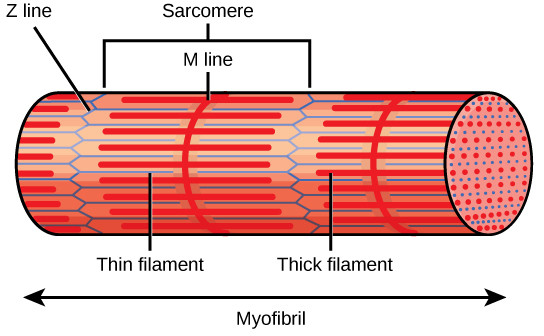
Sarcomere: The sarcomere is the functional contractile region of the myocyte, and defines the region of interaction between a set of thick and thin filaments.
Myofibrils are composed of long myofilaments of actin, myosin, and other associated proteins. These proteins are organized into regions termed sarcomeres, the functional contractile region of the myocyte. Within the sarcomere actin and myosin, myofilaments are interlaced with each other and slide over each other via the sliding filament model of contraction. The regular organization of these sarcomeres gives skeletal and cardiac muscle their distinctive striated appearance.
Myofilaments (Thick and Thin Filaments)
Myofibrils are composed of smaller structures called myofilaments. There are two main types of myofilaments: thick filaments and thin filaments. Thick filaments are composed primarily of myosin proteins, the tails of which bind together leaving the heads exposed to the interlaced thin filaments. Thin filaments are composed of actin, tropomyosin, and troponin. The molecular model of contraction which describes the interaction between actin and myosin myofilaments is called the cross-bridge cycle.
Contractile Myofilament
The structure of the smooth muscle actomyosin array is similar to striated muscle with several important differences:
-
there is no troponin complex in smooth muscle
-
contraction is regulated by Ca2+ calmodulin-dependent myosin light chain kinase (MLCK) mediated phosphorylation of the regulatory light chains of myosin, which enables actin-myosin interaction and cross-bridge cycling
-
in the absence of Ca2+ and calmodulin (CaM), caldesmon interacts with actomyosin inhibiting the activity of myosin ATPase
-
the activity of myosin light chain phosphatase (MLCP) directly causes the dephosphorylation of myosin LC20 leading to the relaxation
-
the actin: myosin ratio is higher in smooth muscle averaging 15:1 in vascular smooth muscle in comparison to 6:1 in skeletal or cardiac muscle. There are no intercalated disks or z-disks, however, dense bodies in smooth muscle are thought to be analogous to z-disks
Molecular structure
A substantial portion of the volume of the cytoplasm of smooth muscle cells are taken up by the molecules myosin and actin,[rx] which together have the capability to contract, and, through a chain of tensile structures, make the entire smooth muscle tissue contract with them.
Myosin
Myosin is primarily class II in smooth muscle.[rx]
- Myosin II contains two heavy chains (MHC) which constitute the head and tail domains. Each of these heavy chains contains the N-terminal head domain, while the C-terminal tails take on a coiled-coil morphology, holding the two heavy chains together (imagine two snakes wrapped around each other, such as in a caduceus). Thus, myosin II has two heads. In smooth muscle, there is a single gene (MYH11[rx]) that codes for the heavy chains myosin II, but there are splice variants of this gene that result in four distinct isoforms.[rx] Also, smooth muscle may contain MHC that is not involved in contraction, and that can arise from multiple genes.[rx]
- Myosin II also contains 4 light chains (MLC), resulting in 2 per head, weighing 20 (MLC20) and 17 (MLC17) kDa.[rx] These bind the heavy chains in the “neck” region between the head and tail.
- The MLC20 is also known as the regulatory light chain and actively participates in muscle contraction.[rx] Two MLC20 isoforms are found in smooth muscle, and they are encoded by different genes, but only one isoform participates in contraction.
- The MLC17 is also known as the essential light chain. Its exact function is unclear, but it’s believed that it contributes to the structural stability of the myosin head along with MLC20.[rx] Two variants of MLC17 (MLC17a/b) exist as a result of alternative splicing at the MLC17 gene.[rx]
Different combinations of heavy and light chains allow for up to hundreds of different types of myosin structures, but it is unlikely that more than a few such combinations are actually used or permitted within a specific smooth muscle bed.[rx] In the uterus, a shift in myosin expression has been hypothesized to avail for changes in the directions of uterine contractions that are seen during the menstrual cycle.[rx]
Actin
The thin filaments that are part of the contractile machinery are predominantly composed of α- and γ-actin.[rx] Smooth muscle α-actin (alpha-actin) is the predominant isoform within the smooth muscle. There is also a lot of actin (mainly β-actin) that does not take part in contraction, but that polymerizes just below the plasma membrane in the presence of a contractile stimulant and may thereby assist in mechanical tension.[rx] Alpha actin is also expressed as distinct genetic isoforms such as smooth muscle, cardiac muscle, and skeletal muscle-specific isoforms of alpha-actin.[rx]
The ratio of actin to myosin is between 2:1[rx] and 10:1[rx] in smooth muscle. Conversely, from a mass ratio standpoint (as opposed to a molar ratio), myosin is the dominant protein in striated skeletal muscle with the actin to myosin ratio falling in the 1:2 to 1:3 range. A typical value for healthy young adults is 1:2.2.
Other proteins of the contractile apparatus
Smooth muscle does not contain the protein troponin; instead, calmodulin (which takes on the regulatory role in smooth muscle), caldesmon, and calponin are significant proteins expressed within the smooth muscle.
- Tropomyosin is present in smooth muscle, spanning seven actin monomers, and is laid out end to end over the entire length of the thin filaments. In striated muscle, tropomyosin serves to block actin-myosin interactions until calcium is present, but in smooth muscle, its function is unknown. [rx]
- Calponin molecules may exist in equal numbers as actin and have been proposed to be a load-bearing protein.[rx]
- Caldesmon has been suggested to be involved in tethering actin, myosin, and tropomyosin, and thereby enhance the ability of a smooth muscle to maintain tension.[rx]
Organ Systems Involved
Smooth muscle is present in all of the organ systems below:
-
Gastrointestinal tract
-
Cardiovascular – blood vessel and lymphatic vessels
-
Renal – urinary bladder
-
Genital – uterus, both male and female reproductive tracts
-
Respiratory tract
-
Integument – erector pili of the skin
-
Sensory – the ciliary muscle and iris of the eye
Function
The primary function of smooth muscle is contraction. Smooth muscle consists of two types: single-unit and multi-unit. Single-unit smooth muscle consists of multiple cells connected through connexins that can become stimulated in a synchronous pattern from only one synaptic input. Connexins allow for cell-to-cell communication between groups of single-unit smooth muscle cells. This intercellular communication allows ions and molecules to diffuse between cells giving rise to calcium waves. This unique property of single-unit smooth muscle allows for synchronous contraction to occur.[rx] Multi-unit smooth muscle differs from single-unit in that each smooth-muscle cell receives its own synaptic input, allowing for the multi-unit smooth muscle to have much finer control.
The function of smooth muscle can expand on a much larger scale to the organ systems it helps regulate. The functions of smooth muscle in each organ system is an incredibly broad topic and beyond the overall scope of this article. For simplicity, the basic functions of smooth muscle in the organ systems appear listed below.
-
Gastrointestinal tract – propulsion of the food bolus
-
Cardiovascular – regulation of blood flow and pressure via vascular resistance
-
Renal – regulation of urine flow
-
Genital – contractions during pregnancy, propulsion of sperm
-
Respiratory tract – regulation of bronchiole diameter
-
Integument – raises hair with erector pili muscle
-
Sensory – dilation and constriction of the pupil as well as changing lens shape
Innervation
The innervation of the smooth musculature is of utmost complexity. It lies under the influence of the visceral nervous system and works autonomously at the same time.
Furthermore, it is regulated by:
- neurotransmitters: e.g. norepinephrine, acetylcholine;
- hormones: e.g. estrogen, oxytocin;
- tissue hormones: e.g. prostaglandins, histamine.
Local changes (e.g. stretching) may have a stimulating or relaxing effect. In contrast to the skeletal musculature, the smooth musculature is contracted involuntarily.
Functionally, one differentiates between the single-unit and multi-unit type. The smooth muscle cells of the single-unit type are electrically connected by gap junctions and contract uniformly. This type of cells is found in the wall of internal organs and blood vessels (visceral smooth musculature). The multi-unit smooth cells are independent from each other and therefore need to be innervated individually allowing a more precise muscle control. They are found, among others, in the iris and hair erector muscles.
references
