
Ligament of Shoulder Girdle – Anatomy, Bursa

Patient Tools

Read, save, and share this guide

Use these quick tools to make this medical article easier to read, print, save, or share with a family member.

Article Summary

Ligament of Shoulder Girdle/Shoulder Girdle is structurally a ball-and-socket joint and functionally is considered a diarthrodial, multiaxial, joint. The glenohumeral articulation involves the humeral head with the glenoid cavity of the scapula, and it represents the major articulation of the shoulder girdle.[rx] The latter also includes minor articulations of the sternoclavicular (SC), acromioclavicular (AC), and scapulothoracic joints.[rx][rx][rx] The glenohumeral joint ranks as the most mobile joint of the...

Key Takeaways

  • This article explains Bursa of Shoulder Girdle in simple medical language.
  • This article explains Ligament of Shoulder Girdle in simple medical language.
  • This article explains Movement of Shoulder Girdle in simple medical language.
Educational health guideWritten for patient understanding and clinical awareness.
Reviewed content workflowUse writer and reviewer profiles for stronger trust.
Emergency safety firstUrgent warning signs are highlighted below.

Seek urgent medical care if you notice

These warning signs are general safety guidance. Local emergency numbers and clinical judgment should always come first.

  • Severe symptoms, breathing difficulty, fainting, confusion, or rapidly worsening illness.
  • New weakness, severe pain, high fever, or symptoms after a serious injury.
  • Any symptom that feels urgent, unusual, or unsafe for the patient.
1

Emergency now

Use emergency care for severe, sudden, rapidly worsening, or life-threatening symptoms.

2

See a doctor

Book a professional medical evaluation if symptoms persist, worsen, recur often, affect daily activities, or occur in a high-risk patient.

3

Learn safely

Use this article to understand possible causes, tests, treatment options, prevention, and questions to ask your clinician.

Ligament of Shoulder Girdle/Shoulder Girdle is structurally a ball-and-socket joint and functionally is considered a diarthrodial, multiaxial, joint. The glenohumeral articulation involves the humeral head with the glenoid cavity of the scapula, and it represents the major articulation of the shoulder girdle. The latter also includes minor articulations of the sternoclavicular (SC), acromioclavicular (AC), and scapulothoracic joints. The glenohumeral joint ranks as the most mobile joint of the human body. The static and dynamic stabilizing structures allow for extreme degrees of motion in multiple planes of the body that predisposes the joint to instability events.

Bursa of Shoulder Girdle

In addition to the synovial fluid reducing friction within the joint, there are multiple synovial bursae present as well. These bursae functionally act as a cushion between joint structures, such as tendons. The most clinically significant are the subacromial and subscapular bursae. There are numerous, including:

  • Subacromial/subdeltoid bursa – This structure lies between the deltoid muscle and joint capsule in the superolateral aspect of the joint. It is superficial to the supraspinatus tendon. This bursa reduces friction underneath the deltoid muscle, allowing an increased range of motion. This bursa, excluding anatomic variants, does not usually communicate with the shoulder joint itself.
  • Subcoracoid bursa –  This bursa is between the coracoid process and the subscapularis.
  • Subscapular bursa – is located between the tendon of the subscapularis muscle and the capsule. It functions to reduces frictional damage to the subscapularis muscle during movement of the glenohumeral joint, particularly during internal rotation.
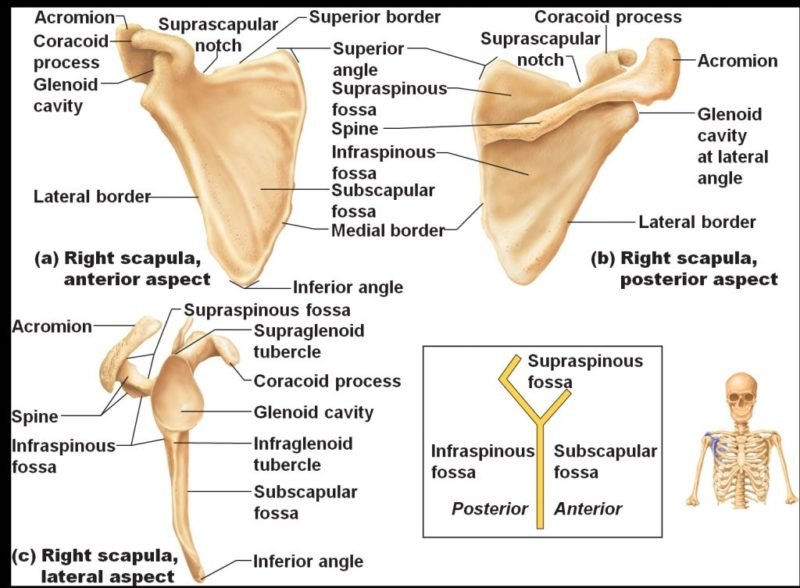
Ligament of Shoulder Girdle - Anatomy, Bursa

Ligament of Shoulder Girdle

Static stabilizing structures include the osseous articular anatomy and joint congruity, the glenoid labrum, the glenohumeral ligaments, joint capsule, and negative intraarticular pressure :

  • Glenohumeral ligaments– Composed of a superior, middle, and inferior ligament, these three ligaments combine to form the glenohumeral joint capsule connecting the glenoid fossa to the humerus. Due to their location, they protect the shoulder and prevent it from dislocating anteriorly — this group of ligaments functions as the primary stabilizers of the joint.
  • Coracoclavicular ligament – This ligament is composed of the conoid and trapezoid ligaments and spans from the coracoid process to the clavicle. It functions to maintain the position of the clavicle in conjunction with the acromioclavicular ligament. Strong forces can rupture these ligaments during acromioclavicular joint injuries.
  • Coracohumeral ligament – This ligament supports the superior aspect of the joint capsule. It is a dense fibrous structure connecting the base of the coracoid process to the greater and lesser tuberosities. At its origin, the ligament is thin and broad, measuring about 2 cm in diameter at the base of the coracoid. Laterally, the CHL separates into two distinct bands that envelope the Long Head Biceps tendon at the proximal extent of the bicipital groove.

Dynamic stabilizing structures include the Long head biceps tendon, rotator cuff muscles, the rotator interval, and the periscapular muscles.

Soft tissue pulley system and Long head of the biceps tendon (LHBT) 

  • The subscapularis has superficial and deep fibers that envelope the bicipital groove, creating the “roof” and “floor,” respectively. These fibers also coalesce with those from the supraspinatus and superior glenohumeral ligament/coracohumeral ligament complex.  These structures attach intimately at the lesser tuberosity to create the proximal and medial aspect of the pulley system, with soft tissue extensions serving to further envelope the LHBT in the bicipital groove. Once the LHBT exits the groove, it takes a 30- to 40-degree turn as it heads toward the supraglenoid tubercle and glenoid labrum. Thus, the proximal soft tissue elements of the groove are especially critical for the overall stability of the entire biceps complex.

Movement of Shoulder Girdle

The glenohumeral joint possesses the capability of allowing an extreme range of motion in multiple planes.

  • Flexion – Defined as bringing the upper limb anterior in the sagittal plane. The usual range of motion is 180 degrees. The main flexors of the shoulder are the anterior deltoid, coracobrachialis, and pectoralis major. Biceps brachii also weakly assists in this action.
  • Extension—Defined as bringing the upper limb posterior in a sagittal plane. The normal range of motion is 45 to 60 degrees. The main extensors of the shoulder are the posterior deltoid, latissimus dorsi, and teres major.
  • Internal rotation—Defined as rotation toward the midline along a vertical axis. The normal range of motion is 70 to 90 degrees. The internal rotation muscles are the subscapularis, pectoralis major, latissimus dorsi, teres major, and the anterior aspect of the deltoid.
  • External rotation – Defined as rotation away from the midline along a vertical axis. The normal range of motion is 90 degrees. Primarily infraspinatus and teres minor are responsible for the motion.
  • Adduction – Defined as bringing the upper limb towards the midline in the coronal plane. Pectoralis major, latissimus dorsi, and teres major are the muscles primarily responsible for shoulder adduction.
  • Abduction – Defined as bringing the upper limb away from the midline in the coronal plane. The normal range of motion is 150 degrees. Due to the ability to differentiate several pathologies by the range of motion of the glenohumeral joint in this plane of motion, it is essential to understand how different muscles contribute to this action.

Range Of Motion

  • I. The supraspinatus is responsible for the first 0 to 15 degrees of abduction
  • II. The middle fibers of the deltoid are responsible for approximately 15 to 90 degrees of abduction following
  • III. Scapular rotation due to the actions of the trapezius and serratus anterior allow for abduction beyond 90 degrees

References

Patient safety assistant

Check your symptom safely

Hi, I am RX Symptom Navigator. I can help you understand what to read next and what warning signs need care.
Warning: Do not use this in emergencies, pregnancy, severe illness, or as a substitute for a doctor. For children or teens, use with a parent/guardian and clinician.
A rural-friendly guide: warning signs, when to see a doctor, related articles, tests to discuss, and OTC safety education.
1 Symptom 2 Severity 3 Safe guidance
First safety question

Is there chest pain, breathing trouble, fainting, confusion, severe bleeding, stroke-like weakness, severe injury, or pregnancy danger sign?

Choose quickly

Browse by body area
Start here: Write or select a symptom. The guide will show warning signs, doctor guidance, diagnostic tests to discuss, OTC safety education, and related RX articles.

Important: This tool is educational only. It cannot diagnose, treat, or replace a doctor. OTC information is not a prescription. In an emergency, contact local emergency services or go to the nearest hospital.

Doctor visit helper

Prepare before seeing a doctor

A simple rural-patient checklist to help you explain symptoms clearly, ask better questions, and avoid unsafe self-treatment.

Safety note: This is not a prescription or diagnosis. For severe symptoms, pregnancy danger signs, children with serious illness, chest pain, breathing difficulty, stroke-like weakness, or major injury, seek urgent care.

Which doctor may help?

Orthopedic doctor, rheumatologist, or physiotherapist depending on cause.

What to tell the doctor

  • Write which joints hurt, swelling, morning stiffness duration, fever, injury, and walking difficulty.
  • Bring X-ray, uric acid, ESR/CRP, rheumatoid factor, or previous reports if available.

Questions to ask

  • Is this injury, osteoarthritis, rheumatoid arthritis, gout, infection, or another cause?
  • Which exercises, supports, or lifestyle changes are safe?
  • Do I need blood tests or X-ray?

Tests to discuss

  • Joint examination and range of motion
  • X-ray when chronic arthritis or injury is suspected
  • ESR/CRP, uric acid, rheumatoid tests when inflammatory arthritis is suspected

Avoid these mistakes

  • Do not ignore hot swollen joint with fever.
  • Avoid repeated steroid injections/tablets without a clear diagnosis and follow-up.

Medicine safety and first-aid guide

This section is for patient education only. It does not replace a doctor, pharmacist, or emergency care.

Safe first steps

  • Rest, drink safe water, and observe symptoms carefully.
  • Keep a written note of symptoms, duration, temperature, medicines already taken, and allergy history.
  • Seek medical care quickly if symptoms are severe, worsening, or unusual for the patient.

OTC medicine safety

  • For mild pain or fever, ask a registered pharmacist or doctor before using common over-the-counter pain/fever medicines.
  • Do not combine multiple pain medicines without advice, especially if you have kidney disease, liver disease, stomach ulcer, asthma, pregnancy, or take blood thinners.
  • Do not give adult medicines to children unless a qualified clinician advises it.

Avoid these mistakes

  • Do not start antibiotics without a proper medical decision.
  • Do not use steroid tablets or injections casually for quick relief.
  • Do not delay emergency care because of home remedies.

Get urgent help if

  • Severe symptoms, confusion, fainting, breathing difficulty, chest pain, severe dehydration, or sudden weakness need urgent medical care.
Medicine names, dose, and timing must be decided by a qualified clinician or pharmacist after checking age, pregnancy, allergy, other diseases, and current medicines.

For rural patients and family caregivers

Patient health record and symptom diary

Write your symptoms, medicines already taken, test results, and questions before visiting a doctor. This note stays on your device unless you print or copy it.

Doctor to discuss: Doctor / qualified healthcare provider
Tests to discuss with doctor
  • Basic vital signs: temperature, pulse, blood pressure, oxygen level if needed
  • Relevant blood, urine, imaging, or specialist tests only after clinical assessment
Questions to ask
  • What is the most likely cause of my symptoms?
  • Which warning signs mean I should go to emergency care?
  • Which tests are really needed now?
  • Which medicines are safe for my age, pregnancy status, allergy, kidney/liver/stomach condition, and current medicines?

Emergency warning signs such as chest pain, severe breathing difficulty, sudden weakness, confusion, severe dehydration, major injury, or loss of bladder/bowel control need urgent medical care. Do not wait for online information.

Safe pathway to proper treatment

Patient care roadmap

Use this simple roadmap to understand the next safe steps. It is educational and does not replace examination by a doctor.

Go to emergency care if you notice:
  • Severe or rapidly worsening symptoms
  • Breathing difficulty, chest pain, fainting, confusion, severe weakness, major injury, or severe dehydration
Doctor / service to discuss: Qualified healthcare provider; specialist depends on symptoms and examination.
  1. Step 1

    Check danger signs first

    If danger signs are present, seek emergency care and do not wait for online information.

  2. Step 2

    Record the symptom story

    Write when symptoms started, severity, medicines already taken, allergies, pregnancy status, and test results.

  3. Step 3

    Visit a qualified clinician

    A doctor, nurse, or qualified healthcare provider can examine you and decide which tests or treatment are needed.

  4. Step 4

    Do only useful tests

    Do tests after clinical assessment. Avoid unnecessary tests, random antibiotics, or repeated medicines without diagnosis.

  5. Step 5

    Follow up and return early if worse

    If symptoms worsen, new warning signs appear, or treatment is not helping, return for review quickly.

Rural patient practical tips
  • Take a written symptom diary and all previous prescriptions/test reports.
  • Do not hide medicines already taken, even herbal or over-the-counter medicines.
  • Ask which warning signs mean urgent referral to hospital.

This roadmap is for education. A real diagnosis and treatment plan requires history, examination, and clinical judgment.

RX Patient Help

Ask a health question safely

Write your symptom story. A health professional or site editor can review it before any answer is prepared. This box is not for emergency care.

Emergency first: Severe chest pain, breathing trouble, unconsciousness, stroke signs, severe injury, heavy bleeding, or rapidly worsening symptoms need urgent local medical care now.

Frequently Asked Questions

Is this article a replacement for a doctor?

No. It is educational content only. Patients should consult a qualified clinician for diagnosis and treatment.

When should I seek urgent care?

Seek urgent care for severe symptoms, rapidly worsening condition, breathing difficulty, severe pain, neurological changes, or any emergency warning sign.

References

Add references, clinical guidelines, textbooks, journal articles, or trusted medical sources here. You can edit this area from the RX Article Professional Blocks panel.
