
A joint or articulation (or articular surface) is the connection made between bones in the body which link the skeletal system into a functional whole. They are constructed to allow for different degrees and types of movement. Some joints, such as the knee, elbow, and shoulder, are self-lubricating, almost frictionless, and are able to withstand compression and maintain heavy loads while still executing smooth and precise movements.[3] Other joints such as sutures between the bones of the skull permit very little movement (only during birth) in order to protect the brain and the sense organs.[3] The connection between a tooth and the jawbone is also called a joint, and is described as a fibrous joint known as a gomphosis. Joints are classified both structurally and functionally.[rx]
Structural Classification of Joints
There are three structural classifications of joints: fibrous, cartilaginous, and synovial.
Key Points
The type
and characteristics of a given joint determine the degree and type of movement.Structural classification categorizes joints based on the type of
tissue involved in their formations.There are three structural
classifications of joints: fibrous, cartilaginous, and synovial.Of the three types of fibrous joints, syndesmoses are the most movable.
Cartilaginous
joints allow more movement than fibrous joints
but less than synovial joints.Synovial joints ( diarthroses ) are the most movable joints of the body and contain synovial fluid.
Key Terms
periosteum: A membrane that covers the outer surface of all bones.
manubrium: The broad upper part of the sternum.
synovial fluid: A viscous fluid found in the cavities of synovial
joints that reduces friction between the articular cartilage during movement.
A joint, also known as an articulation or articular surface, is a connection that occurs between bones in the skeletal system. Joints provide the means for movement. The type and characteristics of a given joint determines its degree and type of movement. Joints can be classified based on structure and function.
Structural classification of joints categorizes them based on the type of tissue involved in formation. There are three structural classifications of joints: fibrous, cartilaginous, and synovial.
Fibrous Joints
Fibrous joints are connected by dense, tough connective tissue that is rich in collagen fibers. These fixed or immovable joints are typically interlocked with irregular edges. There are three types of fibrous joints.
Sutures are the types of joint found in the cranium (skull). The bones are connected by Sharpey’s fibres. The nature of cranial sutures allows for some movement in the fetus. However, they become mostly immovable as the individual ages, although very slight movement allows some necessary cranial elasticity. These rigid joints are referred to as synarthrodial.
Syndesmoses are found between long bones of the body, such as the radio-ulnar and tibio-fibular joints. These moveable fibrous joints are also termed amphiarthrodial. They have a lesser range of movement than synovial joints.
Gomphosis is a type of joint found at the articulation between teeth and the sockets of the maxilla or mandible (dental-alveolar joint). The fibrous tissue that connects the tooth and socket is called the periodontal ligament.

Fibrous joints: Image demonstrating the three types of fibrous joints. (a) Sutures (b) Syndesmosis (c) Gomphosis.
Cartilaginous Joints
Cartilaginous joints are connected by fibrocartilage or hyaline cartilage. They allow more movement than fibrous joints but less than that of synovial joints. These types of joints are further subdivided into primary (synchondroses) and secondary (symphyses) cartilaginous joints. The epiphyseal (growth) plates are examples of synchondroses. Symphyses are found between the manubrium and sternum (manubriosternal joint), intervertebral discs, and the pubic symphysis.
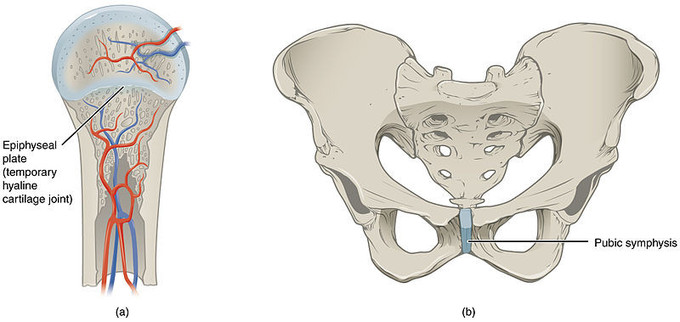
Cartilaginous Joints: Image demonstrates a synchondrosis joint with epiphyseal plate (temporary hyaline cartilage joint) indicated (a) and a symphysis joint (b).

Synovial Joint: This diagram of a synovial joint delineates the articular cartilage, articular capsule, bone, synovial membrane, and joint cavity containing synovial fluid.
Synovial Joints
This is the most common and movable joint type in the body. These joints (also called diarthroses) have a synovial cavity. Their bones are connected by dense irregular connective tissue that forms an articular capsule surrounding the bones’ articulating surfaces.
A synovial joint connects bones with a fibrous joint capsule that is continuous with the bones’ periosteum. This joint capsule constitutes the outer boundary of a synovial cavity and surrounds the bones’ articulating surfaces.
Synovial cavities are filled with synovial fluid. The knees and elbows are examples of synovial joints.
Clinical, numerical classification
- monoarticular – concerning one joint
- oligoarticular or pauciarticular – concerning 2–4 joints
- polyarticular – concerning 5 or more joints
Structural classification (binding tissue)
Structural classification names and divides joints according to the type of binding tissue that connects the bones to each other.[rx] There are four structural classifications of joints:[rx]
- fibrous joint – joined by dense regular connective tissue that is rich in collagen fibers[rx]
- cartilaginous joint – joined by cartilage. There are two types: primary cartilaginous joints composed of hyaline cartilage, and secondary cartilaginous joints composed of hyaline cartilage covering the articular surfaces of the involved bones with fibrocartilage connecting them.
- synovial joint – not directly joined – the bones have a synovial cavity and are united by the dense irregular connective tissue that forms the articular capsule that is normally associated with accessory ligaments.[rx]
- facet joint – joint between two articular processes between two vertebrae.[rx][rx]
Functional Classification of Joints
Functional classification of joints is based on the type and degree of movement permitted.
Key Points
Synarthrosis joints are immobile or have limited mobility and include fibrous joints.
Amphiarthrosis joints allow a small amount of mobility and include cartilaginous joints.
Diarthrosis joints are the freely movable synovial joints.
Synovial joints can also be classified as nonaxial, monoaxial, biaxial, and multiaxial.
The various movements permitted by synovial joints are abduction, adduction, extension, flexion, and rotation.
Key Terms
fibrous joints: Fixed or immobile joints that are connected by dense, tough connective tissue that
is rich in collagen fibers.cartilaginous joints: Joints connected by fibrocartilage or hyaline cartilage. They allow more movement than fibrous joints but less than synovial joints.
gomphosis joints: Joints of very limited mobility. These are found at the articulation
between teeth and the sockets of maxilla or mandible (dental-alveolar joint).
Joints or articulations (connections between bones) can be classified in a number of ways. The primary classifications are structural and functional. Functional classification is based on the type and degree of movement permitted.
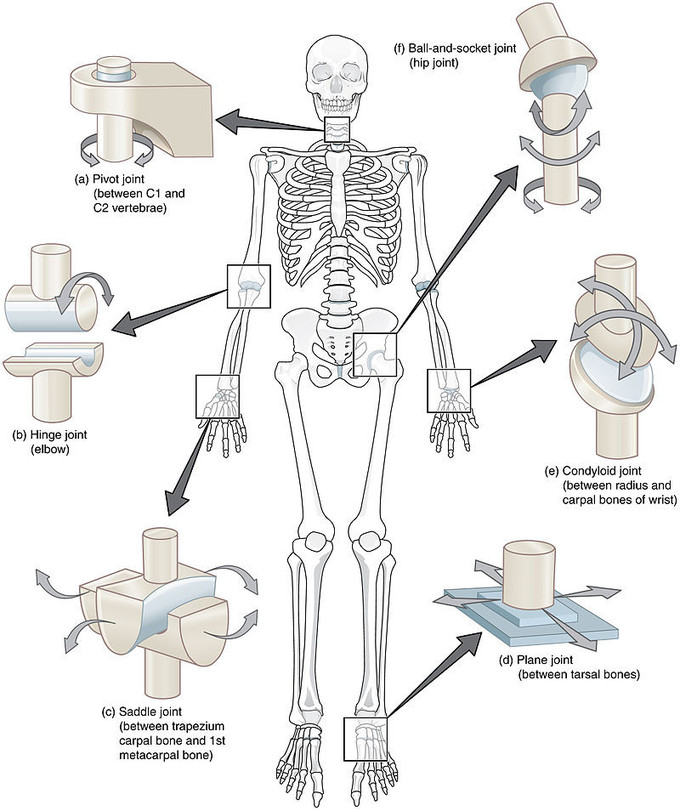
Types of Synovial Joints.jpg: Image of a skeleton and skematics of the different classes of synovial joints.
Three Categories of Functional Joints
- Synarthrosis: These types of joints are immobile or allow limited mobility. This category includes fibrous joints such as suture joints (found in the cranium) and gomphosis joints (found between teeth and sockets of the maxilla and mandible).
- Amphiarthrosis: These joints allow a small amount of mobility. Most joints in this category
include cartilaginous joints such as those found between vertebrae and the pubic symphysis. - Diarthrosis: These are the freely-movable synovial joints. Synovial joints are further classified based on the different types of movement they provide, including:
- Plane joint
- Ball and socket joint
- Hinge joint
- Pivot joint
- Condyloid joint
- Saddle joint
Biomechanical classification
Joints can also be classified based on their anatomy or on their biomechanical properties. According to the anatomic classification, joints are subdivided into simple and compound, depending on the number of bones involved, and into complex and combination joints:[rx]
- Simple joint: two articulation surfaces (e.g. shoulder joint, hip joint)
- Compound joint: three or more articulation surfaces (e.g. radiocarpal joint)
- Complex joint: two or more articulation surfaces and an articular disc or meniscus (e.g. knee joint)
Anatomical
The joints may be classified anatomically into the following groups:
- Joints of hand
- Elbow joints
- Wrist joints
- Axillary joints
- Sternoclavicular joints
- Vertebral articulations
- Temporomandibular joints
- Sacroiliac joints
- Hip joints
- Knee joints
- Articulations of foot
Unmyelinated nerve fibers are abundant in joint capsules and ligaments as well as in the outer part of intraarticular menisci. These nerve fibers are responsible for pain perception when a joint is strained.[rx]
Movement of Synovial Joints
Joints can also be classified by the number of axes of movement they permit:
- Nonaxial (gliding): Found between the proximal ends of the ulna and radius.
- Monoaxial (uniaxial): Movement occurs in one plane. An example is the elbow joint.
- Biaxial: Movement can occur in two planes. An example is the wrist.
- Multiaxial: Includes the ball and socket joints. An example is the hip joint.
The movements possible with synovial joints are:
- Abduction: movement away from the body’s midline
- Adduction: movement toward the body’s midline
- Extension: straightening limbs at a joint
- Flexion: bending the limbs at a joint
- Rotation: a circular movement around a fixed point

