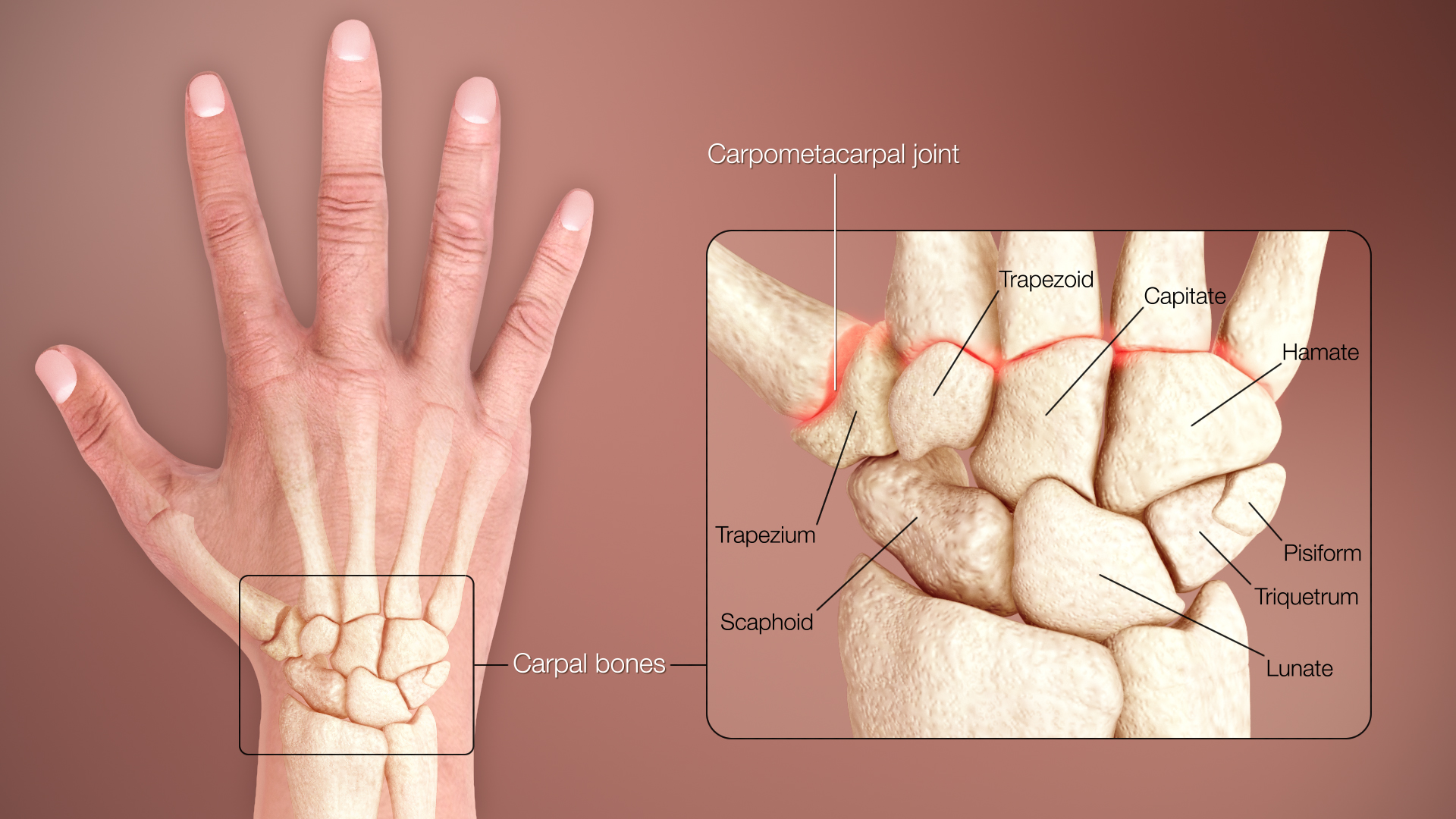
The capitate bone is the largest of all carpal bones both proximally and distally in the human hand. It is surrounded by the lunate bone proximally, the third metacarpal bone distally, and it’s above, a rounded portion or head, which is received into the concavity formed by the scaphoid and lunate bones; a constricted portion called a neck; and below this, the body. It articulates the trapezoid bone laterally and the hamate bone medially with the third metacarpal bone (the middle finger) and forms the third carpometacarpal joint. The capitate lies directly connect to the metacarpal bone of the ring finger on its distal surface, hamate bone on its ulnar surface, trapezoid on its radial surface, lunate and scaphoid proximally.
Surfaces
The superior surface is round in shape, smooth, and articulates with the lunate bone.
The inferior surface is separated by two ridges among three facets, for articulation/connection with the second, third, and fourth metacarpal bones, and the third one is the largest in shape. The dorsal surface is broad and rough shape. The palmar surface is narrow, rounded in shape, and rough, for the attachment of ligaments and a part of the adductor pollicis muscle.
The lateral surface is connected with the lesser multi-angular by alittle facet at its anterior inferior angle, behind has a rough depression for the attachment of an interosseous ligament. Above this is a deep, rough groove, forming a part of the neck, and serving for the attachment of ligaments; it’s bounded superiorly by a smooth, convex surface, for articulation with the ossification of the scaphoid.
The medial surface articulates with the hamate by a smooth, concave facet, which occupies its posterior and superior parts; it’s a rough front, for the attachment of an interosseous ligament.
The capitate articulates with the metacarpal of the index finger its normal articulation is with the center finger.
The joints of the distal carpal row connect the surfaces of the trapezium, trapezoid, capitate, and hamate bones. These articulations form the trapeziotrapezoid, trapezoideocapitate, and capitohamate joints which are less mobile than those of the proximal carpal row.
References
- https://www.ncbi.nlm.nih.gov/pmc/articles/PMC3928373/
- https://www.ncbi.nlm.nih.gov/pmc/articles/PMC2584218/
- https://pubmed.ncbi.nlm.nih.gov/32917569/
- https://pubmed.ncbi.nlm.nih.gov/32025357/
- https://en.wikipedia.org/wiki/Trapezoid_bone
- https://pubmed.ncbi.nlm.nih.gov/10783105/
- https://pubmed.ncbi.nlm.nih.gov/27524693/
- https://pubmed.ncbi.nlm.nih.gov/7075062/
- https://en.wikipedia.org/wiki/Capitate_bone
- https://en.wikipedia.org/wiki/Carpal_bones
- https://en.wikipedia.org/wiki/Second_metacarpal_bone
- https://www.ncbi.nlm.nih.gov/books/NBK470428/
- https://en.wikipedia.org/wiki/Fifth_metacarpal_bone
- https://www.ncbi.nlm.nih.gov/pmc/articles/PMC5072035/
- https://www.ncbi.nlm.nih.gov/pmc/articles/PMC6925376/
- https://www.ncbi.nlm.nih.gov/pmc/articles/PMC8077280/
- https://www.ncbi.nlm.nih.gov/pmc/articles/PMC8604033/
- https://www.ncbi.nlm.nih.gov/pmc/articles/PMC4443413/
- https://www.ncbi.nlm.nih.gov/pmc/articles/PMC4443413/
- https://www.ncbi.nlm.nih.gov/books/NBK545182/
- https://pubmed.ncbi.nlm.nih.gov/7061016/
- https://link.springer.com/article/10.1007/s00590-021-02932-2
- https://pubmed.ncbi.nlm.nih.gov/16930789/
- https://www.ncbi.nlm.nih.gov/pmc/articles/PMC6081790/
- https://link.springer.com/referenceworkentry/10.1007/978-3-319-28226-8_54-1
- https://www.sciencedirect.com/topics/medicine-and-dentistry/phalanx
- https://pubmed.ncbi.nlm.nih.gov/18832602/
- https://www.ncbi.nlm.nih.gov/books/NBK545182/
- https://www.ncbi.nlm.nih.gov/books/NBK557625/
- https://www.ncbi.nlm.nih.gov/pmc/articles/PMC2815833/
- https://link.springer.com/referenceworkentry/10.1007/978-3-319-29980-8_53
- https://pubmed.ncbi.nlm.nih.gov/29267112/
- https://www.sciencedirect.com/topics/medicine-and-dentistry/epiphysis-plate-fracture
- https://www.ncbi.nlm.nih.gov/pmc/articles/PMC4894366/
- https://www.ncbi.nlm.nih.gov/pmc/articles/PMC5154424/
- https://www.ncbi.nlm.nih.gov/books/NBK482508/
- https://www.ncbi.nlm.nih.gov/books/NBK482508/
- https://www.ncbi.nlm.nih.gov/books/NBK482480/
- https://www.ncbi.nlm.nih.gov/pmc/articles/PMC4511693/
- https://en.wikipedia.org/wiki/Subungual_hematoma
- https://www.ncbi.nlm.nih.gov/books/NBK525970/
- https://www.ncbi.nlm.nih.gov/pmc/articles/PMC6292477/
- https://www.ncbi.nlm.nih.gov/pmc/articles/PMC5890942/
- https://www.ncbi.nlm.nih.gov/pmc/articles/PMC2696003/
- https://www.ncbi.nlm.nih.gov/pmc/articles/PMC5891829/
- https://www.ncbi.nlm.nih.gov/pmc/articles/PMC7313162/
- https://www.ncbi.nlm.nih.gov/pmc/articles/PMC7593213/
- https://www.jhandsurg.org/article/S0363-5023(12)01702-9/pdf
- https://en.wikipedia.org/wiki/Vancouver_classification
- https://www.sciencedirect.com/science/article/pii/S0020138318306582
- https://www.ncbi.nlm.nih.gov/pmc/articles/PMC4252160
- https://www.ncbi.nlm.nih.gov/pmc/articles/PMC5291558/
- https://journals.lww.com/md-journal/fulltext/
- https://pacs.de/term/pelvic-bucket-handle-fracture
- https://www.ncbi.nlm.nih.gov/books/NBK519005/
- https://www.ncbi.nlm.nih.gov/pmc/articles/PMC3728390/
- https://academic.oup.com/jrr/article/54/6/1102/1132874
- https://bmjopen.bmj.com/content/9/7/e032111
- https://medlineplus.gov/
- https://radiopaedia.org/articles/judet-and-letournel-classification-for-acetabular-fractures
- https://books.google.com.bd/books?id=XvbsDwAAQBAJ&pg
- https://en.wikipedia.org/wiki/Bone_fracture
- https://en.wikipedia.org/wiki/Fracture
- https://www.ncbi.nlm.nih.gov/pmc/articles/PMC5961267/
- https://www.ncbi.nlm.nih.gov/pmc/articles/PMC5721952/