Bony Landmark and Function of Scapula/ Shoulder Blade is a flat, triangular-shaped bone that is known colloquially as the “shoulder blade.” Its location is in the upper thoracic region on the dorsal surface of the rib cage. It connects with the humerus at the glenohumeral joint as well as the clavicle at the acromioclavicular joint to form the shoulder joint. In total, 17 different muscles attach to the scapula, which makes it difficult to fracture.
Scapula, also called shoulder blade, either of two large bones of the shoulder girdle invertebrates. In humans, they are triangular and lie on the upper back between the levels of the second and eighth ribs. A scapula’s posterior surface is crossed obliquely by a prominent ridge, the spine, which divides the bone into two concave areas, the supraspinous and infraspinous fossae. The spine and fossae give attachment to muscles that act in rotating the arm. The spine ends in the acromion, a process that articulates with the clavicle, or collarbone, in front and helps form the upper part of the shoulder socket. The lateral apex of the triangle is broadened and presents a shallow cavity, the glenoid cavity, which articulates with the head of the bone of the upper arm, the humerus, to form the shoulder joint. Overhanging the glenoid cavity is a beaklike projection, the coracoid process, which completes the shoulder socket. To the margins of the scapula are attached muscles that aid in moving or fixing the shoulder as demanded by movements of the upper limb.

Bony Landmark and Function of Scapula
Bony Landmark and Function of Scapula
Surfaces Of Scapula
- Costal Surface or Subscapular Fossa – It is concave and is directed medially and forwards. It is marked by 3 longitudinal ridges. A thick ridge adjoins the lateral border. This part of the bone is almost rod-like acts a lever for the action of serratus anterior in overhead abduction of the arm
- Dorsal Surface – The prominent spine of scapula divides the surface into a smaller supraspinatus fossa and a larger infraspinatus fossa. The depth of the supraspinatus fossa is filled by the supraspinatus muscle.
Costal Surface
The costal (anterior) surface of the scapula faces the ribcage.
- It contains a large concave depression over most of its surface, known as the subscapular fossa. The subscapularis (rotator cuff muscle) originates from this fossa.
- Originating from the superolateral surface of the costal scapula is the coracoid process. It is a hook-like projection, which lies just underneath the clavicle. The pectoralis minor attaches here, while the coracobrachialis and biceps brachii (short head) muscles originates from this projection.
Lateral Surface
The lateral surface of the scapula faces the humerus. It is the site of the glenohumeral joint, and of various muscle attachments. Its important bony landmarks include:
- Glenoid fossa – a shallow cavity, located superiorly on the lateral border.
- It articulates with the head of the humerus to form the glenohumeral (shoulder) joint.
- Supraglenoid tubercle – a roughening immediately superior to the glenoid fossa.
- The place of attachment of the long head of the biceps brachii.
- Infraglenoid tubercle – a roughening immediately inferior to the glenoid fossa.
- The place of attachment of the long head of the triceps brachii.
Posterior Surface
The posterior surface of the scapula faces outwards. It is a site of origin for the majority of the rotator cuff muscles of the shoulder.
It is marked by:
- Spine – the most prominent feature of the posterior scapula. It runs transversely across the scapula, dividing the surface into two.
- Acromion – a projection of the spine that arches over the glenohumeral joint and articulates with the clavicle at the acromioclavicular joint.
- infraspinous fossa– the area below the spine of the scapula, it displays a convex shape.
- The infraspinatus muscle originates from this area.
- Supraspinous fossa – the area above the spine of the scapula, it is much smaller than the infraspinous fossa, and is more convex in shape.
- The supraspinatus muscle originates from this area.
Borders of Scapula
- Superior Border – It is thin and shorter. It presents the suprascapular notch near the root of the coracoid process. The superior border extends from the superior angle laterally towards the coracoid process.
- Lateral Border – This is thick and presents infraglenoid tubercle at the upper end. The lateral or axillary border runs from the inferior angle to the lateral angle of the scapula.
- Medial Border – This is thin and extends from superior to the inferior angle. With the arm resting by the side, the medial or vertebral border runs almost parallel to the spinal column.
Angles of Scapula
- The superior angle – medial angle, is covered by the trapezius muscle. This angle is formed by the junction of the superior and medial borders of the scapula. The superior angle is located at the approximate level of the second thoracic vertebra. The superior angle of the scapula is thin, smooth, rounded, and inclined somewhat lateralward, and gives attachment to a few fibers of the levator scapulae muscle.[rx]
- Inferior angle – is covered by the latissimus dorsi. It moves forwards round the chest when the arm is abducted. The palpation of the inferior angle provides a convenient method for following the movement of the scapula during arm motion. It is the lowest part of the scapula and is covered by the latissimus dorsi muscle. It moves forwards round the chest when the arm is abducted. The inferior angle is formed by the union of the medial and lateral borders of the scapula.
- Lateral Glenoid Angle – lateral angle of the scapula or glenoid angle also known as the head of the scapula is the thickest part of the scapula. It is broad and bears the glenoid cavity on its articular surface which is directed forward, laterally and slightly upwards, and articulates with the head of the humerus. The inferior angle is broader below than above and its vertical diameter is the longest. The surface is covered with cartilage in the fresh state; and its margins, slightly raised, give attachment to a fibrocartilaginous structure, the glenoidal labrum, which deepens the cavity. At its apex is a slight elevation, the supraglenoid tuberosity, to which the long head of the biceps brachii is attached
Processes of Scapula
- Spine or Spinous Process – is a triangular plate of bone with 3 borders and 2 surfaces. It divides the dorsal surface of the scapula into supraspinous and infraspinous fossae. The posterior border is called the crest of the spine which has upper and lower lips.
- The Acromion Process – has 2 borders, medial and lateral; 2 surfaces and a facet for clavicle.
- The Coracoid Process –
Articulations
- Acromion – the clavicle (forming the acromioclavicular joint)
- Glenoid cavity – humeral head (forming the glenohumeral joint)
Musculotendinous
- The supraspinous fossa – supraspinatus muscle
- The infraspinous fossa – infraspinatus muscle, teres minor muscle
- The subscapular fossa – subscapularis muscle, serratus anterior
- Transverse scapular ligament and adjacent superior border of the blade – the inferior belly of omohyoid
- Acromion – acromial part of the deltoid muscle, trapezius
- Scapular spine – spinous part of the deltoid muscle, trapezius
- Coracoid process – coracobrachialis, pectoralis minor, the short head of biceps muscle
- Lateral border (margo lateralis) – teres minor muscle, teres major muscle
- Vertebral border (posterior) – levator scapulae, rhomboid minor muscle, rhomboid major muscle
- Inferior angle – teres major muscle, a small slip of latissimus dorsi
- Supraglenoid tubercle – long head of biceps muscle
- Infraglenoid tubercle – long head of triceps muscle

Ligamentous
- transverse scapular ligament: crosses suprascapular notch, with the suprascapular nerve below (within the resulting foramen) and the suprascapular vessels above
- coracoacromial ligament
- coracoclavicular ligament
- coracohumeral ligament
- glenohumeral ligaments: upper, middle, and lower bands
- acromioclavicular ligament (weak)
Ligaments Attachment of Scapula
- The margin of the glenoid cavity gives attachment to the capsule of the shoulder joint and to the glenoid labrum
- The margin of the facet on the medial aspect of the acromion gives attachment to the capsule of the acromioclavicular joint
- The coracoacromial ligament is attached to the lateral border of the coracoids process and to the medial side of the tip of the acromion process
- The coracohumeral ligament is attached to the root of the coracoids process.
- The coracoclavicular ligament is attached to the coracoid process; the trapezoid part on the superior aspect, and the conoid part near the root. The coracoclavicular ligament is made up of 2 bands: the conoid and the trapezoid, both of which provide vertical stability. The coracoacromial ligament connects the coracoid process to the acromion.
- The suprascapular ligament bridges across the suprascapular notch and converts it into a foramen which transmits the suprascapular nerve. The suprascapular ligament lies above the ligament.
- The spinoglenoid ligament bridges the spinoglenoid notch. The suprascapular vessels and nerve pass to it.
- The acromioclavicular ligament connects the distal end of the clavicle to the acromion and provides horizontal stability
Bursae of Scapula
There are two major bursae
- Scapulothoracic Bursa, between the serratus and the thorax, and
- Subscapular bursa – Subscapularis Bursa, between the subscapularis and the serratus. It is located between the tendon of the subscapularis muscle and the capsule. It functions to reduces frictional damage to the subscapularis muscle during movement of the glenohumeral joint, particularly during internal rotation.
Blood Supply of Scapula
The scapula is surrounded by an arterial anastomosis, the scapular anastomosis which aims to ensure an adequate supply of blood to the upper limb, but has added benefit of adequate supply to the bone itself. It consists of the:
- Suprascapular artery
- Dorsal scapular artery
- Branches of the subscapular artery (i.e. circumflex scapular artery)
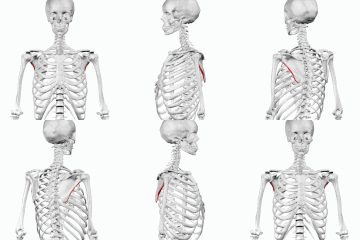

Muscle Attachment of Scapula/ Shoulder Blade
The intrinsic muscles of the scapula attach directly to the surface of the bone. These muscles are the four members of the rotator cuff and act to stabilize the glenohumeral joint. These include:
Supraspinatus
- Function: Initiation of arm abduction (first 15 degrees), stabilize glenohumeral joint
- Origin: Supraspinous fossa
- Insertion: Top of the greater tubercle
- Innervation: Suprascapular nerve (C5, C6)
Infraspinatus
- Function: Lateral rotation of the arm, stabilize glenohumeral joint
- Origin: Infraspinous fossa
- Insertion: Greater tubercle of humerus, between the supraspinatus and teres minor insertion
- Innervation: Suprascapular nerve (C5, C6)
Teres minor
- Function: Lateral rotation of the arm, stabilize glenohumeral joint
- Origin: Lateral/axillary border and adjacent posterior aspect of the scapula
- Insertion: Inferior aspect of the greater tubercle on the humerus
- Innervation: Axillary nerve (C5, C6)
Subscapularis
- Function: Adduction and medial rotation of the arm, stabilize glenohumeral joint
- Origin: Subscapular fossa
- Insertion: Lesser tubercle of humerus
- Innervation: Subscapular nerves (C5, C6, C7)
The extrinsic muscles of the scapula attach to the processes of the scapula and affect motion at the glenohumeral joint: These include:
Biceps brachii
- Function: Resists dislocation of the shoulder, major flexor of the forearm, supination of the forearm
- Origin:
- Short head: coracoid process
- Long head: supraglenoid tubercle
- Insertion: Radial tuberosity and forearm fascia (as bicipital aponeurosis)
- Innervation: Musculocutaneous nerve (C5, C6)
Triceps brachii
- Function: Resists dislocation of the shoulder, major extensor of the forearm
- Origin:
- Lateral head: above the radial groove,
- Medial head: below the radial groove
- Long head: infraglenoid tubercle of scapula
- Insertion: Olecranon process of ulna and fascia of the forearm
- Innervation: Radial nerve (C6, C7, C8)
Deltoid
- Function:
- Anterior aspect is responsible for flexion and medial rotation of the arm
- Middle aspect is responsible for abduction of the arm (up to 90 degrees)
- The posterior aspect is responsible for extension and lateral rotation of the arm
- Origin: Lateral clavicle, acromion and scapular spine
- Insertion: Deltoid tuberosity
- Innervation: Axillary nerve (C5, C6)
Stabilizing muscles of the scapula include:
Trapezius
- Function:
- Upper fibers elevate the scapula and rotate it during abduction of the arm (90 to 180 degrees)
- Middle fibers retract the scapula
- Lower fibers pull the scapula inferiorly.
- Origin: Skull, nuchal ligament and the spinous processes of C7 to T12
- Insertion: clavicle, acromion and the scapular spine
- Innervation: Accessory nerve (C5, C6)
Levator scapulae
- Function: Elevates the scapula
- Origin: Transverse processes of the C1 to C4 vertebrae
- Insertion: Medial border of the scapula
- Innervation: C3, C4, and the Dorsal scapular nerve (C5)
Serratus anterior
- Function: fixes the scapula into the thoracic wall, and aids in rotation and abduction of the arm (90 to 180 degrees)
- Origin: Surface of the upper eight ribs at the side of the chest
- Insertion: Along the entire anterior length of the medial border of the scapula
- Innervation: Long thoracic nerve (C5, C6, C7)
Rhomboid major
- Function: Retracts and rotates the scapula
- Origin: Spinous processes of T2 to T5 vertebrae
- Insertion: Inferomedial border of the scapula
- Innervation: Dorsal scapular nerve (C5)
Rhomboid minor
- Function: Retracts and rotates the scapula
- Origin: Spinous processes of C7 to T1 vertebrae
- Insertion: Medial border of the scapula
- Innervation: Dorsal scapular nerve (C5)
Other muscles attached to the scapula include:
Latissmus dorsi
- Function: Extends, adducts and medially rotates the upper limb
- Origin: Spinous processes of T6 to T12, iliac crest, thoracolumbar fascia, the inferior three ribs, and the inferior angle of the scapula
- Insertion: Intertubercular sulcus of the humerus
- Innervation: Thoracodorsal nerve (C6, C7, C8)
Teres major
- Function: Adduction and medial rotation of the arm
- Origin: Posterior surface of the scapula at its inferior angle
- Insertion: Intertubercular groove on its medial aspect
- Innervation: Lower scapular nerve (C5, C6)
Pectoralis minor
- Function: Depression of the shoulder, protraction of scapula
- Origin: Third, fourth, fifth ribs close to their respective costal cartilages
- Insertion: Coracoid process
- Innervation: Medial pectoral nerve (C8, T1)
Coracobrachialis
- Function: Flexion and adduction of arm
- Origin: Coracoid process
- Insertion: Middle of the humerus, on its medial aspect
- Innervation: Musculocutaneous nerve (C5, C6, C7)
Omohyoid
- Function: Pulls hyoid bone down, active while talking and swallowing
- Origin: Superior border of scapula
- Insertion: Inferior edge of the hyoid
- Innervation: Ansa cervicalis (C1, C2, C3)
The following muscles attach to the scapula
| Muscle | Direction | Region |
| Pectoralis Minor | insertion | coracoid process |
| Coracobrachialis | origin | coracoid process |
| Serratus Anterior | insertion | medial border |
| Triceps Brachii (long head) | origin | infraglenoid tubercle |
| Biceps Brachii (short head) | origin | coracoid process |
| Biceps Brachii (long head) | origin | supraglenoid tubercle |
| Subscapularis | origin | subscapular fossa |
| Rhomboid Major | insertion | medial border |
| Rhomboid Minor | insertion | medial border |
| Levator Scapulae | insertion | medial border |
| Trapezius | insertion | spine of scapula |
| Deltoid | origin | spine of scapula |
| Supraspinatus | origin | supraspinous fossa |
| Infraspinatus | origin | infraspinous fossa |
| Teres Minor | origin | lateral border |
| Teres Major | origin | lateral border |
| Latissimus Dorsi (a few fibers, the attachment may be absent) | origin | inferior angle |
| Omohyoid | origin | superior border |
Movements of Scapula
Movements of the scapula are brought about by the scapular muscles. The scapula can perform six actions:
- Elevation: upper trapezius and levator scapulae
- Depression: lower trapezius
- Retraction (adduction): rhomboids and middle trapezius
- Protraction (abduction): serratus anterior
- Upward rotation: upper and middle trapezius
- Downward rotation: rhomboids[rx][rx]
References
- https://www.ncbi.nlm.nih.gov/books/NBK538319/
- https://www.ncbi.nlm.nih.gov/books/NBK459343/
- https://www.ncbi.nlm.nih.gov/books/NBK534836/
- https://www.ncbi.nlm.nih.gov/books/NBK518994/
- https://www.ncbi.nlm.nih.gov/books/NBK537018/
- https://www.ncbi.nlm.nih.gov/books/NBK536933/
- https://www.ncbi.nlm.nih.gov/books/NBK537148/
- https://www.ncbi.nlm.nih.gov/books/NBK531457/
- https://www.ncbi.nlm.nih.gov/books/NBK531475/
- https://www.ncbi.nlm.nih.gov/books/NBK531475/
- https://en.wikipedia.org/wiki/Scapula
- https://www.britannica.com/science/scapula
- https://www.sciencedirect.com/topics/medicine-and-dentistry/scapula
- https://link.springer.com/chapter/10.1007/978-3-319-53584-5_1
- https://courses.lumenlearning.com/boundless-ap/chapter/the-shoulder/
- https://radiopaedia.org/articles/scapula
- https://teachmeanatomy.info/upper-limb/bones/scapula/
- https://theodora.com/anatomy/the_scapula_shoulder_blade.html