AutoGen Studio: Interactively Explore Multi-Agent Workflows

Patient Tools

Read, save, and share this guide

Use these quick tools to make this medical article easier to read, print, save, or share with a family member.

Article Summary

To help you rapidly prototype multi-agent solutions for your tasks, we are introducing AutoGen Studio, an interface powered by AutoGen. It allows you to: Declaratively define and modify agents and multi-agent workflows through a point and click, drag and drop interface (e.g., you can select the parameters of two agents that will communicate to solve your task). Use our UI to create chat sessions with the...

Key Takeaways

  • This article explains Introduction​ in simple medical language.
  • This article explains Getting Started with AutoGen Studio​ in simple medical language.
  • This article explains What Can You Do with AutoGen Studio?​ in simple medical language.
  • This article explains The AutoGen Studio API​ in simple medical language.
Educational health guideWritten for patient understanding and clinical awareness.
Reviewed content workflowUse writer and reviewer profiles for stronger trust.
Emergency safety firstUrgent warning signs are highlighted below.

Seek urgent medical care if you notice

These warning signs are general safety guidance. Local emergency numbers and clinical judgment should always come first.

  • Severe symptoms, breathing difficulty, fainting, confusion, or rapidly worsening illness.
  • New weakness, severe pain, high fever, or symptoms after a serious injury.
  • Any symptom that feels urgent, unusual, or unsafe for the patient.
1

Emergency now

Use emergency care for severe, sudden, rapidly worsening, or life-threatening symptoms.

2

See a doctor

Book a professional medical evaluation if symptoms persist, worsen, recur often, affect daily activities, or occur in a high-risk patient.

3

Learn safely

Use this article to understand possible causes, tests, treatment options, prevention, and questions to ask your clinician.

To help you rapidly prototype multi-agent solutions for your tasks, we are introducing AutoGen Studio, an interface powered by AutoGen. It allows you to:

  • Declaratively define and modify agents and multi-agent workflows through a point and click, drag and drop interface (e.g., you can select the parameters of two agents that will communicate to solve your task).
  • Use our UI to create chat sessions with the specified agents and view results (e.g., view chat history, generated files, and time taken).
  • Explicitly add skills to your agents and accomplish more tasks.
  • Publish your sessions to a local gallery.

AutoGen Studio is open source code here, and can be installed via pip. Give it a try!

pip install autogenstudio

Introduction

The accelerating pace of technology has ushered us into an era where digital assistants (or agents) are becoming integral to our lives. AutoGen has emerged as a leading framework for orchestrating the power of agents. In the spirit of expanding this frontier and democratizing this capability, we are thrilled to introduce a new user-friendly interface: AutoGen Studio.

With AutoGen Studio, users can rapidly create, manage, and interact with agents that can learn, adapt, and collaborate. As we release this interface into the open-source community, our ambition is not only to enhance productivity but to inspire a level of personalized interaction between humans and agents.

Note: AutoGen Studio is meant to help you rapidly prototype multi-agent workflows and demonstrate an example of end user interfaces built with AutoGen. It is not meant to be a production-ready app.

Getting Started with AutoGen Studio

The following guide will help you get AutoGen Studio up and running on your system.

Configuring an LLM Provider

To get started, you need access to a language model. You can get this set up by following the steps in the AutoGen documentation here. Configure your environment with either OPENAI_API_KEY or AZURE_OPENAI_API_KEY.

For example, in your terminal, you would set the API key like this:

export OPENAI_API_KEY=<your_api_key>

You can also specify the model directly in the agent’s configuration as shown below.

llm_config = LLMConfig(
    config_list=[{
        "model": "gpt-4",
        "api_key": "<azure_api_key>",
        "base_url": "<azure api base url>",
        "api_type": "azure",
        "api_version": "2023-06-01-preview"
    }],
    temperature=0,
)

Installation

  1. Install from PyPi

    We recommend using a virtual environment (e.g., conda) to avoid conflicts with existing Python packages. With Python 3.10 or newer active in your virtual environment, use pip to install AutoGen Studio:

    pip install autogenstudio
    
  2. Install from Source

    Note: This approach requires some familiarity with building interfaces in React.

    If you prefer to install from source, ensure you have Python 3.10+ and Node.js (version above 14.15.0) installed. Here’s how you get started:

    • Clone the AutoGen Studio repository and install its Python dependencies:
      pip install -e .
      

      Navigate to the samples/apps/autogen-studio/frontend directory, install dependencies, and build the UI:

    • npm install -g gatsby-cli
      npm install --global yarn
      cd frontend
      yarn install
      yarn build
      

    For Windows users, to build the frontend, you may need alternative commands provided in the autogen studio readme.

Running the Application

Once installed, run the web UI by entering the following in your terminal:

autogenstudio ui --port 8081

This will start the application on the specified port. Open your web browser and go to http://localhost:8081/ to begin using AutoGen Studio.

Now that you have AutoGen Studio installed and running, you are ready to explore its capabilities, including defining and modifying agent workflows, interacting with agents and sessions, and expanding agent skills.

What Can You Do with AutoGen Studio?

The AutoGen Studio UI is organized into 3 high level sections – BuildPlayground, and Gallery.

Build

AutoGen Studio: Interactively Explore Multi-Agent Workflows

This section focuses on defining the properties of agents and agent workflows. It includes the following concepts:

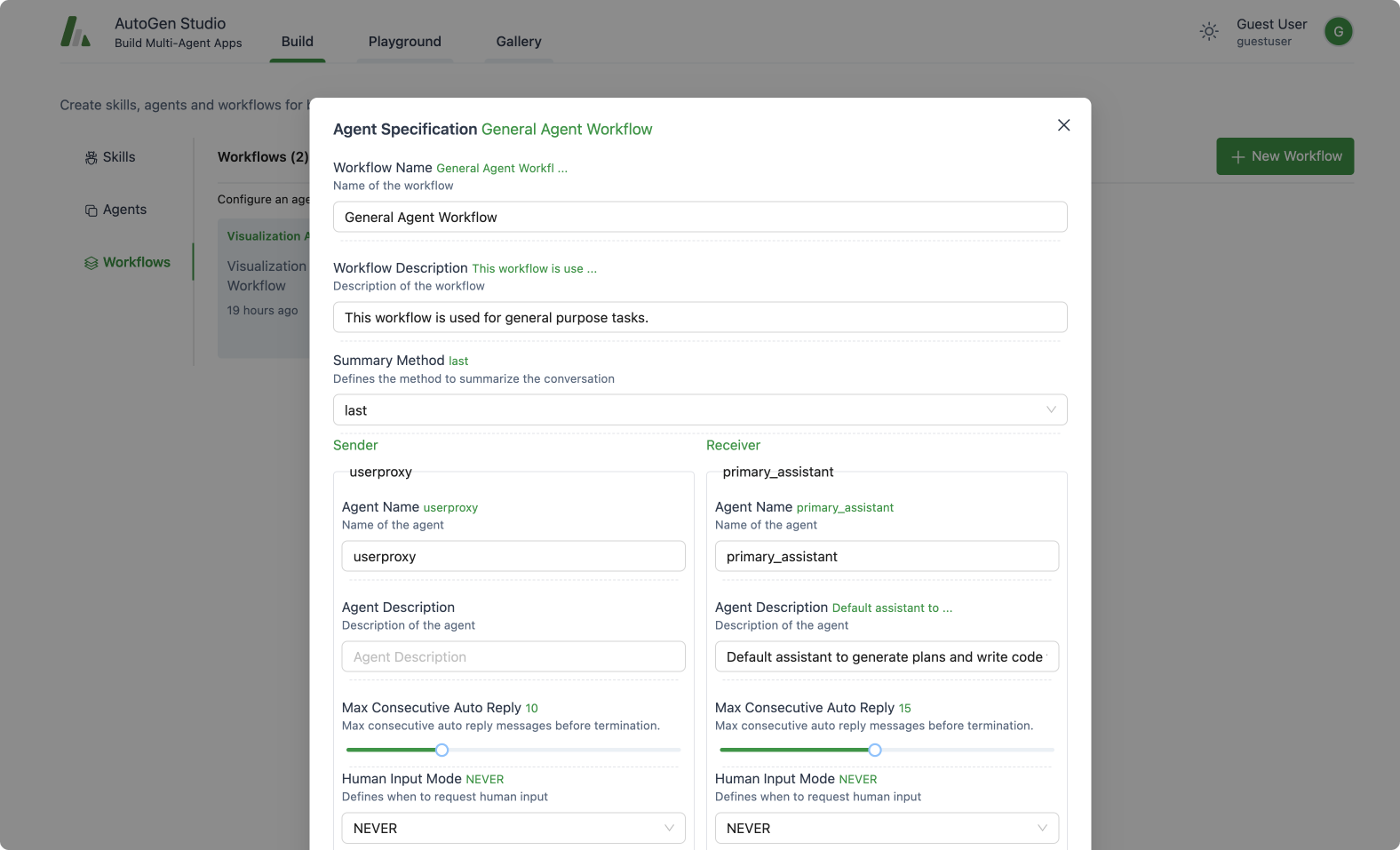
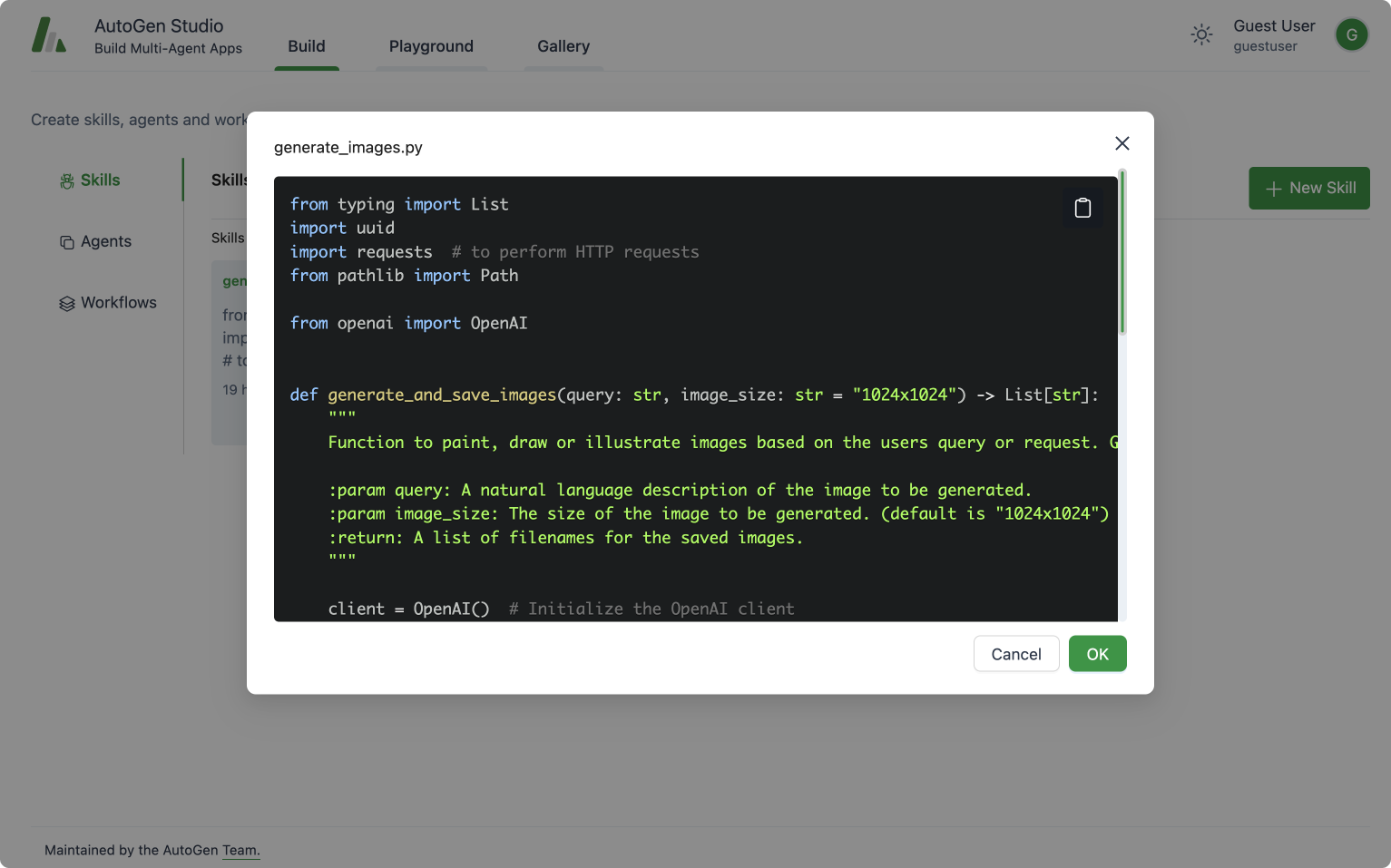
Skills: Skills are functions (e.g., Python functions) that describe how to solve a task. In general, a good skill has a descriptive name (e.g. generate_images), extensive docstrings and good defaults (e.g., writing out files to disk for persistence and reuse). You can add new skills to AutoGen Studio via the provided UI. At inference time, these skills are made available to the assistant agent as they address your tasks.
AutoGen Studio: Interactively Explore Multi-Agent Workflows

AutoGen Studio Build View: View, add or edit skills that an agent can leverage in addressing tasks.

Agents: This provides an interface to declaratively specify properties for an AutoGen agent (mirrors most of the members of a base AutoGen conversable agent class).

Agent Workflows: An agent workflow is a specification of a set of agents that can work together to accomplish a task. The simplest version of this is a setup with two agents – a user proxy agent (that represents a user i.e. it compiles code and prints result) and an assistant that can address task requests (e.g., generating plans, writing code, evaluating responses, proposing error recovery steps, etc.). A more complex flow could be a group chat where even more agents work towards a solution.

Playground
AutoGen Studio: Interactively Explore Multi-Agent Workflows

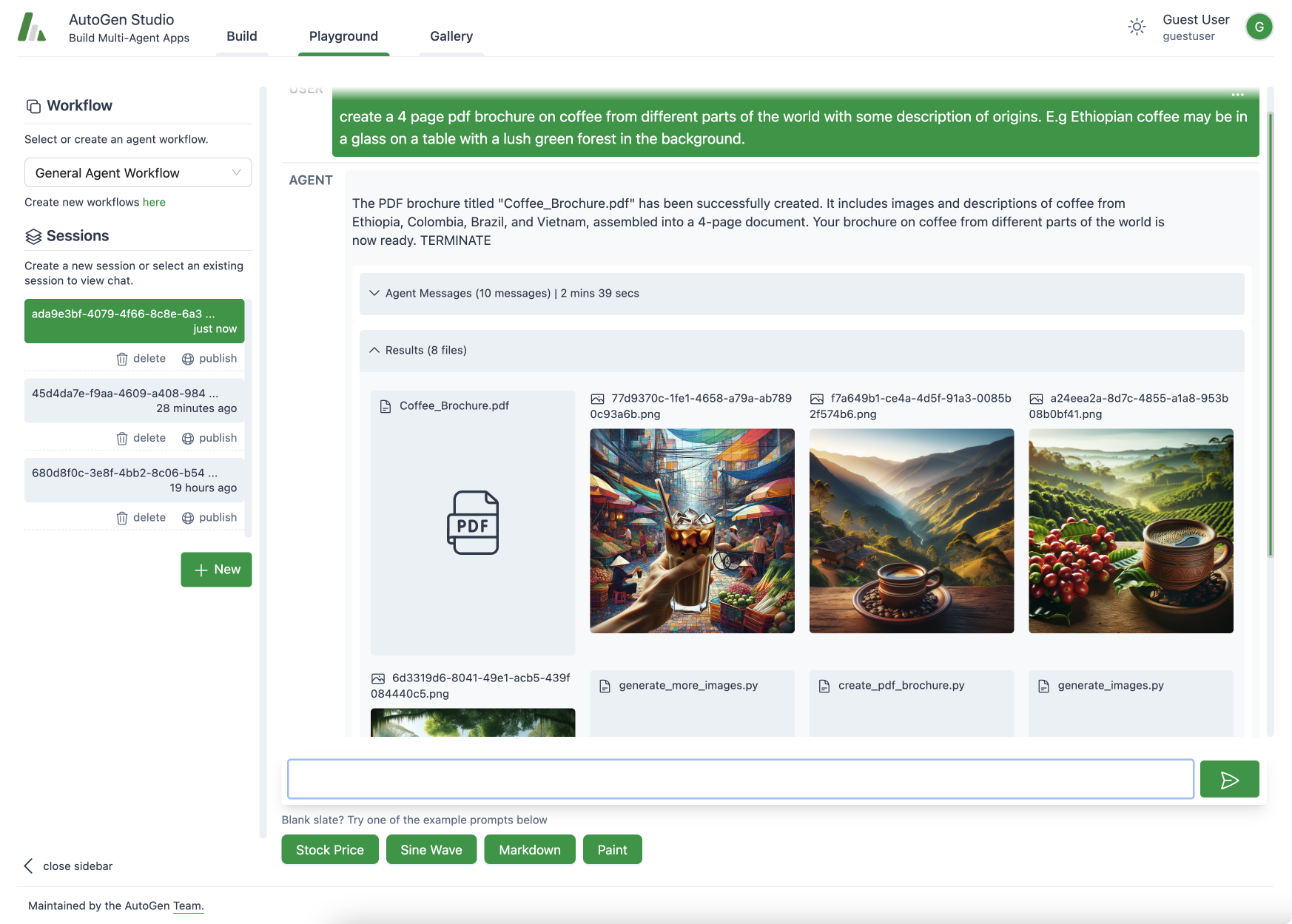
AutoGen Studio Playground View: Agents collaborate, use available skills (ability to generate images) to address a user task (generate pdf’s).

The playground section is focused on interacting with agent workflows defined in the previous build section. It includes the following concepts:

Session: A session refers to a period of continuous interaction or engagement with an agent workflow, typically characterized by a sequence of activities or operations aimed at achieving specific objectives. It includes the agent workflow configuration, the interactions between the user and the agents. A session can be “published” to a “gallery”.

Chat View: A chat is a sequence of interactions between a user and an agent. It is a part of a session.

This section is focused on sharing and reusing artifacts (e.g., workflow configurations, sessions, etc.).

AutoGen Studio comes with 3 example skills: fetch_profilefind_papersgenerate_images. Please feel free to review the repo to learn more about how they work.

The AutoGen Studio API

While AutoGen Studio is a web interface, it is powered by an underlying python API that is reusable and modular. Importantly, we have implemented an API where agent workflows can be declaratively specified (in JSON), loaded and run. An example of the current API is shown below. Please consult the AutoGen Studio repo for more details.

import json
from autogenstudio import AutoGenWorkFlowManager, AgentWorkFlowConfig

# load an agent specification in JSON
agent_spec = json.load(open('agent_spec.json'))

# Create an AutoGen Workflow Configuration from the agent specification
agent_work_flow_config = FlowConfig(**agent_spec)

# Create a Workflow from the configuration
agent_work_flow = AutoGenWorkFlowManager(agent_work_flow_config)

# Run the workflow on a task
task_query = "What is the height of the Eiffel Tower?"
agent_work_flow.run(message=task_query)

Road Map and Next Steps

As we continue to develop and refine AutoGen Studio, the road map below outlines an array of enhancements and new features planned for future releases. Here’s what users can look forward to:

  • Complex Agent Workflows: We’re working on integrating support for more sophisticated agent workflows, such as GroupChat, allowing for richer interaction between multiple agents or dynamic topologies.
  • Improved User Experience: This includes features like streaming intermediate model output for real-time feedback, better summarization of agent responses, information on costs of each interaction. We will also invest in improving the workflow for composing and reusing agents. We will also explore support for more interactive human in the loop feedback to agents.
  • Expansion of Agent Skills: We will work towards improving the workflow for authoring, composing and reusing agent skills.
  • Community Features: Facilitation of sharing and collaboration within AutoGen Studio user community is a key goal. We’re exploring options for sharing sessions and results more easily among users and contributing to a shared repository of skills, agents, and agent workflows.

FAQ

Q: Where can I adjust the default skills, agent and workflow configurations? A: You can modify agent configurations directly from the UI or by editing the autogentstudio/utils/dbdefaults.json file which is used to initialize the database.

Q: If I want to reset the entire conversation with an agent, how do I go about it? A: To reset your conversation history, you can delete the database.sqlite file. If you need to clear user-specific data, remove the relevant autogenstudio/web/files/user/<user_id_md5hash> folder.

Q: Is it possible to view the output and messages generated by the agents during interactions? A: Yes, you can view the generated messages in the debug console of the web UI, providing insights into the agent interactions. Alternatively, you can inspect the database.sqlite file for a comprehensive record of messages.

Q: Where can I find documentation and support for AutoGen Studio? A: We are constantly working to improve AutoGen Studio. For the latest updates, please refer to the AutoGen Studio Readme. For additional support, please open an issue on GitHub or ask questions on Discord.

Patient safety assistant

Check your symptom safely

Hi, I am RX Symptom Navigator. I can help you understand what to read next and what warning signs need care.
Warning: Do not use this in emergencies, pregnancy, severe illness, or as a substitute for a doctor. For children or teens, use with a parent/guardian and clinician.
A rural-friendly guide: warning signs, when to see a doctor, related articles, tests to discuss, and OTC safety education.
1 Symptom 2 Severity 3 Safe guidance
First safety question

Is there chest pain, breathing trouble, fainting, confusion, severe bleeding, stroke-like weakness, severe injury, or pregnancy danger sign?

Choose quickly

Browse by body area
Start here: Write or select a symptom. The guide will show warning signs, doctor guidance, diagnostic tests to discuss, OTC safety education, and related RX articles.

Important: This tool is educational only. It cannot diagnose, treat, or replace a doctor. OTC information is not a prescription. In an emergency, contact local emergency services or go to the nearest hospital.

Doctor visit helper

Prepare before seeing a doctor

A simple rural-patient checklist to help you explain symptoms clearly, ask better questions, and avoid unsafe self-treatment.

Safety note: This is not a prescription or diagnosis. For severe symptoms, pregnancy danger signs, children with serious illness, chest pain, breathing difficulty, stroke-like weakness, or major injury, seek urgent care.

Which doctor may help?

Start with a registered doctor or the nearest qualified health center.

What to tell the doctor

  • Write when the problem started and how it changed.
  • Bring old prescriptions, investigation reports, and current medicines.
  • Write allergies, pregnancy status, diabetes, kidney/liver disease, and major past illnesses.
  • Bring one family member if the patient is weak, elderly, confused, or a child.

Questions to ask

  • What is the most likely cause of my symptoms?
  • Which danger signs mean I should go to hospital quickly?
  • Which tests are necessary now, and which can wait?
  • How should I take medicines safely and what side effects should I watch for?
  • When should I come for follow-up?

Tests to discuss

  • Vital signs: temperature, pulse, blood pressure, oxygen saturation
  • Basic physical examination by a clinician
  • CBC, urine test, blood sugar, or imaging only when clinically needed

Avoid these mistakes

  • Do not use antibiotics, steroid tablets/injections, or strong painkillers without proper medical advice.
  • Do not hide pregnancy, kidney disease, ulcer, allergy, or blood thinner use.
  • Do not delay emergency care when danger signs are present.

Medicine safety and first-aid guide

This section is for patient education only. It does not replace a doctor, pharmacist, or emergency care.

Safe first steps

  • Avoid heavy lifting, sudden bending, and prolonged bed rest.
  • Use comfortable posture and gentle movement as tolerated.
  • Discuss physiotherapy, X-ray, or MRI only when clinically needed.

OTC medicine safety

  • For mild back pain, pain-relief medicine may be discussed with a doctor or pharmacist.
  • Avoid repeated painkiller use if you have kidney disease, stomach ulcer, uncontrolled blood pressure, or are taking blood thinners.

Avoid these mistakes

  • Do not start antibiotics without a proper medical decision.
  • Do not use steroid tablets or injections casually for quick relief.
  • Do not delay emergency care because of home remedies.

Get urgent help if

  • Back pain with leg weakness, numbness around private area, loss of urine/stool control, fever, cancer history, or major injury needs urgent care.
Medicine names, dose, and timing must be decided by a qualified clinician or pharmacist after checking age, pregnancy, allergy, other diseases, and current medicines.

For rural patients and family caregivers

Patient health record and symptom diary

Write your symptoms, medicines already taken, test results, and questions before visiting a doctor. This note stays on your device unless you print or copy it.

Doctor to discuss: Doctor / qualified healthcare provider
Tests to discuss with doctor
  • Basic vital signs: temperature, pulse, blood pressure, oxygen level if needed
  • Relevant blood, urine, imaging, or specialist tests only after clinical assessment
Questions to ask
  • What is the most likely cause of my symptoms?
  • Which warning signs mean I should go to emergency care?
  • Which tests are really needed now?
  • Which medicines are safe for my age, pregnancy status, allergy, kidney/liver/stomach condition, and current medicines?

Emergency warning signs such as chest pain, severe breathing difficulty, sudden weakness, confusion, severe dehydration, major injury, or loss of bladder/bowel control need urgent medical care. Do not wait for online information.

Safe pathway to proper treatment

Back pain care roadmap

Use this simple roadmap to understand the next safe steps. It is educational and does not replace examination by a doctor.

Go to emergency care if you notice:
  • New leg weakness, numbness around private area, or loss of bladder/bowel control
  • Back pain after major injury, fever, unexplained weight loss, cancer history, or severe night pain
Doctor / service to discuss: Orthopedic/spine specialist, physical medicine doctor, physiotherapist under guidance, or qualified clinician.
  1. Step 1

    Check danger signs first

    If danger signs are present, seek emergency care and do not wait for online information.

  2. Step 2

    Record the symptom story

    Write when symptoms started, severity, medicines already taken, allergies, pregnancy status, and test results.

  3. Step 3

    Visit a qualified clinician

    A doctor, nurse, or qualified healthcare provider can examine you and decide which tests or treatment are needed.

  4. Step 4

    Do only useful tests

    Discuss neurological examination first. X-ray or MRI may be needed only when red flags, injury, nerve weakness, or persistent severe symptoms are present.

  5. Step 5

    Follow up and return early if worse

    If symptoms worsen, new warning signs appear, or treatment is not helping, return for review quickly.

Rural patient practical tips
  • Take a written symptom diary and all previous prescriptions/test reports.
  • Do not hide medicines already taken, even herbal or over-the-counter medicines.
  • Ask which warning signs mean urgent referral to hospital.
  • Avoid forceful massage or bone-setting when there is weakness, injury, fever, or nerve symptoms.

This roadmap is for education. A real diagnosis and treatment plan requires history, examination, and clinical judgment.

RX Patient Help

Ask a health question safely

Write your symptom story. A health professional or site editor can review it before any answer is prepared. This box is not for emergency care.

Emergency first: Severe chest pain, breathing trouble, unconsciousness, stroke signs, severe injury, heavy bleeding, or rapidly worsening symptoms need urgent local medical care now.

Frequently Asked Questions

Is this article a replacement for a doctor?

No. It is educational content only. Patients should consult a qualified clinician for diagnosis and treatment.

When should I seek urgent care?

Seek urgent care for severe symptoms, rapidly worsening condition, breathing difficulty, severe pain, neurological changes, or any emergency warning sign.

References

Add references, clinical guidelines, textbooks, journal articles, or trusted medical sources here. You can edit this area from the RX Article Professional Blocks panel.