Raphanus raphanistrum commonly known as wild radish, white charlock or jointed charlock is a flowering plant in the family Brassicaceae ⁄ Cruciferae. The plant is native to western Asia, Europe and parts of Northern Africa. It has been introduced into most parts of the world and is regarded as a habitat threatening offensive species in many areas, for example, Australia. It spreads rapidly and is often found growing on roadsides or in other places where the ground has been disturbed. Wild radish, jointed charlock, Runch, jointed radish, jointed wild radish, white charlock, pointer charlock, sea radish, white charlock, wild turnip, cadlock, charlock, radish, radish weed, wild charlock, wild kale and wild rape are some of the popular common names of the plant.
It now occurs worldwide, and is a serious pest in some countries. Wild Radish is occasionally considered by some to be the ancestor of the edible radish, Raphanus sativus. Wild Radish differs from the Garden Radish in that it has usually has creamy yellow or white flowers as opposed to white, pink, or purple in the Garden Radish. The fruit of the Wild Radish is strongly constricted between the seed while on the Garden Radish the fruit are only slightly constricted. The roots of Wild Radish usually do not become fleshy as in the Garden Radish. The fruit of the Radish is a silique. This is a fruit developing from two fused carpels that is dry at maturity and more than two times as long as wide. At maturity the outer walls separate leaving the seed exposed on a papery septum.
Plant description
Wild Radish is an annual, winter annual or biennial, upright and short-lived herbaceous plant that normally grows about 40-100 cm tall, but occasionally reaches up to 1.5 m in height. The plant is found growing in roadsides, fields, waste areas, low altitude, interior valleys, coastal mountains, coastal areas, humid areas, disturbed sites, pastures, waterways, floodplains, and open woodlands in temperate, subtropical, semi-arid, and sometimes also tropical regions. The plant has a fibrous root system and is very widespread to a depth of 20 cm, spreading horizontally to 80 cm in all directions. The root is white, long, and slender and has a tough outer core that must be peeled. It has a dense texture and mild flavor like that of kohlrabi.
Wild Radish Facts
| Name | Wild Radish |
|---|---|
| Scientific Name | Raphanus raphanistrum |
| Native | Western Asia, Europe and parts of Northern Africa. It has been introduced into most parts of the world |
| Common Names | Wild radish, Jointed charlock, Runch, jointed radish, jointed wild radish, white charlock, pointer charlock, sea radish, white charlock, wild turnip, cadlock, charlock, radish, radish weed, wild charlock, wild kale, wild rape |
| Name in Other Languages | Afrikaans: Ramnas Albanian: Rrapanidhe, rrapanidhë repë e egër, rrepan i egër Algeria: Abou vel bou-quir, lebsan Argentina: Rabizon Arabic: Fugl barri, fajal (fijl) (فجل (فِجل), fajal bry (فجل بري) Armenian: Boghk vayri (Բողկ վայրի) Assamese: Bonoriya-mula Belgium: Knopherik Brazil: Nabica, nabo Bulgarian: Diva ryapa (дива ряпа) Catalan: Citró, Erviana, Rafanistre, Rave bord, Rave petit, Ravenissa, Raves de bosc Chinese: Ye luo bo (野萝卜) Colombia: Rabano morado, rabon mostaza Corsican: Armuraccia Croatian: Bridasta rotkva Czech: Redkev ohnice Danish: Kiddike Dutch: Knopherik, wilde radijs English: Wild radish, Jointed charlock, Runch, jointed radish, jointed wild radish, white charlock, pointer charlock, sea radish, white charlock, wild turnip Egypt: Figl Estonian: Põldrõigas Finnish: Peltoretikka French: Ravenelle, Raifort sauvage, Raveluche, radis-rouge, rave sauvage, radis ravenelle, ravenelle sauvage, Radis sauvage, pied de glène, raveluche Galician: Saramago Georgian: Bolok’ura (ბოლოკურა) German: Ackerrettich, Acker-Rettich, Echter Hederich, Hederich, Wilder Rettich, Acker-Hederich Greek: Ráfanos rafanískos (ράφανος ραφανίσκος), rapanída (ραπανίδα) Hebrew: Tzenon matzui, צְנוֹן מָצוּי, צנון מצוי Hungary: Repcsenyretek Icelandic: Akurræfla, akurhreðka Iraq: Fijaila, fujul Israel: Tznon matzui Italian: Rafano selvatico, Rafanistro, Rapastrello, Ravanello selvatico, ramolaccio selvatico; rapastrello Japanese: Kibana daikon (キ バナダイコン), Seiyou no daikon (セイヨウノダイコン), hamadaikon Kazakh: Jabayı şomır (Жабайы шомыр) Korean: Seo yang mu a jae bi Latvian: Tīruma pērkone, pērkone Lebanon: Aysh wa gubn, fijjaylah Lithuanian: Dirvinis ridikas, svėrė Madagascar: Radia Maltese: Ravanell salvaġġ Mexico: Flor de nabo, jaramado, nabillo, nebo Cimarron, nebo silvestre, taramao Morocco: Bahamon Nahuatl: Popoyauh Norwegian: Åkerreddik, Villreddik Occitan: Ravanello Paraguay: Rabinito salvaje Peru: Rabano Cimarron, rabano silvestre Persian: ترب وحشی Polish: Rzodkiew świrzepa, lopucha poina Portuguese: Cabrestos, Saramago, nabiça, nabo, labresto, rábão-bravo, nabica, Rábano-Silvestre Romanian: Ridichioară Russian: Red’ka dikaia, Redʹka polevaya (Редька полевая), redʹka dykaya (редька дикая) Saudi Arabia: Aysh wa gubn Serbian: Divlja rotkva (дивља ротква) Slovak: Reďkev ohnicová, ohnicá poľná Slovene: Njivska redkev Saudi Arabia: Aysh wa gubn South Africa: Ramenas, wildemostert Spanish: Rabanille, Rabanillo blanco, Rabaniza, Rabaniza comun, Rábano cimarron, Rábano Silvestre, Jaramago, citró, erviana, flor de nabo, jaramago blanco, lobrastos, mostaza, nabo cimarron, rábano, rábano morado, rabancá, ravenissa, taramao, rabanete-de-cavalo, rabanete-selvagem, rabanete-silvestre, rábano Silvestre. Oruga Silvestre, rabanillo, ravenissa, novissa, novissa, Swedish: Åkerrättika, Vanlig åkerrättika, Peltoretikka Tunisia: Abou vel bou-toum, ravelle Turkey: Esek turpu Ukrainian: Redʹka dyka (Редька дика) Uruguay: Mostacilla, rabano silvestre Welsh: Rhuddygl |
| Plant Growth Habit | Annual, winter annual or biennial, upright and short-lived herbaceous plant |
| Growing Climates | Roadsides, fields, waste areas, low altitude, interior valleys, coastal mountains, coastal areas, humid areas, disturbed sites, pastures, waterways, floodplains and open woodlands in temperate, sub-tropical, semi-arid and sometimes also tropical regions |
| Plant Size | About 40-100 cm tall, but occasionally reaching up to 1.5 m in height |
| Root | Fibrous root system is very extensive to a depth of 20 cm, spreading horizontally to 80 cm in all directions |
| Stem | Erect or spreading (striate to angled in South Africa), much branched, 30 to 100 cm (to 200 cm in Australia), with short, stiff hairs especially at the base |
| Leaf | Alternate, rough, lower deeply lobed with much enlarged terminal segment, upper narrower, entire to slight indentations, 8 to 20 cm long |
| Flowering season |
|
| Flower | Flowers have a perianth with four free segments in long terminal, corymbose racemes, petals pale yellow, rarely white, purple veins (occasionally petals reported to be pinkish or purplish, may be straw colored in Scotland, UK), 1 to 2 cm across, pedicels, 1 to 2 cm |
| Fruit Shape & Size | Fleshy pod, spongy, long, narrow, cylindrical, 5 to 10 mm in diameter, 2 to 7 cm long, terminating in a 1-2 cm pointed beak, longitudinally ribbed, indehiscent |
| Fruit Color | Green or purplish when immature, but turn yellowish-brown or greyish in color as they mature |
| Seed | Globular, ovoid, reddish to orange-brown (dark brown in South Africa), 2 to 4 mm in diameter, covered with fine network of veins with shallow interspaces |
| Propagation | By Seed |
| Taste | Peppery and earthy, much like those of the common cultivated radish |
| Plant Parts Used | Flowers, Leaves, Seed, Seedpod |
| Traditional Uses |
|
Wild Radish Scientific Classification
Scientific Name: Raphanus raphanistrum
| Rank | Scientific Name & (Common Name) |
|---|---|
| Kingdom | Plantae (Plants) |
| Subkingdom | Tracheobionta (Vascular plants) |
| Infrakingdom | Streptophyta (land plants) |
| Super Division | Spermatophyta (Seed plants) |
| Division | Magnoliophyta (Flowering plants) |
| Sub Division | Spermatophytina (spermatophytes, seed plants, phanérogames) |
| Class | Magnoliopsida (Dicotyledons) |
| Sub Class | Dilleniidae |
| Super Order | Rosanae |
| Order | Capparales |
| Family | Brassicaceae ⁄ Cruciferae (Mustard family) |
| Genus | Raphanus L. (radish) |
| Species | Raphanus raphanistrum L. (wild radish) |
| Synonyms |
|
Stems
The stems are erect or spreading, rounded or slightly angled, 30 to 100 cm, and often bluish-green to purplish in color with short, stiff hairs especially at the base. They may be unbranched or produce a few long branches near the base of the plant.
Leaves
The leaves are green or bluish-green in color, covered with scattered stiff hairs (i.e. they are hispid), and are slightly rough to the touch. Basal leaves are oblong-elliptic to spatula-shaped in outline, up to 15-30 cm long and 5-10 cm wide, with a large round lobe at the tip and smaller, deep lobes towards the stalk and have irregularly toothed (i.e. crenate or serrate) margins. Stem leaves are alternate, becoming shorter and less lobed as they ascend the stem, upper leaves nearly lance-elliptic with irregular, shallowly lobed or toothed edges that may also have a few stiff hairs. The uppermost leaves are smaller up to 7.5 cm long, narrower, and less lobed or toothed than the lower leaves.
Flowers
The flowers (18-40 mm across) are borne on stalks (i.e. pedicels) and are arranged in loose elongated clusters at the tips of the branches (i.e. in terminal racemes). They have four petals about 1-2 cm long which alternate with four sepals. Sepals are narrow, lance-shaped, smooth waxy surface with sparse, stiff hairs towards tip. Flower stalks are about ½ inch long, spreading to ascending. The petals may vary in color; yellow or white petals are more common than purple, pink, lilac or brown. Petals often have light or dark distinct veins. Flowering occurs mostly from winter through to early summer. It blooms between May and September, in the UK, or between June and August, in the US.
Fruits
Fertile flowers are followed by elongated fruit that resembles a pod (i.e. siliqua) and is slight to strongly constricted between each of the seeds. These fruit are 3-9 cm long and 3-6 mm wide and are borne upright or spreading on stalks 1-3 cm long. The surface of the pod is typically smooth. They are green or purplish when immature, but turn yellowish-brown or grayish in color as they mature. When fully mature, they readily break up into 3-10 barrel-shaped segments (3-7 mm long and 2-5 mm wide), each segment containing a single seed.
Seeds
The seeds are egg-shaped or almost rounded in shape about 1.5-4 mm long, with a finely pitted surface, and are reddish or yellowish-brown in color. Seeds are covered with fine network of veins with shallow interspaces.
Culinary uses of Wild Radish
- Young leaves can be consumed raw or cooked.
- They are somewhat hot taste and are finely cut and added to salads or used as a potherb.
- It is best to use just the young leaves in spring, older leaves soon become bitter.
- Seed can be consumed raw or cooked.
- Seed can be ground into a powder and made into a paste when it is an excellent substitute for mustard.
- Sprouted seeds have a somewhat hot spicy flavor and are a tasty addition to salads.
- Flowers can be consumed raw and is a nice addition to salads.
- Flower buds are used as a broccoli substitute; they should be lightly steamed for no more than 5 minutes.
- Young seedpods can be consumed raw.
- Crisp and juicy, they must be eaten when young because they quickly become tough and fibrous.
- Edible oil is obtained from the seed.
- In Mexico, leaves of R. raphanistrum may be eaten by humans during food shortages.
Cold-pickled Wild Radish Pods
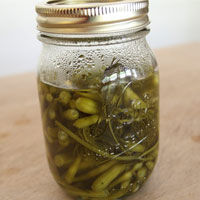
Ingredients
- 2 cups wild radish pods
- white wine vinegar
- 1 jalapeno (or other hot pepper)
- 1/2 cup wild mustard buds
- 4 cups water
- 1 red onion
- several whole black peppercorns
- 1 tbsp. almond oil
- several leaves of sticky monkeyflower of black sage
Directions
- Wash pods, remove stems.
- Boil water in small saucepan, remove from heat and plunge pods into water until they turn bright green (1-3 minutes).
- If pods still haven’t turned bright green or softened enough, boil another round of water and repeat the plunge.
- Strain off water and transfer to sterilized glass jar. Add sliced red onion, sliced jalepeno, pepper corns, herb leaves and cleaned mustard flowers.
- Boil vinegar, then add to glass jar entirely submerging all foods. Drizzle on oil.
- Allow to cool, then cap with lid and refrigerate. Allow to marinate for 2-3 days before consuming.
- Pods kept submerged in vinegar should last 2-3 months, perhaps longer.
- For a sweet and sour taste, try adding 2 tbsps. brown sugar while heating the vinegar.
Methods of Prevention and Control of Wild Radish
Prevention of Wild Radish is less expensive and less time-consuming than trying to control it. Make sure when you are seeding a new area you are doing so with specialized weed-free seeds. If there is an infested area on your property, be sure to drive around, instead of through it. Finally, make sure to give all equipment that has been in infested fields a good clean, to make sure no seeds are transferred.
Wild Radish Control
Cultural Control
Mowing is an option to control Wild Radish to reduce the seed production. Due to the fact that they come up at the same time as cereal crops, mowing can only be done in infested pastures.
Here are a few steps that may be able to help you control this particular weed.
- Do the recommendations given to you by the soil test
- Make sure you have high-yielding varieties of plants that are adaptable
- Field should be planted with high-yield varieties in narrow rows, with high plant population. as soon as ideal soil and weather conditions are met
- Scout fields on a regular basis
Chemical Control
Herbicides are a more passable method for trying to control Wild Radish in fields that cannot be mowed. Trying to control older and larger plants is much more difficult and time consuming, so timely application is critical. Herbicides will be ineffective if applied when the plant is under stress. The herbicides will have more effect right before or right after rain, due to the fact that the roots of the plants are taking in water at the time, which in turn means they will be taking in the herbicides as well. MCPA (4.0 lb. active/gal) applied at 1.0 to 1.25 pt./A or 2,4-D (3.8 lb. active/gal) applied at 1.0 to 1.25 pt./A provides extremely effective control for Wild Radish that is 8 inches tall or less.
References
- https://www.itis.gov/servlet/SingleRpt/SingleRpt?
- http://www.hear.org/pier/species/pyrus_calleryana.htm
- https://npgsweb.ars-grin.gov/gringlobal/taxon/taxonomydetail?
- https://pfaf.org/user/Plant.aspx?
- https://www.wildflower.org/plants/result.php?
- http://www.missouribotanicalgarden.org/PlantFinder/PlantFinderDetails.aspx?
- https://plants.usda.gov/core/profile?
- https://www.invasive.org/browse/subinfo.cfm?
- https://www.cabi.org/isc/datasheet/46188
- https://www.cal-ipc.org/plants/profile/pyrus-calleryana-profile/
- http://www.efloras.org/florataxon.aspx?
- https://texasinvasives.org/plant_database/detail.php?
- http://www.iucngisd.org/gisd/species.php?
- http://www.theplantlist.org/tpl1.1/record/rjp-6009
- https://en.wikipedia.org/wiki/vegetables
- https://gd.eppo.int/taxon/PYUCA
- https://www.illinoiswildflowers.info/savanna/plants/
- https://uses.plantnet-project.org/en/
- https://www.theplantlist.org/tpl1.1/record/
- https://training.ars-grin.gov/gringlobal/taxon/taxonomydetail?
- http://hort.ufl.edu/database/documents/pdf/tree_fact_sheets/
- https://www.illinoiswildflowers.info/trees/plants/callery_pear.htm
- https://www.ncbi.nlm.nih.gov/books/NBK218749/
- https://www.ncbi.nlm.nih.gov/books/NBK551014/
- https://www.ncbi.nlm.nih.gov/books/NBK551727/
- https://www.ncbi.nlm.nih.gov/books/NBK65874/
- https://www.ncbi.nlm.nih.gov/books/NBK304428/
- https://www.ncbi.nlm.nih.gov/books/NBK218759/
- https://www.ncbi.nlm.nih.gov/books/NBK556048/
- https://www.ncbi.nlm.nih.gov/books/NBK218749/
- https://www.niehs.nih.gov/health/topics/agents/vegetables/index.cfm
- https://www.sciencedirect.com/book/9780443062414/vegetable
- https://www.amazon.com/Essential-Oils-Fully-Revised-Updated/dp/1787752291
- https://www.healthbenefitstimes.com/category/herbs-and-spices/
- https://www.frontiersin.org/articles/257193
- https://www.tandfonline.com/toc/tjeo20/current
- https://www.intechopen.com/chapters/68027
- https://onlinelibrary.wiley.com/doi/full/10.1002/ptr.6854
- https://www.nature.com/articles/s41598-020-68823-4
- https://www.cancer.gov/about-cancer/treatment/cam/patient/aromatherapy-pdq
- https://www.researchgate.net/publication/254247133_
- https://link.springer.com/article/10.1365/s10337-010-1680-0
- https://fdc.nal.usda.gov/ndb/foods/show/herb
- https://www.nccih.nih.gov/health/herbsataglance
- https://portal.nifa.usda.gov/web/crisprojectpages/0092887
- https://academic.oup.com/database/article/doi/10.1093/database/bau120
- https://www.cambridge.org/core/journals/weed-science/article/herbicide-effects-of-vegetable/
- https://www.fs.fed.us/wildflowers/ethnobotany/vegetable
- https://www.karger.com/Article/Abstract/501062
- https://en.wikipedia.org/wiki/List_of_plant
- https://en.wikipedia.org/wiki/Types_of_plant_harb
- https://www.britannica.com/topic/cereals
- https://www.planttherapy.com/
- https://academic.oup.com/plphys/article/54/4/560/
- https://www.healthbenefitstimes.com/category/oils/
- https://www.aromaweb.com/essentialoils/default.asp
- https://books.google.com/books/about/Herbs_And_Essential_Oils_Book.html?
- https://books.google.com/books/about/Herbal_herb_for_Health_Beauty.html?id=C_MX9tKpttMC
- https://books.google.com/books/about/Herbal_vegetable_for_Health_Beauty.html?id=C_MX9tKpttMC
- https://www.niehs.nih.gov/health/topics/agents/
- https://www.botanical.com/botanical/mgmh/l/
- https://www.nccih.nih.gov/health/atoz
- https://clinicaltrials.gov/ct2/show/NCT02764567
- https://fda.report/Company/Young-Living-Essential-Oils-Lc
- http://www.fao.org/3/ad420e/ad420e.pdf
- https://www.healthywa.wa.gov.au/Articles/A_E/
- https://www.niehs.nih.gov/health/topics/agents/
- https://www.consumerreports.org/health-product-recalls/
- https://www.itis.gov/servlet/SingleRpt/SingleRpt?search_topic=TSN&search_value=42325#null
- https://www.cabi.org/isc/datasheet/46654
- https://www.itis.gov/servlet/SingleRpt/SingleRpt?search_topic=TSN&search_value=506060#null
- https://www.itis.gov/servlet/SingleRpt/SingleRpt?search_topic=TSN&search_value=784875#null
- https://www.itis.gov/servlet/SingleRpt/SingleRpt?
- https://www.itis.gov/servlet/SingleRpt/SingleRpt?search_topic=TSN&search_value=23289#null
http://www.hear.org/pier/species/raphanus_raphanistrum.htm
https://npgsweb.ars-grin.gov/gringlobal/taxonomydetail.aspx?id=30856
https://pfaf.org/user/Plant.aspx?LatinName=Raphanus+raphanistrum
https://www.cabi.org/isc/datasheet/46795
http://www.floracatalana.net/raphanus-raphanistrum-l
http://wisflora.herbarium.wisc.edu/taxa/index.php?taxon=4771&cl=Brassicaceae%20(mustards)
http://floraofalabama.org/Plant.aspx?id=1278
https://plants.usda.gov/core/profile?symbol=RARA2
https://en.wikipedia.org/wiki/Raphanus_raphanistrum
http://www.theplantlist.org/tpl1.1/record/kew-2422367
https://keyserver.lucidcentral.org/weeds/data/media/Html/raphanus_raphanistrum.htm