Populus fremontii, commonly known as Cottonwood is a fast-growing deciduous tree native to riparian zones of the Southwestern United States and northern through central Mexico. The plant belongs to Salicaceae or Willow family. Few of the common names of the plant are Fremont cottonwood, Fremont’s cottonwood, Western Cottonwood, Fremont Poplar, Alamo cottonwood, poplar, balsam poplar, Alamo, aspen, quaking aspen, tacamahac, hackmatac, western poplar, Arizona cottonwood, Valley Cottonwood, Rio Grande Cottonwood and Meseta Cottonwood. It is fast growing deciduous hardwood tree that grows about 12-35 meter (39-115 ft.) height and trunk diameter ranges from 1.5 m (4.9 ft.) wide. The largest known Populus fremontii tree in the United States grows in Skull Valley, Arizona. In 2012 it had a measured circumference of 557 inches (14.1 m) or 46.4 feet, height of 102 feet (31 m), and a spread of 149.5 feet (45.6 m).
Plant Description
Cottonwood is a large tree growing primarily on alluvial soil and on other sites such as near water tanks, along irrigation ditches, dry washes, floodplains of major rivers, large perennial streams, springs, and in desert oases. It prefers well-drained, alluvial, sandy to sandy clay loams with varying degrees of organic matter, clay or other fine soil and rock deposits, coarse, rocky and sterile soils, and fine-grained alluvial substrates. It has also been described as fairly salt tolerant. Growth is much less on wet soils, on poor acid soils and on thin dry soils. The plant has extensive and aggressive root systems that can attack and damage drainage systems. Bark is smooth and light grey in younger trees, becoming deeply furrowed dark brown, with whitish cracked bark with age.
Leaves
Leaves are 3-7 cm (1.2-2.8 in) long that are shiny, smooth, green, cordate (heart-shaped) with white veins and coarse crenate-serrate teeth on the margins. The leaves have petioles 1/2 to equal the blade length, laterally compressed near the blade which causes the leaves to flutter in the wind. They are glabrous to hairy, and often stained with milky resin. They are shiny and dark green above and silvery below. They turn yellow in the fall and form a thick layer of mulch on the forest floor.
Flower & fruit
Catkins (flowering body of the tree) grow differently on male and female trees, along with sticky fragrant leaf buds, and are among the first signs of spring. Male flowers are reddish pint and droop down in a catkin shape and are ¾–1¼ inches (2–3 cm) long and female ones are larger, 3–8 inches (8–20 cm) long catkins. Flowering normally takes place from March to April. The female flowers are followed by light green seed capsules. The ripe capsules split into 3 valves and release seeds with white, cottony down that are carried great distances by the wind, thus the name cottonwood. Cottonwood fluff can be so thick that the tree is called “snow in summer.” Despite this dissemination of seeds, poplar usually propagates through root sprouts instead.
Traditional uses and benefits of Cottonwood
- Inner bark was consumed by numerous native North American Indian tribes in order to prevent scurvy.
- Bark is therefore anodyne, anti-inflammatory and febrifuge.
- It is used particularly in treating rheumatism and fevers, and also to relieve the pain of menstrual cramps.
- An infusion of the bark and leaves has been used to wet a cloth which is then tied around the head as a treatment for headaches.
- Infusion has also been used as a wash on cuts, bruises, wounds and insect stings.
- Poultice of the boiled bark and leaves has been used to treat swellings caused by muscle strain.
- Native Americans ate the inner bark of Fremont cottonwood for antiscorbutic.
- Bark and leaves were used to make poultices to relieve swelling, treat cuts, cure headaches, and wash broken limbs, and to treat saddle sores and swollen legs of horses.
- Leaf buds make an excellent ointment for burns and skin irritations.
- Wash of the bark is applied externally for cuts, bruises, abrasions, burns and fetid perspiration, as well as healing chafing sores on horses.
- Salve can be made that cleanses and conditions the skin when used regularly.
- Taken internally, it is an anti-inflammatory agent, reduces fever, indigestion, aids coughs from colds, expels worms and intestinal parasites, is effective against scurvy, heart troubles, back pain, excessive menses, urinary tract infections, is a diuretic, and is used to prevent premature birth.
- Cherokee used cottonwood for chronic rheumatism, people with phlegmatic habits, sores, colic, aching teeth, and venereal complaints.
- Iroquois used cottonwood to kill worms in adults, arthritis, skin eruptions and scabs and a decoction of bark taken as a laxative.
- Menominee put the resinous buds in fat which was then used in the nostrils for a head cold, and they used a decoction of resinous buds in fat as a salve for wounds.
- You can make vinegar of the bark to decrease heartburn and improve overall digestion and assimilation.
- It makes a great addition to creams or salves for chapped, scaly skin.
- Wetting a handkerchief in a solution made from the bark and leaves and then tying it around the head cured headaches.
Culinary uses
- Catkins raw or cooked can be consumed as a snack.
- Young green seedpods have been chewed as a gum.
- Inner bark is often dried, ground into a powder and then used as a thickener in soups etc. or added to cereals when making bread.
- Bark is bitter, but edible and can be eaten, cooked in strips like soup noodles, or dried and powdered as a flour substitute.
- Bark is the most effective part for tea but is rather bitter; for this reason the leaves are often preferred.
Other facts
- Strips of the inner bark have been used in garments.
- An extract of the shoots can be used as a rooting hormone for all types of cuttings.
- Young twigs are peeled and split then used in basket making.
- Wood is soft, weak, light, and rather woolly in texture, without smell or taste, of low flammability, not durable, very resistant to abrasion.
- It is used locally for fence posts, the trees are also frequently pollarded for fuel.
- Fremont cottonwood has been widely planted as an ornamental and a shade tree, and used as a windbreak throughout the southwestern United States.
- Twigs were used by the Pima for basket materials.
- Cahuilla tribes used the wood for mortars and tools.
- Small industries utilize the wood to make bowls and small statues in northern Mexico.
- Fremont cottonwoods were used by the Pueblo tribes for drums and were the preferred wood species for Quechan cremations.
- Chumash skirts were made of fibers of Populus inner bark.
- Cordage, made from the inner bark of cottonwood or milkweed, held the rest of the fibers hanging freely.
- Wintun also used Populus fibers for skirts and for padding baby cradles.
- Fremont cottonwood was used in the past by settlers and ranchers for fuel and fence posts.
- Many herbalists use poplar bud oil as a base for salves and creams or add it to other oils to prevent them from going rancid.
Cottonwood Salve Recipe
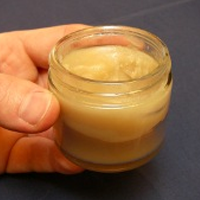
Ingredients
- 1 cup of cottonwood oil
- 1/4 cup of shaved beeswax
Directions
- First, choose a pot or pan that you don’t mind dedicating to salve-making, as the medicine will be very difficult to completely remove.
- Heat up your cottonwood oil on the stove on low heat.
- You can even use a double-boiler to further protect the oil from getting too hot, though it is not necessary.
- Once the oil has warmed up, slowly add the thin shavings of beeswax into the pot (a cheese grater can be used to shave a block of beeswax), waiting for shavings to melt before adding more.
- You can test the consistency of your medicine by removing a teaspoon of the heated oil/beeswax mix, and allowing it to fully cool.
- Your goal is to create an ointment consistency. Too little beeswax and the mixture remain as thick oil, while too much beeswax turns the mix into a hard consistency similar to lip balm.
- You can adjust by adding more oil or beeswax to gain the desired consistency.
- Once you have melted your beeswax into the mix and achieved the desired consistency upon testing, you can allow the mix to begin to cool.
- Just before your salve begins to firm up, you can pour the warm salve into small containers such as baby food jars or small tins.
- Your salve will then cool down into place. The small containers of cottonwood salve make great gifts and additions to first aid kits.
- You can now use the salve to sooth sore muscles, treat minor burns and scrapes, and soften rough hands. Enjoy!
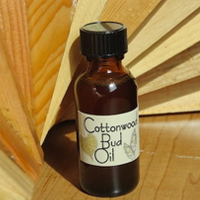
Cottonwood bud Oil
Ingredients
- Extra virgin olive oil (enough to cover the buds)
- Double boiler
- Blender (only if you are making a large amount)
- Pressing cloth like muslin
- Strainer
- Glass jar for long-term storage (If you do not have a double boiler you can create your own by placing a small pot in a larger pot with an inch or two of water in it.)
Step 1: Blend or pinches open the buds. This will help the resin to more easily release into the oil. If you have a small amount you can simply pinch the buds with your fingernail. Place directly in a double boiler and cover completely with olive oil.
For larger amounts, using a blender will save you a considerable amount of time. First, place your buds in a double boiler and cover them with olive oil so they are fully covered ½ to 1 inch above the buds. Pour oil and buds into the blender. Turn on and blend just until the buds are mostly broken open. Place back in the double boiler.
Step 2: Gently heat. Heat on a very low setting. Do not allow the olive oil to get hot enough that it boils! You can turn the burner on and off to keep the temperature low. Heat for several days. The oil will turn a deep golden color and become very fragrant.
Step 3: Press out the oil. Lay a piece of muslin cloth over a strainer that is sitting on a container. Pour a couple of cups of buds and oil into the muslin, bundle it up, twist the cloth and squeeze with all you might. Once oil stops dripping, empty the buds into a compost container and continue pressing until done. Let the pressed oil rest for an hour or so. If there is any water or solid material it will fall to the bottom of your container.
Step 4: Store. Pour your oil (minus any water or solids that might be at the bottom) into a glass storage container. You can use any glass jar with a tight fitting lid. Amber jars are nice because they protect the oil from sunlight, but you can keep clear glass containers in a cupboard in a cool place and the oil will preserve just as well. Remember to label – although the smell of this oil makes it easy to identify.
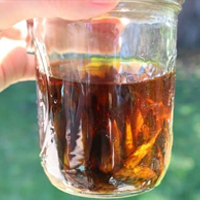
Cottonwood Tincture
Ingredients
- A mason jar
- 1 part cottonwood buds
- 3 parts high-proof alcohol
Directions
- Measure out the cottonwood buds you want to use and add them to the jar. I used 2oz of cottonwood buds, but you can certainly make a larger batch.
- Next, pour the alcohol over the buds. I used 6oz of high-proof alcohol.
- Tightly seal the lid and label the jar with the contents and the date.
- Allow the tincture to infuse for 4 weeks or longer. Be sure to swirl the tincture every so often to make sure all the plant matter stays under the alcohol. This will also help with extraction.
- Once the tincture has finished macerating, strain it through a fine mesh strainer into the desired vessel. Be sure to squeeze out as much tincture from the buds as you can.
References
- https://www.itis.gov/servlet/SingleRpt/SingleRpt?
- http://www.hear.org/pier/species/pyrus_calleryana.htm
- https://npgsweb.ars-grin.gov/gringlobal/taxon/taxonomydetail?
- https://pfaf.org/user/Plant.aspx?
- https://www.wildflower.org/plants/result.php?
- http://www.missouribotanicalgarden.org/PlantFinder/PlantFinderDetails.aspx?
- https://plants.usda.gov/core/profile?
- https://www.invasive.org/browse/subinfo.cfm?
- https://www.cabi.org/isc/datasheet/46188
- https://www.cal-ipc.org/plants/profile/pyrus-calleryana-profile/
- http://www.efloras.org/florataxon.aspx?
- https://texasinvasives.org/plant_database/detail.php?
- http://www.iucngisd.org/gisd/species.php?
- http://www.theplantlist.org/tpl1.1/record/rjp-6009
- https://en.wikipedia.org/wiki/vegetables
- https://gd.eppo.int/taxon/PYUCA
- https://www.illinoiswildflowers.info/savanna/plants/
- https://uses.plantnet-project.org/en/
- https://www.theplantlist.org/tpl1.1/record/
- https://training.ars-grin.gov/gringlobal/taxon/taxonomydetail?
- http://hort.ufl.edu/database/documents/pdf/tree_fact_sheets/
- https://www.illinoiswildflowers.info/trees/plants/callery_pear.htm
- https://www.ncbi.nlm.nih.gov/books/NBK218749/
- https://www.ncbi.nlm.nih.gov/books/NBK551014/
- https://www.ncbi.nlm.nih.gov/books/NBK551727/
- https://www.ncbi.nlm.nih.gov/books/NBK65874/
- https://www.ncbi.nlm.nih.gov/books/NBK304428/
- https://www.ncbi.nlm.nih.gov/books/NBK218759/
- https://www.ncbi.nlm.nih.gov/books/NBK556048/
- https://www.ncbi.nlm.nih.gov/books/NBK218749/
- https://www.niehs.nih.gov/health/topics/agents/vegetables/index.cfm
- https://www.sciencedirect.com/book/9780443062414/vegetable
- https://www.amazon.com/Essential-Oils-Fully-Revised-Updated/dp/1787752291
- https://www.healthbenefitstimes.com/category/herbs-and-spices/
- https://www.frontiersin.org/articles/257193
- https://www.tandfonline.com/toc/tjeo20/current
- https://www.intechopen.com/chapters/68027
- https://onlinelibrary.wiley.com/doi/full/10.1002/ptr.6854
- https://www.nature.com/articles/s41598-020-68823-4
- https://www.cancer.gov/about-cancer/treatment/cam/patient/aromatherapy-pdq
- https://www.researchgate.net/publication/254247133_
- https://link.springer.com/article/10.1365/s10337-010-1680-0
- https://fdc.nal.usda.gov/ndb/foods/show/herb
- https://www.nccih.nih.gov/health/herbsataglance
- https://portal.nifa.usda.gov/web/crisprojectpages/0092887
- https://academic.oup.com/database/article/doi/10.1093/database/bau120
- https://www.cambridge.org/core/journals/weed-science/article/herbicide-effects-of-vegetable/
- https://www.fs.fed.us/wildflowers/ethnobotany/vegetable
- https://www.karger.com/Article/Abstract/501062
- https://en.wikipedia.org/wiki/List_of_plant
- https://en.wikipedia.org/wiki/Types_of_plant_harb
- https://www.britannica.com/topic/
- https://www.planttherapy.com/
- https://academic.oup.com/plphys/article/54/4/560/
- https://www.healthbenefitstimes.com/category/oils/
- https://www.aromaweb.com/essentialoils/default.asp
- https://books.google.com/books/about/Herbs_And_Essential_Oils_Book.html?
- https://books.google.com/books/about/Herbal_herb_for_Health_Beauty.html?id=C_MX9tKpttMC
- https://books.google.com/books/about/Herbal_vegetable_for_Health_Beauty.html?id=C_MX9tKpttMC
- https://www.niehs.nih.gov/health/topics/agents/
- https://www.botanical.com/botanical/mgmh/l/
- https://www.nccih.nih.gov/health/atoz
- https://www.inaturalist.org/taxa
- https://clinicaltrials.gov/ct2/show/NCT02764567
- https://fda.report/Company/Young-Living-Essential-Oils-Lc
- http://www.fao.org/3/ad420e/ad420e.pdf
- https://www.healthywa.wa.gov.au/Articles/A_E/
- https://www.niehs.nih.gov/health/topics/agents/
- https://www.consumerreports.org/health-product-recalls/
- https://www.itis.gov/servlet/SingleRpt/SingleRpt?search_topic=TSN&search_value=22459#nullhttps://davesgarden.com/guides/pf/go/54168/https://pfaf.org/user/Plant.aspx?LatinName=Populus+fremontiihttp://www.theplantlist.org/tpl1.1/record/kew-5000106https://plants.usda.gov/core/profile?symbol=pofr2https://en.wikipedia.org/wiki/Populus_fremontii