Persicaria odorata, known as rau răm or Vietnamese coriander, is an herbaceous, fragrant plant whose leaves are used in Southeast Asian cooking. Vietnamese coriander is not related to the mints, nor is it in the mint family Lamiaceae, but its general appearance and fragrance are reminiscent of them. Persicaria is in the family Polygonaceae, collectively known as “smartweeds” or “pink weeds”. The plant is native to Indo-China. Since the 1960s its cultivation has spread with Vietnamese migrants, mainly to Australia, the Philippines, and the United States. Additional common names for this plant include Cambodian mint, preview leaf, Asian Mint, Laksa Leaf, Vietnamese Coriander, Vietnamese Mint, hot mint, rau mint, Vietnamese Cilantro, Rau Răm, Perennial Coriander, Coriandre du Vietnam, Daun Kesom, Daun Kesum, Daun Laksa, Korianderpilört, Persicaire du Vietnam and Renouée Odorant.
Genus name comes from the Latin persica meaning peach-like and sagittata meaning barbed or arrow-shaped in reference to the shape of the leaves. Specific epithet comes from Latin in reference to the aromatic and flavorful leaves. Persicaria Odorata has been widely used in many fields such as cooking, medicines and culture. Young leaves are used raw or cooked as a flavoring. Leaves are used extensively in Vietnamese cooking to flavor soups, stews, and salads. Leaves have a coriander-like smell and a spicy, pungent, hot peppery flavor. Vietnamese coriander is best when consumed young and fresh as older leaves can develop a tough texture and bitter flavor. In Southeast Asian cooking, Vietnamese coriander is often used interchangeably with mint and cilantro. Leaves are less frequently used as a diuretic, antipyretic, digestive tonic, or anti-aphrodisiac. Juice prepared from the crushed leaves was at one time taken as an antidote for treating poisonous snake bites.
Plant description
Vietnamese coriander is a short-lived creeping, perennial, herbaceous, fragrant plant that grows up to 15–30 cm (5.9–11.8 in) tall but it has been stated to grow up to 80 cm in ideal conditions. The plant grows best in tropical and subtropical zones in warm and damp conditions. The plant best grown in consistently moist to wet, moderately fertile soils in full sun to part shade. However plants prefer boggy soils including ones with some standing water. Stem is ascending, 10-25 cm tall, 2-3 mm in diameter, red, grooved; base trailing and forming roots at all nodes, much thicker than upright part. . The stem is jointed at each leaf. In Vietnam, it can be cultivated or found in the wild. It can grow very well outside in summer in non-tropical Europe. It should be brought inside for winter and treated as a house plant. It rarely flowers outside the tropics.
Leaves
Leaves alternate; lance-shaped to lanceolate-ovate (intermediate between lance- and egg-shaped) , ocrea membranous, short, up to a quarter of the length of the internode, loosely enveloping the stem, parallel veined, each vein culminating at apex in a long silky hair, with some glandular dots in horizontal lines; petiole attached to basal part of ocrea. The blade is entire, lanceolate to ovate-lanceolate, base attenuates, apex acuminate or obtuse, green, marked with red. The margins and veins are lined with long hairs. The top of its leaf is dark green, with chestnut-colored spots, while the leaf’s bottom is burgundy red-colored.
Flowers & Fruits
Flowers are arranged in a spike inflorescence which is rarely produced under cultivation and in cold climates. Flowers are produced singly or in pairs or in a small cluster; bracts long and funnel-shaped, with long hairs on margins. Flowers are attractive, hermaphrodite; white to purplish-pink colored (each to 1 ¼ inch long), the perianth is pentamerous. It blooms in late summer, but bloom rarely occurs in cool climates. Fertile flowers are followed by triangular-shaped fruit, 1.5 mm long, acuminate at both ends, smooth and shiny.
Health benefits of Vietnamese Coriander
Listed below are popular health benefits of Vietnamese coriander
1. Treat Flatulence and Abdominal Distension
Heat of Vietnamese coriander intensely encourages the digestive process. If you encounter digestive problems like flatulence or abdominal swelling, try solving them with this superb herb. Take a handful of washed Vietnamese coriander. Crush it into a liquid for drinking. For the remaining residue, rub it around your navel. You’ll see the positive changes after some time.
2. Treat Flu
Vietnamese coriander is considered an ideal solution for those having a cold. If you catch severe flu in the middle of the night when no pharmacy is open, search for Vietnamese coriander in your house. Wash a handful of this herb, grind it with fresh ginger, add in some water, and then filter the mixture for drinking medicine. Finally, your flu will be cured!
3. Treat Snake’s Bite
If someone accidentally gets bitten by a snake, don’t panic! Go to your herb garden and grab some Vietnamese coriander. As usual, crush them then drink the extracted liquid and apply the remaining on the bite.
4. Treat Diarrhea due to Cold Infection
Have you ever felt severe abdominal pain and then diarrhea right after you wake up and your belly exposes to the cold of the early morning? Well, lots of people have. Luckily, the hot Vietnamese coriander can handle it. Boil 16 g of dried Vietnamese coriander, 16 g of marjoram, 12 g of Aractylodes macrocephaly, 12 g of galangal, 10 g of cinnamon and 4 g of grilled ginger with 2 bowls of water until there is about 1 bowl left. Split the mixture into 2 parts for a daily dose.
5. Treat Fungus between Toes (Athlete’s Foot)
Vietnamese coriander also works for fungus between your toes. This fungus is a result of having your feet exposed to dirty water for a long time. Also, it can happen to people who have to wear shoes all day, particularly office workers. Wash the leaves; crush it into a liquid to apply on the wounded area. Or you can use the residue to cover it. And remember never to let your wound touch water.
6. Treat Ringworm and Scabies
Same as the athlete’s foot, Vietnamese coriander is also a fantastic treatment for ringworm and scabies. Both of these cause itching on your skin. Those with scabies may experience small red spots raised. To remove these itchy spots, soak the whole plant into white wine. Either apply the wine on the spots or crush the plant to put on the wound and then use a clean cloth as a bandage.
7. Treat Bruising and Swollen Wound
When you injure, it always takes time to fully heal. During that time, there are lots of suffering. And if your injury becomes bruising and swollen painfully, this outstanding plant can help relieve your pain. Wash a handful of Vietnamese coriander. Grind it along with camphor, and then rub the mixture over your wound. After that, fix the wound with a clean bandage.
8. Treat Skin Issues
Shockingly, Vietnamese coriander is also a favorite herb of girls as it’s great for skin care. Due to its anti-inflammatory and antidotal effects, this plant is an excellent natural method to remove pimples as well as tighten the pores. Crush a handful of washed Vietnamese coriander then mix it with some salt. For the pimples, cover them with the residue and fix them with a bandage. You should replace the residue once a day.
And for tightening the pores, after rinsing your face with warm water, apply the extract on it and rewash it with cold water after 2 hours. Now you can walk on the streets confidently!
9. Treat Tinea Versicolor in Newborns
This disease commonly occurs in infants. It causes a strange skin color in many areas in the body such as the chest, neck, back, and arms. Luckily, Vietnamese coriander is a phenomenal cure for this frightening disease. Pound the Vietnamese coriander leaves and add in a little alcohol. Then, gently rub the mixture over the affected areas with cotton. Wipe clean the skin after about 5 minutes. Apply this treatment for 2 or 3 times per day for the best results. (Note: Please keep in mind that because this herb is relatively hot, it can cause skin irritation. Once you see your child’s skin turns red in places where you’ve applied the mixture, stop using this treatment right away.)
10. Treat Sudden Heart Attack
There are numerous diseases that one has to overcome when they get aged. Some of which are diabetes, osteoporosis, high blood pressure, heart attack, and many more. If you usually face unexpected heart attacks, this incredible herb can give you better sleeps. Take the extract from 50 g of Vietnamese coriander roots. Drink it with a glass of white wine. A simple solution to fight back your nightmare!
11. Helps in Controlling Sexual Desires
One of the reasons why this herb is used very much in Vietnam is because it is known to suppress the need of sex. It is known that most Buddhist monks have this hot mint in their garden as it helps them in having celibate life.
12. Possess Anti-bacterial qualities
Oils that are derived from the leaves of this hot mint are used because of their powerful anti-oxidant behavior. This is one of the powerful herbs that can be used against bacteria such as E .coli.
Traditional Uses and benefits of Vietnamese Coriander
- Traditionally, in Vietnam, the herb is believed to curb sexual urges.
- Leaves are used as diuretic, stomachic, febrifuge, and anti-aphrodisiac.
- Externally the crushed leaves are applied against fever, vomiting, ringworm, and phagedaena.
- Juice prepared from the crushed leaves is taken as an antidote against poisonous snake bite, and the bite is covered with the residue of the leaves.
- In Vietnam, pregnant women avoid the use of rau ram since fresh leaves seem to have abortifacient properties.
- Leaves are used widely to treat skin infections caused by fungi or bacteria.
- Roots of Persicaria Odorata have been used for a variety of therapeutic purposes in Traditional Chinese Medicine.
Culinary Uses
- It is also popularly eaten with hột vịt lộn (fertilized duck egg).
- In the cuisine of Cambodia, the leaf is used in soups, stews, salads, and Cambodian summer rolls, name.
- In Singapore and Malaysia, the shredded leaf is an essential ingredient of laksa, a spicy noodle soup, so much so that the Malay name daun kesum means “kesum leaf”.
- In Malaysia, the leaf is also used for the dishes nasi kerabu and asam pedas.
- In Laos and certain parts of Thailand, the leaf is eaten with raw beef larb.
- In Australia, the plant is being examined as a source of essential oil (kesom oil).
- The leaves of rau ram are used to flavor many Vietnamese dishes.
- Fresh leaves are eaten in salads and also with incubated duck eggs, while fresh or cooked leaves are used in various fish, shellfish (mussels, clams, and oysters), and turtle and frog dishes.
- Young leaves are used raw or cooked as a flavoring.
- Few leaves can be added to a mixed salad, or they can be cooked with rice, vegetables etc.
- Few young shoots, combined with water dropwort (Oenanthe javanica) are often added when preparing cabbage preserved in brine (like sauerkraut).
- Persicaria Odorata leaves is usually used as a flavor in culinary and it also used as additional flavor to curries and hot soups.
Dosing consideration for Vietnamese Coriander
The appropriate dose of Vietnamese coriander depends on several factors such as the user’s age, health, and several other conditions. At this time there is not enough scientific information to determine an appropriate range of doses for Vietnamese coriander. Keep in mind that natural products are not always necessarily safe and dosages can be important. Be sure to follow relevant directions on product labels and consult your pharmacist or physician or other healthcare professional before using.
Other facts
- Many Buddhist monks grow coriander in their private gardens and eat it frequently, believing it helps them remain celibate.
- The flavor is destroyed by prolonged cooking.
- In Vietnam and the Philippines flowering is profuse and starts in the first year.
Precautions
- Women who are in their period shouldn’t eat Vietnamese coriander because it may cause over-bleeding.
- This herb may also weaken male physiology and lessen sexual desire; therefore, not recommended for men that are planning to have babies.
- Vietnamese coriander is specifically not for pregnant women as it increases the risk of miscarriage.
- Those who are thin and hot-blooded should never try this herb.
Recipes
Sweet and Sour Clam Soup (Canh ngao chua)
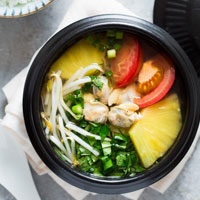
Ingredients
- 15 clams
- 8 oz. pineapple (about 1/4 of a whole pineapple)
- 2 medium tomatoes
- 1 1/2 cups bean sprouts
- 2 teaspoons fish sauce
- 2 1/2 cups water
- scallions
- Vietnamese coriander (or substitute with dill)
Instructions
- Scrub clams under running water. Place in a bowl, cover with water and add salt generously to the water. Set aside to purge clams for about 20 minutes. If clams are too dirty, repeat this process. After that, give them a quick rinse.
- Slice pineapple into 1/3 inch thick slices. Cut tomatoes into wedges. Thinly slice scallion and roughly chop Vietnamese coriander.
- Bring 2 1/2 cups of water to a boil in a pot over medium high heat. Add clams, cover the pot. When the shells are open, remove clams immediately from the pot. Skim off foam from the cooking liquid if there’s any.
- Remove the pot from the heat. Let all the impurities sink to the bottom of the pot. Carefully pour the cooking liquid into another clean pot without pouring the impurities. When you find it impossible to continue pouring without letting the impurities poured in, discard the remaining liquid.
- Place the new pot with clear cooking liquid on the stove and bring to boil. Add pineapple and tomatoes, reduce heat to a simmer and cover and cook. Meanwhile, pick the clam meat from the shells, set aside.
- When tomatoes are softened and you start to smell the pineapple scent, about 5 minutes or so, turn up the heat and when it starts to boil, add fish sauce and bean sprouts. Stir and when it starts boiling again, add clam meat and herbs.
- Adjust seasoning to taste, then transfer to serving bowls and serve hot.
Vietnamese Chicken Rice (Com Ga Hoi An)
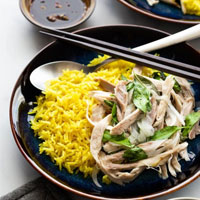
Ingredients
Homemade Chicken Stock and Shredded Chicken for Hoi an Chicken Rice (with leftover)
- 1 whole chicken (about 2.5-3 lbs.)
- 8 cups hot water
- salt
- 2-inch long piece of ginger, roughly peeled
To Assemble Hoi an Chicken Rice
- 3/4 cup long grain rice
- olive oil
- 1/4 teaspoon turmeric powder
- 1 1/4 cup homemade chicken stock
- half a medium onion
- 3/4 cup iced cold water
- 4 1/2 tablespoons lime juice, divided (juice of about 2 limes)
- 1 1/2 teaspoons sugar, divided (divided)
- 1 1/4 teaspoons salt
- 1 3/4 cups packed shredded chicken
- 3/4 cup lightly packed Vietnamese coriander leaves
- freshly cracked black pepper
To serve
- soy sauce
- bird’s eye chili, thinly sliced (optional)
- 3 small bowls of hot chicken stock
- thinly sliced scallions
Instructions
Making Homemade Chicken Stock and Shredded Chicken
- In a stock pot, add plenty of boiling water then add the whole chicken and a pinch of salt. Bring back to a boil and parboil for a minute. Discard the liquid and clean the pot.
- Add the chicken back to the pot, and add ginger, a teaspoon of salt and 8-9 cups of hot water (enough to barely cover the chicken). Bring to a boil and then lower to a gentle simmer.
- Cook for about 20 minutes or until the chicken is just cooked through. Remove the chicken from the stock and you can place it in a bowl of cold water for a couple of minutes to stop the cooking process.
- Separate the meat from the bones. Add the bones back to the stock and continue to simmer for about 40 minutes (or longer for a stronger stock if you have time). Chill the chicken meat in the refrigerator.
Making Turmeric Rice with Homemade Chicken Stock
- Once the chicken stock is ready, place a pan over medium heat and add some olive oil. Add rice and sauté for about 30 seconds then add turmeric powder. Stir and sauté until rice is evenly coated with turmeric powder.
- Transfer rice to your rice cooker pot. Add enough chicken stock you just made as indicated by the rice cooker. I need about 1 1/4 cups of chicken stock with my rice cooker. Choose the regular program you usually use to cook the rice.
Assembling Hoi An Chicken Rice
- While the rice is cooking, slice half of an onion as thinly as you can. We need about half a cup of onion slices. Soak them in 3/4 cup of iced cold water plus 2 tablespoons of lime juice and 1 1/4 teaspoons of sugar. Soak for at least 15 minutes.
- In a small bowl, mix together 2 1/2 tablespoons of lime juice, 1 1/4 teaspoons of salt and 1/4 teaspoon of sugar (the sugar is completely optional) to make the lime juice dressing. Tweak the ratio of ingredients to your liking.
- Take the chicken meat out of the refrigerator and shred. We need about 1 3/4 cups of shredded chicken. Mix the shredded chicken with onion slices and lime juice dressing. Set aside to let the flavors meld.
- When the rice is ready, add Vietnamese coriander leaves and plenty of freshly cracked black pepper to the shredded chicken and onion. Gently toss to combine.
- Fluff the rice with a spatula then add rice to serving plates. Top rice with the chicken salad. Serve immediately with soy sauce on the side and a small bowl of hot chicken stock as soup for each person. You can add bird’s eye chili to the soy sauce and some scallions to the soup. Taste and flavor the soup with some salt or a dash of fish sauce.
References
- https://www.itis.gov/servlet/SingleRpt/SingleRpt?
- http://www.hear.org/pier/species/pyrus_calleryana.htm
- https://npgsweb.ars-grin.gov/gringlobal/taxon/taxonomydetail?
- https://pfaf.org/user/Plant.aspx?
- https://www.wildflower.org/plants/result.php?
- http://www.missouribotanicalgarden.org/PlantFinder/PlantFinderDetails.aspx?
- https://plants.usda.gov/core/profile?
- https://www.invasive.org/browse/subinfo.cfm?
- https://www.cabi.org/isc/datasheet/46188
- https://www.cal-ipc.org/plants/profile/pyrus-calleryana-profile/
- http://www.efloras.org/florataxon.aspx?
- https://texasinvasives.org/plant_database/detail.php?
- http://www.iucngisd.org/gisd/species.php?
- http://www.theplantlist.org/tpl1.1/record/rjp-6009
- https://en.wikipedia.org/wiki/vegetables
- https://gd.eppo.int/taxon/PYUCA
- https://www.illinoiswildflowers.info/savanna/plants/
- https://uses.plantnet-project.org/en/
- https://www.theplantlist.org/tpl1.1/record/
- https://training.ars-grin.gov/gringlobal/taxon/taxonomydetail?
- http://hort.ufl.edu/database/documents/pdf/tree_fact_sheets/
- https://www.illinoiswildflowers.info/trees/plants/callery_pear.htm
- https://www.ncbi.nlm.nih.gov/books/NBK218749/
- https://www.ncbi.nlm.nih.gov/books/NBK551014/
- https://www.ncbi.nlm.nih.gov/books/NBK551727/
- https://www.ncbi.nlm.nih.gov/books/NBK65874/
- https://www.ncbi.nlm.nih.gov/books/NBK304428/
- https://www.ncbi.nlm.nih.gov/books/NBK218759/
- https://www.ncbi.nlm.nih.gov/books/NBK556048/
- https://www.ncbi.nlm.nih.gov/books/NBK218749/
- https://www.niehs.nih.gov/health/topics/agents/vegetables/index.cfm
- https://www.sciencedirect.com/book/9780443062414/vegetable
- https://www.amazon.com/Essential-Oils-Fully-Revised-Updated/dp/1787752291
- https://www.healthbenefitstimes.com/category/herbs-and-spices/
- https://www.frontiersin.org/articles/257193
- https://www.tandfonline.com/toc/tjeo20/current
- https://www.intechopen.com/chapters/68027
- https://onlinelibrary.wiley.com/doi/full/10.1002/ptr.6854
- https://www.nature.com/articles/s41598-020-68823-4
- https://www.cancer.gov/about-cancer/treatment/cam/patient/aromatherapy-pdq
- https://www.researchgate.net/publication/254247133_
- https://link.springer.com/article/10.1365/s10337-010-1680-0
- https://fdc.nal.usda.gov/ndb/foods/show/herb
- https://www.nccih.nih.gov/health/herbsataglance
- https://portal.nifa.usda.gov/web/crisprojectpages/0092887
- https://academic.oup.com/database/article/doi/10.1093/database/bau120
- https://www.cambridge.org/core/journals/weed-science/article/herbicide-effects-of-vegetable/
- https://www.fs.fed.us/wildflowers/ethnobotany/vegetable
- https://www.karger.com/Article/Abstract/501062
- https://en.wikipedia.org/wiki/List_of_plant
- https://en.wikipedia.org/wiki/Types_of_plant_harb
- https://www.britannica.com/topic/cereals
- https://www.planttherapy.com/
- https://academic.oup.com/plphys/article/54/4/560/
- https://www.healthbenefitstimes.com/category/oils/
- https://www.aromaweb.com/essentialoils/default.asp
- https://books.google.com/books/about/Herbs_And_Essential_Oils_Book.html?
- https://books.google.com/books/about/Herbal_herb_for_Health_Beauty.html?id=C_MX9tKpttMC
- https://books.google.com/books/about/Herbal_vegetable_for_Health_Beauty.html?id=C_MX9tKpttMC
- https://www.niehs.nih.gov/health/topics/agents/
- https://www.botanical.com/botanical/mgmh/l/
- https://www.nccih.nih.gov/health/atoz
- https://clinicaltrials.gov/ct2/show/NCT02764567
- https://fda.report/Company/Young-Living-Essential-Oils-Lc
- http://www.fao.org/3/ad420e/ad420e.pdf
- https://www.healthywa.wa.gov.au/Articles/A_E/
- https://www.niehs.nih.gov/health/topics/agents/
- https://www.consumerreports.org/health-product-recalls/
- https://www.missouribotanicalgarden.org/PlantFinder/PlantFinderDetails.aspx?taxonid=293779&isprofile=0&
- https://en.wikipedia.org/wiki/Persicaria_odorata
- https://npgsweb.ars-grin.gov/gringlobal/taxonomydetail.aspx?id=407755
- https://uses.plantnet-project.org/en/Persicaria_odorata_(PROSEA)
- http://gernot-katzers-spice-pages.com/engl/Pers_odo.html
- http://tropical.theferns.info/viewtropical.php?id=Persicaria+odorata
- https://wikivisually.com/wiki/Persicaria_odorata
- https://medwinpublishers.com/JONAM/JONAM16000174.pdf
- https://www.gardensonline.com.au/gardenshed/plantfinder/show_3888.aspx
- https://davesgarden.com/guides/pf/go/310/#b
- https://www.doc-developpement-durable.org/file/Plantes-Medicinales-