Kosher salt commonly known as cooking salt, flake salt, rock salt and kashering salt is a coarse-grained salt made from the salt crystals, used in the process of koshering meats by removing surface blood. It has a much larger and more porous grain size than common table salt. Kosher salt consists of sodium chloride, but it normally does not contain the mineral iodine, so it is not considered iodized salt. Some kosher salt contains anti-clumping agents in small amounts. It is considered a useful salt for sodium reduction. One teaspoon of kosher salt contains about 1,120 milligrams of sodium. In comparison, 1 teaspoon of table salt contains about 2,325 milligrams of sodium. Total sodium should be limited to less than 2,300 milligrams daily; and 1,500 milligrams for people aged 51 or older, African Americans or people with existing chronic kidney disease, diabetes or hypertension. The evaporation process concludes the salt’s final shape, so kosher salt can be flat or pyramidal in structure depending on the brand. The top two brands are Morton and Diamond Crystal: Morton’s is much coarser than table salt, but Diamond Crystal is even coarser than Morton.
Kosher salt Facts
| Name | Kosher salt |
|---|---|
| Common Names | Cooking salt, flake salt, rock salt and kashering salt |
| Method of Extraction | Evaporation process |
| Salt shape & size | Larger, flat, coarse, irregular crystal flakes shaped |
| Salt Color | White |
| Taste | Less salty |
| Major brands |
|
| Popular for | Marinades, pickling and brining |
| Great topping for | Homemade bagels, soft pretzels, and breadsticks |
| Lifespan | Lasts indefinitely |
Kosher salt can be used in most cooking applications. Some chefs favor kosher salt to table salt for its purity. Though, Kosher salt is generally not suggested for baking applications, particularly recipes that contain a small number of liquid ingredients, since it may not thoroughly dissolve. It may also be used as a finishing salt for cooked and baked goods to give the impression that an item is saltier. However, its porous grains help to remove moisture, so other finishing salts may be superior to retaining moisture and infuse a mineral-like taste.
Kosher salt will also increase the temperature of the water when boiling foods, such as potatoes, pasta or vegetables. This, in turn, will shorten the amount of time that the food needs to cook. This can come in handy when you are in a hurry to put dinner on the table in the evening. Kosher salt, is considered better than processed salt for pickling purposes. The salt crystals do not dissolve as readily as table salt in the pickling solution, making kosher salt a better option.
When to Use Kosher Salt
The best usage of kosher salt is when you’re seasoning food with your hands, particularly meat and vegetables before cooking. You can easily pick up pinches with your fingers, and since they don’t dissolve immediately, you can visually see where you’ve sprinkled it and determine if it’s even or if you need to do more.
Kosher salt is also great to use when a recipe specifies “coarse salt.” However, many bakers tend to shy away from kosher salt and call for table salt instead because they feel that it dissolves more quickly and evenly into baked goods.
Other Usage
General cooking
Because the salt has a more pure flavor due to the lack of metallic tasting additives such as iodine or dextrose, it is often used in the kitchen instead of additive-containing table salt so such flavors are not introduced to prepared food. Estimating the amount of salt can also be more easily evaluated when salting by hand due to the larger grain size. Some recipes specifically call for volume measurement of Kosher/kitchen salt which weighs less per measure due to its lower density, and is therefore less salty than an equal volume measurement of table salt.
Brining meats
Coarse-grained salt is used to create dry brine which increases succulence and flavor, sometimes with flavor additions such as herbs, spices or sugar. The meat is usually soaked in cool water, drained, completely covered with a thin layer of salt, and then allowed to stand on a rack or board for an hour or more. The larger salt granules remain on the surface of the meat, for the most part un-dissolved, and absorb fluids from the meat which are then partly reabsorbed with the salt and any added flavors essentially brining the meat in its own juices. The salt rub is then rinsed off and discarded before cooking.
Cleaning
Due to its grain size the salt is also used as a rough cleaner for cookware such as cast iron skillets. Mixed with oil it retains its harshness but can be easily dissolved with water after cleaning, unlike pumice or calcium carbonate based cleansers which can leave a gritty residue if not thoroughly rinsed away.
Other Facts
- Kosher salt is free of additives.
- Kosher salt’s flake-shaped crystals are easy to grab when seasoning by hand.
- Kosher salt tastes better than table salt.
- Kosher salt dissolves better and adheres to food more easily.
- Kosher salt is inexpensive and easy to find.
- 1 teaspoon Morton’s Kosher Salt = 3/4 teaspoon table salt.
Recipes
Goat Cheese and Panko-Crusted Australian Leg of Lamb

Ingredients
- 1 semi-boneless leg of Australian lamb (about 4-1/2 lb.), excess fat removed, tied
- 4 cloves garlic, cut lengthwise into quarters
- 16 1-inch sprigs fresh rosemary, plus 1 tsp. minced
- Kosher salt
- 5 Tbs. olive oil
- 8 oz. fresh goat cheese, at room temperature
- 1 Tbs. Dijon mustard
- 1 cup panko
- Freshly ground black pepper
Instructions
- Position a rack in the lower middle of the oven and heat the oven to 375°F. Trim any excess fat from the lamb.
- With the point of a knife, make 16 slits all over the lamb and insert a sliver of garlic and a rosemary sprig into each slit.
- Heat 2 Tbs. of the oil in a large, heavy ovenproof skillet or a flameproof roasting pan over medium-high heat.
- When the pan is hot, burn the roast until browned lightly on all four sides.
- Transfer the meat to a cutting board and cut away the twine. Carefully pour the hot fat out of the pan.
- In a medium bowl, mash and stir together the goat cheese and 1 Tbs. olive oil until smooth.
- Stir in the mustard.
- In another medium bowl, combine the panko with the remaining 2 Tbs. olive oil, the rosemary, 1 tsp. salt, and 1/4 tsp. pepper.
- Pat the lamb dry.
- Spread the goat cheese-mustard mixture on the three exposed sides of the lamb, then pat on the panko, pressing firmly so it adheres.
- Return the lamb to the pan and put in the oven. Roast until an instant-read thermometer inserted in the thickest part of the leg reads 145°F for medium rare, about 1 hour and 30 minutes.
- Let the lamb rest for 15 minutes before carving.
Cloud Eggs with Spinach Salad
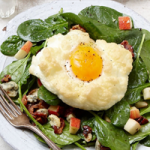
Ingredients
- 1 medium lime
- 1 Tbs. honey
- 1-1/2 tsp. white wine vinegar
- 1 small clove garlic, minced
- 1 Tbs. extra-virgin olive oil; more as needed
- Kosher salt and freshly ground black pepper
- 4 large eggs
- 8 oz. baby spinach (about 6 cups)
- 1/3 cup coarsely chopped candied pecans
- 1/4 lb. bacon (about 6 slices), cooked until crisp and chopped
- 1 Braeburn or similar apple, cut into 1/4-inch dice (about 1 cup)
Instructions
- Zest and juice the lime into a small bowl.
- Whisk in the honey, vinegar, and garlic, and then slowly add the oil while whisking. Season with salt and pepper.
- Position a rack in the center of the oven and heat to 425°F. Line a rimmed baking sheet with a silicone baking mat or lightly oiled parchment.
- Separate the eggs, putting the whites into the bowl of a stand mixer fitted with a whisk attachment and the yolks into four separate small bowls.
- Whisk the whites on medium-high speed until they reach stiff peaks, 2 to 3 minutes.
- Gently scoop the whites onto the prepared baking sheet into four cloudlike shapes, and season lightly with salt.
- Using the back of a spoon, gently create small wells for the yolks.
- Bake the whites for 3-1/2 minutes, then gently add one yolk into the well of each white. Sprinkle each yolk with a pinch of salt and bake until the whites are light golden brown and the yolks are not quite set, about 3 minutes.
- While the eggs are baking, toss the spinach with just enough of the vinaigrette to lightly coat, then divide the spinach among four plates.
- Top with the pecans, bacon, and apple. Gently place the eggs over the salads, sprinkle with pepper, and serve immediately.
Curried Yogurt Potato Salad
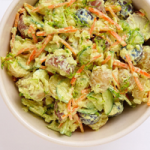
Ingredients
- 1-1/4 lb. baby Yukon Gold potatoes, halved (or quartered if large)
- 1 Tbs. olive oil
- 1 Tbs. grated fresh ginger
- 3/4 tsp. curry powder
- 3/4 cup plain whole-milk Greek yogurt
- 1/2 tsp. finely grated lime zest, more for garnish
- 1 tsp. fresh lime juice
- Kosher salt
- Freshly ground black pepper
- 2 medium carrots, cut into matchsticks
- 2 Persian cucumbers, sliced into thin half-moons
- 1/2 sweet onion, finely diced
Instructions
- Put the potatoes in a large pot of well-salted water. Bring to a boil over medium-high heat and cook until just tender, about 10 minutes. Drain and rinse under cold water.
- Heat the oil in a small skillet over medium heat.
- Add the ginger and curry powder and cook, stirring, until fragrant, about 1 minute; transfer to a large bowl.
- Whisk in the yogurt, lime zest, and juice, and 1-1/2 tsp. salt.
- Add the carrots, cucumbers, and onion, and toss well, then add the potatoes and toss gently.
- Season to taste with salt and black pepper, and garnish with additional lime zest, if you like.
Sear-Roasted Skirt Steak with Endive and Blue Cheese
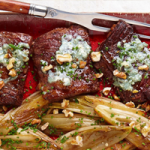
Ingredients
- 4 Tbs. unsalted butter, at room temperature
- 2 oz. mild blue cheese, such as Gorgonzola, crumbled (about 1/4 cup)
- 1-1/4 lb. skirt steak, cut into 4 portions
- Kosher salt and freshly ground black pepper
- 1 Tbs. vegetable oil
- 1 lb. endive (3 large or 6 small), cut lengthwise into 4 to 8 wedges depending on size
- 1 Tbs. honey; more for drizzling
- 2 Tbs. walnut pieces, lightly toasted
- 2 Tbs. thinly sliced chives
Instructions
- Position a rack in the center of the oven and heat to 350°F.
- In a small bowl, mash 2 Tbs. of the butter and the blue cheese. Set aside.
- Pat the steaks dry and season with salt and pepper.
- Heat the oil in a large skillet over medium-high heat. add the steaks and cook, flipping once, until nicely browned, about 4 minutes.
- Reserving the skillet, transfer the steaks to a small baking sheet and roast until medium rare (130°F to 135°F), 3 to 5 minutes. Let rest for 5 minutes.
- Meanwhile, arrange the endive in one layer in the skillet. Dot with the remaining 2 Tbs. butter and drizzle with the honey.
- Cover and cook over medium heat, stirring occasionally, until tender, about 5 minutes.
- Season to taste with salt and pepper.
- Arrange the steaks and endive on a platter.
- Slather the steaks with half of the blue cheese butter, and drizzle lightly with additional honey, if you like. Sprinkle with the walnuts and chives, and serve.
References
- https://www.itis.gov/servlet/SingleRpt/SingleRpt?
- http://www.hear.org/pier/species/pyrus_calleryana.htm
- https://npgsweb.ars-grin.gov/gringlobal/taxon/taxonomydetail?
- https://pfaf.org/user/Plant.aspx?
- https://www.wildflower.org/plants/result.php?
- http://www.missouribotanicalgarden.org/PlantFinder/PlantFinderDetails.aspx?
- https://plants.usda.gov/core/profile?
- https://www.invasive.org/browse/subinfo.cfm?
- https://www.cabi.org/isc/datasheet/46188
- https://www.cal-ipc.org/plants/profile/pyrus-calleryana-profile/
- http://www.efloras.org/florataxon.aspx?
- https://texasinvasives.org/plant_database/detail.php?
- http://www.iucngisd.org/gisd/species.php?
- http://www.theplantlist.org/tpl1.1/record/rjp-6009
- https://en.wikipedia.org/wiki/vegetables
- https://gd.eppo.int/taxon/PYUCA
- https://www.illinoiswildflowers.info/savanna/plants/
- https://uses.plantnet-project.org/en/
- https://www.theplantlist.org/tpl1.1/record/
- https://training.ars-grin.gov/gringlobal/taxon/taxonomydetail?
- http://hort.ufl.edu/database/documents/pdf/tree_fact_sheets/
- https://www.illinoiswildflowers.info/trees/plants/callery_pear.htm
- https://www.ncbi.nlm.nih.gov/books/NBK218749/
- https://www.ncbi.nlm.nih.gov/books/NBK551014/
- https://www.ncbi.nlm.nih.gov/books/NBK551727/
- https://www.ncbi.nlm.nih.gov/books/NBK65874/
- https://www.ncbi.nlm.nih.gov/books/NBK304428/
- https://www.ncbi.nlm.nih.gov/books/NBK218759/
- https://www.ncbi.nlm.nih.gov/books/NBK556048/
- https://www.ncbi.nlm.nih.gov/books/NBK218749/
- https://www.niehs.nih.gov/health/topics/agents/vegetables/index.cfm
- https://www.sciencedirect.com/book/9780443062414/vegetable
- https://www.amazon.com/Essential-Oils-Fully-Revised-Updated/dp/1787752291
- https://www.healthbenefitstimes.com/category/herbs-and-spices/
- https://www.frontiersin.org/articles/257193
- https://www.tandfonline.com/toc/tjeo20/current
- https://www.intechopen.com/chapters/68027
- https://onlinelibrary.wiley.com/doi/full/10.1002/ptr.6854
- https://www.nature.com/articles/s41598-020-68823-4
- https://www.cancer.gov/about-cancer/treatment/cam/patient/aromatherapy-pdq
- https://www.researchgate.net/publication/254247133_
- https://link.springer.com/article/10.1365/s10337-010-1680-0
- https://fdc.nal.usda.gov/ndb/foods/show/herb
- https://www.nccih.nih.gov/health/herbsataglance
- https://portal.nifa.usda.gov/web/crisprojectpages/0092887
- https://academic.oup.com/database/article/doi/10.1093/database/bau120
- https://www.cambridge.org/core/journals/weed-science/article/herbicide-effects-of-vegetable/
- https://www.fs.fed.us/wildflowers/ethnobotany/vegetable
- https://www.karger.com/Article/Abstract/501062
- https://en.wikipedia.org/wiki/List_of_plant
- https://en.wikipedia.org/wiki/Types_of_plant_harb
- https://www.britannica.com/topic/
- https://www.planttherapy.com/
- https://academic.oup.com/plphys/article/54/4/560/
- https://www.healthbenefitstimes.com/category/oils/
- https://www.aromaweb.com/essentialoils/default.asp
- https://books.google.com/books/about/Herbs_And_Essential_Oils_Book.html?
- https://books.google.com/books/about/Herbal_herb_for_Health_Beauty.html?id=C_MX9tKpttMC
- https://books.google.com/books/about/Herbal_vegetable_for_Health_Beauty.html?id=C_MX9tKpttMC
- https://www.niehs.nih.gov/health/topics/agents/
- https://www.botanical.com/botanical/mgmh/l/
- https://www.nccih.nih.gov/health/atoz
- https://www.inaturalist.org/taxa
- https://clinicaltrials.gov/ct2/show/NCT02764567
- https://fda.report/Company/Young-Living-Essential-Oils-Lc
- http://www.fao.org/3/ad420e/ad420e.pdf
- https://www.healthywa.wa.gov.au/Articles/A_E/
- https://www.niehs.nih.gov/health/topics/agents/
- https://www.consumerreports.org/health-product-recalls/
- https://www.sciencedirect.com/topics/immunology-and-microbiology/kosher-salthttps://en.wikipedia.org/wiki/Kosher_salt