Cotinus coggygria, commonly known as smoke tree, European smoketree, Eurasian smoketree, is an upright, deciduous shrub species of flowering plant in the family Anacardiaceae. The plant is native to large area from southern Europe, east across central Asia and the Himalayas to northern China. Few of the popular common names of the plants are Elm-leaved sumac, Fustet, Smoke bush, Smoke tree, Venetian sumac, Wig tree, Young fustic, European smoketree, Common smoketree, Purpler smoke tree, Smoke wood and Venetian sumach. It gets its common name of smoketree (or smokebush) not from the tiny, insignificant, yellowish flowers which appear in branching, terminal panicles in spring, but from the billowy hairs (attached to elongated stalks on the spent flower clusters) which turn a smoky pink to purplish pink in summer, thus covering the tree with fluffy, hazy, smoke-like puffs throughout summer.
Genus name comes from the Greek word kotinus meaning olive. Specific epithet comes from the Greek word kokkugia meaning smoke tree. The etymology of the specific name comes from the Greek term reported by Theophrastus, “κοκκυγέα”, in Latin “coccygéa”, that in Italian means “cotino, scotano, sommacco”. Probably the specific term may be also related to the Latin “coccum”, cochineal, due to the bright red color the leaves assume in autumn. The plant is harvested from the wild for local use as a medicine and source of materials, being especially valued as a dye plant and source of tannins for local use. It is often grown as an ornamental, valued especially for the attractive purple leaves of some cultivars.
Smoke Tree Facts
| Name | Smoke tree |
|---|---|
| Scientific Name | Cotinus coggygria |
| Native | Large area from southern Europe, east across central Asia and the Himalayas to northern China |
| Common Names | Elm-leaved sumac, Fustet, Smoke bush, Smoke tree, Venetian sumac, Wig tree, Young fustic, European smoketree, Common smoketree, Purpler smoke tree, Smoke wood, Venetian sumach |
| Name in Other Languages | lbanian: Cërmëdell Azerbaijani: Parik ağacı Bokmal: Parykkbusk Bulgarian: Smradlika (смрадлика), tetra (тетра), obiknovena smradlika (обикновена смрадлика) Chinese: Huang lu (黄栌) Croatian: Obična rujevina, Rujevina Czech: Ruj vlasatá Danish: Parykbusk Dutch: Pruikeboom, Pruikenboom English: Elm-leaved sumac, Fustet, Smoke bush, Smoke tree, Venetian sumac, Wig tree, Young fustic, European smoketree, Common smoketree, Purpler smoke tree, Smoke wood, Venetian sumach Esperanto: Eŭrazia kotino Finnish: Peruukkipensas French: Arbre à boucane, Arbre à perruque, Arbre à perruques, Barbe de Jupiter, Coquecigrue, Fustet, Fustot, Sumac fustet, Fustet commun, bois jaune, pompon, pustet, sumac des teinturiers, German: Europäischer Perückenstrauch, Färbersumach, Fisettholz, Gewöhnlicher Perückenstrauch, Perückenbaum, Perückenstrauch, Tiroler Sumach, Ungarischer Sumach, Venezianischer Sumach, Gelbholzsumach, gemeiner Perückenstrauch, Greek: Kótinos o kongýgrios (Κότινος ο κογγύγριος) Hebrew: קוטינוס מזרח Hungarian: Cserszömörce, Cserzőfa, Szömörcefa, Szumák, Sárga cserszömörce Italian: Albero della nebbia, Scotano, Sommaco selvatico, capecchio, cotino, sommacco Japanese: Kasuminoki (カスミノキ), Kasumi no ki (霞 の木 ), Kemuri no ki (煙の木), Kemurinoki (ケムリノキ), Kemuri no ki (けむりのき), Shirokuma no ki (白熊 の木), Wa guma no ki (はぐまの木), Sumōkutsurī (スモークツリー), hagumanoki (ハグマノキ) Korean: An gae na mu (안개나무) Lithuanian: Europinis pūkenis Netherlands: Pruikeboom Ossetic: Tırımılı (Тырымылы) Persian: درخت پر Polish: Perukowiec podolski Russian: Skumpiya kozhevennaya (Скумпия кожевенная), Skumpiya obyknovennaya (Скумпия обыкновенная), Skumpiya koggigriya (Скумпия коггигрия), Skumpiiyu kozhevennuyu (Скумпиию кожевенную), Skumpiyu obyknovennaya (Скумпию обыкновенная), Parikovoye derevo (Париковое дерево), Zheltinnik (Желтинник) Shambala: Obični ruj Slovak: Skumpa vlasatá Slovene: Navadni ruj Spanish: Árbol de las pelucas, Árbol de las pelugas, Árbol de la niebla, Árbol del humo, Fustete, Plumeros, Rus cotino, Zumaque cabelludo Swedish: Perukbuske Turkish: Duman Ağacı, Peruka Çalıs, boyacı sumağı Ukrainian: Skumpiya zvychayna (скумпія звичайна) |
| Plant Growth Habit | Slow growing, open-crowned, round, multiple-branching shrub or small tree |
| Growing Climates | Natural forests, ruderal/disturbed, urban areas, dry hillsides and prefers dry environments such as bushes, hedges, calcareous rocks, arid coasts, thickets, stony places, but it can be found also in the woods, close to banks and sources and in the nitrophilous vegetation of natural or anthropic origin |
| Soil | Easily grown in average, medium moisture, well-drained soils in full sun. Tolerates a wide range of soils except wet, poorly-drained ones |
| Plant Size | 10 to 15 feet tall (occasionally 20) and 10 to 15 feet wide |
| Bark | Thin, reddish-brown with prominent, horizontal lenticels when young |
| Stem | Stems are smooth and purple or brown in color . The older bark is light grey |
| Leaf | Leaves are 3–8 cm long rounded ovals, green with a waxy glaucous sheen. The autumn color can be strikingly varied, from peach and yellow to scarlet |
| Flowering season | June to July |
| Flower | Numerous, produced in large inflorescences 15–30 cm (5.9–11.8 in) long; each flower 5–10 mm diameter, with five pale yellow petals. Most of the flowers in each inflorescence abort, elongating into yellowish-pink to pinkish-purple feathery plumes (when viewed en masse these have a wispy ‘smoke-like’ appearance, hence the common name) |
| Fruit Shape & Size | Small 0.25 wide, kidney-shaped, dry, reticulate drupe |
| Propagation | By Seed and cuttings |
| Season | September to October |
| Precautions |
|
Smoke tree Scientific Classification
Scientific Name: Cotinus coggygria
| Rank | Scientific Name & (Common Name) |
|---|---|
| Kingdom | Plantae (Plants) |
| Subkingdom | Tracheobionta (Vascular plants) |
| Infrakingdom | Streptophyta (land plants) |
| Super Division | Spermatophyta (Seed plants) |
| Division | Magnoliophyta (Flowering plants) |
| Sub Division | Spermatophytina (spermatophytes, seed plants, phanérogames) |
| Class | Magnoliopsida (Dicotyledons) |
| Sub-Class | Rosidae |
| Super Order | Rosanae |
| Order | Sapindales |
| Family | Anacardiaceae (Sumac family) |
| Genus | Cotinus Mill. (smoketree) |
| Species | Cotinus coggygria Scop. (European smoketree) |
| Synonyms |
|
Plant Description
Smoke tree is a slow growing, open-crowned, round, multiple-branching shrub or small tree that grows about 10 to 15 feet tall (occasionally 20) and 10 to 15 feet wide with an open, spreading, irregular habit, only rarely forming a small tree. The plant is found growing in natural forests, ruderal/disturbed, urban areas, dry hillsides and prefers dry environments such as bushes, hedges, calcareous rocks, arid coasts, thickets, stony places, but it can be found also in the woods, close to banks and sources and in the nitrophilous vegetation of natural or anthropic origin. It is easily grown in average, medium moisture, well-drained soils in full sun. The plant tolerates a wide range of soils except wet, poorly-drained ones. It also prefers somewhat infertile loams, but performs well in poor, rocky soils. Sharp drainage is essential. Stem are smooth and purple or brown in color. The older bark is light grey.
Leaves
Leaves are 3–8 cm long rounded ovals, green with a waxy glaucous sheen. Autumn color can be strikingly varied, from peach and yellow to scarlet. The flowers are numerous, produced in large inflorescences 15–30 cm (5.9–11.8 in) long. Each flower is 5–10 mm diameter, with five pale yellow petals. Most of the flowers in each inflorescence abort, elongating into yellowish-pink to pinkish-purple feathery plumes (when viewed en masse these have a wispy ‘smoke-like’ appearance, hence the common name) which surround the small (2–3 mm) drupaceous fruit that do develop.
| Leaf arrangement | alternate |
| Leaf type | simple |
| Leaf margin | entire |
| Leaf shape | obovate, elliptic (oval) |
| Leaf venation | reticulate, pinnate |
| Leaf type and persistence | deciduous |
| Leaf blade length | 2 to 4 inches |
| Leaf color | blue or blue-green, green |
| Fall color | yellow, orange, red, purple |
| Fall characteristic | showy |
Flower & Fruits
Flowers are numerous, produced in large inflorescences 15–30 cm (5.9–11.8 in) long. Each flower is 5–10 mm diameter, with five pale yellow petals. Most of the flowers in each inflorescence abort, elongating into yellowish-pink to pinkish-purple feathery plumes (when viewed in mass these have a wispy ‘smoke-like’ appearance, hence the common name). Flowering normally takes place from June to July. Fertile flowers are followed by clusters of small, dry, kidney shaped reticulate drupes about 1/16 inches in diameter
| Flower color | pink, white/cream/gray |
| Flower characteristics | very showy |
They make a wonderful accent in a shrub border and can be planted as a specimen or as a patio tree where the black, showy, multiple trunk can be displayed. Planting Smoketree is a good way to extend the spring flowering-tree season into the summer before the Crape-Myrtles come into full bloom. Fall color is usually good to excellent and ranges from yellow to orange and brilliant red-purple. Many people grow it simply to enjoy the vivid fall color.
| Fruit shape | oval, irregular |
| Fruit length | less than .5 inch |
| Fruit covering | dry or hard |
| Fruit color | brown |
| Fruit characteristics | does not attract wildlife; showy; fruit/leaves not a litter problem |
Varieties
Several varieties of smoke tree do exist; they differentiate for the color of the leaves and of the flowers. The following varieties are popular among gardeners
1. Royal Purple smoke tree
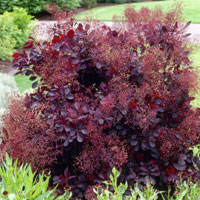
The most common variety is Cotinus. It grows slowly, in height and in diameter and reaches no more than 1.5-3 m, takes a rounded shape. The leaves of this variety immediately after blooming are dark red, almost black; in the summer it acquire a metallic sheen and somewhat less saturated color. In autumn, the plant shows itself in all its glory, dressed in an orange-red outfit. The flowers are red with a silvery sheen.
2. Rubrifolius smoke tree
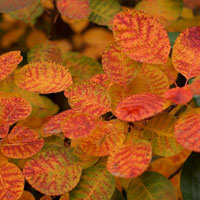
This variety usually grows up to 2 m in the southern regions and reaches 3-5. Leaves are unusually beautiful rich violet-plum color, in the autumn their color becomes red.
3. Golden Spirit smoke tree
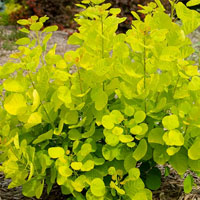
The average height of the plant is 1.5 – 3 m. Its leaves are very decorative at the beginning of its dissolution with an orange tint on the edges of the leaves and in the center of the veins. Autumn tree becomes even more beautiful. It gradually changes the color of the leaves from light green and orange to rich red, almost purple.
4. Young Lady smoke tree
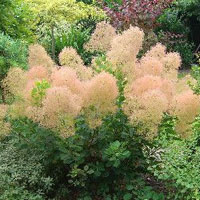
It’s a dwarf form that grows slowly. For 5-10 years, the shrub reaches 1-1. 5 m in height. The plant forms a neat and compact bush. The leaves are green in summer with a slight blue tint, in autumn they are painted in the whole range of yellow, orange, red.
5. Daydream Eurasian smoke tree
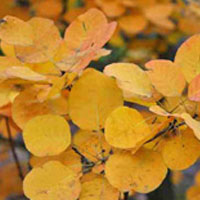
It has a bluish-green leaves that turn yellow to red in the fall; dense clusters of persistent flower stalks produce purplish-red smoke in mid-summer.
6. Grace smoke tree
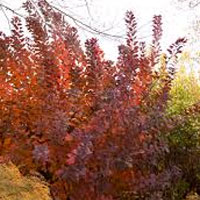
It is a hybrid of Cotinus obovatus and Cotinus coggygria ‘Velvet Cloak’. Large pink flower panicles are with 4 to 6 inch long blue-green leaves. It can be a small tree or large shrub reaching 15 to 20 feet high.
7. Nordine smoke tree
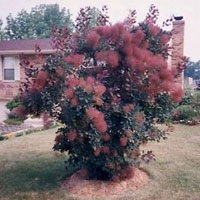
It is one of the hardiest of the purple-leaf forms, selected from The Morton Arboretum collections; oval to slightly elongate purplish-red leaves hold color well into the summer and then change to an orange-yellow in the fall.
8. Velvet Cloak smoke tree
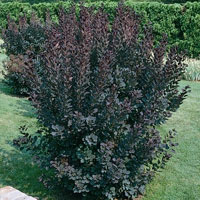
The plant has dark, oval to slightly elongate purple leaves that maintain color throughout the summer; fall color is a reddish-purple; large, purple-pink, airy, plume-like flower stalk clusters provide interest all summer.
Traditional uses and benefits of Smoke tree
- The yellow wood is used as a cholagogue, febrifuge and for eye ailments.
- The herb is also used to treat hair loss, leg sweating, colitis, diarrhea, dysentery.
- Smoke tree extract also finds use as an aid in treating various diseases of the genitourinary system.
- The plant is often used in traditional medicine, where it is seen as antiseptic, anti-inflammatory, antimicrobial and an anti-hemorrhagic agent for use in wound-healing.
- The plant has been used to prepare an herbal tea, used in the treatment of diarrhea, mouth inflammation and gastric and duodenal ulcers.
- Extracts of the plant have been shown to have high phenolic content and antioxidant properties.
- Various plant parts are rich in tannins and are effective astringents.
Other facts
- An essential oil is obtained from the leaves and flowers.
- A yellow to orange dye is obtained from the root and stem.
- The leaves, fruits and bark are a good source of tannins.
- Wood is used as ornamental.
- It is used for cabinet making, picture frames.
- The twigs are used in basketry.
- The wood was formerly used to make the yellow dye called young fustic.
- The plant has been grown to provide cover in windbreaks.
- The plant is traditionally used to dye carpets and woven matting in the eastern Mediterranean region.
- An extract of the leaves is used as an ingredient in commercial cosmetic preparations as a skin conditioner.
References
- https://www.itis.gov/servlet/SingleRpt/SingleRpt?
- http://www.hear.org/pier/species/pyrus_calleryana.htm
- https://npgsweb.ars-grin.gov/gringlobal/taxon/taxonomydetail?
- https://pfaf.org/user/Plant.aspx?
- https://www.wildflower.org/plants/result.php?
- http://www.missouribotanicalgarden.org/PlantFinder/PlantFinderDetails.aspx?
- https://plants.usda.gov/core/profile?
- https://www.invasive.org/browse/subinfo.cfm?
- https://www.cabi.org/isc/datasheet/46188
- https://www.cal-ipc.org/plants/profile/pyrus-calleryana-profile/
- http://www.efloras.org/florataxon.aspx?
- https://texasinvasives.org/plant_database/detail.php?
- http://www.iucngisd.org/gisd/species.php?
- http://www.theplantlist.org/tpl1.1/record/rjp-6009
- https://en.wikipedia.org/wiki/vegetables
- https://gd.eppo.int/taxon/PYUCA
- https://www.illinoiswildflowers.info/savanna/plants/
- https://uses.plantnet-project.org/en/
- https://www.theplantlist.org/tpl1.1/record/
- https://training.ars-grin.gov/gringlobal/taxon/taxonomydetail?
- http://hort.ufl.edu/database/documents/pdf/tree_fact_sheets/
- https://www.illinoiswildflowers.info/trees/plants/callery_pear.htm
- https://www.ncbi.nlm.nih.gov/books/NBK218749/
- https://www.ncbi.nlm.nih.gov/books/NBK551014/
- https://www.ncbi.nlm.nih.gov/books/NBK551727/
- https://www.ncbi.nlm.nih.gov/books/NBK65874/
- https://www.ncbi.nlm.nih.gov/books/NBK304428/
- https://www.ncbi.nlm.nih.gov/books/NBK218759/
- https://www.ncbi.nlm.nih.gov/books/NBK556048/
- https://www.ncbi.nlm.nih.gov/books/NBK218749/
- https://www.niehs.nih.gov/health/topics/agents/vegetables/index.cfm
- https://www.sciencedirect.com/book/9780443062414/vegetable
- https://www.amazon.com/Essential-Oils-Fully-Revised-Updated/dp/1787752291
- https://www.healthbenefitstimes.com/category/herbs-and-spices/
- https://www.frontiersin.org/articles/257193
- https://www.tandfonline.com/toc/tjeo20/current
- https://www.intechopen.com/chapters/68027
- https://onlinelibrary.wiley.com/doi/full/10.1002/ptr.6854
- https://www.nature.com/articles/s41598-020-68823-4
- https://www.cancer.gov/about-cancer/treatment/cam/patient/aromatherapy-pdq
- https://www.researchgate.net/publication/254247133_
- https://link.springer.com/article/10.1365/s10337-010-1680-0
- https://fdc.nal.usda.gov/ndb/foods/show/herb
- https://www.nccih.nih.gov/health/herbsataglance
- https://portal.nifa.usda.gov/web/crisprojectpages/0092887
- https://academic.oup.com/database/article/doi/10.1093/database/bau120
- https://www.cambridge.org/core/journals/weed-science/article/herbicide-effects-of-vegetable/
- https://www.fs.fed.us/wildflowers/ethnobotany/vegetable
- https://www.karger.com/Article/Abstract/501062
- https://en.wikipedia.org/wiki/List_of_plant
- https://en.wikipedia.org/wiki/Types_of_plant_harb
- https://www.britannica.com/topic/cereals
- https://www.planttherapy.com/
- https://academic.oup.com/plphys/article/54/4/560/
- https://www.healthbenefitstimes.com/category/oils/
- https://www.aromaweb.com/essentialoils/default.asp
- https://books.google.com/books/about/Herbs_And_Essential_Oils_Book.html?
- https://books.google.com/books/about/Herbal_herb_for_Health_Beauty.html?id=C_MX9tKpttMC
- https://books.google.com/books/about/Herbal_vegetable_for_Health_Beauty.html?id=C_MX9tKpttMC
- https://www.niehs.nih.gov/health/topics/agents/
- https://www.botanical.com/botanical/mgmh/l/
- https://www.nccih.nih.gov/health/atoz
- https://clinicaltrials.gov/ct2/show/NCT02764567
- https://fda.report/Company/Young-Living-Essential-Oils-Lc
- http://www.fao.org/3/ad420e/ad420e.pdf
- https://www.healthywa.wa.gov.au/Articles/A_E/
- https://www.niehs.nih.gov/health/topics/agents/
- https://www.consumerreports.org/health-product-recalls/
- https://www.itis.gov/servlet/SingleRpt/SingleRpt?search_topic=TSN&search_value=42325#null
- https://www.cabi.org/isc/datasheet/46654
- https://www.itis.gov/servlet/SingleRpt/SingleRpt?search_topic=TSN&search_value=506060#null
- https://www.itis.gov/servlet/SingleRpt/SingleRpt?search_topic=TSN&search_value=784875#null
- https://www.itis.gov/servlet/SingleRpt/SingleRpt?
- https://www.itis.gov/servlet/SingleRpt/SingleRpt?search_topic=TSN&search_value=28800#null
- http://www.hear.org/pier/species/cotinus_coggygria.htm
- https://npgsweb.ars-grin.gov/gringlobal/taxonomydetail.aspx?id=11697
- http://www.missouribotanicalgarden.org/PlantFinder/PlantFinderDetails.aspx?kempercode=c390
- https://plants.usda.gov/core/profile?symbol=COCO10
- https://en.wikipedia.org/wiki/Cotinus_coggygria
- https://edis.ifas.ufl.edu/st201
- http://www.theplantlist.org/tpl/record/kew-2739996
- https://gd.eppo.int/taxon/COTCO
- http://temperate.theferns.info/plant/Cotinus+coggygria