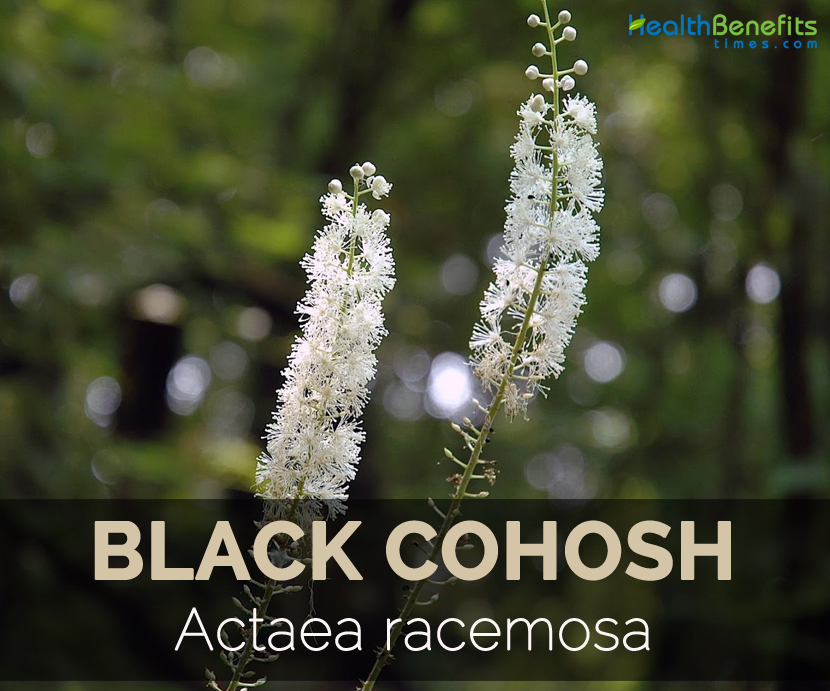
Actaea racemosa, black cohosh a species of Actaea racemosa L. also called Black snakeroot, Squawroot, Rattlesnake root, Black cohosh, Macrotys, Black snakeroot, Bugwort, Bugbane, Rattleweed, Rattleroot, Rattletop and Richweed, is a flowering plant in the buttercup family Ranunculaceae. It is an herbaceous perennial plant with oval shaped fruits. It grows in cool, well-drained and moist soils. The plant lives for more than two years in the wild. This plant is called Zong zhuang sheng ma in Chinese, Chasse-punaises in French, Traubensilberkerze in German, Cimicifuga in Italian and Cohosh negro in Spanish.
Black Cohosh Scientific Classification
Scientific Name: Actaea racemosa
| Rank | Scientific Name & (Common Name) |
|---|---|
| Kingdom | Plantae (Plants) |
| Subkingdom | Tracheobionta (Vascular plants) |
| Superdivision | Spermatophyta (Seed plants) |
| Division | Magnoliophyta (Flowering plants) |
| Class | Magnoliopsida (Dicotyledons) |
| Subclass | Magnoliidae |
| Order | Ranunculales |
| Family | Ranunculaceae (Buttercup family) |
| Genus | Actaea L. (Baneberry) |
| Species | Actaea racemosa L. (Black baneberry) |
| Variety | Actaea racemosa L. var. racemosa (Black bugbane) |
| Synonyms |
|
Black cohosh is native to North America. In 19th century, it was used as a home remedy in America and also used in Native American medicine. Black cohosh is used for rheumatism but it is recently used in a folk and traditional remedy to treat night sweats, hot flashes and vaginal dryness which are the symptoms that is experienced during menopause. Black cohosh is used to treat premenstrual syndrome and menstrual irregularities and promote labor.
Native American Indians are the one who use Black cohosh firstly for medicinal purposes and got introduced to European colonists. In the mid-1950s in Europe, Black cohosh became a well-known treatment for dealing with women’s health problems. The roots and underground stems of Black cohosh are used dried or fresh to make teas, capsules, solid extracts and liquid extracts.
This herb was used in Europe for about more than 40 years and is in Germany, it was authorized for painful menstruation, premenstrual discomfort and menopausal symptoms. In 1996, about 10 million retail units of a standardized isopropanolic and ethanolic extract were sold in Australia, Germany and the U.S. monthly. The herb was popular in U.S. as a dietary supplement.
Plant
Black cohosh is a herbaceous plant which grows upto 3-8 feet tall. The roots are thick, large, branching and black. Stems are smooth, erect, unbranched of about 4-8 feet. Leaves are alternately arranged, compound, tripinnate, smooth, glossy dark green which is 15-60 cm long. Stamens are 1/2″ long. The flowers turn to the oval shaped and follicle of size 5-10 mm. The fruits are angular, glabrous, brown and triangular seeds.
Health Benefits of Black cohosh
Black cohosh is mostly used by the medical practitioners. It helps to eradicate spasms, ease menopausal symptoms, lower inflammation, prevent mood swings and enhance sleep. It is considered as the natural cure all. It is considered to possess sedative, analgesic and anti-inflammatory properties. It is used to treat hot flashes, depression, insomnia, night sweats, anxiety, vaginal dryness and depression. The roots either fresh or dried are used for medicinal purposes.
- Anti-spasmodic
Black cohosh is anti-spasmodic which assists the functions of muscles and nerves, prevent cramps and aching pains. Black cohosh possesses anti-inflammatory properties. It helps to relieve the pains and aches associated with muscle strain, injury, chronic nervous tension and others. (1)
- Anti-inflammatory properties
Black cohosh is an anti-inflammatory property. The anti-inflammatory properties are helpful for congestion, sore throats and maintain high blood pressure. Black cohosh acts as a vasodilator which helps to reduce stress on cardiovascular system and reduces the blood clots which cause the heart attacks or strokes. (2)
- Menopausal symptoms
Black cohosh is used to treat menopausal symptoms for those who are going through menopause. One should supplement the diet by adding Black cohosh which helps to replace the hormone therapy. The studies show that Black cohosh helps to reduce night sweats and hot flashes to the menopausal women, lower stress and tension. (3)
- Supports digestion
The research shows that Black cohosh helps to raise the uptake of nutrients and eradicate the waste from the body that lowers the chances of constipation such as gastric ulcers. Black cohosh helps to lower cramping, flatulence, morning sickness, bloating and nausea. (4)
- Manage pain
Black cohosh helps to reduce pain in the women who experience painful menstrual cycles and going through painful labor contractions. It is often conducted during low development of labor and weak contractions. It is good to promote contractions and fasten the birthing process as it lowers the chances of delivery and labor. (5)
- Sound sleep
Black cohosh is considered as the natural sedative. Black cohosh treats the people suffering from stress, chronic anxiety, insomnia and non-restful sleep. It provides long, restful and undisturbed sleep. Black cohosh should be taken with other sleep aids. (6)
- Treat mood swings
Black cohosh has a great impact on balancing the hormones in the body. Black cohosh has hormonal potency which helps to regulate the stress and mood. Black cohosh helps the people with depression, mood swings, assists to release hormones and maintains the stable mental state. (7)
- Menstrual problems
Black cohosh has the ability to reduce the symptoms of menopause and manage the unpredictable periods. It promotes the menstrual bleeding and soothes the uterine tension that lowers the cramps during the periods. Black cohosh helps to tone the uterine muscles and prevents the premature delivery or miscarriage. (8)
Traditional uses
- Black cohosh is used to treat premenstrual syndrome (PMS), menopause, acne, painful menstruation, osteoporosis and induce labor in pregnant women.
- Black cohosh is also used for anxiety, fever, rheumatism, cough and sore throat.
- The application of Black cohosh on the skin helps to enhance the appearance of skin.
- Black cohosh is used to remove wart and moles.
- Black cohosh also acts as an insect repellent.
- It provides relief from menopausal symptoms, menstrual cramps such as irritability, hot flashes, sleep disturbances and mood swings.
- In North American Indian Medicine, Black cohosh was used for malaise, kidney disorders, gynecological disorders, rheumatism, malaria and sore throat.
- It is also used for colds, constipation, hives, cough and backache.
- In 19th century in America, Black cohosh is used as a diuretic, treat rheumatism and fever.
- Black Cohosh is traditionally used for cognitive and inflammatory problems.
- It has traditionally used by Native American tribes to enhance the breast milk production.
- As far back as 1832, the tinctures were used to treat pain and inflammation related with endometriosis, neuralgia, rheumatism and dysmenorrhea.
- The herb is used by North American colonists to treat bronchitis, nervous disorder, spasms, fever, swelling, itch, hysteria, back pain, snakebite, yellow fever, nervous disorders and uterine disorders.
- In traditional Chinese medicine, this herb is used to relieve pain, reduce swelling and fevers.
- Since 17th century, the plant is used in Europe to treat pain, joint pain, pain in pregnancy and labor.
- Black cohosh helps to cure influenza, acute rheumatism, smallpox, headache, chorea, cough and nervous system problems.
- It is believed to possess astringent, diaphoretic, diuretic, antitussive, antirheumatic, aphrodisiac, antispasmodic, nervine, emmenagogue, stomachic, sedative and emmenagogue properties.
- In Chinese medicine, the rhizomes are used to cure inflammation, headache, fever, sore throat, pain and chills.
- Traditionally, black cohosh is used to treat dyspepsia, whooping cough, sciatica and tinnitus.
- Flowers possess a strong odor which acts as effective insect repellents.
- It is used to treat diarrhea in children if used in small doses.
- Black cohosh is used by North American Indians to cure kidney, gynecological disorders, sore throat, malaise, colds and cough.
Precautions
- One should consult the health care professional before using the supplements of Black cohosh.
- Black cohosh is often confused with Blue cohosh.
- The excessive dose of Black cohosh leads to gastrointestinal upset, rashes, headaches, dizziness, nausea and vomiting.
- The intake of Black cohosh and ginseng leads to tongue biting, interference with speech and difficulty in eating.
- Black cohosh can cause side effects such as stomach upset, headache, cramping, a feeling of heaviness, rash, vaginal spotting, bleeding and weight gain.
- Black cohosh may be related with liver damage. The symptoms for liver damage are jaundice, dark urine and unusual fatigue.
- The pregnant and breast feeding women should not use Black cohosh because it could raise the chances of miscarriage.
- Black cohosh could worsen the condition of breast cancer.
- One should not use Black cohosh if one has the condition which is affected by the female hormones. Such as ovarian cancer, endometriosis, uterine cancer and fibroids.
- People with liver disease should avoid Black cohosh.
- The one having kidney transplant and Protein S deficiency should avoid Black cohosh.
- Some people might experience headache, stomach discomfort or rash with the use of Black cohosh.
- It is still unclear that Black cohosh promotes the growth of breast cancer cells.
- Those who are allergic to Black cohosh should not use Black cohosh.
- Black cohosh may lower the blood pressure.
Other Facts
- Black cohosh is called women’s remedy as it is used to treat menstrual cramps, mood swings and hot flashes, pain in uterus, breasts and ovaries.
- About more than 500 pounds Black cohosh (dried rhizome) is consumed in a year.
- The market of Black cohosh is industry worth of about 2.5 million dollars.
- Black cohosh is also found in the form of capsules, tinctures, powders and tablets.
- Black cohosh is also called bugbane as it is able to repel insects.
References
- https://www.itis.gov/servlet/SingleRpt/SingleRpt?
- http://www.hear.org/pier/species/pyrus_calleryana.htm
- https://npgsweb.ars-grin.gov/gringlobal/taxon/taxonomydetail?
- https://pfaf.org/user/Plant.aspx?
- https://www.wildflower.org/plants/result.php?
- http://www.missouribotanicalgarden.org/PlantFinder/PlantFinderDetails.aspx?
- https://plants.usda.gov/core/profile?
- https://www.invasive.org/browse/subinfo.cfm?
- https://www.cabi.org/isc/datasheet/46188
- https://www.cal-ipc.org/plants/profile/pyrus-calleryana-profile/
- http://www.efloras.org/florataxon.aspx?
- https://texasinvasives.org/plant_database/detail.php?
- http://www.iucngisd.org/gisd/species.php?
- http://www.theplantlist.org/tpl1.1/record/rjp-6009
- https://en.wikipedia.org/wiki/vegetables
- https://gd.eppo.int/taxon/PYUCA
- https://www.illinoiswildflowers.info/savanna/plants/
- https://uses.plantnet-project.org/en/
- https://www.theplantlist.org/tpl1.1/record/
- https://training.ars-grin.gov/gringlobal/taxon/taxonomydetail?
- http://hort.ufl.edu/database/documents/pdf/tree_fact_sheets/
- https://www.illinoiswildflowers.info/trees/plants/callery_pear.htm
- https://www.ncbi.nlm.nih.gov/books/NBK218749/
- https://www.ncbi.nlm.nih.gov/books/NBK551014/
- https://www.ncbi.nlm.nih.gov/books/NBK551727/
- https://www.ncbi.nlm.nih.gov/books/NBK65874/
- https://www.ncbi.nlm.nih.gov/books/NBK304428/
- https://www.ncbi.nlm.nih.gov/books/NBK218759/
- https://www.ncbi.nlm.nih.gov/books/NBK556048/
- https://www.ncbi.nlm.nih.gov/books/NBK218749/
- https://www.niehs.nih.gov/health/topics/agents/vegetables/index.cfm
- https://www.sciencedirect.com/book/9780443062414/vegetable
- https://www.amazon.com/Essential-Oils-Fully-Revised-Updated/dp/1787752291
- https://www.healthbenefitstimes.com/category/herbs-and-spices/
- https://www.frontiersin.org/articles/257193
- https://www.tandfonline.com/toc/tjeo20/current
- https://www.intechopen.com/chapters/68027
- https://onlinelibrary.wiley.com/doi/full/10.1002/ptr.6854
- https://www.nature.com/articles/s41598-020-68823-4
- https://www.cancer.gov/about-cancer/treatment/cam/patient/aromatherapy-pdq
- https://www.researchgate.net/publication/254247133_
- https://link.springer.com/article/10.1365/s10337-010-1680-0
- https://fdc.nal.usda.gov/ndb/foods/show/herb
- https://www.nccih.nih.gov/health/herbsataglance
- https://portal.nifa.usda.gov/web/crisprojectpages/0092887
- https://academic.oup.com/database/article/doi/10.1093/database/bau120
- https://www.cambridge.org/core/journals/weed-science/article/herbicide-effects-of-vegetable/
- https://www.fs.fed.us/wildflowers/ethnobotany/vegetable
- https://www.karger.com/Article/Abstract/501062
- https://en.wikipedia.org/wiki/List_of_plant
- https://en.wikipedia.org/wiki/Types_of_plant_harb
- https://www.britannica.com/topic/
- https://www.planttherapy.com/
- https://academic.oup.com/plphys/article/54/4/560/
- https://www.healthbenefitstimes.com/category/oils/
- https://www.aromaweb.com/essentialoils/default.asp
- https://books.google.com/books/about/Herbs_And_Essential_Oils_Book.html?
- https://books.google.com/books/about/Herbal_herb_for_Health_Beauty.html?id=C_MX9tKpttMC
- https://books.google.com/books/about/Herbal_vegetable_for_Health_Beauty.html?id=C_MX9tKpttMC
- https://www.niehs.nih.gov/health/topics/agents/
- https://www.botanical.com/botanical/mgmh/l/
- https://www.nccih.nih.gov/health/atoz
- https://www.inaturalist.org/taxa
- https://clinicaltrials.gov/ct2/show/NCT02764567
- https://fda.report/Company/Young-Living-Essential-Oils-Lc
- http://www.fao.org/3/ad420e/ad420e.pdf
- https://www.healthywa.wa.gov.au/Articles/A_E/
- https://www.niehs.nih.gov/health/topics/agents/
- https://www.consumerreports.org/health-product-recalls/
- https://en.wikipedia.org/wiki/Salvia_elegans
- http://cms.herbalgram.org/BAP/pdf/BAP-BABs-BlackCohosh-FINAL_copy1.pdfhttp://www.botanical.com/botanical/mgmh/c/cohbla83.html#med
http://theessentialherbal.blogspot.com/2009/05/pining-for-pineapple-sage-recipes.html
http://extension.wsu.edu/clark/wp-content/uploads/sites/36/2014/02/PineappleSage.pdf
http://mandeplants.blogspot.com/2015/05/pineapple-sage-and-lemon-balm.html
https://www.ayurtimes.com/pineapple-sage-salvia-elegans-health-benefits-dosage-side-effects/
http://www.ageless.co.za/pineapple_sage.htm
https://www.ayurtimes.com/pineapple-sage-tea-preparation-method-benefits-side-effects/
http://wimastergardener.org/files/2015/12/Salvia_elegans.pdf
http://www.herbcottage.com.au/pineapple-sage.html
https://bonnieplants.com/growing/growing-pineapple-sage /
http://www.gardeningknowhow.com/edible/herbs/sage/pineapple-sage-plant.htm
https://www.ayurtimes.com/pineapple-sage-salvia-elegans-health-benefits-dosage-side-effects/