
Adrenal glands also known as suprarenal glands are endocrine glands that produce a variety of hormones including adrenaline and the steroids aldosterone and cortisol.They are found above the kidneys. Each gland has an outer cortex which produces steroid hormones and an inner medulla. The adrenal cortex itself is divided into three zones: zona glomerulosa, the zona fasciculata and the zona reticularis.
The adrenal cortex produces three main types of steroid hormones: mineralocorticoids, glucocorticoids, and androgens. Mineralocorticoids (such as aldosterone) produced in the zona glomerulosa help in the regulation of blood pressure and electrolyte balance. The glucocorticoids cortisol and corticosterone are synthesized in the zona fasciculata; their functions include the regulation of metabolism and immune system suppression. The innermost layer of the cortex, the zona reticularis, produces androgens that are converted to fully functional sex hormones in the gonads and other target organs. The production of steroid hormones is called steroidogenesis, and involves a number of reactions and processes that take place in cortical cells. The medulla produces the catecholamines adrenaline and noradrenaline, which function to produce a rapid response throughout the body in stress situations
Your hypothalamic–pituitary–adrenal (HPA) axis is the system responsible for one of the most important functions in your body — the management of stress. This includes stress from every conceivable source, be it injury or disease, work or relationship problems.
Exposure to chronic stress from overwork, chronic inflammation or long-term illness, for example, can result in HPA axis dysfunction, commonly — although perhaps somewhat inaccurately — referred to as “adrenal fatigue” or “adrenal exhaustion.”
There’s plenty of controversy on this issue. According to conventional medicine, there’s no such thing as “adrenal fatigue.” Some alternative practitioners disagree, holding fast to the hypothesis that your adrenal glands can become taxed and lose their ability to make cortisol due to overwork.

A more recent hypothesis is that most so-called adrenal fatigue cases are not really due to the adrenal glands’ reduced ability to make cortisol.
While this can occasionally occur, more often than not, people have dysfunction in the brain signaling portion of the HPA axis, meaning the primary problem is with the hypothalamus and pituitary (the H and the P, and not so much the A, or adrenal portion of the axis).
Exercise is an important component of optimal health, but it can be a real challenge to exercise when you’re exhausted all the time. Also, since exercise is a physical stressor, it can easily exacerbate HPA axis dysfunction if you’re not careful.

While the cause of most “adrenal fatigue” may in fact be due to a dysfunctional stress response in your brain, opposed to fatigued or overtaxed adrenal glands, adrenal health is still important.
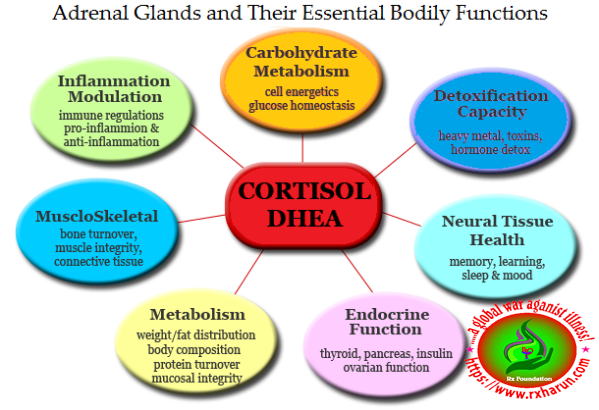
Your body has two adrenal glands, located just above each of your kidneys. As part of your endocrine system, your adrenal glands secrete more than 50 hormones, including:
Glucocorticoids. These hormones, which include cortisol, help your body convert food into energy, normalize blood sugar, respond to stress and maintain your immune system’s inflammatory response.
Mineralocorticoids. These hormones, which include aldosterone, help keep your blood pressure and blood volume normal by maintaining a proper balance of sodium, potassium and water in your body.
Adrenaline. This hormone increases your heart rate and controls blood flow to your muscles and brain, along with helping with the conversion of glycogen to glucose in your liver.
Together, these hormones and others produced by your adrenal glands control such body functions as:1
Maintaining metabolic processes, such as managing blood sugar levels and regulating inflammation
Regulating your body’s balance of salt and water
Controlling your fight-or-flight response to stress
Maintaining pregnancy
Producing sex steroids such as estrogen and testosterone; initiating and controlling sexual maturation during childhood and puberty
Signs and Symptoms of HPA Dysfunction
From the point of allopathic medicine, there’s no such thing as “adrenal fatigue.” There is, however, a condition known as Addison’s disease or “primary adrenal insufficiency,” a condition where damage to your adrenal glands impairs their ability to produce cortisol.
Addison’s disease affects an estimated 110 to 144 out of every 1 million people, so it’s quite rare.
Symptoms of this potentially life threatening condition include muscle weakness, weight loss, low blood pressure and low blood sugar. An estimated 80 percent of Addison’s cases are due to autoimmune disorders.
Many alternative practitioners believe that there are grades of insufficiency beyond the extreme of Addison’s. But even here, there are open questions as to what is actually causing the diminished adrenal gland activity. As mentioned, it may be primarily related to dysfunctional brain signaling.
What seems clear is that HPA axis dysfunction affects a great many people. Though the symptoms are less severe than in Addison’s disease, they can be debilitating.
In more serious cases, the physical fatigue is so great that the person may have difficulty getting out of bed for more than a few hours a day. Signs and symptoms typically associated with “adrenal fatigue” or
HPA dysfunction include
- rust colored urine
- Fatigue and weakness
- Depression, fearfulness or anxiety
- Hormonal imbalance and/or abnormal blood sugar levels
- Suppressed immune function
- Muscle and bone loss, muscular weakness and/or body aches
- Cravings for foods high in salt, sugar or fat
- Increased allergies
- Skin problems
- Autoimmune disorders
- Increased PMS or menopausal symptoms
- Lightheadedness when getting up from sitting or lying down; poor blood circulation
- Trouble waking up in the morning, despite a full night’s sleep
- Low sex drive
- Decreased ability to handle stress
- Poor memory; mental fogginess
- Rebuilding Your Metabolic Reserve

Exercise can exacerbate the situation, so while exercise is important, now’s not the time to push. If you have HPA axis dysfunction, your primary objective is to rebuild your metabolic reserve.
To do this:4
Reduce and address emotional and psychological stressors — anything that sets off your fight-or-flight response. Strategies such as mindfulness meditation and the Emotional Freedom Techniques (EFT) can be very helpful. Also, be sure to set aside time for fun and play with those you love, for creative expression, and for spending more time in nature
Get appropriate amounts of physical activity, but don’t overdo it
Improve blood sugar regulation by eating a healthy diet, low in net carbs (total carbohydrates minus fiber) and higher in healthy fats, along with a moderate amount of high quality protein
Reduce inflammation by improving your gut microbiome (avoid antibiotics and processed foods, eat real food, including fermented vegetables, and/or take a high quality probiotic supplement, reduce your net carbs and increase your fiber intake)
Address circadian disruption by making sure you get proper light exposure at the right times of the day. This means getting natural, bright sun exposure during the morning and midday, and avoiding artificial lighting and light emissions from electronics in the evening. Also be sure to get enough sleep. Most need right around eight hours of sleep each night.
How to Exercise While Recovering From Adrenal Fatigue

Exercise is a physical stressor and as such, it can tax your adrenals. The key is to focus on gentle activities such as walking, yoga, gentle cycling or swimming, qigong or tai chi. Once you’re starting to feel better and have improved your exercise tolerance, gradually begin to add in some moderate exercise.
There’s great danger of overdoing it during this phase, however, so listen carefully to your body and be patient. Eventually, your metabolic reserve will be rebuilt, allowing you to resume whatever exercise regimen you were used to doing before adrenal fatigue set in. Relapse is possible, though, so carefully monitor your energy reserves, and back off if you start to feel like you’re backsliding.
How to Identify HPA Dysfunction
Both primary and secondary adrenal insufficiency can be diagnosed with a lab test. More subtle abnormalities in the HPA axis, on the other hand, are more difficult to diagnose, as there’s no accepted medical test for it. Many doctors will use an ACTH (adrenocorticotropic hormone) test to check for problems with your adrenal glands.
However, the test only recognizes extreme underproduction or overproduction of hormone levels, as shown by the top and bottom 2 percent of a bell curve. This means your adrenal cortisol production could be functioning 20 percent below the mean, and your body experiencing symptoms of HPA dysfunction, yet the test will not recognize it.
To identify HPA dysfunction, a comprehensive hormone panel is recommended. One of the best is the DUTCH test, which stands for Dried Urine test for Comprehensive Hormones, developed by Mark Newman, founder of Precision Analytical Laboratory in Oregon. The DUTCH test is innovative in a number of respects, and offers several benefits over older hormone tests — all of which have their drawbacks and limitations.
One of the biggest problems is that some hormones fluctuate throughout the day. Cortisol, for example, rises as soon as you get out of bed and then declines as the day wears on. If your diurnal pattern is dysfunctional, meaning you’re low in the morning and high at night, you have a serious problem. But a 24-hour urine test cannot show you this. The DUTCH test, on the other hand, does. It also shows you hormonal metabolites, which helps reveal the underlying pathology.
The DUTCH test really outperforms all of the other methods when it comes to telling the story about what your hormones are doing, and this will allow you to figure out what areas you should be focusing on in terms of taking corrective action.
The DUTCH Complete test, which sells for $399, is a complete hormone panel, including estrogen, androgens, metabolites, melatonin, cortisol and more. You can learn more about it and purchase it directly from dutchtest.com. To receive a $50 discount, simply enter MERCOLA as a coupon code. This is not an affiliate program and I earn nothing from your order of this test. I only recommend it because I believe it’s the best one out there.
For insurance reimbursement, you’d have to order it through your health care provider and get an insurance receipt from Precision Analytical. You can then try to submit it to your insurance company for reimbursement (reimbursement is usually about 65 percent). In some cases, you may receive at least a portion of the cost back.
Common Medications and Head Trauma Can Dramatically Lower HPA Axis Function
Many people do not realize that certain common medications may in fact be suppressing their HPA output of cortisol. Drugs that fall into the “steroid” category, such as prednisone, can essentially shut down the pathway, which is why when taking this medication, the dose is often tapered so as to not cause a crash from lack of cortisol production.
Steroid asthma and allergy medications can also have this effect. Those who need inhalers or intranasal sprays such as those containing beclomethasone, triamcinolone, fluticasone, or budesonide are at risk, especially when taken over the long-term.
Mark Newman, founder of Precision Analytical Laboratory and the developer of the DUTCH Test discusses this in a 2015 blog post.5 He references a systematic review and meta-analysis6 that shows how often these medications suppress hormonal production. They also reported surprising data showing that these effects often last more than six months after discontinuing the therapy.
If you are taking Prednisone, most doctors will know that it suppresses adrenal production. Many of these other medications will do the same thing, but your health care provider may not be aware of their suppressive effects.
Another medication known to affect the hypothalamus and pituitary and thus the output of cortisol is isotretinoin, commonly used for the treatment of acne. In a 2015 Dermatology study,7 105 acne vulgaris patients were studied. The researchers found that many hormones, including Luteinizing hormone, testosterone, ACTH, cortisol, growth hormone and free T3 (thyroid) were decreased after three months of use.
Isotretinoin is often used in the teenage years and early 20s, but could have lasting health effects on energy, weight, the menstrual cycle and fertility. Another major one that likely affects a great number of people is opioid painkillers.
An internet search for a particular medication with the words “adrenal suppression” may not be the most accurate way to inquire about a medicine’s potential suppressive effects, but it can be a starting point. As an example, a Google search for the words “opioid” and “adrenal” together immediately returns a warning statement from a scientific journal article8 about the potential for opiate pain medications to shut down HPA axis, noting that this is “not always sufficiently appreciated in clinical practice.”
Testing is the best way to see if any regular medications being taken may be shutting off your hormone production. Newman notes that in order to determine whether your cortisol production is suppressed, you need to test both free cortisol AND metabolites. Lastly, studies have also shown that traumatic brain injury (TBI) or any serious head injury that affects the hypothalamus and/or pituitary can have a direct impact on your adrenal gland’s ability to produce cortisol.9,10,11
Car accidents, sporting events, slips and falls, bike crashes, boxing, military-related, or any other high impact motion resulting in trauma to the tissue in the brain are the most common causes. Unfortunately, TBI can also result in changes to both the male and female hormones and often results in fatigue and depression.
References
- Curnow KM, Tusie-Luna MT, Pascoe L, Natarajan R, Gu JL, Nadler JL, White PC (October 1991). “The product of the CYP11B2 gene is required for aldosterone biosynthesis in the human adrenal cortex” (PDF). Mol. Endocrinol. 5 (10): 1513–1522. doi:10.1210/mend-5-10-1513. PMID 1775135.
- Zhou M, Gomez-Sanchez CE (July 1993). “Cloning and expression of a rat cytochrome P-450 11 beta-hydroxylase/aldosterone synthase (CYP11B2) cDNA variant”. Biochem Biophys Res Commun. 194 (1): 112–117. doi:10.1006/bbrc.1993.1792. PMID 8333830.
- Marieb, EN; Hoehn, K (2012). Human anatomy & physiology (9th ed.). Pearson. p. 629. ISBN 978-0321743268.
- Dunn R. B.; Kudrath W.; Passo S.S.; Wilson L.B. (2011). “10”. Kaplan USMLE Step 1 Physiology Lecture Notes. pp. 263–289.
- Sapru, Hreday N.; Siegel, Allan (2007). Essential Neuroscience. Hagerstown, MD: Lippincott Williams & Wilkins. ISBN 0-7817-9121-9.
- Mirilas P, Skandalakis JE, Colborn GL, Weidman TA, Foster RS, Kingsnorth A, Skandalakis LJ, Skandalakis PN (2004). Surgical Anatomy: The Embryologic And Anatomic Basis Of Modern Surgery. McGraw-Hill Professional Publishing. ISBN 960-399-074-4.
- “OpenStax CNX”. cnx.org. Retrieved 2015-08-01.
- Britton, the editors Nicki R. Colledge, Brian R. Walker, Stuart H. Ralston ; illustrated by Robert (2010). Davidson’s principles and practice of medicine (21st ed.). Edinburgh: Churchill Livingstone/Elsevier. pp. 768–778. ISBN 978-Corticosteroid”. TheFreeDictionary. Retrieved 23 September 2015.
- Marieb Human Anatomy & Physiology 9th edition, chapter:16, page:629, question number:14
- “Corticosteroid”. TheFreeDictionary. Retrieved 23 September 2015.
- Sherwood, Lauralee (2001). Human physiology: from cells to systems. Pacific Grove, CA: Brooks/Cole. ISBN 0-534-56826-2. OCLC 43702042.
- Boron, WF.; Boulapep, EL. (2012). Medical Physiology (2nd ed.). Philadelphia: Saunders. ISBN 978-1437717532.
- Miller, WL; Bose, HS (2011). “Early steps in steroidogenesis: intracellular cholesterol trafficking”. Journal of Lipid Research. 52 (12): 2111–2135. doi:10.1194/jlr.R016675. PMC 3283258 . PMID 21976778.
- Charmandari, E; Brook, CG; Hindmarsh, PC (2004). “Classic congenital adrenal hyperplasia and puberty”. European Journal of Endocrinology. 151(Suppl 3): 77–82. doi:10.1530/eje.0.151U077. PMID 15554890. Archived from the original on 2015-02-04.
- Crowley, SD; Coffman, TM (2012). “Recent advances involving the renin–angiotensin system”. Experimental Cell Research. 318 (9): 1049–1056. doi:10.1016/j.yexcr.2012.02.023. PMC 3625040 . PMID 22410251.
- Henry Gleitman, Alan J. Fridlund and Daniel Reisberg (2004). Psychology (6 ed.). W. W. Norton & Company. ISBN 0-393-97767-6.
- García, AG; García de Diego, AM; Gandía, L; Borges, R; García Sancho, J (2006). “Calcium signaling and exocytosis in adrenal chromaffin cells”.

