
Deploying Elastic Cloud

Patient Tools

Read, save, and share this guide

Use these quick tools to make this medical article easier to read, print, save, or share with a family member.

Patient Mode

Understand this article easily

Switch between simple English and easy Bangla patient notes. This is for education and does not replace a doctor consultation.

From startups to the global 2000, Elastic powers search solutions for thousands of companies worldwide to find documents, monitor infrastructure, protect against security threats, and more. With Elastic Cloud managed services on Azure, you have the power of Elastic Enterprise Search, Elastic Observability, and Elastic Security. You can...

For severe symptoms, danger signs, pregnancy, child illness, or sudden worsening, seek urgent medical care.

বাংলা রোগী নোট এখনো যোগ করা হয়নি। পোস্ট এডিটরে “RX Bangla Patient Mode” বক্স থেকে সহজ বাংলা সারাংশ যোগ করুন।

এই তথ্য শিক্ষা ও সচেতনতার জন্য। এটি ডাক্তারি পরীক্ষা, রোগ নির্ণয় বা প্রেসক্রিপশনের বিকল্প নয়।

Article Summary

From startups to the global 2000, Elastic powers search solutions for thousands of companies worldwide to find documents, monitor infrastructure, protect against security threats, and more. With Elastic Cloud managed services on Azure, you have the power of Elastic Enterprise Search, Elastic Observability, and Elastic Security. You can quickly and easily deploy as a managed service or with orchestration tools you manage in Azure. In this article, I’ll...

Key Takeaways

  • This article explains Deploying Elastic Cloud in simple medical language.
  • This article explains Deployment choices in simple medical language.
  • This article explains Deployment settings in simple medical language.
  • This article explains Conclusion in simple medical language.
Educational health guideWritten for patient understanding and clinical awareness.
Reviewed content workflowUse writer and reviewer profiles for stronger trust.
Emergency safety firstUrgent warning signs are highlighted below.

Seek urgent medical care if you notice

These warning signs are general safety guidance. Local emergency numbers and clinical judgment should always come first.

  • Severe symptoms, breathing difficulty, fainting, confusion, or rapidly worsening illness.
  • New weakness, severe pain, high fever, or symptoms after a serious injury.
  • Any symptom that feels urgent, unusual, or unsafe for the patient.
1

Emergency now

Use emergency care for severe, sudden, rapidly worsening, or life-threatening symptoms.

2

See a doctor

Book a professional medical evaluation if symptoms persist, worsen, recur often, affect daily activities, or occur in a high-risk patient.

3

Learn safely

Use this article to understand possible causes, tests, treatment options, prevention, and questions to ask your clinician.

Before reading

RX Patient Tools

Use these quick guides before reading the article, or return to them when you need help preparing questions for a doctor.

Start here Choose the right pathway for symptoms, reports, medicines, or urgent warning signs. Disease article roadmap Read this topic step by step: meaning, symptoms, warning signs, diagnosis, treatment, prevention, and follow-up. Treatment planner Prepare questions about treatment choices, benefits, risks, side effects, and follow-up. Family & caregiver guide Organize symptoms, reports, medicines, questions, and follow-up safely. Nutrition & diet guide Prepare food, hydration, supplement, and medicine-timing questions safely. Prevention guide Organize risk factors, protective habits, screening, and warning signs. Recovery guide Prepare a safe plan for activity, rehabilitation, warning signs, and follow-up.

From startups to the global 2000, Elastic powers search solutions for thousands of companies worldwide to find documents, monitor infrastructure, protect against security threats, and more. With Elastic Cloud managed services on Azure, you have the power of Elastic Enterprise SearchElastic Observability, and Elastic Security. You can quickly and easily deploy as a managed service or with orchestration tools you manage in Azure.

In this article, I’ll describe deployment options and how to get started with Elastic Cloud on Azure.

Deploying Elastic Cloud

One great starting point is the Azure Marketplace, where you can sign up using your existing Azure account with integrated billing. Just search for Elastic Cloud and then select the Elastic Cloud (Elasticsearch managed service).

Deploying Elastic Cloud

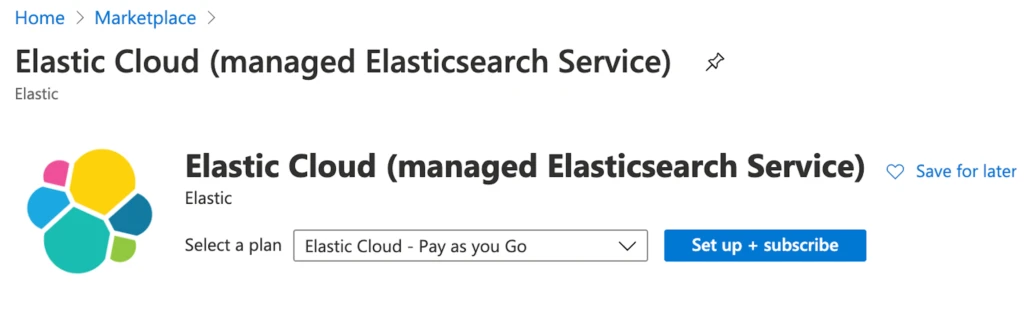
The Azure Marketplace listing provides a great overview, as well as links to learn more.

Click Get it Now and then agree to the authentication request to continue. You will be redirected to the Azure portal, where you will need to click Set up + subscribe.
Deploying Elastic Cloud

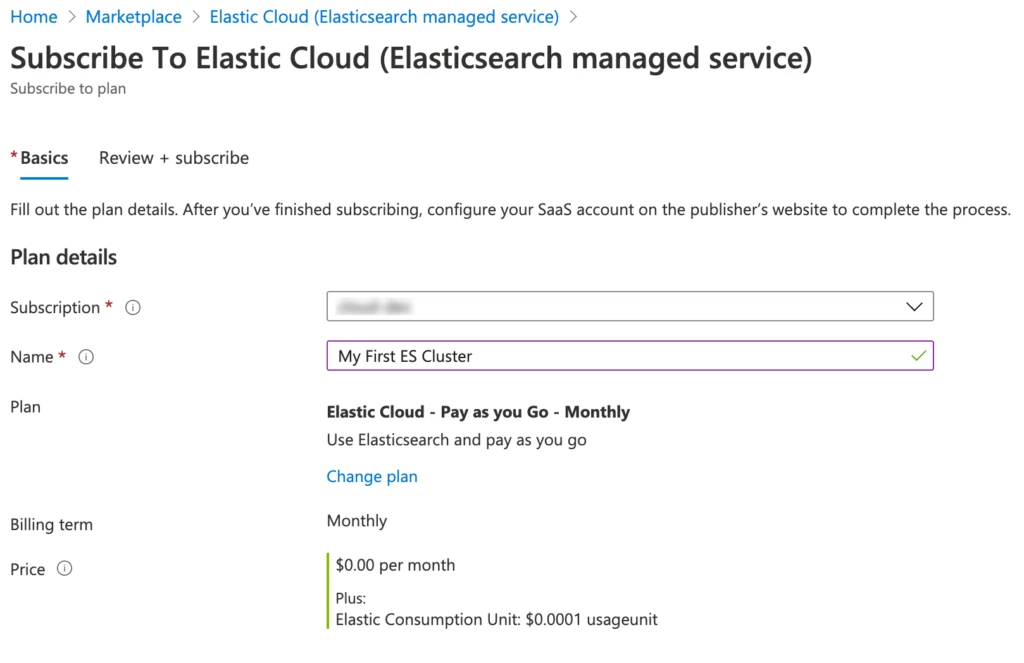
You will select the Azure subscription, provide a name, such as My First ES Cluster, and then review and click Subscribe.
Deploying Elastic Cloud

Once the SaaS configuration is complete, you will need to click Configure account now. This directs you to the elastic.co site, where you will need to create an account.

Once you have signed up, confirmed your account through an email notification, login, and click Create deployment.

Deploying Elastic Cloud

Deployment choices

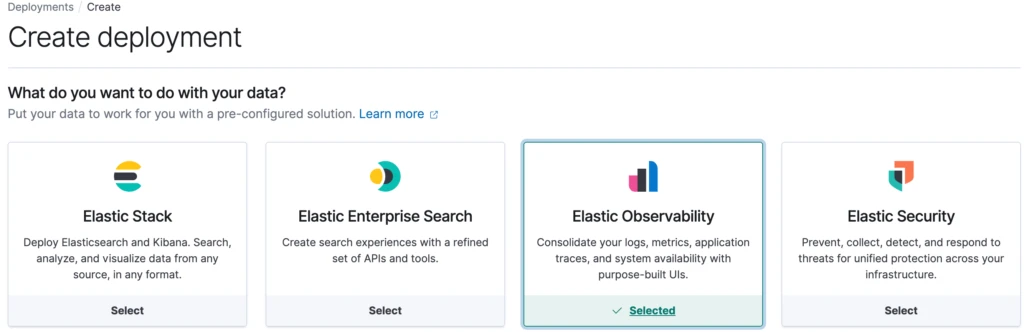
To get started, we recommend you pick one of the pre-configured solutions that best fits your needs. Let us start with the example of Elastic Observability.

With the Elastic Observability solution, users can combine logs, metrics, and application performance management (APM) under one unified visibility product, Kibana. This solution offers enhanced insight analysis. Ingesting and then aggregating logs and metrics to produce a relevant search experience is a fundamental tenet to the needs of operations, support, and executive leadership looking to make intelligent decisions.
Deploying Elastic Cloud

Of course, this is just one of the four pre-configured solutions offered through this deployment process. The others include:

  • Enterprise Search: Search everything anywhere and break down silos. Elastic App Search, provides tools to design and deploy a powerful search experience for websites and applications. Elastic Workplace Search gives teams the power to instantly search through all their favorite content sources.
  • Elastic Security: Incorporates Elastic SIEM and Elastic Endpoint Security, where interacting with real-time data allows for actionable insights under a single holistic view. SIEM includes automated threat detection features and uses Elastic features, such as machine learning with prebuilt anomaly detection jobs to gain deep intelligence. Endpoint Security protects the endpoints with threat detection, including anti-malware.
  • Elastic Stack: Incorporates Elastic’s data visualization product Kibana, as well as its open source data search and analytics engine, Elasticsearch, which drives relevant search results at speed and scale.

Deployment settings

After choosing a relevant solution, you will confirm the cloud providerregion, and version.

Should you need to make a change simply click Expand to the right of the listings.

Deploying Elastic Cloud

Elastic Stack versions

The latest version will always be selected, though it is a simple click or two to change. It is that simple after deployment as well, making it super simple to take advantage of newer features, as well as the latest security patches the day they are released, by performing a similar configuration change to the template. You should receive email notifications as new releases are made available.

The upgrades are designed to be automated and trouble-free while helping mitigate unplanned downtime. You can validate version upgrade changes by visiting the change reference guide.

To learn more about upgrading to newer versions of the Elastic Stack on our hosted service, see Upgrade Versions.

Complete deployment settings

Simply assign a unique name to the deployment, if you would like, and then click Create deployment. That’s it!

Deploying Elastic Cloud

Launch Kibana

During the deployment creation process, you are provided the elastic user password to securely save. Take note of this, though if you do not remember your password, do not to worry. You can easily reset it at any time. Instructions are available by visiting the Reset the elastic user password page.

Click Open Kibana.

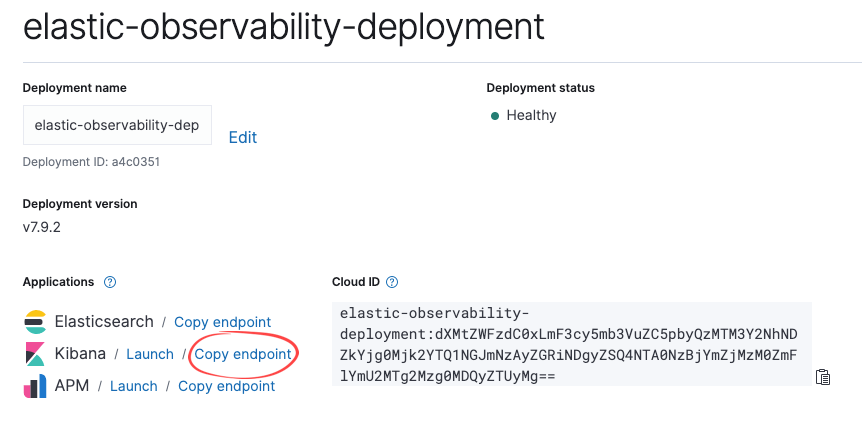
Launching Kibana from the Elastic Console will seamlessly log you on as the user who created the deployment. However, additional users will want to use the endpoint link, provided within the console.
Deploying Elastic Cloud

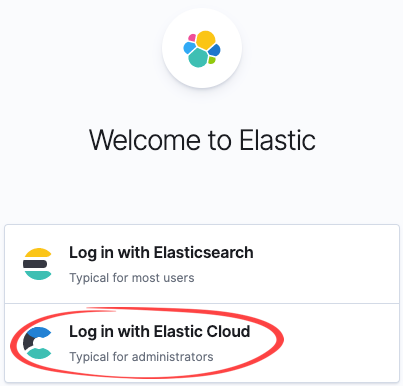
The end user will click Log in with Elasticsearch, which is what non-administrative users will use, such as a user who has permissions to run reports within Kibana.
Deploying Elastic Cloud

As the administrator, you can also utilize this link by choosing to Log in with Elastic Cloud, and then entering the same credentials you had while logging into the Elastic Console, when creating the deployment. This provides the most administrative privileges.

Ingesting sample data

Let’s look at real-world data in Kibana. Elastic provides the ability to add sample data. This is a wonderful way to get familiar with visualizing real-world data without spending too much extra time on configuring data ingestion, though that too is rather straightforward and will be covered in a subsequent blog. Check out the Getting started with Kibana video.

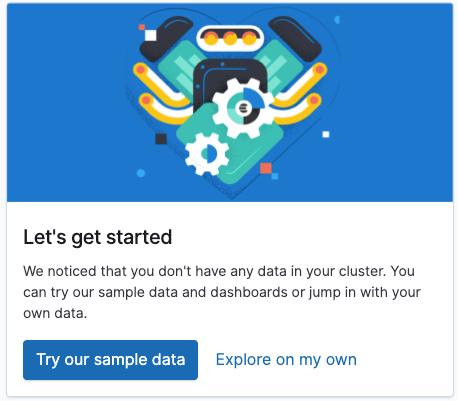
Once logged into Kibana, since it is the first time, you will be prompted to choose between “try our sample data” or “explore on my own.” If you are ready to visualize and navigate through the Kibana features, like Kibana Lens, which allows you to build amazingly rich visualizations by a simple drag-n-drop method, there is no quicker way than to load one of three types of sample data.
Deploying Elastic Cloud

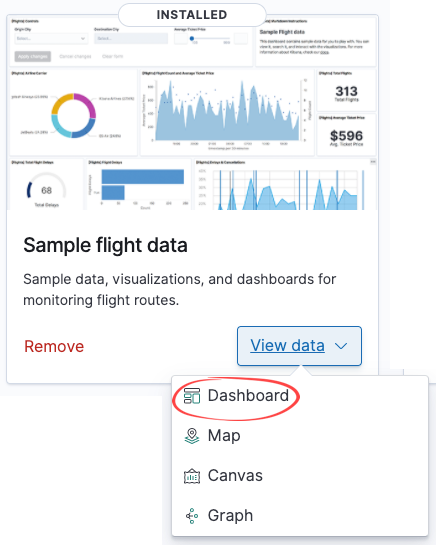
Whichever sample you choose, simply click Load data, wait for the data to be loaded, and then click View data and then Dashboard to see the power of Kibana firsthand.
Deploying Elastic Cloud

Customizable settings

Pre-configured solutions, along with deployment templates, can get you up and running without needing to worry about properly sizing the cluster, giving you the ability at any time to customize them. You can adjust capacity and performance, change the level of fault tolerance, add more features, and much more.

Feel free to click wherever there is a Learn more button, to gain more insight to the various deployment settings.

Conclusion

We hope this overview of deploying Elastic Cloud on Azure conveyed some of the benefits and options you have with the various solutions. Be sure and visit elasitc.co for more information, specifically around the list of products and features. Please check out all the great getting started videos and free training as well.

Doctor visit helper

Prepare before seeing a doctor

A simple rural-patient checklist to help you explain symptoms clearly, ask better questions, and avoid unsafe self-treatment.

Safety note: This is not a prescription or diagnosis. For severe symptoms, pregnancy danger signs, children with serious illness, chest pain, breathing difficulty, stroke-like weakness, or major injury, seek urgent care.

Which doctor may help?

Start with a registered doctor or the nearest qualified health center.

What to tell the doctor

  • Write when the problem started and how it changed.
  • Bring old prescriptions, investigation reports, and current medicines.
  • Write allergies, pregnancy status, diabetes, kidney/liver disease, and major past illnesses.
  • Bring one family member if the patient is weak, elderly, confused, or a child.

Questions to ask

  • What is the most likely cause of my symptoms?
  • Which danger signs mean I should go to hospital quickly?
  • Which tests are necessary now, and which can wait?
  • How should I take medicines safely and what side effects should I watch for?
  • When should I come for follow-up?

Tests to discuss

  • Vital signs: temperature, pulse, blood pressure, oxygen saturation
  • Basic physical examination by a clinician
  • CBC, urine test, blood sugar, or imaging only when clinically needed

Avoid these mistakes

  • Do not use antibiotics, steroid tablets/injections, or strong painkillers without proper medical advice.
  • Do not hide pregnancy, kidney disease, ulcer, allergy, or blood thinner use.
  • Do not delay emergency care when danger signs are present.

Medicine safety and first-aid guide

This section is for patient education only. It does not replace a doctor, pharmacist, or emergency care.

Safe first steps

  • Rest, drink safe water, and observe symptoms carefully.
  • Keep a written note of symptoms, duration, temperature, medicines already taken, and allergy history.
  • Seek medical care quickly if symptoms are severe, worsening, or unusual for the patient.

OTC medicine safety

  • For mild pain or fever, ask a registered pharmacist or doctor before using common over-the-counter pain/fever medicines.
  • Do not combine multiple pain medicines without advice, especially if you have kidney disease, liver disease, stomach ulcer, asthma, pregnancy, or take blood thinners.
  • Do not give adult medicines to children unless a qualified clinician advises it.

Avoid these mistakes

  • Do not start antibiotics without a proper medical decision.
  • Do not use steroid tablets or injections casually for quick relief.
  • Do not delay emergency care because of home remedies.

Get urgent help if

  • Severe symptoms, confusion, fainting, breathing difficulty, chest pain, severe dehydration, or sudden weakness need urgent medical care.
Medicine names, dose, and timing must be decided by a qualified clinician or pharmacist after checking age, pregnancy, allergy, other diseases, and current medicines.

For rural patients and family caregivers

Patient health record and symptom diary

Write your symptoms, medicines already taken, test results, and questions before visiting a doctor. This note stays on your device unless you print or copy it.

Doctor to discuss: Doctor / qualified healthcare provider
Tests to discuss with doctor
  • Basic vital signs: temperature, pulse, blood pressure, oxygen level if needed
  • Relevant blood, urine, imaging, or specialist tests only after clinical assessment
Questions to ask
  • What is the most likely cause of my symptoms?
  • Which warning signs mean I should go to emergency care?
  • Which tests are really needed now?
  • Which medicines are safe for my age, pregnancy status, allergy, kidney/liver/stomach condition, and current medicines?

Emergency warning signs such as chest pain, severe breathing difficulty, sudden weakness, confusion, severe dehydration, major injury, or loss of bladder/bowel control need urgent medical care. Do not wait for online information.

Safe pathway to proper treatment

Care roadmap for: Deploying Elastic Cloud

Use this simple roadmap to understand the next safe steps. It is educational and does not replace examination by a doctor.

Go to emergency care if you notice:
  • Severe or rapidly worsening symptoms
  • Breathing difficulty, chest pain, fainting, confusion, severe weakness, major injury, or severe dehydration
Doctor / service to discuss: Qualified healthcare provider; specialist depends on symptoms and examination.
  1. Step 1

    Check danger signs first

    If danger signs are present, seek emergency care and do not wait for online information.

  2. Step 2

    Record the symptom story

    Write when symptoms started, severity, medicines already taken, allergies, pregnancy status, and test results.

  3. Step 3

    Visit a qualified clinician

    A doctor, nurse, or qualified healthcare provider can examine you and decide which tests or treatment are needed.

  4. Step 4

    Do only useful tests

    Do tests after clinical assessment. Avoid unnecessary tests, random antibiotics, or repeated medicines without diagnosis.

  5. Step 5

    Follow up and return early if worse

    If symptoms worsen, new warning signs appear, or treatment is not helping, return for review quickly.

Rural patient practical tips
  • Take a written symptom diary and all previous prescriptions/test reports.
  • Do not hide medicines already taken, even herbal or over-the-counter medicines.
  • Ask which warning signs mean urgent referral to hospital.

This roadmap is for education. A real diagnosis and treatment plan requires history, examination, and clinical judgment.

RX Patient Help

Ask a health question safely

Write your symptom story. A health professional or site editor can review it before any answer is prepared. This box is not for emergency care.

Emergency first: Severe chest pain, breathing trouble, unconsciousness, stroke signs, severe injury, heavy bleeding, or rapidly worsening symptoms need urgent local medical care now.

Frequently Asked Questions

Is this article a replacement for a doctor?

No. It is educational content only. Patients should consult a qualified clinician for diagnosis and treatment.

When should I seek urgent care?

Seek urgent care for severe symptoms, rapidly worsening condition, breathing difficulty, severe pain, neurological changes, or any emergency warning sign.

References

Add references, clinical guidelines, textbooks, journal articles, or trusted medical sources here. You can edit this area from the RX Article Professional Blocks panel.