
How to Balance Time for a Truly Balanced Life

Patient Tools

Read, save, and share this guide

Use these quick tools to make this medical article easier to read, print, save, or share with a family member.

On this page3 sections

Article Summary

Health and meaningful relationships add years and quality to our lives. Few people contest this fact.  Does it then follow that more people are focusing on these areas of their lives?  Do you regularly exercise and go for holidays or fun meals with your spouse/partner and family?  If the answer is no, why not?  Expenses could be an issue.  If your reason is  “I can’t...

Key Takeaways

  • This article explains 1. Pause and review your past week. in simple medical language.
  • This article explains 2. Make a plan to manage time; decide which life areas need attention. in simple medical language.
  • This article explains 3. Prepare your weekly to-do list and daily schedule to prioritize those life areas you want to focus on. in simple medical language.
Before reading

RX Patient Tools

Use these quick guides before reading the article, or return to them when you need help preparing questions for a doctor.

Start here Choose the right pathway for symptoms, reports, medicines, or urgent warning signs. Disease article roadmap Read this topic step by step: meaning, symptoms, warning signs, diagnosis, treatment, prevention, and follow-up. Treatment planner Prepare questions about treatment choices, benefits, risks, side effects, and follow-up. Family & caregiver guide Organize symptoms, reports, medicines, questions, and follow-up safely. Nutrition & diet guide Prepare food, hydration, supplement, and medicine-timing questions safely. Prevention guide Organize risk factors, protective habits, screening, and warning signs. Recovery guide Prepare a safe plan for activity, rehabilitation, warning signs, and follow-up.
Educational health guideWritten for patient understanding and clinical awareness.
Reviewed content workflowUse writer and reviewer profiles for stronger trust.
Emergency safety firstUrgent warning signs are highlighted below.
Definition

Health and meaningful relationships add years and quality to our lives. Few people contest this fact.  Does it then follow that more people are focusing on these areas of their lives?  Do you regularly exercise and go for holidays or fun meals with your spouse/partner and family?  If the answer is no, why not?  Expenses could be an issue.  If your reason is  “I can’t find the time,”  you’re not alone.  You keep track of your expenses and know how much your bank balance is, but do you also know exactly where your time goes?  Here are simple tools to manage time and become conscious of how you spend it.

1. Pause and review your past week.

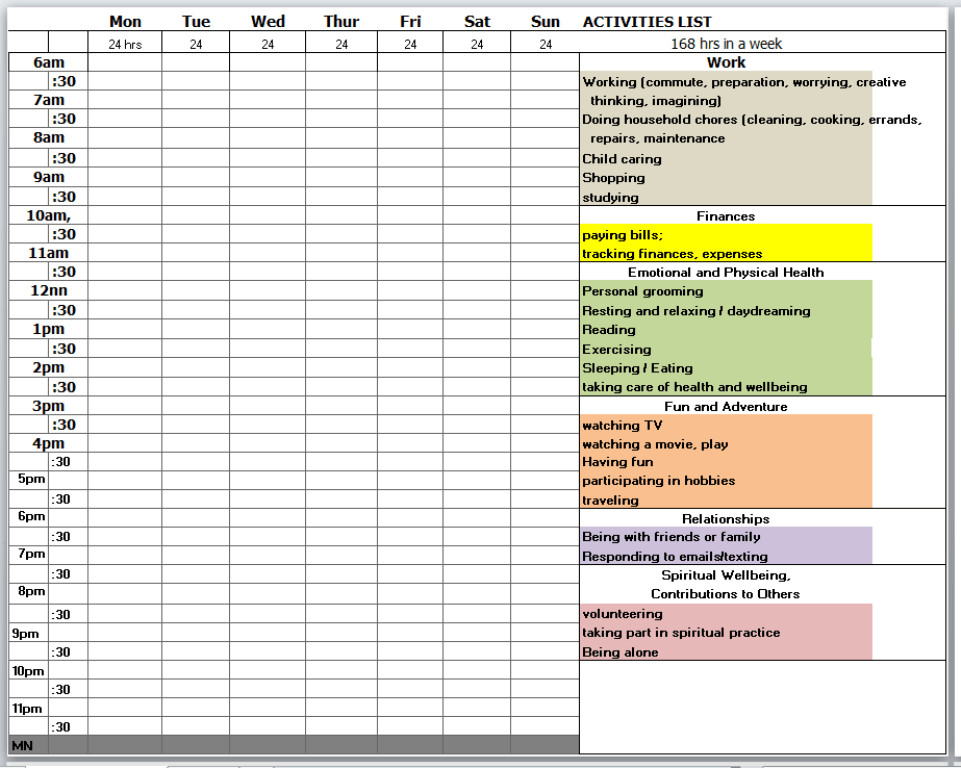
You attend to many things at work and after work.  How do you decide on which tasks to prioritize?  Usually, you first do those that need to be finished sooner or whose deadlines are looming.  This generally works, but over the long term, it could turn into crisis management rather than a way to manage time.  Cheryl Richardson in her book Take Time for Your Life challenges us to check where our time goes. Determined to get an accurate indicator for the exercise, I came up with these forms that assign colors per Life Area to make it visually easier to track time.

First, look over a typical week.  On the Time Tracking Daily Form, block the hours spent per day according to the color of the Life Area they fall under.
 

How to Balance Time for a Truly Balanced Life

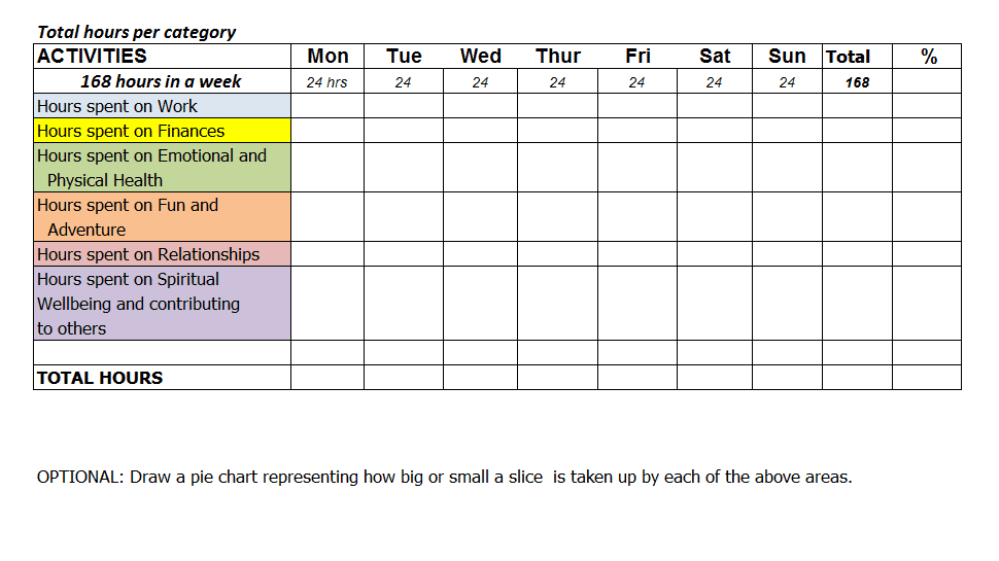
Next, total those hours by Life Areas on the Time Tracking Weekly Totals Form. An optional step is to convert those weekly totals to a pie chart for a more dramatic visual.
 

How to Balance Time for a Truly Balanced Life

So just where does your time go?  Aside from sleeping and eating, which area of your life do you spend the most time on? Which life area gets the smallest portion?  I had expected work to eat up a big chunk of my time but was surprised at how little I spent on Spiritual and Fun and Adventure.

2. Make a plan to manage time; decide which life areas need attention.

These forms are not absolute and have room for improvement.  Exercise, for example, is grouped with sleeping under Physical and Emotional Health. Although this area gets the largest share of your time, it does not necessarily mean you are spending that time on exercise.  Watching TV falls under Fun and Adventure, but it’s a poor substitute for traveling or participating in a hobby. Reading falls under Physical and Emotional Health when it could be considered a hobby.  You can tweak the activities that go under each life area or even change the colors altogether.  What’s important is you’re aware of the other areas of your life you may be neglecting and can then decide to manage time so these get more attention.

The Simple Abundance Companion author, Sarah Ban Breathnach remembers the she had felt while looking at her calendar and realizing, in her own words, that “there was no space in the day, week, or month for me to take care of my needs.” She talks about how our inability to say no to family, friends, colleagues and volunteer work can quickly fill up our calendars, leaving no time for ourselves. Taking action, she set aside two hours a week on her calendar just for her.  She didn’t label it but blocked the time with a bright yellow marker. This visual prompt made it easy for her to say no to any activity that conflicted with her “just my own” time.  Her color-blocking tip inspired me to use colors on my weekly and daily schedules.

3. Prepare your weekly to-do list and daily schedule to prioritize those life areas you want to focus on.

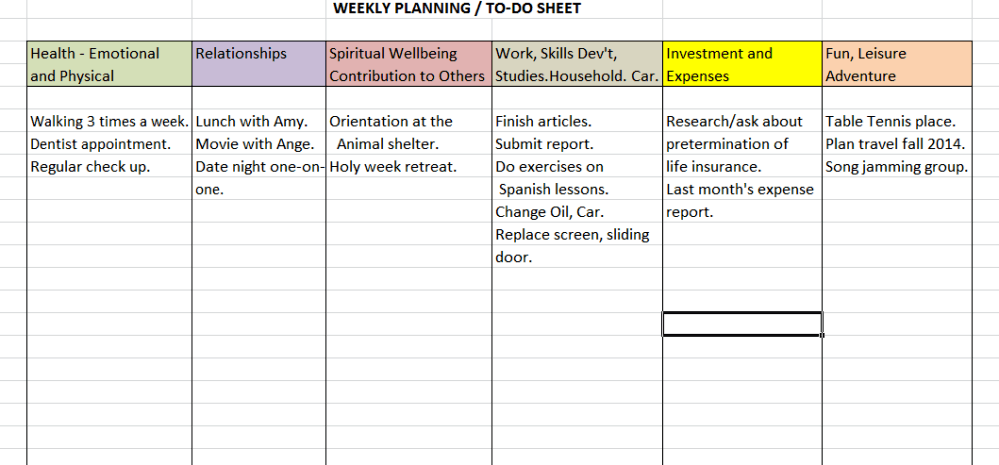
Planning what you want to accomplish every week works well.  List the tasks by Life Area on the Weekly To-Do List.
How to Balance Time for a Truly Balanced Life

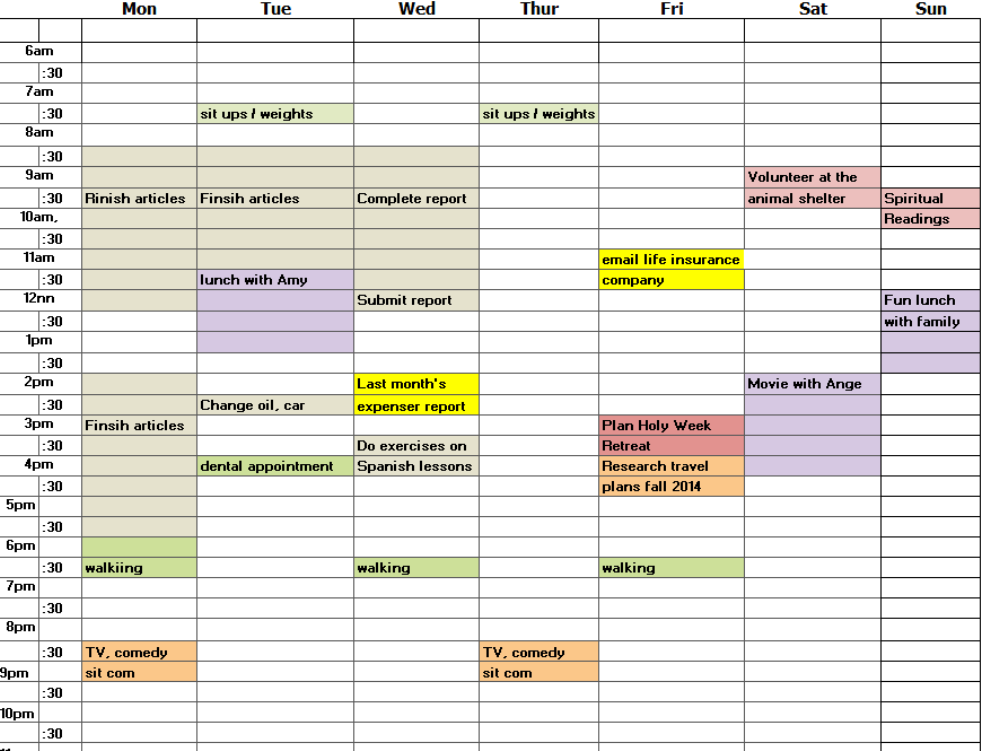
These tasks can then be carried over to your Daily Schedule.  At the end of each day and week, review what you have accomplished.  The colors will clearly show which life areas you spent most of your day and the week on. You can then decide to focus on the other areas in the coming days and weeks.
 

How to Balance Time for a Truly Balanced Life


Often, there will be demands on your time beyond your control. These effective, colorful tools will equip you with some leeway for deciding how you spend your time.  Consider it like a bank or expense account that shows you where your money goes.  Unlike money, time is a finite resource.  Once spent, it can never be recovered. When you consciously manage time, you can balance not just your finances, but more importantly, your life.

Doctor visit helper

Prepare before seeing a doctor

A simple rural-patient checklist to help you explain symptoms clearly, ask better questions, and avoid unsafe self-treatment.

Safety note: This is not a prescription or diagnosis. For severe symptoms, pregnancy danger signs, children with serious illness, chest pain, breathing difficulty, stroke-like weakness, or major injury, seek urgent care.

Which doctor may help?

Orthopedic doctor, rheumatologist, or physiotherapist depending on cause.

What to tell the doctor

  • Write which joints hurt, swelling, morning stiffness duration, fever, injury, and walking difficulty.
  • Bring X-ray, uric acid, ESR/CRP, rheumatoid factor, or previous reports if available.

Questions to ask

  • Is this injury, osteoarthritis, rheumatoid arthritis, gout, infection, or another cause?
  • Which exercises, supports, or lifestyle changes are safe?
  • Do I need blood tests or X-ray?

Tests to discuss

  • Joint examination and range of motion
  • X-ray when chronic arthritis or injury is suspected
  • ESR/CRP, uric acid, rheumatoid tests when inflammatory arthritis is suspected

Avoid these mistakes

  • Do not ignore hot swollen joint with fever.
  • Avoid repeated steroid injections/tablets without a clear diagnosis and follow-up.

Medicine safety and first-aid guide

This section is for patient education only. It does not replace a doctor, pharmacist, or emergency care.

Safe first steps

  • Rest, drink safe water, and observe symptoms carefully.
  • Keep a written note of symptoms, duration, temperature, medicines already taken, and allergy history.
  • Seek medical care quickly if symptoms are severe, worsening, or unusual for the patient.

OTC medicine safety

  • For mild pain or fever, ask a registered pharmacist or doctor before using common over-the-counter pain/fever medicines.
  • Do not combine multiple pain medicines without advice, especially if you have kidney disease, liver disease, stomach ulcer, asthma, pregnancy, or take blood thinners.
  • Do not give adult medicines to children unless a qualified clinician advises it.

Avoid these mistakes

  • Do not start antibiotics without a proper medical decision.
  • Do not use steroid tablets or injections casually for quick relief.
  • Do not delay emergency care because of home remedies.

Get urgent help if

  • Severe symptoms, confusion, fainting, breathing difficulty, chest pain, severe dehydration, or sudden weakness need urgent medical care.
Medicine names, dose, and timing must be decided by a qualified clinician or pharmacist after checking age, pregnancy, allergy, other diseases, and current medicines.

For rural patients and family caregivers

Patient health record and symptom diary

Write your symptoms, medicines already taken, test results, and questions before visiting a doctor. This note stays on your device unless you print or copy it.

Doctor to discuss: Doctor / qualified healthcare provider
Tests to discuss with doctor
  • Basic vital signs: temperature, pulse, blood pressure, oxygen level if needed
  • Relevant blood, urine, imaging, or specialist tests only after clinical assessment
Questions to ask
  • What is the most likely cause of my symptoms?
  • Which warning signs mean I should go to emergency care?
  • Which tests are really needed now?
  • Which medicines are safe for my age, pregnancy status, allergy, kidney/liver/stomach condition, and current medicines?

Emergency warning signs such as chest pain, severe breathing difficulty, sudden weakness, confusion, severe dehydration, major injury, or loss of bladder/bowel control need urgent medical care. Do not wait for online information.

Safe pathway to proper treatment

Care roadmap for: How to Balance Time for a Truly Balanced Life

Use this simple roadmap to understand the next safe steps. It is educational and does not replace examination by a doctor.

Go to emergency care if you notice:
  • Severe or rapidly worsening symptoms
  • Breathing difficulty, chest pain, fainting, confusion, severe weakness, major injury, or severe dehydration
Doctor / service to discuss: Qualified healthcare provider; specialist depends on symptoms and examination.
  1. Step 1

    Check danger signs first

    If danger signs are present, seek emergency care and do not wait for online information.

  2. Step 2

    Record the symptom story

    Write when symptoms started, severity, medicines already taken, allergies, pregnancy status, and test results.

  3. Step 3

    Visit a qualified clinician

    A doctor, nurse, or qualified healthcare provider can examine you and decide which tests or treatment are needed.

  4. Step 4

    Do only useful tests

    Do tests after clinical assessment. Avoid unnecessary tests, random antibiotics, or repeated medicines without diagnosis.

  5. Step 5

    Follow up and return early if worse

    If symptoms worsen, new warning signs appear, or treatment is not helping, return for review quickly.

Rural patient practical tips
  • Take a written symptom diary and all previous prescriptions/test reports.
  • Do not hide medicines already taken, even herbal or over-the-counter medicines.
  • Ask which warning signs mean urgent referral to hospital.

This roadmap is for education. A real diagnosis and treatment plan requires history, examination, and clinical judgment.