
Artificial Intelligence, typically abbreviated to AI, is a fascinating field of Information Technology that finds its way into many aspects of modern life. Although it may seem complex, and yes, it is, we can gain a greater familiarity and comfort with AI by exploring its components separately. When we learn how the pieces fit together, we can better understand and implement them.
That’s why today we’re tackling the intelligent Agent in AI. This article defines intelligent agents in Artificial Intelligence, AI agent functions and structure, and the number and types of agents in AI.
Let’s define what we mean by an intelligent agent in AI.
What Is an Agent in AI?
Okay, did anyone, upon hearing the term “intelligent agent,” immediately picture a well-educated spy with a high IQ? No? Anyway, in the context of the AI field, an “agent” is an independent program or entity that interacts with its environment by perceiving its surroundings via sensors, then acting through actuators or effectors.
Agents use their actuators to run through a cycle of perception, thought, and action. Examples of agents in general terms include:
- Software: This Agent has file contents, keystrokes, and received network packages that function as sensory input, then act on those inputs, displaying the output on a screen.
- Human: Yes, we’re all agents. Humans have eyes, ears, and other organs that act as sensors, and hands, legs, mouths, and other body parts act as actuators.
- Robotic: Robotic agents have cameras and infrared range finders that act as sensors, and various servos and motors perform as actuators.
Intelligent agents in AI are autonomous entities that act upon an environment using sensors and actuators to achieve their goals. In addition, intelligent agents may learn from the environment to achieve those goals. Driverless cars and the Siri virtual assistant are examples of intelligent agents in AI.
These are the main four rules all AI agents must adhere to:
- Rule 1: An AI agent must be able to perceive the environment.
- Rule 2: The environmental observations must be used to make decisions.
- Rule 3: The decisions should result in action.
- Rule 4: The action taken by the AI agent must be a rational. Rational actions are actions that maximize performance and yield the best positive outcome.
The Functions of an Artificial Intelligence Agent
Artificial Intelligence agents perform these functions continuously:
- Perceiving dynamic conditions in the environment
- Acting to affect conditions in the environment
- Using reasoning to interpret perceptions
- Problem-solving
- Drawing inferences
- Determining actions and their outcomes
The Number and Types of Agents in Artificial Intelligence
There are five different types of intelligent agents used in AI. They are defined by their range of capabilities and intelligence level:
- Reflex Agents: These agents work here and now and ignore the past. They respond using the event-condition-action rule. The ECA rule applies when a user initiates an event, and the Agent turns to a list of pre-set conditions and rules, resulting in pre-programmed outcomes.
- Model-based Agents: These agents choose their actions like reflex agents do, but they have a better comprehensive view of the environment. An environmental model is programmed into the internal system, incorporating into the Agent’s history.
- Goal-based agents: These agents build on the information that a model-based agent stores by augmenting it with goal information or data regarding desirable outcomes and situations.
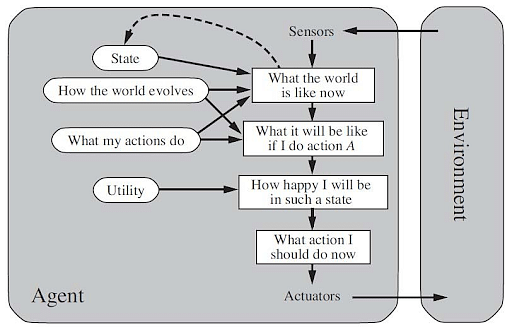
- Utility-based agents: These are comparable to the goal-based agents, except they offer an extra utility measurement. This measurement rates each possible scenario based on the desired result and selects the action that maximizes the outcome. Rating criteria examples include variables such as success probability or the number of resources required.
- Learning agents: These agents employ an additional learning element to gradually improve and become more knowledgeable over time about an environment. The learning element uses feedback to decide how the performance elements should be gradually changed to show improvement.
The Structure of Agents in Artificial Intelligence
Agents in Artificial Intelligence follow this simple structural formula:
Architecture + Agent Program = Agent
These are the terms most associated with agent structure:
- Architecture: This is the machinery or platform that executes the agent.
- Agent Function: The agent function maps a precept to the Action, represented by the following formula: f:P* – A
- Agent Program: The agent program is an implementation of the agent function. The agent program produces function f by executing on the physical architecture.
Many AI Agents use the PEAS model in their structure. PEAS is an acronym for Performance Measure, Environment, Actuators, and Sensors. For instance, take a vacuum cleaner.
- Performance: Cleanliness and efficiency
- Environment: Rug, hardwood floor, living room
- Actuator: Brushes, wheels, vacuum bag
- Sensors: Dirt detection sensor, bump sensor
Here’s a diagram that illustrates the structure of a utility-based agent, courtesy of Researchgate.net.
Master the Right AI Tools for the Right Job!
Caltech Post Graduate Program in AI & MLEXPLORE PROGRAM

What Are Agents in Artificial Intelligence Composed Of?
Agents in Artificial Intelligence contain the following properties:
- Enrironment
- Autonomous
- Flexibility
- Reactive
- Proactiveness
- Using Response Rules
Now, let’s discuss these in detail.
Environment
The agent is situated in a given environment.
Autonomous
The agent can operate without direct human intervention or other software methods. It controls its activities and internal environment. The agent independently which steps it will take in its current condition to achieve the best improvements. The agent achieves autonomy if its performance is measured by its experiences in the context of learning and adapting.
Flexibility
- Reactive: Agents must recognize their surroundings and react to the changes within them.
- Proactive: Agents shouldn’t only act in response to their surroundings but also be able to take the initiative when appropriate and effect an opportunistic, goal-directed performance.
- Social: Agents should work with humans or other non-human agents.
Reactive
- Reactive systems maintain ongoing interactions with their environment, responding to its changes.
- The program’s environment may be guaranteed, not concerned about its success or failure.
- Most environments are dynamic, meaning that things are constantly in a state of change, and information is incomplete.
- Programs must make provisions for the possibility of failure.
Pro-Activeness
Taking the initiative to create goals and try to meet them.
Using Response Rules
The goal for the agent is directed behavior, having it do things for the user.
- Mobility: The agent must have the ability to actuate around a system.
- Veracity: If an agent’s information is false, it will not communicate.
- Benevolence: Agents don’t have contradictory or conflicting goals. Therefore, every Agent will always try to do what it is asked.
- Rationality: The agent will perform to accomplish its goals and not work in a way that opposes or blocks them.
- Learning: An agent must be able to learn.
Your AI/ML Career is Just Around The Corner!
Caltech Post Graduate Program in AI & MLEXPLORE PROGRAM
How to Improve the Performance of Intelligent Agents
When tackling the issue of how to improve intelligent Agent performances, all we need to do is ask ourselves, “How do we improve our performance in a task?” The answer, of course, is simple. We perform the task, remember the results, then adjust based on our recollection of previous attempts.
Artificial Intelligence Agents improve in the same way. The Agent gets better by saving its previous attempts and states, learning how to respond better next time. This place is where Machine Learning and Artificial Intelligence meet.
All About Problem-Solving Agents in Artificial Intelligence
Problem-solving Agents in Artificial Intelligence employ several algorithms and analyses to develop solutions. They are:
- Search Algorithms: Search techniques are considered universal problem-solving methods. Problem-solving or rational agents employ these algorithms and strategies to solve problems and generate the best results.
Uninformed Search Algorithms: Also called a Blind search, uninformed searches have no domain knowledge, working instead in a brute-force manner.
Informed Search Algorithms: Also known as a Heuristic search, informed searches use domain knowledge to find the search strategies needed to solve the problem.
- Hill Climbing Algorithms: Hill climbing algorithms are local search algorithms that continuously move upwards, increasing their value or elevation until they find the best solution to the problem or the mountain’s peak.
Hill climbing algorithms are excellent for optimizing mathematical problem-solving. This algorithm is also known as a “greedy local search” because it only checks out its good immediate neighbor.
- Means-Ends Analysis: The means-end analysis is a problem-solving technique used to limit searches in Artificial Intelligence programs, combining Backward and Forward search techniques.
The means-end analysis evaluates the differences between the Initial State and the Final State, then picks the best operators that can be used for each difference. The analysis then applies the operators to each matching difference, reducing the current and goal state difference.
Choose the Right Program
Supercharge your career in AI and ML with Simplilearn’s comprehensive courses. Gain the skills and knowledge to transform industries and unleash your true potential. Enroll now and unlock limitless possibilities!
Program Name
AI Engineer
Post Graduate Program In Artificial Intelligence
Post Graduate Program In Artificial Intelligence
Geo All Geos All Geos IN/ROW University Simplilearn Purdue Caltech Course Duration 11 Months 11 Months 11 Months Coding Experience Required Basic Basic No Skills You Will Learn 10+ skills including data structure, data manipulation, NumPy, Scikit-Learn, Tableau and more. 16+ skills including
chatbots, NLP, Python, Keras and more.8+ skills including
Supervised & Unsupervised Learning
Deep Learning
Data Visualization, and more.Additional Benefits Get access to exclusive Hackathons, Masterclasses and Ask-Me-Anything sessions by IBM
Applied learning via 3 Capstone and 12 Industry-relevant ProjectsPurdue Alumni Association Membership Free IIMJobs Pro-Membership of 6 months Resume Building Assistance Upto 14 CEU Credits Caltech CTME Circle Membership Cost $$ $$$$ $$$$ Explore Program Explore Program Explore Program
Can You Picture a Career in Artificial Intelligence?
As you can infer from what we’ve covered, the field of Artificial Intelligence is complicated and involved. However, AI is the way of the future and is making its way into every area of our lives. If you want to join the AI revolution and pursue a career in the field, Simplilearn has everything you need.
The Caltech Post Graduate Program in AI & ML program, built and delivered in partnership with Caltech CTME and IBM, will help you master vital Artificial Intelligence concepts such as Data Science with Python, Machine Learning, Deep Learning, and Natural Language Programming (NLP). In addition, the course offers exclusive hackathons and “Ask me anything” sessions held by IBM. Before you know it, the live sessions, practical labs, and hands-on projects give you job-ready AI certification.
Glassdoor says that Artificial Intelligence Engineers in the United States can earn an average of $119,316 per year. However, a similar position in India makes a yearly average of ₹986,682.
Check out Simplilearn today, and get started on that exciting new career in Artificial Intelligence!
FAQs
1. What are Intelligent Agents in Artificial Intelligence?
Intelligent Agents in AI are autonomous entities that perceive their environment and make decisions to achieve specific goals.
2. How do Intelligent Agents contribute to AI?
Intelligent Agents enhance AI by autonomously processing information and performing actions to meet set objectives.
3. What are examples of Intelligent Agents in AI?
Examples include recommendation systems, self-driving cars, and voice assistants like Siri or Alexa.
4. How do Intelligent Agents perceive their environment?
Intelligent Agents use sensors to perceive their environment, gathering data for decision-making.
5. What role do Intelligent Agents play in Machine Learning?
In Machine Learning, Intelligent Agents can learn and improve their performance without explicit programming.
6. Are Intelligent Agents the same as AI robots?
Not all Intelligent Agents are robots, but all AI robots can be considered Intelligent Agents.
7. What’s the future of Intelligent Agents in AI?
The future of Intelligent Agents is promising, with potential advancements in automation, decision-making, and problem-solving.
8. How do Intelligent Agents impact everyday life?
Intelligent Agents impact our lives by providing personalized recommendations, automating tasks, and enhancing user experiences.
9. How do Intelligent Agents make decisions in AI?
Intelligent Agents make decisions based on their perception of the environment and pre-defined goals.
10. Can anyone use Intelligent Agents in AI?
Yes, anyone with the right tools and understanding can utilize Intelligent Agents in AI.
