
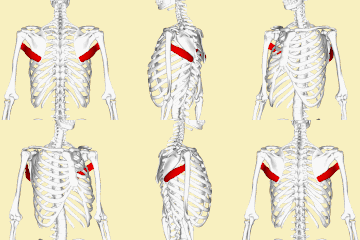
Teres Major Muscle is a muscle of the upper limb. It attaches to the scapula and the humerus and is one of the seven scapulohumeral muscles. It is a thick but somewhat flattened muscle. The teres major muscle (from Latin teres, meaning “rounded”) is positioned above the latissimus dorsi muscle and assists in the extension and medial rotation of the humerus. This muscle is commonly confused as a rotator cuff muscle, but it is not because it does not attach to the capsule of the shoulder joint, unlike the teres minor muscle for example.
The primary function of the teres minor is to modulate the action of the deltoid, preventing the humeral head from sliding upward as the arm is abducted. It also functions to rotate the humerus laterally. The teres minor is innervated by the axillary nerve.[rx]
At a Glance of Teres major
-
Function: Adduction and medial rotation of the arm
-
Origin: Posterior surface of the scapula at its inferior angle
-
Insertion: Intertubercular groove on its medial aspect
-
Innervation: Lower scapular nerve (C5, C6)
[stextbox id=’custom’ defcaption=”true”]
|
Teres major muscle (in red) seen from the back (posterior to anterior perspective).
|
|
| Details | |
|---|---|
| Origin | Posterior aspect of the inferior angle of the scapula |
| Insertion | The medial lip of the intertubercular sulcus of the humerus |
| Artery | Subscapular and circumflex scapular arteries |
| Nerve | Lower subscapular nerve (segmental levels C5 and C6) |
| Actions | adduct the humerus, Internal rotation (medial rotation) of the humerus, extend the humerus from flexed position, Depress shoulder |
| Identifiers | |
| Latin | Musculus teres major |
| TA | A04.6.02.011 |
| FMA | 32549 |
| Anatomical terms of muscle | |
[/stextbox]
Nerve Supply of Teres Major Muscle
Teres major is supplied primarily by the lower subscapular nerve and additionally by the thoracodorsal nerve (middle subscapular nerve). These are distal to the upper subscapular nerve. These three nerves branch off the posterior cord of the brachial plexus. The nerves that innervate teres major consist of fibers from spinal nerves C5-C8.
Functions of Teres Major Muscle
The teres major is a medial rotator and adductor of the humerus and assists the latissimus dorsi in drawing the previously raised humerus downwards and backward (extension, but not hyperextension). It also helps stabilize the humeral head in the glenoid cavity.
References
- https://www.ncbi.nlm.nih.gov/books/NBK531475/
- https://www.ncbi.nlm.nih.gov/books/NBK459343/
- https://www.ncbi.nlm.nih.gov/books/NBK538319/
- https://www.ncbi.nlm.nih.gov/books/NBK539746/
- https://www.ncbi.nlm.nih.gov/books/NBK531457/
- https://www.ncbi.nlm.nih.gov/books/NBK537216/
- https://www.ncbi.nlm.nih.gov/books/NBK539746/
- https://www.ncbi.nlm.nih.gov/books/NBK542313/
- https://www.ncbi.nlm.nih.gov/books/NBK541005/
- https://en.wikipedia.org/wiki/Rhomboid_major_muscle
- https://en.wikipedia.org/wiki/Rhomboid_minor_muscle

