
Tensor Fasciae Latae Muscle(TFL) is a muscle of the proximal anterolateral ligament located between the superficial and deep fibers of the iliotibial (IT) band. The muscles have higher variability in abdominal length, although in most patients the TFL muscle ends before the larger trochanter of the abdominal femur. TFL works closely with gluteus maximus, gluteus medium, and gluteus minimus in a variety of hip movements, including flexibility, abduction, and internal rotation. It acts via the iliotibial (IT) band’s attachment to the tibia to assist in knee flexion and lateral rotation. The TEFL is most important clinically for assisting in pelvis stability while standing and walking.[rx][rx][rx]
The Tensor fasciae latae (or tensor fasciae latae or, formerly, the tensor vagina femoris) is a muscle of the thigh. Together with the gluteus maximus, it works in the iliotibial band and remains uninterrupted with the iliotibial tract, which is attached to the tibia. Muscles help to balance the pelvis when standing, walking or running.
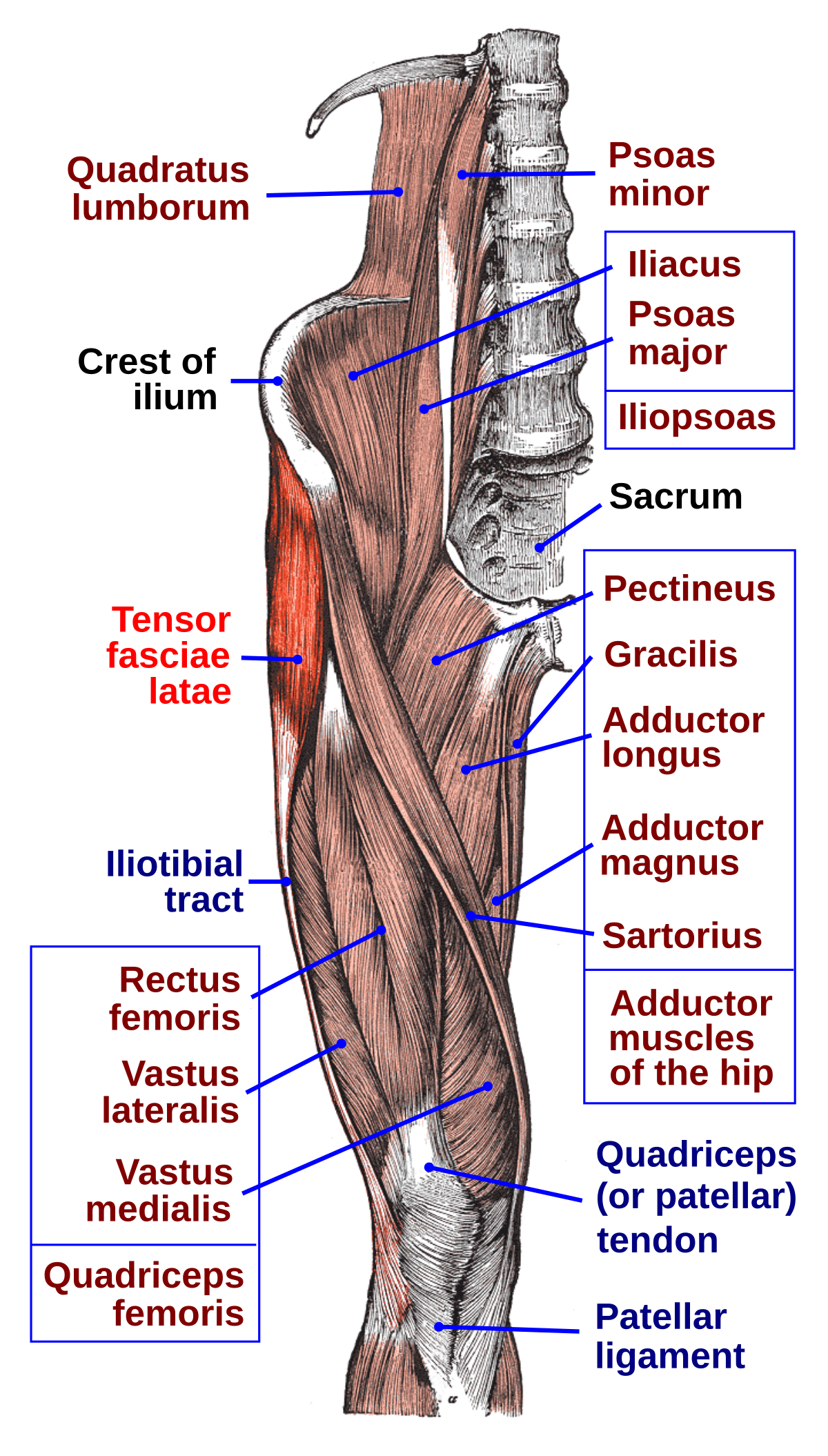
Origin
It arises from the anterior part of the outer lip of the iliac crest; from the outer surface of the anterior superior iliac spine, and part of the outer border of the notch below it, between the gluteus medius and sartorius; and from the deep surface of the fascia lata.
It is inserted between the two layers of the iliotibial tract of the fascia lata about the junction of the middle and upper thirds of the thigh. The tensor fasciae latae tautens the iliotibial tract and braces the knee, especially when the opposite foot is lifted.[rx] The terminal insertion point lies on the lateral condyle of the tibia.[rx]
Nerves
The TFL is innervated by the superior gluteal nerve, L4, L5, and S1. The superior gluteal nerve is formed from the anterior rami of L4-S1. It runs with the superior gluteal artery and vein, passing superior to the piriformis before exiting the pelvis through the greater sciatic foramen. It runs anterior to the gluteus maximus muscle before ending at the gluteus minimus and TFL muscles.
Blood Supply and Lymphatics
The TFL is supplied by the deep branch of the superior gluteal artery. The superior gluteal artery is the largest branch of the posterior division of the internal iliac artery. It runs posteriorly between the lumbosacral trunk and the first sacral nerve root. It exits the pelvis via the greater sciatic foramen where it divides into superficial and deep branches. The deep branch travels between the gluteus minimus and gluteus medius to supply those muscles and the TFL.
Function
The TFL acts on the tibia via the IT band’s attachment to the Gerdy tubercle of the lateral tibia. The TFL is an accessory knee flexor, though its action is only seen once the knee is flexed beyond 30 degrees. Furthermore, it works with the IT band to stabilize the knee when the knee is in full extension. It also acts via the IT band in the lateral rotation of the tibia. This lateral rotation may be performed while the hip is in the abduction and medial rotation as is seen when kicking a soccer ball.
Clinically, the main function of the TFL is to assist in walking. The TFL does this by pulling the ilium inferiorly on the weight-bearing side, causing the contralateral hip to rise. The rise in the non-weight-bearing hip allows the leg to swing through without hitting the ground during the swing phase of the gait.[rx]
- TFL is the prime mover in hip medial rotation and a weak hip abductor
- It serves as an accessory muscle/ hip synergist in abduction and flexion of the hip
- Together with gluteus maximus and the iliotibial band, it stabilizes the hip joint by holding the head of the femur in the acetabulum
- The tensor of fasciae latae, together with the gluteus maximus contributes instability of the knee during extension and also in partial flexion
- As part of the iliotibial tract, it aids lateral rotation of the leg.
- TFL also assists in walking by inferiorly tilting the ilium on the weight-bearing side, with resultant an upward tilt of the contralateral hip. Thus, allowing the leg of the nonweight bearing hip to swing through without hitting the ground during the swing phase of the gait.
References
- https://www.ncbi.nlm.nih.gov/books/NBK499870/
- https://pubmed.ncbi.nlm.nih.gov/32491429/
- https://www.ncbi.nlm.nih.gov/books/NBK557497/
- https://www.ncbi.nlm.nih.gov/pmc/articles/PMC1256751/
- https://pubmed.ncbi.nlm.nih.gov/26388173/
- https://en.wikipedia.org/wiki/Tensor_fasciae_latae_muscle
- https://www.physio-pedia.com/Tensor_Fascia_Lata
