
A kitchen generally can be referred to as the principal section in a home (or to some even an office), as it is known to be the dominant center of activities in the house. For all these activities to run smoothly, there are certain devices to be in place. Today, we will be discussing kitchen faucets and some advice for choosing them.
The primary function of the kitchen faucets is to provide the kitchen with both hot and cold water to wash the food, dishes, hands; running water is also necessary in the preparation of meals. Apart from these essential uses, the faucet you select plays a significant role in defining and expressing your style.
If you are planning to replace, upgrade or buy a new faucet, there are some factors that must be considered before making a purchase. In the course of this article, you will be provided with information on important things that should be put into consideration before choosing a kitchen faucet.
The Seven Best Guides For Choosing Kitchen Faucets
1. Number of Holes in the sink
When upgrading or changing from an old kitchen faucet, it is recommended that you get a kitchen faucet that has the same number of holes that are also present in the sink’s deck. Conventional or traditional faucets with hot and cold water taps need three holes (which are meant for the spout and the taps). At times there can be an additional hole; this is where the sprayer is placed.
A typical one-piece kitchen faucet uses a single hole just for the handle, and the other hole is meant for the sprayer. The single hole faucet is more common because it’s easier to maintain and operate. Still, it’s possible to include any number of holes that you are comfortable with; they will only be visible if (or when) you are planning to install a new sink.
2. Installation
 Will you repair your kitchen faucet on your own, or will you need to request a plumber’s professional assistance? This question must be resolved before installing a faucet. Typically, faucet installations are much more straightforward than in the past thanks to the latest designs of the faucets themselves. Nevertheless, since the whole installation process has to do with pipes and water (and there’s a huge possibility of leaks due to incorrect installation or poor handling), we strongly recommend consulting a professional plumber for assistance, especially if you are not confident in your ability to complete the installation yourself. It is also essential to be sure that the kitchen faucet you want to get is readily available on the market.
3. The Type of Handle Needed
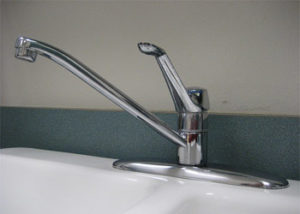
The typical faucet comes with a handle that always rotates in a particular direction to determine the strength of the water stream; the handle also controls the water temperature (or it could come with two handles which allows a mix of both the hot and cold water). Single-handle kitchen faucets are easily maintained and used, and they are ubiquitous, too.
Additionally, the handles of this type of faucet are either attached to the side or are on the faucet unit itself. It also comes with a unique design that allows people with various forms of disability to access and use the faucet efficiently. Also, although the single lever is known to be more practical, there are other types, too (which will be discussed in the course of this article).
4. Faucet with Sprayer
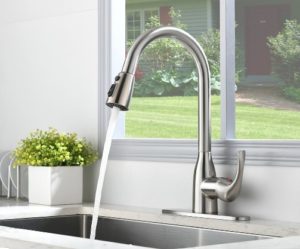
Faucets with sprayers are designed with a pull-down system from the spout, usually at the faucet side or possibly extending from the head of the faucet itself. Certain types of sprayers feature built-in soap or dishwasher dispensers; this is a common design in newer models of kitchen faucets. A multi-functioning spray head that can be pulled down for easy use also seems to be one of the most sought after faucets for many people.
A significant part to look out for is the button on the sprayer; one has to be extremely careful not to get a sprayer with very cheap button, especially for a sprayer that has a soap dispenser at the under-mount. It is necessary that the product be durable and very high quality.
5. Price and Quality
 As far as price and quality are concerned, you should know that faucets with a ceramic ball or disk valves, as well as those made with solid brass or stainless steel, do cost more than those made with plastic; the price is often worth it, though because they are also more durable.
To find a faucet with better quality, you should try to pick one up and inspect it. For example, when picking up a faucet made from a solid brass, it will definitely be more substantial in weight than other units made from lesser materials. A solid brass faucet is the most expensive only because it requires no severe care and lasts longer, even when used with hard water which corrodes most metals.
Kitchen faucets with plastic parts are enticing mostly because of the lower price and inclusive designs, but when weighing its low cost against maintenance requirements and the need for more frequent replacement, it’s clear that brass faucets are a better investment for the long-term.
6. Water Filtrating System in Kitchen Faucets
Modern kitchen faucets are now mainly built with a healthier lifestyle in mind. Specifically, they feature new built-in filtration systems that give you clean, filtered water right from the faucet without installing a separate filtrating system. And the filter present in the faucet does not just prevent dirt from getting into your water, it can also help to remove germs. So when getting a kitchen faucet remember to include this feature as one of your top priorities.
7. Style
Is your kitchen a contemporary and sleek one, or does it reminds you of an old kitchen at a farmhouse? The style of your kitchen could be anything from a detailed historical type to something with clean lines and simple curves, and so on. Styles are known to change the way the kitchen looks; with a wide variety of materials and finishes there are endless options that can help to define your mood and status. Therefore, when choosing a faucet, the stylistic expression you want for your kitchen must be established. The information below discusses the various types of kitchen faucets’ mounting styles and handle options.
8. Mounting Styles
Sink Mounted Faucets: When it comes to mounted faucets, the level of compatibility varies with the design of the faucet as well as the design of the sink. So when working on an existing sink, be sure about the number of mounting holes present, as the number of holes for a modern faucet can range from one to four holes depending on the variety.
The replacement of existing faucets with one or two holes is possible with an escutcheon plate design that often comes with a new faucet; the escutcheon plate covers the holes that are not needed. Although it limits the stylistic options of the faucet, it prevents leakages and in general is a simple trick that can be used for different standard sinks.
Wall Mounted Faucets: The wall mounted kitchen faucet is another mounting style that makes the cleanup of your counter-tops swift and straightforward. While installing the wall faucet, it is necessary to be very careful while considering the distance between the water spout and the sink (because it is the primary factor that determines their compatibility), but it does become more problematic if a double sink is involved.
Another potentially serious setback is that an anti-freezing system must be in place if the region you live in ever has freezing cold weather. Installation can also become an issue if a stud is in the same location that faucet and its handles need to be in; if this occurs, then relocation of the faucet is necessary.
Deck Mounted Faucets: Deck mounted kitchen faucets come in different styles, but typically they give a kitchen a contemporary, seamless look. This mounting style requires the faucet to be mounted on the counter-top and not on the sink itself. Mounting a faucet on the counter-top is usually possible if you are planning to install an under-mount sink.
It is always important to leave space at least the width of a finger at the back of the faucet; when deck mounted kitchen faucets are installed this way, it makes cleaning much easier. The downside of this style is that it tends to accumulate grime, dirt, and water between the wall and the faucet; also, some people believe that it occupies unnecessary space on the counter-top.
9. Handle Options
Faucets with Single Handle: This type of handle comes with a smooth side-to-side motion for regulating the temperature and an up-and-down motion that controls the flow of water. This type of handle allows the sink to accommodate big vessels and pots. And although the adjustment of the temperature might be less precise, it is still the most convenient option for people with disabilities or when only a single hand is free.
Faucets with Double Handles: The two handles on this type of faucet are meant for cold and hot water. This dual-handle design aids in the adjustment of both water flow rates and water temperature. It requires at least three holes before installation is possible.
The designs of this type of kitchen faucet are easily customized because of the many different handle options. Each of the handles comes with a shut-off valve that helps stop leakages if either of the handles becomes faulty. Adjusting the two knobs at once when your hands are full is impossible, but when any part becomes defective, it can be fixed independently.
Hands-Free Faucets: The hands-free option works whenever the sensor detects motion. This option is best for those with arthritic hands or other disabilities. This type of faucet also helps conserve water automatically and saves you from worrying about any sort of overflow from the sink. The handle present at the side is mainly meant for flow rate and temperature adjustment. The only major drawback is that the battery needs to be occasionally changed for the sensor to perform optimally.
Final Words
The discussed guides above are the crucial things that must be understood and considered before and during the process of choosing a kitchen faucet. What to want can’t be decided for you, but the purpose of this article is to help you better know your options and choose what you deem fit for your kitchen. After considering all the guidelines we’ve provided for you, we feel confident that the decision you will be making for your kitchen is the best one.
