
Best Balance Exercises You Can Try At Home

Patient Tools

Read, save, and share this guide

Use these quick tools to make this medical article easier to read, print, save, or share with a family member.

Patient Mode

Understand this article easily

Switch between simple English and easy Bangla patient notes. This is for education and does not replace a doctor consultation.

Balance keeps you from falling – whether you are sitting or standing. But in case of an inner ear infection, head injury, or recent surgery, your body’s balance might take a hit. Simple tasks like turning over and walking short distances seem impossible without you tripping...

For severe symptoms, danger signs, pregnancy, child illness, or sudden worsening, seek urgent medical care.

বাংলা রোগী নোট এখনো যোগ করা হয়নি। পোস্ট এডিটরে “RX Bangla Patient Mode” বক্স থেকে সহজ বাংলা সারাংশ যোগ করুন।

এই তথ্য শিক্ষা ও সচেতনতার জন্য। এটি ডাক্তারি পরীক্ষা, রোগ নির্ণয় বা প্রেসক্রিপশনের বিকল্প নয়।

Article Summary

Balance keeps you from falling – whether you are sitting or standing. But in case of an inner ear infection, head injury, or recent surgery, your body’s balance might take a hit. Simple tasks like turning over and walking short distances seem impossible without you tripping over and falling. This is where balance exercises are really helpful. You can regain stability and strength by doing simple balance training exercises...

Key Takeaways

  • This article explains Best Balance Exercises You Can Try At Home in simple medical language.
  • This article explains Exercises To Increase Static Balance in simple medical language.
  • This article explains Exercises To Increase Dynamic Balance in simple medical language.
  • This article explains Other Exercises To Do As You Progress in simple medical language.
Educational health guideWritten for patient understanding and clinical awareness.
Reviewed content workflowUse writer and reviewer profiles for stronger trust.
Emergency safety firstUrgent warning signs are highlighted below.

Seek urgent medical care if you notice

These warning signs are general safety guidance. Local emergency numbers and clinical judgment should always come first.

  • Severe symptoms, breathing difficulty, fainting, confusion, or rapidly worsening illness.
  • New weakness, severe pain, high fever, or symptoms after a serious injury.
  • Any symptom that feels urgent, unusual, or unsafe for the patient.
1

Emergency now

Use emergency care for severe, sudden, rapidly worsening, or life-threatening symptoms.

2

See a doctor

Book a professional medical evaluation if symptoms persist, worsen, recur often, affect daily activities, or occur in a high-risk patient.

3

Learn safely

Use this article to understand possible causes, tests, treatment options, prevention, and questions to ask your clinician.

Before reading

RX Patient Tools

Use these quick guides before reading the article, or return to them when you need help preparing questions for a doctor.

Start here Choose the right pathway for symptoms, reports, medicines, or urgent warning signs. Disease article roadmap Read this topic step by step: meaning, symptoms, warning signs, diagnosis, treatment, prevention, and follow-up. Treatment planner Prepare questions about treatment choices, benefits, risks, side effects, and follow-up. Family & caregiver guide Organize symptoms, reports, medicines, questions, and follow-up safely. Nutrition & diet guide Prepare food, hydration, supplement, and medicine-timing questions safely. Prevention guide Organize risk factors, protective habits, screening, and warning signs. Recovery guide Prepare a safe plan for activity, rehabilitation, warning signs, and follow-up.
Definition

Balance keeps you from falling – whether you are sitting or standing. But in case of an inner ear infection, head injury, or recent surgery, your body’s balance might take a hit. Simple tasks like turning over and walking short distances seem impossible without you tripping over and falling. This is where balance exercises are really helpful.

You can regain stability and strength by doing simple balance training exercises with the help of your physical therapist for at least 20 minutes a day. Start from the neck and move on to the torso and lower extremities. Your healing process can last from a few weeks to several months depending on your injury or infection. You will end up feeling more confident about moving around and happy to see your progress. Listed below are 15 best exercises for improving balance.

Best Balance Exercises You Can Try At Home

Before starting, you should know that balance exercises should always be done in progression. Do not get too ambitious and think you can do it all without help. That’s not going to happen, especially if you are recovering from an injury.

Let’s start with the two kinds of balance exercises – static and dynamic. Once you are confident about doing exercises of both categories with ease, you can start doing strength and conditioning exercises to recover completely. Without further ado, let’s begin!

Exercises To Increase Static Balance

1. Supine On Mat Or Bed

Best Balance Exercises You Can Try At Home
How To Do
  1. Lie down on a mat or your bed. Flex your knees and draw them close to your chest by wrapping your hands around your legs.
  2. Roll over to your right, hold for two seconds, and then roll back to the starting position.
  3. Roll over to your left, hold for two seconds, and then roll back to the starting position.

Note: You might need assistance from your physical therapist initially if you are recovering from an injury.

Sets And Reps – 2 sets of 5 reps

2. 4-Point Stance On Mat Or Bed

Best Balance Exercises You Can Try At Home
How To Do
  1. Lie down on a mat or your bed.
  2. Roll over to your right and get into a prone position.
  3. Clench your fists, flex your elbows and knees, and use your arm strength to lift your upper body and then your torso.
  4. Get on all fours and hold this pose for 10 seconds.
  5. Lower your torso slowly and get into a resting pose.
  6. Repeat one more time if you are comfortable.

Note: You might need assistance initially from your physical therapist while you hold the pose for 10 seconds.

Sets And Reps – 2-3 sets of 10 seconds hold

3. 3-Point Stance On Mat Or Bed

Best Balance Exercises You Can Try At Home
How To Do
  1. Get on all fours.
  2. Lift off your left leg off the mat and extend it backward.
  3. Hold this pose for 5-10 seconds.

Sets And Reps – 3 sets of 3 reps

4. 2-Point Stance On Mat Or Bed

Best Balance Exercises You Can Try At Home
How To Do
  1. Get on all fours.
  2. Slowly lift your left hand off the mat and extend it forward.
  3. Lift your right knee off the mat and extend your leg behind.
  4. Hold this pose for 5-10 seconds.

Sets And Reps – 3 sets of 2 reps

5. Assisted Kneeling

Best Balance Exercises You Can Try At Home
How To Do
  1. Get on all fours.
  2. Your physical therapist will place a gym ball in front of you. Place your right hand on it.
  3. Once you are comfortable, place your left hand on the ball and raise your torso slowly.
  4. Get into a kneeling position.
  5. Your physical therapist will help to stabilize your shoulders and back if needed.
  6. Hold this pose for 20 seconds.

Sets And Reps – 2 sets of 3 reps

6. Knee Walking

Caution: Do not do this exercise if you just had knee surgery or are not allowed to put any pressure on your knees.

How To Do
  1. Get on all fours.
  2. Walk forward and backward. You might need assistance from your physical therapist in the beginning.
  3. Walk sideways as well.
  4. Increase the distance gradually as you progress.

Sets And Reps – 2 sets of 2 reps

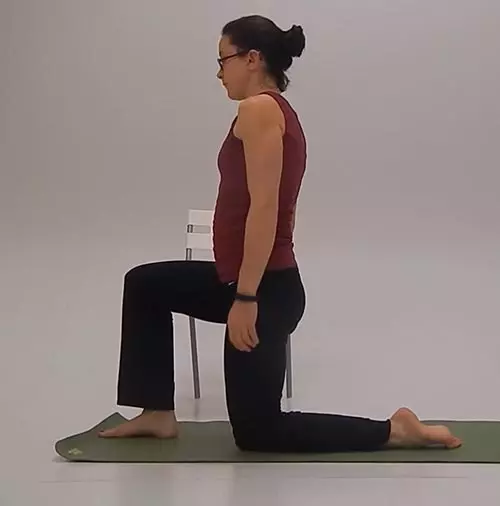
7. Kneeling To Standing
Best Balance Exercises You Can Try At Home
How To Do
  1. Get on all fours in front of a stall bar or beside a chair. Make sure that the chair is stable and strong enough to take your weight. Your physical therapist will stand behind you.
  2. Hold one of the lower bars, one hand after another, place your right foot in front of you, and keep the right knee flexed. Or place one palm on the chair and get into a sitting lunge position.
  3. Use your body’s strength and assistance from your physical therapist to get into a standing position slowly.
  4. Get into the kneeling position with the help of your physical therapist again and repeat.

Sets And Reps – 2 sets of 2 reps

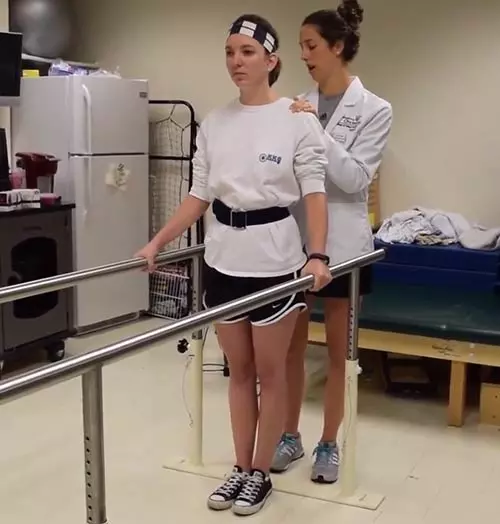
8. Standing Between Parallel Bars
Best Balance Exercises You Can Try At Home
How To Do
  1. Stand holding two parallel bars.
  2. Place one foot forward, keep your shoulders relaxed, and sway from side to side.
  3. Do this 10 times and then sway backward and forward.
  4. Do this 10 times.

Sets And Reps – 3 sets of 3 reps

You must do these exercises for about 3-4 weeks. Consult with your doctor and physiotherapist before advancing to the next stage – dynamic balance exercises.

Exercises To Increase Dynamic Balance

9. Stepping Over Small Objects

How To Do
  1. Your physical therapist will place small objects on the floor.
  2. Start walking and try stepping over those objects. You can take assistance from your physical therapist.

Sets And Reps – 3 sets of 1 rep

10. Walking In A Straight Line

Best Balance Exercises You Can Try At Home
How To Do
  1. Your physical therapist will stick arrows to direct your walking path.
  2. Step on those arrows and walk in a straight line after putting your hands across your chest.

Sets And Reps – 3 sets of 2 reps

11. Ascend And Descend The Staircase

Best Balance Exercises You Can Try At Home
How To Do
  1. Hold the side railing of a short staircase.
  2. Place your good leg up first and then place your bad leg on the first step.
  3. Climb up the stairs, turn around and climb down with your bad leg first and then the good leg.

Sets And Reps – 2 sets of 3 rep

12. Small Vertical Jumps

Best Balance Exercises You Can Try At Home
How To Do
  1. Hold the back of a stable chair or a stall bar.
  2. Hop and jump vertically.
  3. Land softly on the balls of your feet first and then the heels.

Sets And Reps – 3 sets of 10 reps

Do these exercises for another two weeks. Talk to your doctor and/physiotherapist before moving on to the next stage, where you will rebuild your strength. Here are a few exercises that you can start with.

Other Exercises To Do As You Progress

13. Lunges

Best Balance Exercises You Can Try At Home
How To Do
  1. Stand straight. Keep your hands on your waist, chest out, shoulders relaxed, core engaged, and look straight ahead. This is the starting position.
  2. Place your right foot in front of you.
  3. Flex both your knees, keep your torso straight, and lower your body. Your thighs should be perpendicular to your shin bone.
  4. Hold this pose for a moment and get back up to the starting position.
  5. Now, place your left foot in front of you and repeat.

Tip: You can do weighted lunges by holding a 5-pound dumbbell in each hand.

Sets And Reps – 3 sets of 10 reps

14. Calf Raises

Best Balance Exercises You Can Try At Home
How To Do
  1. Stand behind a chair and hold the backrest.
  2. Lift both the heels off the floor and bring them back down.

Sets And Reps – 3 sets of 10 reps

15. Sumo Squat

Best Balance Exercises You Can Try At Home
How To Do
  1. Stand straight with your feet a little more than shoulder-width apart.
  2. Keep your shoulders relaxed, chin up, and core engaged.
  3. Push your buttocks out, flex your knees, and sit down until your thighs are parallel to the floor. Make sure your knees don’t overshoot your toes.
  4. Hold this pose for 3 seconds and then rise back to the starting position.

Sets And Reps – 3 sets of 10 reps

There you go – 15 balance exercises that you can do to improve your strength and stability. Do these exercises regularly, and you will recover much faster. Moving your body will also help boost your confidence and make you feel good about the recovery process. So, no more thinking! Get on the “stay active” bandwagon and get the quality of life that you deserve. Take care!


Doctor visit helper

Prepare before seeing a doctor

A simple rural-patient checklist to help you explain symptoms clearly, ask better questions, and avoid unsafe self-treatment.

Safety note: This is not a prescription or diagnosis. For severe symptoms, pregnancy danger signs, children with serious illness, chest pain, breathing difficulty, stroke-like weakness, or major injury, seek urgent care.

Which doctor may help?

Start with a registered doctor or the nearest qualified health center.

What to tell the doctor

  • Write when the problem started and how it changed.
  • Bring old prescriptions, investigation reports, and current medicines.
  • Write allergies, pregnancy status, diabetes, kidney/liver disease, and major past illnesses.
  • Bring one family member if the patient is weak, elderly, confused, or a child.

Questions to ask

  • What is the most likely cause of my symptoms?
  • Which danger signs mean I should go to hospital quickly?
  • Which tests are necessary now, and which can wait?
  • How should I take medicines safely and what side effects should I watch for?
  • When should I come for follow-up?

Tests to discuss

  • Vital signs: temperature, pulse, blood pressure, oxygen saturation
  • Basic physical examination by a clinician
  • CBC, urine test, blood sugar, or imaging only when clinically needed

Avoid these mistakes

  • Do not use antibiotics, steroid tablets/injections, or strong painkillers without proper medical advice.
  • Do not hide pregnancy, kidney disease, ulcer, allergy, or blood thinner use.
  • Do not delay emergency care when danger signs are present.

Medicine safety and first-aid guide

This section is for patient education only. It does not replace a doctor, pharmacist, or emergency care.

Safe first steps

  • Rest, drink safe water, and observe symptoms carefully.
  • Keep a written note of symptoms, duration, temperature, medicines already taken, and allergy history.
  • Seek medical care quickly if symptoms are severe, worsening, or unusual for the patient.

OTC medicine safety

  • For mild pain or fever, ask a registered pharmacist or doctor before using common over-the-counter pain/fever medicines.
  • Do not combine multiple pain medicines without advice, especially if you have kidney disease, liver disease, stomach ulcer, asthma, pregnancy, or take blood thinners.
  • Do not give adult medicines to children unless a qualified clinician advises it.

Avoid these mistakes

  • Do not start antibiotics without a proper medical decision.
  • Do not use steroid tablets or injections casually for quick relief.
  • Do not delay emergency care because of home remedies.

Get urgent help if

  • Severe symptoms, confusion, fainting, breathing difficulty, chest pain, severe dehydration, or sudden weakness need urgent medical care.
Medicine names, dose, and timing must be decided by a qualified clinician or pharmacist after checking age, pregnancy, allergy, other diseases, and current medicines.

For rural patients and family caregivers

Patient health record and symptom diary

Write your symptoms, medicines already taken, test results, and questions before visiting a doctor. This note stays on your device unless you print or copy it.

Doctor to discuss: Doctor / qualified healthcare provider
Tests to discuss with doctor
  • Basic vital signs: temperature, pulse, blood pressure, oxygen level if needed
  • Relevant blood, urine, imaging, or specialist tests only after clinical assessment
Questions to ask
  • What is the most likely cause of my symptoms?
  • Which warning signs mean I should go to emergency care?
  • Which tests are really needed now?
  • Which medicines are safe for my age, pregnancy status, allergy, kidney/liver/stomach condition, and current medicines?

Emergency warning signs such as chest pain, severe breathing difficulty, sudden weakness, confusion, severe dehydration, major injury, or loss of bladder/bowel control need urgent medical care. Do not wait for online information.

Safe pathway to proper treatment

Care roadmap for: Best Balance Exercises You Can Try At Home

Use this simple roadmap to understand the next safe steps. It is educational and does not replace examination by a doctor.

Go to emergency care if you notice:
  • Severe or rapidly worsening symptoms
  • Breathing difficulty, chest pain, fainting, confusion, severe weakness, major injury, or severe dehydration
Doctor / service to discuss: Qualified healthcare provider; specialist depends on symptoms and examination.
  1. Step 1

    Check danger signs first

    If danger signs are present, seek emergency care and do not wait for online information.

  2. Step 2

    Record the symptom story

    Write when symptoms started, severity, medicines already taken, allergies, pregnancy status, and test results.

  3. Step 3

    Visit a qualified clinician

    A doctor, nurse, or qualified healthcare provider can examine you and decide which tests or treatment are needed.

  4. Step 4

    Do only useful tests

    Do tests after clinical assessment. Avoid unnecessary tests, random antibiotics, or repeated medicines without diagnosis.

  5. Step 5

    Follow up and return early if worse

    If symptoms worsen, new warning signs appear, or treatment is not helping, return for review quickly.

Rural patient practical tips
  • Take a written symptom diary and all previous prescriptions/test reports.
  • Do not hide medicines already taken, even herbal or over-the-counter medicines.
  • Ask which warning signs mean urgent referral to hospital.

This roadmap is for education. A real diagnosis and treatment plan requires history, examination, and clinical judgment.

RX Patient Help

Ask a health question safely

Write your symptom story. A health professional or site editor can review it before any answer is prepared. This box is not for emergency care.

Emergency first: Severe chest pain, breathing trouble, unconsciousness, stroke signs, severe injury, heavy bleeding, or rapidly worsening symptoms need urgent local medical care now.

Frequently Asked Questions

Is this article a replacement for a doctor?

No. It is educational content only. Patients should consult a qualified clinician for diagnosis and treatment.

When should I seek urgent care?

Seek urgent care for severe symptoms, rapidly worsening condition, breathing difficulty, severe pain, neurological changes, or any emergency warning sign.

References

Add references, clinical guidelines, textbooks, journal articles, or trusted medical sources here. You can edit this area from the RX Article Professional Blocks panel.