
Labour /Child Birth is the ending of a pregnancy by one or more babies leaving a woman’s uterus by vaginal passage or Caesarean section. In 2015, there were about 135 million births globally. About 15 million were born before 37 weeks of gestation, while between 3 and 12% were born after 42 weeks. In the developed world most deliveries occur in hospital,[8][9] while in the developing world most births take place at home with the support of a traditional birth attendant.
The most common way of childbirth is a vaginal delivery.It involves three stages of labour: the shortening and opening of the cervix, descent and birth of the baby, and the delivery of the placenta. The first stage typically lasts twelve to nineteen hours, the second stage twenty minutes to two hours, and the third stage five to thirty minutes. The first stage begins with crampy abdominal or back pains that last around half a minute and occur every ten to thirty minutes. The crampy pains become stronger and closer together over time. During the second stage pushing with contractions may occur. In the third stage delayed clamping of the umbilical cord is generally recommended. A number of methods can help with pain such as relaxation techniques, opioids, and spinal blocks.
Safe And Natural Labour /Child Birth Control Methods
The American Congress of Obstetricians and Gynecologists (ACOG) guidelines recommend a full evaluation of the maternal-fetal status, the status of the cervix, and at least a 39 completed weeks (full term) of gestation for optimal health of the newborn when considering elective induction of labour. Per these guidelines, the following conditions may be an indication for induction, including:
- Abruptio placentae
- Chorioamnionitis
- Fetal compromise such as isoimmunization leading to hemolytic disease of the newborn or oligohydramnios
- Fetal demise
- Gestational hypertension
- Maternal conditions such as gestational diabetes or chronic kidney disease
- Preeclampsia or eclampsia
- Premature rupture of membranes
- Postterm pregnancy
Induction is also considered for logistical reasons, such as the distance from hospital or psychosocial conditions, but in these instances gestational age confirmation must be done, and the maturity of the fetal lung must be confirmed by testing. The ACOG also note that contraindications for induced labour are the same as for spontaneous vaginal delivery, including vasa previa, complete placenta praevia, umbilical cord prolapse or active genital herpes simplex infection.
Safe And Natural Labour /Child Birth-Control Methods
- Temperature and cervical secretion-monitoring method
- Calendar-based method
- Using fertility tests
- Lactational amenorrhoea method (LAM)
- Outercourse
Natural birth-control methods can be effective if used accurately. A popular option is to keep track of changes in your body temperature and cervical fluid while tracking your monthly cycle. Using fertility tests can also be useful. Lactational amenorrhoea, outercourse, and herbal medications also help.
Birth-control pills are constantly in the news with various side effects from their prolonged use coming to light every single day. Where does that leave you if you’re not looking to conceive? Natural birth-control methods have been used for generations, yet not all of them are equally effective. So which ones should you opt for?
Should You Even Consider Natural Labour /Child Birth Control Methods?
While natural birth-control methods might not be as effective as commonly used artificial methods like male or female condoms or birth-control pills. But, if any of the modern Fertility Awareness-Based Methods (FABM) are followed accurately, the protection can be as much as 97–99 percent.
What you should know, however, is that if you make an error in your calculations or take a misstep, the protection that may have been 98–99 percent drops to just about 75 percent or lower, depending on how far off your accuracy is.2 While protection in the high 90s is good enough for most, if you need to improve the effectiveness of the method, be doubly sure to follow all the rules. Besides this, you might want to consider a different approach if
- You have a medical condition that could pose a risk to the child if you got pregnant
- You have irregular periods
- You’re on a medication that disrupts production of cervical mucus
- You’ve recently stopped taking hormonal contraception
- You’ve recently had a miscarriage or abortion
- You’ve recently given birth or are breastfeeding
- You travel through different time zones
- You have a vaginal infection such as thrush or STI
- You’re a heavy drinker
The above-mentioned factors could lower the effectivity of this form of contraception or affect your health adversely. Besides, do remember, while these natural birth-control methods might protect you against conceiving, they do not deflect sexually transmitted diseases. So if you are not in an exclusive monogamous sexual relationship, or are concerned that either of you might be carrying an infection of some kind, you would do well to also use a barrier like a condom.
1. Temperature And Cervical Secretion-Monitoring Method
These options are examples of FABM. The temperature method involves the use of a basal thermometer which indicates a small rise in body temperature after ovulation. Do note that ear and nose thermometers are not accurate enough for this method. The method involves taking your temperature every morning, ideally at the same time, before you get out of bed and especially before you eat or drink anything.
For 3 days in a row, your temperature might be higher than all of the previous 6 days. This increase in temperature is very small, generally around 0.2 C (0.4 F). It’s likely that at this point, you’re no longer fertile.
The cervical secretion-monitoring method, meanwhile, involves keeping a check on the change in the amount and texture of your cervical secretions (cervical mucus) during different times in your menstrual cycle. To do this, gently insert your middle finger into your vagina, pushing it up to around your middle knuckle.
For the first few days after your period, you might notice that your vagina is dry and doesn’t produce a lot of mucus. As your hormonal levels rise to prepare for ovulation, it might turn moist, sticky, white and creamy. This indicates the start of the fertile period of your menstrual cycle. Immediately after ovulation, your cervical mucus is likely to get wetter, clearer, and slippery, resembling the texture of a raw egg white. Eventually, your mucus should return to being thicker and more sticky. 3 days post this, you should no longer be fertile.
Combining these two methods has been found to prevent pregnancy. In fact, one study found that it is an effective option for family planning/birth control. During the fertile days, intercourse must be done with some form of birth control or protection. Alternatively, abstinence may be practiced for those days. Of the women enrolled in the study, only 1.8 in every 100 became pregnant over a 13-cycle window. Here, too, the researchers emphasized that effectiveness depends on adhering to the guidelines for observations/tracking of these parameters.
2. Calendar-Based Method
You could also determine your most fertile days by tracking your menstrual cycle closely. The modern FABM way of doing this is called the Standard Days Method. If you’re someone with a cycle of 26–32 days, this calendar-based method may work for you. What it does is to spot the fertile window, occurring between days 8 and 19 of your cycle. This generally refers to 7 days before your ovulation and 2 days after, when you’re most likely to get pregnant. Once you have zeroed in on the exact dates, you need to either abstain from having sex on these days or use a suitable contraceptive. In one study of the method across the Philippines, Peru, and Bolivia over 13 cycles, researchers found that when used correctly, the method resulted in only a 4.75 percent cumulative probability of conception. It could thus be a sound natural alternative.5
The only caveat here for this method is that if a woman’s cycle is irregular or unpredictable, the accuracy and therefore effectiveness of natural birth-control drops. As such, you could combine this method with the temperature and cervical secretion-monitoring method, both of which are generally considered more effective, as seen also in the pregnancy rates in the studies mentioned.
3. Using Fertility Tests
This approach relies on easy-to-use home kits that generally contain a device that can tell you what your most fertile days are. This is done by measuring the levels of luteinizing hormone or estrogen metabolites in your urine and requires you to record the beginning of her cycle, i.e the first day of your menstruation and continue recording each day until the 6th day when you will be asked to take a urine test first thing in the morning. Depending on the brand of the test, you might have to do a test for 10–20 days. The device will then indicate when your fertility rate is low, high, and at its peak. It will also, on an average, give you a 2-5 day warning before the actual day of ovulation. During this period, it is recommended that you use protection or abstain from sexual intercourse. This method is simple and the use of calibrated measuring tools makes its accuracy good. In general, it is said to result in a 1–3 percent pregnancy rate over a year-long window, when used correctly.
That said, besides being expensive, the warning period might not be enough to prevent pregnancy and doesn’t look at the status of cervical mucus. Hence, it might be ideal to combine this method with the cervical secretion-monitoring method monitoring method to fine-tune your observations. It may also be supplemented by basal body temperature measurement to improve accuracy.8 One study even noted a pregnancy rate of 2.1 percent for every 12 months of correct use of this method. That translates to effective protection 97–99 percent of the time, and 97.9 percent protection in the case of the study.9
4. Lactational Amenorrhoea Method (LAM)
This method applies to breastfeeding mothers who breastfeed exclusively (only feed your baby breast milk) and have babies that are under 6 months of age. Post-childbirth, exclusive breastfeeding leads to the lack of menstruation in women. Both these factors lead to temporary infertility that some women use as a form of contraception.
When used correctly and consistently, less than 2 in 100 women who use this method will get pregnant in the first 6 months. However, do take care to use the method correctly and be sure not to feed your baby other foods because this may reduce your lactation. That said, it’s important to note that this method becomes unreliable when
- Breastmilk is substituted with other foods or liquids
- Your baby turns 6 months old
- You have a period
Additionally, it is possible for you to get pregnant before your periods start again since women generally ovulate 2 weeks before their period.10
5. Outercourse
This form of contraception refers to lovemaking without penetration into a vagina or anus. Partners can be sexual, intimate, and even orgasmic without engaging in intercourse. Hence, no semen, vaginal fluids, or blood is shared between them, making it an effective way to prevent pregnancy.11
6. Herbal Medications
Herbs are also believed to be highly effective at reducing fertility in order to naturally and safely prevent pregnancy. Some herbs may affect the ovary, while others act upon the uterus, affect normal hormone production, or block certain hormones. Some herbs also have the ability to interfere with implantation and are useful as an emergency contraceptive. A few of these herbs are as follows:
- Queen Anne’s Lace (Daucus carota): Also known as wild carrot, Queen Anne’s Lace can be taken on as needed basis, making it useful for women who have sex infrequently. Research suggests that terpenoids in the seed block crucial progesterone synthesis in pregnant animals, which disrupts the implantation process, or if a fertilized egg has implanted for only a short period, it will cause the egg to be released without developing.12 To try this method, eat 1 teaspoon of these seeds within 8 hours of unprotected intercourse and continue the course for a week. Be sure to thoroughly chew the seeds for maximum effectiveness.
- Neem: Neem can be used in three different forms for birth control -neem leaves, neem oil, and neem leaf extract. Neem oil kills sperm in the vagina within 30 seconds and remains active for five hours. It causes no irritation or discomfort like the chemical based spermicidal foams do. In addition, neem oil acts as a lubricant and it may also offer some protection from vaginal and sexually transmitted diseases. To try this method, use a water-based vaginal lubricant with ten percent neem oil added. Apply before intercourse to give the surface of the vaginal wall time to become coated with the material. If there was no neem lubricant available during intercourse, applying the lubricant soon after intercourse will prevent implantation.13
- Papaya: Unripe papaya has been used traditionally to prevent or terminate pregnancies. A ripe papaya cannot be used as it loses the phytochemicals that interfere with hormones. The papaya seeds can kill sperms, hence a daily intake of papaya seeds can decrease the sperm count in a healthy male. According to research, the seeds of Carica papaya have been experimentally found to inhibit spermatogenesis in males.14
There are several other herbs, which have partially or in combination with other natural birth control methods, reported to be similarly effective as a contraceptive. However, we have omitted them merely due to the lack of potential research regarding their efficacy. Do not continue using a herb if you start developing problems and also never increase the dosage of herbs more than the required amount. You should never disregard verified advice from a healthcare provider, regarding safety and efficacy of these natural birth control methods.
7. The Pull-Out Method
Also known as coitus interruptus or withdrawal, the pull-out method is one in which the man withdraws or pulls out his penis from his partner’s vagina before ejaculating. This method requires the man to keep his semen away from the woman’s genitalia while ejaculating. This method prevents fertilization by hindering any contact between the sperm and the egg.
While this is an easy, low-cost method, it relies heavily on the consistency and self-control of the man, lack of which can lead to pregnancy. In addition to this, the method does not take into account pre-ejaculatory fluid which doesn’t usually contain sperm but can sometimes contain a few. It might also pick up any sperm left in the urethra from a previous ejaculation. Hence, it is considered to be one of the least effective natural birth-control methods because it depends on the man’s ability to withdraw before he ejaculates. However, its effectivity goes up to 73 percent if used correctly.
Cesarean or cesarean delivery
A C-section (also called a cesarean or cesarean delivery) is surgery to deliver your baby through your abdomen and uterus. C-sections happen when a vaginal delivery isn’t possible or safe.
What are the reasons for needing a C-section?
A planned C-section happens when any of the following conditions exist:
- Cephalopelvic disproportion (CPD): You may need a C-section if your baby’s head is too large to fit through your pelvis.
- Previous C-section: You may need one if you already had one due to risks of having a vaginal birth after C-section (VBAC).
- Expecting multiples: Although twins can often be delivered vaginally, two or more babies might require a C-section.
- Breech position: Your provider may recommend a C-section if your baby isn’t in a head-down position.
- Health conditions: A C-section may be needed if labor or delivery could be unsafe for you or your baby due to having a heart condition, placenta previa or an active genital herpes infection.
An unplanned or emergency C-section delivery might be necessary if these things happen during labor:
- Labor isn’t progressing: Your cervix dilates and stops, doesn’t efface (thin) or your baby stops moving down the birth canal.
- Umbilical cord compression: The umbilical cord is looped around your baby’s neck or body or caught between your baby’s head and your pelvis.
- Umbilical cord prolapse: The umbilical cord comes out of your cervix before your baby does.
- Placental abruption: The placenta separates from the wall of your uterus before your baby is born.
- Fetal distress: Any signs that show your baby is in trouble may lead to needing a C-section.
Common Operative Methods for Cesarean Delivery
The 4 general operative methods are listed below.
Pfannenstiel-Kerr method
-
Pfannenstiel skin incision
-
Sharp dissection of the subcutaneous layer
-
Sharp extension of the fascial opening
-
Sharp entry into the peritoneum
-
Sharp superficial, then blunt entry into the uterus
-
Manual removal of the placenta
-
Single-layer interrupted closure of the uterus
-
Closure of the peritoneum
-
Interrupted closure of the fascia
-
Continuous suture of the skin
Joel-Cohen method
-
Joel-Cohen skin incision
-
Blunt dissection of the subcutaneous layer
-
Blunt extension of the fascial opening
-
Blunt entry into the peritoneum
-
Sharp superficial, then blunt entry into the uterus
-
Spontaneous removal of the placenta
-
Single-layer interrupted closure of the uterus
-
Nonclosure of the peritoneum
-
Interrupted closure of the fascia
-
Continuous suture of the skin
Misgav-Ladach method
-
Joel-Cohen skin incision
-
Blunt dissection of the subcutaneous layer
-
Blunt extension of the fascial opening
-
Blunt entry into the peritoneum
-
Sharp superficial, then blunt entry into the uterus
-
Manual removal of the placenta
-
Single-layer running closure of the uterus
-
Nonclosure of the peritoneum
-
Continuous closure of the fascia
-
Mattress suture closure of the skin
Modified Misgav-Ladach method
-
Pfannenstiel skin incision
-
Blunt dissection of the subcutaneous layer
-
Blunt extension of the fascial opening
-
Blunt entry into the peritoneum
-
Sharp superficial, then blunt entry into the uterus
-
Spontaneous removal of the placenta
-
Single-layer running closure of the uterus
-
Closure of the peritoneum
-
Continuous closure of the fascia
-
Continuous suture of the skin [27]
Pain Management and Enhaced Recovery after Surgery Protocols
Pain management for cesarean deliveries involves a combination of preoperative anesthesia and an enhanced recovery after surgery (ERAS) protocol, which spans the preoperative, perioperative, and postoperative periods.[42] A regional anesthetic, such as a spinal or epidural block, is the preferred modality of surgical anesthesia and should be administered promptly before surgery. Regional anesthetics help minimize fetal exposure to agents that could suppress respiration or adversely affect the newborn’s transition.
Cesarean deliveries can also be performed under general anesthesia with endotracheal intubation, typically reserved for emergencies where there is insufficient time for regional anesthesia placement. If an anesthesiologist is not readily available in an urgent or emergent case, a cesarean delivery may be performed using a local anesthetic, although this approach is not preferred.
ERAS is a standardized perioperative care program widely implemented across multiple surgical disciplines, including colorectal, urologic, gynecologic, and hepatobiliary surgery. The ERAS protocol refers to a multimodal care pathway aimed at promoting early recovery for patients undergoing major surgery. Cesarean delivery has a unique ERAS protocol tailored to address its dual role as both a perioperative and peripartum procedure.[rx][rx] Guidelines have been delineated through the ERAS Society for the preoperative, perioperative, and postoperative periods. These evidence-based recommendations help clinical settings develop tailored protocols that best meet the needs of their institutions and patient populations.[rx][rx][rx]
Treatment Details
How do you prepare for a C-section?
If you have a planned C-section, the following will happen:
- You’ll sign consent forms for the procedure.
- The anesthesiologist will discuss options for anesthesia. Most often, it’s a spinal block that numbs you from your breasts down to your feet.
- A catheter will be inserted to keep your bladder empty.
- You’ll have heart and blood pressure monitors applied.
- You’ll get an IV in your hand or arm to give you medicine and fluid.
- You’ll discuss the procedure and what to expect with your obstetrician (if you haven’t already).
If you need an unplanned C-section, your obstetrician delivers your baby during labor because a vaginal birth is no longer the safest option. Most unplanned C-sections aren’t emergencies. An emergency C-section is when delivery needs to happen quickly due to very high risk of complications.
What happens during a C-section?
Here are the steps of a C-section:
- Most planned C-sections use an epidural, so you’re awake for the delivery. In rare cases, general anesthesia is used, and you’re asleep. They may give you an oxygen mask.
- Next, they’ll clean your abdomen with antiseptic, then place a sterile drape over your legs and chest. There will be a hole in the drape where the incision will be made. Finally, your providers will raise a sterile curtain or drape between your head and your lower body.
- Your partner or support person will be allowed to come back at this time if you’re awake and not under general anesthesia.
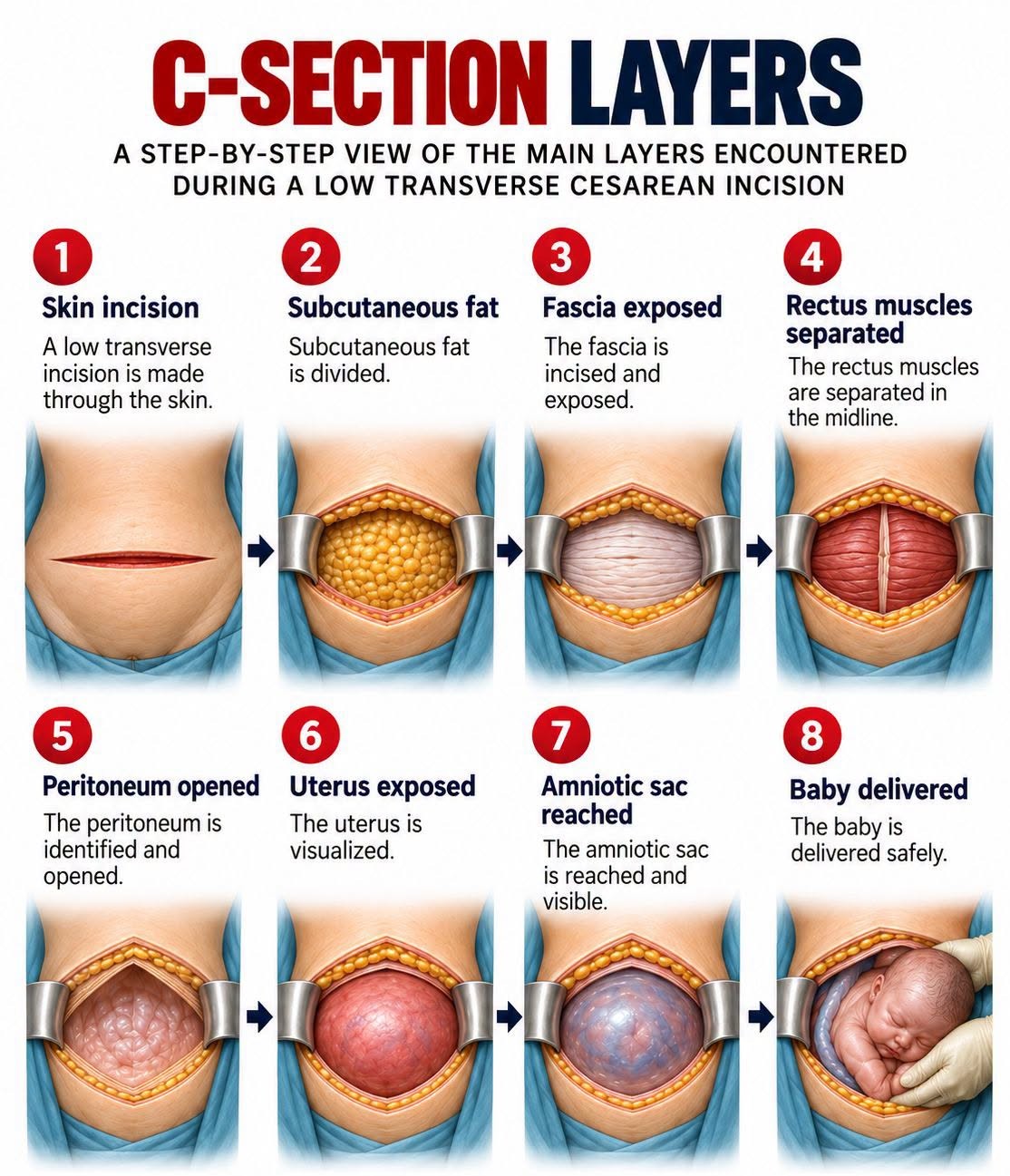
- The obstetrician will make an incision through your skin and into the wall of your abdomen. Then, they’ll cut a 3- to 4-inch incision into your uterus.
- Your obstetrician will remove your baby through the incision. The umbilical cord is then cut, the placenta is removed, and the incisions are closed with stitches and staples.
If you’re awake for surgery, you’ll be able to see and hold your baby shortly after they’re born.
How long does a C-section take?
A typical C-section takes about 45 minutes to an hour and a half from start to finish, including delivering the baby and closing the incision. In emergencies, it may happen much faster, sometimes within 10 to 15 minutes.
How painful is it?
You’ll be under anesthesia to prevent you from feeling any pain. You may feel a tug or pull when your baby is removed and as they repair your incision.
What are the different types of caesarean sections?
C-sections can be planned or unplanned. They can also be different based on the type of cut your obstetrician makes. The different types are:
- Low transverse or bikini incision: A cut is made horizontally across your lower uterus (most common).
- Low vertical incision: A cut is made vertically across your lower uterus.
- Classic incision: A cut is made vertically in the upper part of your uterus.
What happens after a C-section?
Your obstetrician will deliver the placenta after your baby is born. Next, they’ll stitch your uterus and stitch or staple your abdominal muscles. A typical C-section surgery requires at least three to four days in the hospital.
Your abdomen will be sore for several days or weeks. In some cases, your provider may prescribe pain medication. You can expect to limit your activities, take it easy, and rely on family and friends once you go home.
Risks / Benefits
What are the benefits of a C-section?
In most cases, the biggest benefit of a C-section is that it’s safer for both you and your baby. It’s a way to eliminate risks of a vaginal delivery.
What are the risks involved?
The risks of complications are slightly higher with C-sections than with vaginal delivery. These include:
- Infection
- Blood loss
- A blood clot that may break off and enter your bloodstream
- Injury to your bowel or bladder
- A cut that might weaken the uterine wall
- Risks from general anesthesia
- Injuries to the baby
Other disadvantages of having a C-section are:
- Recovering from a C-section may be more difficult than a vaginal delivery.
- C-sections are more likely to cause chronic pelvic pain.
- You’re more likely to have a C-section in future pregnancies.
- Your baby may be at greater risk for breathing problems or trouble breastfeeding.
Is a C-section safer than normal delivery?
Vaginal births are usually safer. But a C-section may be the only safe option depending on your situation.
Recovery and Outlook
What is the recovery process for a caesarean section?
Once the anesthesia wears off, you’ll begin to feel the pain from the incisions. You might also experience gas pains and have trouble taking deep breaths. Make sure an adult is there to help you get up from bed the first several days.
A full recovery can take between four and six weeks. Ask your healthcare provider what you can expect during recovery. Most providers recommend limiting walking and lifting, and avoiding exercise and other strenuous activities for several weeks. Ask your friends or partner for help with errands, cooking and cleaning so you can rest and recover. Avoid driving for about two weeks. Before driving again, make sure you can comfortably turn your body and press the brake and gas pedals.
You can expect cramping and bleeding for up to six weeks, as well as some discomfort around the incision. Taking over-the-counter pain relievers like acetaminophen or ibuprofen for pain may help. Avoid sex for at least six weeks or until your healthcare provider gives you the OK.
You will also have a vaginal discharge after the surgery. It will be red at first and then gradually change to yellow. Be sure to call your healthcare provider if you experience heavy bleeding or a foul odor from the vaginal discharge. Use sanitary pads, not tampons, until you’re completely done bleeding.
Can I have a baby vaginally after a C-section?
You may be able to have a vaginal delivery after a C-section if:
- Your surgeon used a low transverse incision.
- You’re not having twins or triplets.
- Your first C-section was only performed because your baby was breech or wasn’t tolerating labor.
You should discuss this with your healthcare team. They can help you weigh the pros and cons.
When should I call my healthcare provider?
Call your provider if you have these symptoms after a C-section:
- Red or swollen incision
- Pus or leaking discharge from the incision
- Fever, chills or flu-like symptoms
- Severe pelvic pain and cramping
- Heavy bleeding
How many C-sections can you have?
There isn’t an exact number. Factors like your health history and reasons for previous C-sections all play a role. Your healthcare provider will talk to you about the risks of having several C-sections if they apply to you.
Not all mothers need an episiotomy, a surgical incision that widens the vaginal opening. It is only necessary if the baby is large, in an abnormal position, or is not handling the last minutes of labor well. While the recovery may take upto a month, having warm sitz baths and keeping the area clean, dry can help ensure safe episiotomy aftercare and healing.
If you’re a mother-to-be, you might need an episiotomy. This is a minor cut that widens the vaginal opening to encourage a smooth delivery. But it can be scary if you’re not sure what to expect! Here are nine things every expectant mother should know about an episiotomy.
1. Episiotomy Is Not A Routine Procedure Anymore
Once upon a time, an episiotomy was a routine part of giving birth. But now, the procedure isn’t recommended for everyone. Your doctor will determine if you should get one or not!1 It all depends on your body and baby.
2. Only Some Cases Need One
If your baby is too big for your vaginal opening, an episiotomy may prevent painful tearing. It might also be necessary if your little one’s feet or bottom comes out first. This is an abnormal position, but an episiotomy can make the delivery easier.2 The procedure also helps deliveries that need to happen quickly or require extra instruments.
3. There Are 2 Kinds Of Episiotomies
A midline or median incision is the most common episiotomy. This is a straight vertical cut that goes from the vagina to the anus. It’s also the easiest to repair. There’s also a mediolateral incision which is a diagonal cut. It has less potential of tearing through the anus but is harder to repair. Recovery might be slightly more painful, too.
4. The Procedure Isn’t Painful
Thanks to anesthesia, you won’t feel the actual cuts. The area around the vagina will be numb. After birth, the incisions will be repaired with dissolving stitches. But feeling mild to moderate pain during recovery is perfectly normal. Your doctor will let you know how you can safely relieve the pain.
5. It’s Done Right Before Delivery
An episiotomy is done right before you give birth. When the doctor sees that the baby is about to come out, the cut will be made. It’ll be stitched up after both the baby and the placenta have been delivered.
6. There Are Some Risks
Like all surgeries, an episiotomy presents a few risks. The cut might tear even more during delivery and reach the anus. You might also lose a lot of blood during the process or the cut might become infected. But depending on the situation, the benefits of an episiotomy might outweigh these risks.
7. Recovery Takes A Month
Episiotomy recovery takes up to a month. And since the stitches dissolve, you won’t need to go back to remove them. Instead, take it easy during this time. Bathing in warm water may help you feel more comfortable. If your baby is healthy, you can take the painkillers paracetamol and ibuprofen while breastfeeding. Avoid aspirin, though.
8. Preventing Infection Is Important
Taking care of the healing cut is crucial. This will avoid infections and even more complications. After every trip to the bathroom, clean the area. You can do this by washing it with warm water. And when you empty your bowel, wipe from front to back, away from the cut.
9. Reduce Your Need For An Episiotomy
To lower your chances of needing an episiotomy, focus on making your body stronger before delivery. Kegel exercises can be a huge help.10 You can also massage the perineum, the area under your vagina. Use vegetable-based massage oil for best results.11 And don’t forget about prenatal yoga!
Don’t panic if you need an episiotomy. Your doctor can help you have a successful procedure and delivery. If you have concerns, be sure to ask questions.
References
- Fanaroff and Martin’s Neonatal-Perinatal Medicine: Diseases of the Fetus and Infant.
- Education material for teachers of midwifery : midwifery education modules (PDF) (2nd ed.). Geneva [Switzerland]: World Health Organisation. 2008.
- . “Vaginal childbirth and pelvic floor disorders”. Women’s health (London, England).
- , Elizabeth. Concise Colour Medical l.p.Dictionary. Oxford University Press.
- “Preterm birth Fact sheet N°363”. WHO. November 2015. Archived from the o “Use of active management of the third stage of labour in seven developing countries”. Bulletin of the World Health Organization. 87 (3): 207–13. doi:10.2471/BLT.08.052597. PMC 2654655 . PMID 19377717.
- Jump up^ International Confederation of Midwives; International Federation of Gynaecologists Obstetricians (2004).
- “Second-stage labour duration in nulliparous women: Relationship to maternal and perinatal outcomes”. American Journal of Obstetrics and Gynecology. 201 (4): 357.e1–7. doi:10.1016/j.ajog.2009.08.003. PMC 2768280 PMID 19788967.

