
Upper Limb Examination – Technique, Procedure, Result

Patient Tools

Read, save, and share this guide

Use these quick tools to make this medical article easier to read, print, save, or share with a family member.

Patient Mode

Understand this article easily

Switch between simple English and easy Bangla patient notes. This is for education and does not replace a doctor consultation.

The upper limb examination is another skill to elicit neurological signs, such as nerve problems that supply the arms and hands. Patients may present with a number of complaints including altered sensation, for example, pins and needles or numbness or loss of power of a...

For severe symptoms, danger signs, pregnancy, child illness, or sudden worsening, seek urgent medical care.

বাংলা রোগী নোট এখনো যোগ করা হয়নি। পোস্ট এডিটরে “RX Bangla Patient Mode” বক্স থেকে সহজ বাংলা সারাংশ যোগ করুন।

এই তথ্য শিক্ষা ও সচেতনতার জন্য। এটি ডাক্তারি পরীক্ষা, রোগ নির্ণয় বা প্রেসক্রিপশনের বিকল্প নয়।

Article Summary

The upper limb examination is another skill to elicit neurological signs, such as nerve problems that supply the arms and hands. Patients may present with a number of complaints including altered sensation, for example, pins and needles or numbness or loss of power of a limb, it may be intermittent such as multiple sclerosis, or permanent such as in motor neurone disease. Neuropathies can also occur and...

Key Takeaways

  • This article explains Procedure Steps in simple medical language.
  • This article explains Conclusion in simple medical language.
Educational health guideWritten for patient understanding and clinical awareness.
Reviewed content workflowUse writer and reviewer profiles for stronger trust.
Emergency safety firstUrgent warning signs are highlighted below.

Seek urgent medical care if you notice

These warning signs are general safety guidance. Local emergency numbers and clinical judgment should always come first.

  • New or worsening weakness, numbness, or loss of coordination.
  • Loss of bladder or bowel control, or numbness around the groin or saddle area.
  • Back or neck pain with fever, recent major injury, cancer history, or unexplained weight loss.
1

Emergency now

Use emergency care for severe, sudden, rapidly worsening, or life-threatening symptoms.

2

See a doctor

Book a professional medical evaluation if symptoms persist, worsen, recur often, affect daily activities, or occur in a high-risk patient.

3

Learn safely

Use this article to understand possible causes, tests, treatment options, prevention, and questions to ask your clinician.

Before reading

RX Patient Tools

Use these quick guides before reading the article, or return to them when you need help preparing questions for a doctor.

Start here Choose the right pathway for symptoms, reports, medicines, or urgent warning signs. Disease article roadmap Read this topic step by step: meaning, symptoms, warning signs, diagnosis, treatment, prevention, and follow-up. Treatment planner Prepare questions about treatment choices, benefits, risks, side effects, and follow-up. Family & caregiver guide Organize symptoms, reports, medicines, questions, and follow-up safely. Nutrition & diet guide Prepare food, hydration, supplement, and medicine-timing questions safely. Prevention guide Organize risk factors, protective habits, screening, and warning signs. Recovery guide Prepare a safe plan for activity, rehabilitation, warning signs, and follow-up.
Definition

The upper limb examination is another skill to elicit neurological signs, such as nerve problems that supply the arms and hands. Patients may present with a number of complaints including altered sensation, for example, pins and needles or numbness or loss of power of a limb, it may be intermittent such as multiple sclerosis, or permanent such as in motor neurone disease.

Neuropathies can also occur and can be mono such as wrist drop or Erb’s palsy or poly such as “glove and stocking” which can occur in insulin is low or not working well. সহজ বাংলা: রক্তে চিনি বেশি থাকার রোগ।" data-rx-term="diabetes" data-rx-definition="Diabetes is a condition where blood sugar stays too high because insulin is low or not working well. সহজ বাংলা: রক্তে চিনি বেশি থাকার রোগ।">diabetes mellitus.

A full neurological examination, therefore, includes an assessment of both the motor and sensory systems of the legs. In exams, you may be asked to focus on one part, such as the sensory or the motor. For reference, this guide will include both.

Procedure Steps

Step 01

As with all examinations, the best method is your own – one with which you are comfortable and familiar. The one explained here takes the following format:

  • Tone.
  • Power.
  • Reflexes.
  • Function.
  • Sensation.

Step 02

Wash your hands, introduce yourself to the patient and clarify their identity. Explain the procedure you about to perform and obtain consent.

Step 03

The upper body should be exposed for this examination. Initially, observe the patient’s arms, look for any muscle wasting, fasciculations, or asymmetry.

Upper Limb Examination - Technique, Procedure, Result
Observe the patients arms, look for any muscle wasting, fasciculations or asymmetry

Step 04 – Tone

Start proximally at the shoulder, feeling how easy the joint is to move passively. Then move down to the elbow, wrist and hand joints, again assessing each one’s tone in turn.

Upper Limb Examination - Technique, Procedure, Result
Assess arm tone
Upper Limb Examination - Technique, Procedure, Result
Assess elbow, wrist, and hand joints

Step 05 – Power

Start at the shoulder asking the patient to abduct and adduct against your hand so you can assess how much force they can overcome. Do the same for flexion and extension at the elbow and wrist, as well as the fingers; also checking abduction and adduction of the thumb.

Upper Limb Examination - Technique, Procedure, Result
Assess the power of the shoulders 1
Upper Limb Examination - Technique, Procedure, Result
Assess the power of the shoulders 2
Upper Limb Examination - Technique, Procedure, Result
Elbow flexion
Upper Limb Examination - Technique, Procedure, Result
Elbow extension
Upper Limb Examination - Technique, Procedure, Result
Wrist flexion
Upper Limb Examination - Technique, Procedure, Result
Wrist extension
Upper Limb Examination - Technique, Procedure, Result
Finger flexion
Upper Limb Examination - Technique, Procedure, Result
Finger extension
Upper Limb Examination - Technique, Procedure, Result
Finger abduction
Upper Limb Examination - Technique, Procedure, Result
Abduction of the thumb

Step 06 – Reflexes

There are three reflexes in the upper limb:

  1. The biceps reflex
  2. The triceps reflex
  3. The supinator reflexes

Biceps Reflex

The biceps reflex is tested by supporting the patient’s arm, with it flexed at roughly 60 degrees, placing your thumb over the biceps tendon and hitting your thumb with the tendon hammer. It is vital to get your patient to relax as much as possible and for you to take the entire weight of their arm.

Upper Limb Examination - Technique, Procedure, Result
Bicep reflex test right
Upper Limb Examination - Technique, Procedure, Result
Bicep reflex test left

Triceps Reflex

The triceps reflex is elicited by resting the patient’s arm across their chest and hitting the triceps tendon just proximal to the elbow.

Upper Limb Examination - Technique, Procedure, Result
Triceps reflex test right
Upper Limb Examination - Technique, Procedure, Result
Triceps reflex test left

Supinator Reflex

Finally, with their arm rested on their abdomen, locate the supinator tendon as it crosses the radius, place three fingers on it, and hit the fingers. This should give the supinator reflex. If you struggle with any of these reflexes, asking the patient to clench their teeth should exaggerate the reflex.

Upper Limb Examination - Technique, Procedure, Result
Supinator reflex test right
Upper Limb Examination - Technique, Procedure, Result
Supinator reflex test left

Step 10 – Function

To assess the upper limb, you should ask the patient to touch their head with both hands and then ask them to pick up a small object such as a coin which each hand.

Step 11 – Sensation

You should test light touch, pinprick, vibration, and joint position sense, or proprioception.

Light Touch

Ask the patient to place their arms by their sides with their palms facing forwards. Lightly touch the patient’s sternum with a piece of cotton wool so that they know how it feels.

Then, with the patient’s eyes shut, lightly touch their arm with the cotton wool. The places to touch them should test each of the dermatomes – make sure you know these! Tell the patient to say “yes” every time they feel the cotton wool as it felt before.
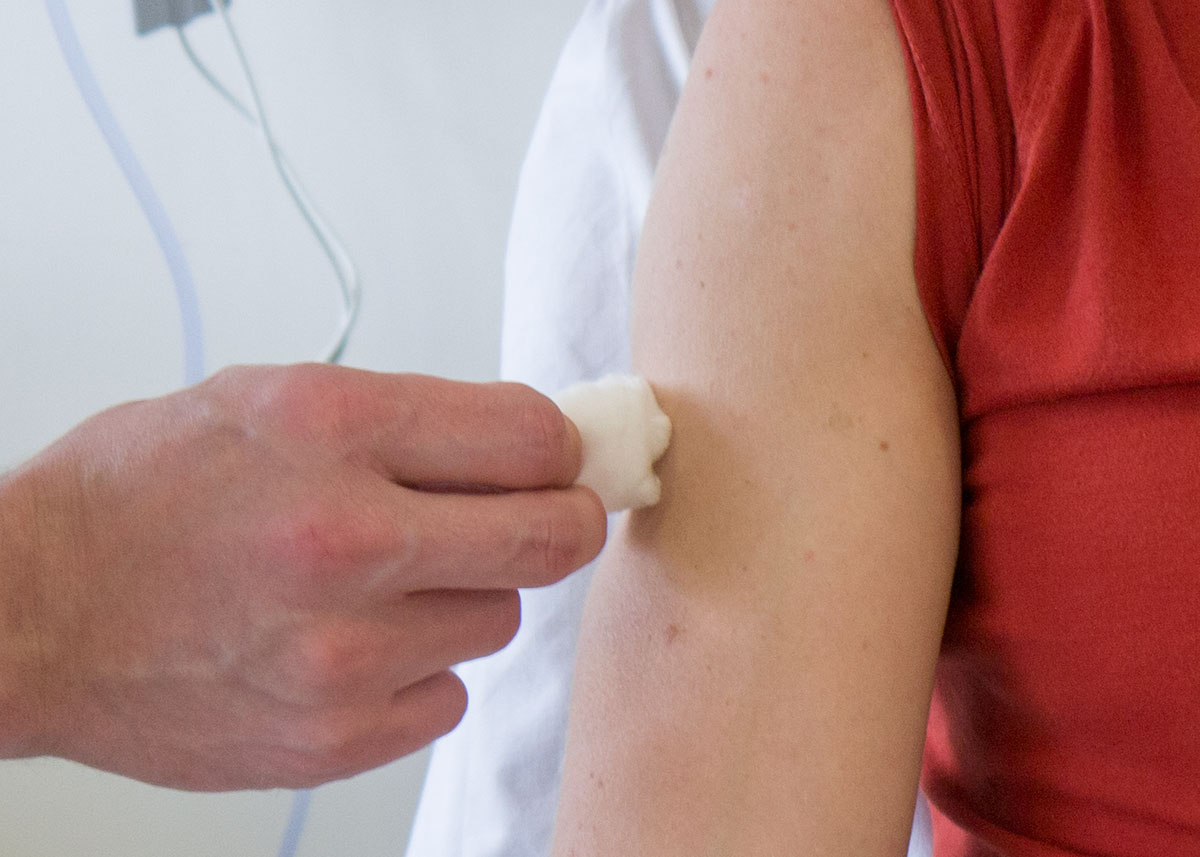
Upper Limb Examination - Technique, Procedure, Result
Touch sensation with cotton wool

Pin Prick

Repeat the last step using a slight pinprick.

Upper Limb Examination - Technique, Procedure, Result
Touch sensation with pinprick

Vibration

To assess vibration you should use a sounding tuning fork. Place the fork on the patient’s sternum to show them how it should feel.

Now place it on the bony prominence at the base of their thumb and ask them if it feels the same. If it does, there is no need to check any higher. If it feels different you should move to the radial stylus and then to the olecranon until it feels normal.

Upper Limb Examination - Technique, Procedure, Result
Vibration test using a sounding tuning fork

Proprioception

Finally assess proprioception. Hold the distal phalanx of the thumb on either side so that you can flex the interphalangeal joint.

Show the patient that when you hold the joint extended, that represents Up whereas when you hold it flexed that represents Down. Ask the patient to close their eyes and, having moved the joint a few times hold it in one position – up or down. Ask the patient which position the joint is in.

Upper Limb Examination - Technique, Procedure, Result
Thumb position up
Upper Limb Examination - Technique, Procedure, Result
Thumb position down

Conclusion

Allow the patient to dress and thank them.

Wash your hands and report your findings to the examiner.

References

Doctor visit helper

Prepare before seeing a doctor

A simple rural-patient checklist to help you explain symptoms clearly, ask better questions, and avoid unsafe self-treatment.

Safety note: This is not a prescription or diagnosis. For severe symptoms, pregnancy danger signs, children with serious illness, chest pain, breathing difficulty, stroke-like weakness, or major injury, seek urgent care.

Which doctor may help?

Orthopedic doctor, spine specialist, neurologist, or physiotherapist depending on severity.

What to tell the doctor

  • Mark pain area and whether pain travels to leg.
  • Write numbness, weakness, bladder/bowel problem, fever, injury, or night pain if present.
  • Bring previous X-ray/MRI and medicine list.

Questions to ask

  • Is this muscle pain, disc problem, nerve pressure, arthritis, infection, or another cause?
  • Do I need X-ray or MRI now?
  • Which activities should I avoid and which exercises are safe?
  • When can I return to work?

Tests to discuss

  • Spine and neurological examination
  • Straight leg raise or similar nerve tension tests
  • X-ray if trauma/deformity/chronic pain is suspected
  • MRI if leg weakness, sciatica, or red flags are present

Avoid these mistakes

  • Avoid heavy lifting, long bed rest, and untrained spinal manipulation.
  • Avoid NSAIDs if ulcer, kidney disease, blood thinner use, pregnancy, or allergy unless doctor says safe.

Medicine safety and first-aid guide

This section is for patient education only. It does not replace a doctor, pharmacist, or emergency care.

Safe first steps

  • Avoid heavy lifting, sudden bending, and prolonged bed rest.
  • Use comfortable posture and gentle movement as tolerated.
  • Discuss physiotherapy, X-ray, or MRI only when clinically needed.

OTC medicine safety

  • For mild back pain, pain-relief medicine may be discussed with a doctor or pharmacist.
  • Avoid repeated painkiller use if you have kidney disease, stomach ulcer, uncontrolled blood pressure, or are taking blood thinners.

Avoid these mistakes

  • Do not start antibiotics without a proper medical decision.
  • Do not use steroid tablets or injections casually for quick relief.
  • Do not delay emergency care because of home remedies.

Get urgent help if

  • Back pain with leg weakness, numbness around private area, loss of urine/stool control, fever, cancer history, or major injury needs urgent care.
Medicine names, dose, and timing must be decided by a qualified clinician or pharmacist after checking age, pregnancy, allergy, other diseases, and current medicines.

For rural patients and family caregivers

Patient health record and symptom diary

Write your symptoms, medicines already taken, test results, and questions before visiting a doctor. This note stays on your device unless you print or copy it.

Doctor to discuss: Doctor / qualified healthcare provider
Tests to discuss with doctor
  • Basic vital signs: temperature, pulse, blood pressure, oxygen level if needed
  • Relevant blood, urine, imaging, or specialist tests only after clinical assessment
Questions to ask
  • What is the most likely cause of my symptoms?
  • Which warning signs mean I should go to emergency care?
  • Which tests are really needed now?
  • Which medicines are safe for my age, pregnancy status, allergy, kidney/liver/stomach condition, and current medicines?

Emergency warning signs such as chest pain, severe breathing difficulty, sudden weakness, confusion, severe dehydration, major injury, or loss of bladder/bowel control need urgent medical care. Do not wait for online information.

Safe pathway to proper treatment

Care roadmap for: Upper Limb Examination – Technique, Procedure, Result

Use this simple roadmap to understand the next safe steps. It is educational and does not replace examination by a doctor.

Go to emergency care if you notice:
  • Severe or rapidly worsening symptoms
  • Breathing difficulty, chest pain, fainting, confusion, severe weakness, major injury, or severe dehydration
Doctor / service to discuss: Qualified healthcare provider; specialist depends on symptoms and examination.
  1. Step 1

    Check danger signs first

    If danger signs are present, seek emergency care and do not wait for online information.

  2. Step 2

    Record the symptom story

    Write when symptoms started, severity, medicines already taken, allergies, pregnancy status, and test results.

  3. Step 3

    Visit a qualified clinician

    A doctor, nurse, or qualified healthcare provider can examine you and decide which tests or treatment are needed.

  4. Step 4

    Do only useful tests

    Do tests after clinical assessment. Avoid unnecessary tests, random antibiotics, or repeated medicines without diagnosis.

  5. Step 5

    Follow up and return early if worse

    If symptoms worsen, new warning signs appear, or treatment is not helping, return for review quickly.

Rural patient practical tips
  • Take a written symptom diary and all previous prescriptions/test reports.
  • Do not hide medicines already taken, even herbal or over-the-counter medicines.
  • Ask which warning signs mean urgent referral to hospital.

This roadmap is for education. A real diagnosis and treatment plan requires history, examination, and clinical judgment.

RX Patient Help

Ask a health question safely

Write your symptom story. A health professional or site editor can review it before any answer is prepared. This box is not for emergency care.

Emergency first: Severe chest pain, breathing trouble, unconsciousness, stroke signs, severe injury, heavy bleeding, or rapidly worsening symptoms need urgent local medical care now.

Frequently Asked Questions

Is this article a replacement for a doctor?

No. It is educational content only. Patients should consult a qualified clinician for diagnosis and treatment.

When should I seek urgent care?

Seek urgent care for severe symptoms, rapidly worsening condition, breathing difficulty, severe pain, neurological changes, or any emergency warning sign.

References

Add references, clinical guidelines, textbooks, journal articles, or trusted medical sources here. You can edit this area from the RX Article Professional Blocks panel.
