
How Does A Blockchain Technology Work

Patient Tools

Read, save, and share this guide

Use these quick tools to make this medical article easier to read, print, save, or share with a family member.

Article Summary

So what is blockchain technology in simple terms? Blockchain generally defined as an advanced database technology. All the data stored is public and is easily verified. All the blocks are connected to each other. Share the access with your reliable business partners and they will be receiving the same information about the transaction in chronological order. Access to the chain is prohibited for unauthorized users....

Key Takeaways

  • This article explains What Are The Advantages Of Blockchain in simple medical language.
  • This article explains Disadvantages Of Blockchain in simple medical language.
  • This article explains How Is Blockchain Used In Cryptocurrency in simple medical language.
  • This article explains How Does Blockchain Technology Work in simple medical language.
Educational health guideWritten for patient understanding and clinical awareness.
Reviewed content workflowUse writer and reviewer profiles for stronger trust.
Emergency safety firstUrgent warning signs are highlighted below.

Seek urgent medical care if you notice

These warning signs are general safety guidance. Local emergency numbers and clinical judgment should always come first.

  • Severe symptoms, breathing difficulty, fainting, confusion, or rapidly worsening illness.
  • New weakness, severe pain, high fever, or symptoms after a serious injury.
  • Any symptom that feels urgent, unusual, or unsafe for the patient.
1

Emergency now

Use emergency care for severe, sudden, rapidly worsening, or life-threatening symptoms.

2

See a doctor

Book a professional medical evaluation if symptoms persist, worsen, recur often, affect daily activities, or occur in a high-risk patient.

3

Learn safely

Use this article to understand possible causes, tests, treatment options, prevention, and questions to ask your clinician.

So what is blockchain technology in simple terms? Blockchain generally defined as an advanced database technology. All the data stored is public and is easily verified. All the blocks are connected to each other. Share the access with your reliable business partners and they will be receiving the same information about the transaction in chronological order. Access to the chain is prohibited for unauthorized users. It’s an immutable ledger for many purposes.

What Are The Advantages Of Blockchain

Blockchain technology brings many benefits. There are the main ones:

➜ Advanced security
Blockchain uses the three principles of cryptography, decentralization, and consensus to create enhanced security. There is no single point of failure, and a single user cannot change the transaction records.

➜ Improved efficiency
Transparency and smart contracts in blockchain make business-to-business transactions faster and more efficient.

➜ Faster auditing
With Blockchain, records are available for every participant and always ordered by time, which makes audit processing much faster.

Disadvantages Of Blockchain

Disadvantages are present as well:

➜ Scalability
Contrary to their centralized counterparts, blockchains have limited scalability. The more nodes participating, the slower the transaction is.

➜ Storage
Blockchain ledgers have the potential to become extremely large over time. The size of blockchains seems to be growing faster than the size of hard drives, and the network could lose nodes if the ledger gets too big for users to download and store.

➜ Security
Blockchain offers greater security than other platforms. However, this does not imply that it is entirely safe.

➜ Privacy
Despite being anonymous and encrypted, all network nodes have access to data on a public blockchain accessible to everyone.

➜ Power Use
Blockchain’s energy consumption is very high due to mining.

➜ Private Keys
Blockchain’s dependence on its users is a limitation – if the keys are stolen there’s no other way for the user to access their funds.

➜ Data Immutability
The immutability of data may be a disadvantage too. If someone uses a blockchain-based digital platform, they can’t erase its record.

➜ Cost
Maintaining a chain is simply expensive.

How Is Blockchain Used In Cryptocurrency

Cryptocurrency and blockchain are inseparable. Basically, Blockchain is the foundation of crypto. It even allows cryptocurrencies and almost all of the services created to manage them to exist. Thanks to that, selling, buying and trading in crypto is available to us.

Eventually, the development of blockchain is driven by cryptocurrencies because cryptocurrency relies on its network. Blockchain is not only used for financial purposes, though – many other innovative solutions are based on blockchain technology.

How Does Blockchain Technology Work

The complex mechanism of blockchain may be explained by the following steps:

1. Record the transaction
The record shows the detailed process of asset movement from one party to another. The blockchain data contains all the details about the transaction, including who was involved in it, the time, date, place, and amount of the transaction, etc.

2. Gain consensus
At the start of the network, participants must agree that the recorded transaction is valid.

How Does A Blockchain Technology Work3. Link the blocks
Once the participants have reached a consensus, transactions are written into blocks. These blocks are linked to each other with the hash. Because of the hash, data tampering is easily detected as the hash value changes when data is being modified. Blocks are linked securely, and each additional block strengthens the verification of the previous block.

4. Share the ledger
The latest copy of the ledger is shared with all participants.

History Of Blockchain

Scientists Stuart Haber and W. Scott Stometta described blockchain technology in 1991. They aimed to create a tool for time-stamping digital documents to avoid tampering. They developed a system of a secured chain.

Later, Merkle trees were integrated into the technology, making the chain more structured by the ability to connect several documents into one block. It stores many data blocks, each one being a part of the one before it. The newest record contains the entire record history. Although, the technology went unused.

In 2004 the Reusable Proof of Work system was introduced by Hal Finney as a prototype for digital money. The system worked by receiving a non-fungible Hashcash-based coin as a reward. Then, the token could be transferred between users.

In 2008 Satoshi Nakamoto elaborated on the distributed ledger theory. He modified the blockchain system by improving its design. The design he developed is still being used for storing crypto transaction data.

Types Of Blockchain

There are four types of blockchain structures:How Does A Blockchain Technology Work
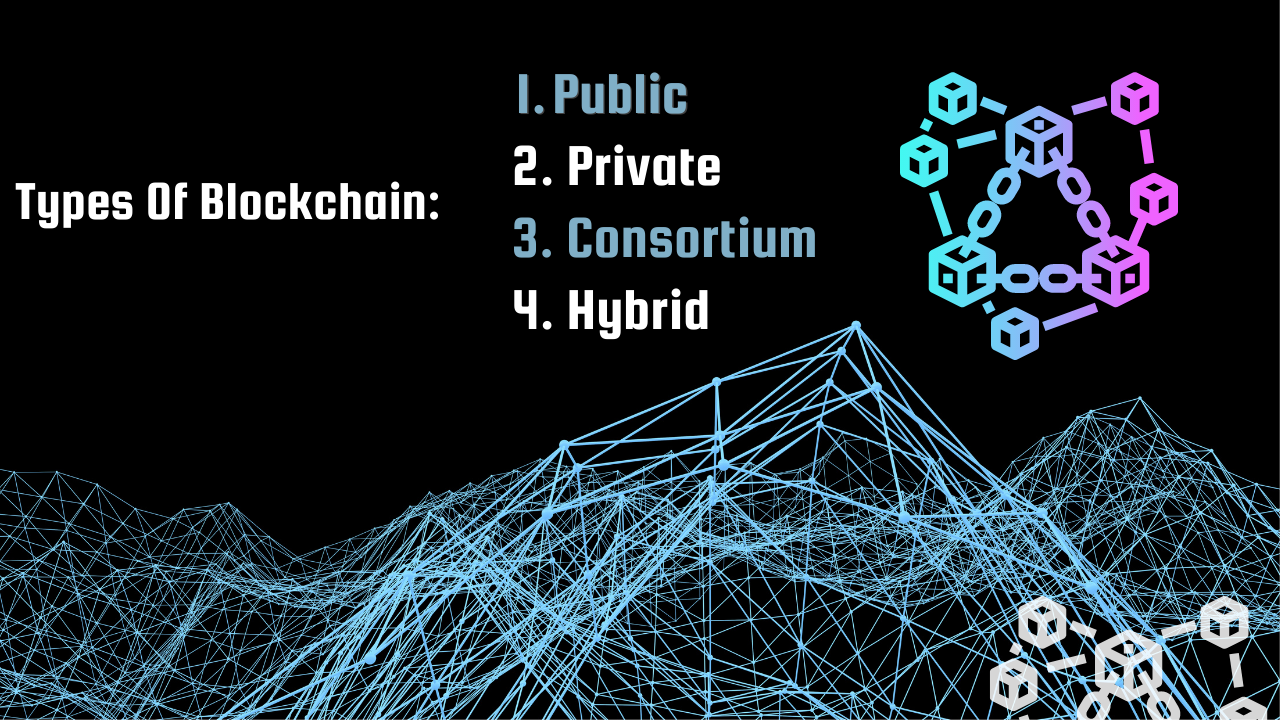
1. Public Blockchains
In simple terms, this type of blockchain is usually characterized by having no restrictions – anyone can join, read, write, review, and download the protocol anytime. There are often offers incentives for validators.

The big community of participants keeps it safe from cybersecurity issues, as the more participants, the safer blockchain is. Public blockchains are completely decentralized so all nodes can create new blocks and validate them.

However, it’s impossible to change the data already put into the chain – blockchain is immutable. The main drawback of this kind of blockchain is that validation tends to take time.

2. Private (or Managed) Blockchains
Private blockchains are much faster in comparison to public ones, which are provided by lesser nodes participating. Public access is restricted, only the central authority determines who can be a node. These blockchains are partially decentralized and controlled by a single organization. Because of it, equal rights are not granted to all of the participants.

The drawback is that managed chains are more vulnerable to fraud.

3. Consortium (or Federated) Blockchains
Federated Blockchains are rarely focused on cryptocurrency and often being arranged for other projects based on blockchain. These chains are governed by groups of organizations. Only pre-selected participants are accepted and each of them has equal power. Each participant will be verified in advance and excluded by the other participants in case of malicious actions.

It’s rather difficult to set up consortiums as it requires cooperation between a number of organizations, which may lead to logistical challenges.

4. Hybrid blockchains
Hybrid blockchains are controlled by a single organization, but with the ability to communicate with all shareholders. The qualities they share with private blockchains make them able to achieve low transaction costs as it takes only a few participants to validate. The mixed nature provides controlled access and freedom at the same time. The architecture of hybrid blockchains is completely customizable and the rules may be changed at any time.

Blockchain Privacy And Security

Even though Blockchain is known to be a secure technology, there are still some drawbacks waiting to be improved.

Transactions stored in the blockchain are not encrypted so everybody has access to it. This may be troublesome as it may lead to regulatory and legal problems in some cases. The solution is to encrypt this information, but if the key is lost, there’s no way to decrypt it back correctly/ Bigger problem may emerge if the key is stolen.

However, blockchain can also help to improve cybersecurity. Such problems, as MITM attacks, data tampering, and DDoS attacks are successfully avoided with the help of blockchain.

Blockchain Examples And Use Cases

The application of blockchain technology is diverse, let’s look at some examples:

• Money Transfer
Cryptocurrency transfer apps make it easier, faster, and cheaper to transfer money, especially when it comes to international transactions.

• Smart contracts
It’s like our regular contracts, but a middleman is not needed. This saves time and money for businesses.

• Internet of Things (IoT)
The Internet of Things opens a new era of smart household appliances. Control your fridge, robotic vacuum, or even coffeemaker from any distance. By the way, the Machine Learning technology is extremely helpful in that very case. A smart home enabled with both blockchain and machine learning algorithms is easily monitored and can be adjusted according to personal preferences.

• Personal identity security
Protect yourself from identity fraud by keeping your personal data on a decentralized blockchain ledger.

• Healthcare
Blockchain solutions may reduce healthcare costs by implementing the technology for collecting and sharing patients’ private information between medical workers.

• Logistics
Shipping companies are using technology to manage the supply chain by tracking it around the world using blockchain technology.

• Non-fungible tokens (NFTs)
Thanks to blockchain, consumers can now claim sole ownership of some of the most desirable digital assets.

• Government
The technology is used to store government documents, which significantly improves the efficiency of bureaucratic work. It also may be used to make elections simpler.

• Media
To secure your media pieces from being stolen you can tokenize them using blockchain technology.

In conclusion

In the article we discussed what the blockchain is, how it was created and what blockchain may be potentially used for. In one sentence, blockchain has many applications, not just in finance, and the development what can we do using the technology is very revolutionary. Hope you have learned something new!


Patient safety assistant

Check your symptom safely

Hi, I am RX Symptom Navigator. I can help you understand what to read next and what warning signs need care.
Warning: Do not use this in emergencies, pregnancy, severe illness, or as a substitute for a doctor. For children or teens, use with a parent/guardian and clinician.
A rural-friendly guide: warning signs, when to see a doctor, related articles, tests to discuss, and OTC safety education.
1 Symptom 2 Severity 3 Safe guidance
First safety question

Is there chest pain, breathing trouble, fainting, confusion, severe bleeding, stroke-like weakness, severe injury, or pregnancy danger sign?

Choose quickly

Browse by body area
Start here: Write or select a symptom. The guide will show warning signs, doctor guidance, diagnostic tests to discuss, OTC safety education, and related RX articles.

Important: This tool is educational only. It cannot diagnose, treat, or replace a doctor. OTC information is not a prescription. In an emergency, contact local emergency services or go to the nearest hospital.

Doctor visit helper

Prepare before seeing a doctor

A simple rural-patient checklist to help you explain symptoms clearly, ask better questions, and avoid unsafe self-treatment.

Safety note: This is not a prescription or diagnosis. For severe symptoms, pregnancy danger signs, children with serious illness, chest pain, breathing difficulty, stroke-like weakness, or major injury, seek urgent care.

Which doctor may help?

Start with a registered doctor or the nearest qualified health center.

What to tell the doctor

  • Write when the problem started and how it changed.
  • Bring old prescriptions, investigation reports, and current medicines.
  • Write allergies, pregnancy status, diabetes, kidney/liver disease, and major past illnesses.
  • Bring one family member if the patient is weak, elderly, confused, or a child.

Questions to ask

  • What is the most likely cause of my symptoms?
  • Which danger signs mean I should go to hospital quickly?
  • Which tests are necessary now, and which can wait?
  • How should I take medicines safely and what side effects should I watch for?
  • When should I come for follow-up?

Tests to discuss

  • Vital signs: temperature, pulse, blood pressure, oxygen saturation
  • Basic physical examination by a clinician
  • CBC, urine test, blood sugar, or imaging only when clinically needed

Avoid these mistakes

  • Do not use antibiotics, steroid tablets/injections, or strong painkillers without proper medical advice.
  • Do not hide pregnancy, kidney disease, ulcer, allergy, or blood thinner use.
  • Do not delay emergency care when danger signs are present.

Medicine safety and first-aid guide

This section is for patient education only. It does not replace a doctor, pharmacist, or emergency care.

Safe first steps

  • Avoid heavy lifting, sudden bending, and prolonged bed rest.
  • Use comfortable posture and gentle movement as tolerated.
  • Discuss physiotherapy, X-ray, or MRI only when clinically needed.

OTC medicine safety

  • For mild back pain, pain-relief medicine may be discussed with a doctor or pharmacist.
  • Avoid repeated painkiller use if you have kidney disease, stomach ulcer, uncontrolled blood pressure, or are taking blood thinners.

Avoid these mistakes

  • Do not start antibiotics without a proper medical decision.
  • Do not use steroid tablets or injections casually for quick relief.
  • Do not delay emergency care because of home remedies.

Get urgent help if

  • Back pain with leg weakness, numbness around private area, loss of urine/stool control, fever, cancer history, or major injury needs urgent care.
Medicine names, dose, and timing must be decided by a qualified clinician or pharmacist after checking age, pregnancy, allergy, other diseases, and current medicines.

For rural patients and family caregivers

Patient health record and symptom diary

Write your symptoms, medicines already taken, test results, and questions before visiting a doctor. This note stays on your device unless you print or copy it.

Doctor to discuss: Doctor / qualified healthcare provider
Tests to discuss with doctor
  • Basic vital signs: temperature, pulse, blood pressure, oxygen level if needed
  • Relevant blood, urine, imaging, or specialist tests only after clinical assessment
Questions to ask
  • What is the most likely cause of my symptoms?
  • Which warning signs mean I should go to emergency care?
  • Which tests are really needed now?
  • Which medicines are safe for my age, pregnancy status, allergy, kidney/liver/stomach condition, and current medicines?

Emergency warning signs such as chest pain, severe breathing difficulty, sudden weakness, confusion, severe dehydration, major injury, or loss of bladder/bowel control need urgent medical care. Do not wait for online information.

Safe pathway to proper treatment

Back pain care roadmap

Use this simple roadmap to understand the next safe steps. It is educational and does not replace examination by a doctor.

Go to emergency care if you notice:
  • New leg weakness, numbness around private area, or loss of bladder/bowel control
  • Back pain after major injury, fever, unexplained weight loss, cancer history, or severe night pain
Doctor / service to discuss: Orthopedic/spine specialist, physical medicine doctor, physiotherapist under guidance, or qualified clinician.
  1. Step 1

    Check danger signs first

    If danger signs are present, seek emergency care and do not wait for online information.

  2. Step 2

    Record the symptom story

    Write when symptoms started, severity, medicines already taken, allergies, pregnancy status, and test results.

  3. Step 3

    Visit a qualified clinician

    A doctor, nurse, or qualified healthcare provider can examine you and decide which tests or treatment are needed.

  4. Step 4

    Do only useful tests

    Discuss neurological examination first. X-ray or MRI may be needed only when red flags, injury, nerve weakness, or persistent severe symptoms are present.

  5. Step 5

    Follow up and return early if worse

    If symptoms worsen, new warning signs appear, or treatment is not helping, return for review quickly.

Rural patient practical tips
  • Take a written symptom diary and all previous prescriptions/test reports.
  • Do not hide medicines already taken, even herbal or over-the-counter medicines.
  • Ask which warning signs mean urgent referral to hospital.
  • Avoid forceful massage or bone-setting when there is weakness, injury, fever, or nerve symptoms.

This roadmap is for education. A real diagnosis and treatment plan requires history, examination, and clinical judgment.

RX Patient Help

Ask a health question safely

Write your symptom story. A health professional or site editor can review it before any answer is prepared. This box is not for emergency care.

Emergency first: Severe chest pain, breathing trouble, unconsciousness, stroke signs, severe injury, heavy bleeding, or rapidly worsening symptoms need urgent local medical care now.

Frequently Asked Questions

Is this article a replacement for a doctor?

No. It is educational content only. Patients should consult a qualified clinician for diagnosis and treatment.

When should I seek urgent care?

Seek urgent care for severe symptoms, rapidly worsening condition, breathing difficulty, severe pain, neurological changes, or any emergency warning sign.

References

Add references, clinical guidelines, textbooks, journal articles, or trusted medical sources here. You can edit this area from the RX Article Professional Blocks panel.