
The Digestive System comprises the gastrointestinal tract and accessory organs. The gastrointestinal tract consists of the oral cavity, pharynx, esophagus, stomach, small intestine, and large intestine. The accessory organs are the teeth, tongue, and the glandular organs such as salivary gland, liver, gallbladder, and pancreas.
The digestive system functions to provide mechanical processing, digestion, absorption of food, secretion of water, acids, enzymes, buffer, and salt, as well as excretion of waste products.
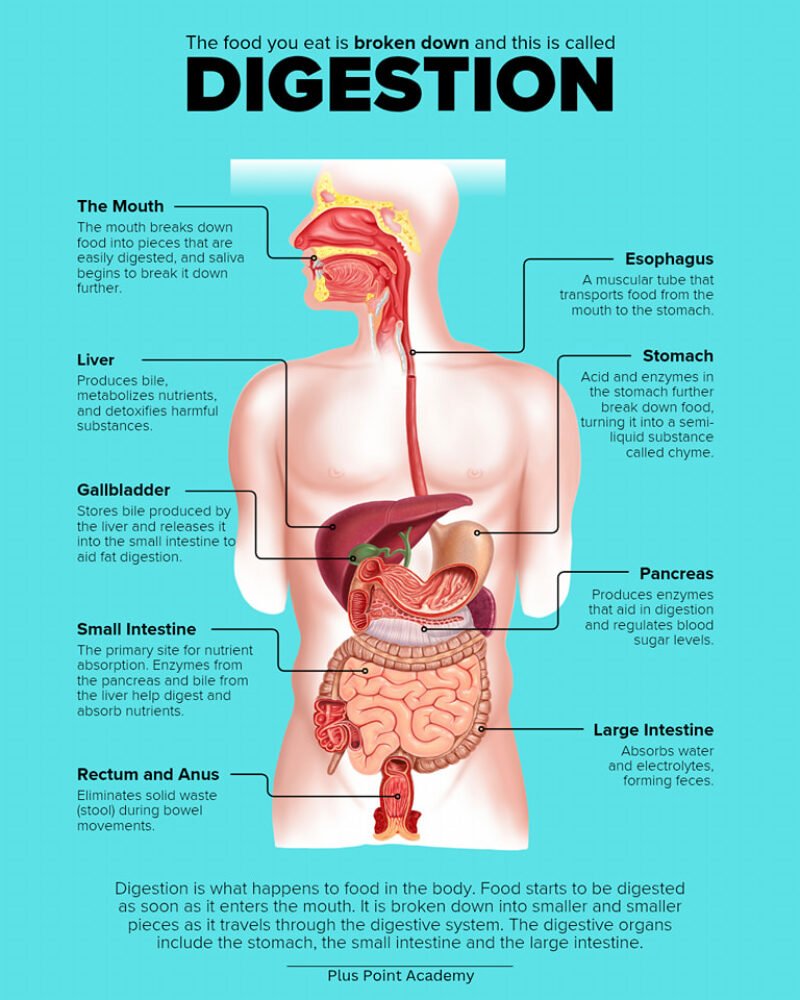
Function of Digestive System
The function of the digestive system is to digest and absorb food and then excrete the waste products with the help of the liver, gallbladder, pancreas, small intestine, large intestine, and rectum. Each of these organs plays a specific role in the digestive system.
The oral cavity functions to provide:
-
sensory analysis of food material before swallowing
-
mechanical processing via the action of the teeth, tongue, and palatal surfaces
-
lubrication by mixing food material with mucus and salivary gland secretion
-
limited digestion of carbohydrates and lipids
Starting with the oral mucosa, which is lined by both keratinized (seen in the superior surface of the tongue and the hard palate) and nonkeratinized squamous epithelial cells (seen in cheeks, lips, and inferior surface of the tongue), these cells are not known to absorb molecules except for the mucosa inferior to the tongue.
Functions of the tongue include mechanical processing by compression, abrasion, and distortion; manipulation to assist in chewing and prepare material for swallowing; sensory analysis by touch, temperature, and taste receptors; and secretion of mucins and lingual lipase. The lingual lipase has a broad pH and breaks down lipids (mainly triglyceride). The pH of 3.5 – 6 allows lingual lipase to work even in the acid environment of the stomach.[rx]
Within the oral cavity, there are three pairs of salivary glands. The first pair is the parotid salivary glands located inferior to the zygomatic arch and posterolateral to the mandible. The parotid glands produce serous secretions containing a large amount of salivary amylase, which breaks down carbohydrate complexes. Next are the sublingual salivary glands located at the floor of the mouth. The sublingual glands produce a mucous secretion that serves as both a buffer and lubricant. The third is the submandibular salivary glands, located at the floor of the mouth within the mandibular groove. They function by secreting a mixture of buffers, glycoproteins called mucins, and salivary amylase.
Altogether, these glands produce 1.0 – 1.5 liters of saliva each day[rx] Close to 99.4% of the saliva produced is water, and the remaining 0.6% consists of electrolytes, buffers, glycoproteins (mucins), antibodies, enzymes, and waste products. These function to lubricate the mouth to prevent friction between the mucosa of the oral cavity and the food material; moisten the food material for easy swallowing process; and initiation of lipid and carbohydrate complex digestion.
The teeth provide a mechanical breakdown of food materials; for instance, the connective tissue of meat and plant fibers in vegetables. This process also saturates the salivary secretions and enzymes within the food material for better digestion.
The pharynx serves as a passageway of food material to the esophagus although it also has a respiratory function for air movement into the lung. During swallowing, closure of nasopharynx and larynx occur to maintain proper direction of food. This process is achieved by cranial nerves IX and X. From the pharynx, food material goes to the esophagus.
The esophagus’s primary function is to empty food materials into the stomach via waves of contraction of its longitudinal and circular muscle known as peristalsis. The upper one-third of the esophagus is predominantly skeletal muscle. The middle one-third is a mixture of both the skeletal muscle and smooth muscle. The lower one-third is mainly smooth muscle. However, during the act of deglutition, the buccal phase is the only voluntary phase where one can still control the swallowing process. The skeletal muscles found in the pharynx and upper esophagus are all under the control of the swallow reflex; hence the pharyngeal and esophageal phase of swallowing are under involuntary control with the help of afferent and efferent fibers of glossopharyngeal and vagus nerves. The smooth muscles of the esophagus are arranged in a circular and longitudinal fashion and aid in peristaltic movement during swallowing.[rx][rx]
Once the food material arrives in the stomach, it can be temporarily stored and mechanically and chemically broken down by the actions of stomach acids and enzymes. The secretion of intrinsic factor produced by the stomach helps with proper absorption of B12.[rx] The ability of the stomach to store food stems from its compliance and ability to change size. On average, the lesser curvature of the stomach has a length of approximately 10cm and the larger curvature has a length of approximately 40cm. The stomach typically spans from vertebrae T7 and L3 giving it the ultimate ability to hold on to a large amount of food.
The stomach’s function in breaking down food materials mechanically is due to its sophisticated muscular dimensions. The stomach has 3 muscular layers: an inner oblique layer, a middle circular layer, and an external longitudinal layer. The contraction and relaxation of these 3 muscular layers of the stomach assist in the mixing and churning activities essential in the formation of chyme. Then the chemical breakdown of food material in the stomach is propagated by the gastric glands produced majorly by the parietal cells, the chief cells, G-cells, the foveolar cells, and the mucous neck cells. The parietal cells secrete intrinsic factor and hydrochloric acid. The intrinsic factor produced is essential in the absorption of vitamin B12. It binds to B12 allowing for proper absorption at the ileum of the small intestine.[rx] The hydrochloric acid produced by the parietal cell keeps the stomach pH between 1.5-2.0. The acidity of the stomach brought on by hydrochloric acid destroys most of the microorganisms ingested with food; denatures protein and breaks down plant cell walls; and is essential for the activation and function of pepsin, a protein-digesting enzyme secreted by chief cells. The chief cells produce a zymogen called pepsinogen, which gets activated at pH between 1.5-2 to become pepsin. Pepsin is a protein digesting enzyme. The foveolar cells and mucous neck cells produces mucous, which protects the gastric epithelium from acidic corrosion[rx]. The G cells are abundant within the pyloric section of the stomach. They produces gastrin which stimulates secretions from the parietal and chief cells. Within the pyloric section of the stomach, D cells produces somatostatin, which inhibits the release of gastrin.[rx]
The small intestine is the next location where digestion take place. But unlike the stomach, which has minor absorptive property, 90% of food absorption occurs in the small intestine. The small intestine has three segments: the duodenum, the jejunum, and the ileum. The duodenum receives chyme from the stomach as well as digestive material from the pancreas and the liver. The jejunum is where the bulk of chemical digestion and absorption occur. The ileum also has digestion and absorption function. The ileum is the last segment of the small intestine and has the ileocecal valve, a sphincter that controls the flow of material from the ileum to the cecum of the large intestine. The mucosa of the small intestine has villi and each villus has multiple microvilli; thereby increasing the surface area exponentially for optimal absorption.[rx] There are extensive networks of capillaries within the villi that carry absorbed nutrients to the hepatic portal circulation. Also, there is a vast quantity of lymphatic capillaries called lacteals that aid in chylomicron transportation to the venous circulation.
The intestine has both endocrine and exocrine glands that produce hormones, enzymes, and alkaline mucinous material. The hormones released by the small intestine include[rx][rx]:
-
Gastrin produced by G-cells in the upper small intestine (but mostly found in the stomach)
-
Cholecystokinin (CCK) produced by I-cells in the upper small intestine;
-
secretin produced by the S-cells in the upper small intestine in response to decreased upper intestine pH;
-
Gastric inhibitory peptide (GIP) produced by K-cells in the upper small intestine in response to fat, amino acids, and glucose
-
Pro-glucagon produced by the L-cells in distal ileum and colon in response to glucose and fat
-
Somatostatin produced by D-cells in the small intestine including stomach and pancreas
-
Vasoactive intestinal polypeptide (VIP) produced by parasympathetic ganglia in the small intestine in response to distention
-
Motilin produced by M-cells in the upper small intestine
The enzymes produced by the small intestine include lipase for fats digestion; peptidase for peptide breakdown; sucrase, maltase, and lactase for sucrose, maltose, and lactose breakdown respectively. Then there are the Brunner glands mostly found in the duodenum that produce bicarbonate for acid neutralization.[rx]
Within the duodenum of the small intestine, accessory digestive organs such as the liver and the pancreas release digestive secretions. The liver is the largest internal organ and the largest gland in the human body. It has numerous functions; but as an accessory organ of the digestive system, it produces bile which emulsifies fats and various kinds of lipids for optimal digestion. Bile produced in the liver is stored in the gallbladder. The gallbladder contracts to release bile into the duodenum when fat containing food is present.[rx] The pancreas also has exocrine glands that are essential for the food digestion process. The exocrine glands of the pancreas produce multiple enzyme precursors and enzymes which includes trypsinogen, chymotrypsinogen, and procarboxypeptidase which are activated by enteropeptidase in the small intestine; active alpha amylase; lipases and colipase which act on triglycerides and phospholipids; and several other enzymes like ribonuclease, elastase and collagenase.[rx]
The unabsorbed and undigested food material progresses to the large intestine. At this point, it is called feces. The large intestine is about 6 feet long and starts with the cecum, ascending colon, transverse colon, descending colon, and sigmoid colon. The large intestine absorbs water and electrolytes.[rx][tx] Also, due to the trillions of microbes that live in the large intestine, these organisms can break down the undigested food material. In addition, nutrients such as vitamin K are produced and absorbed in the large intestine.[rx] Peristaltic movement of the large intestine move the feces into the rectum. In the rectum, there are stretch receptors that signal for the defecation process to start which includes a reflexive relaxation of internal anal sphincter smooth muscle and conscious relaxation of the external anal sphincter skeletal muscle.[rx]
References
- https://www.ncbi.nlm.nih.gov/books/NBK513295/
- https://www.ncbi.nlm.nih.gov/books/NBK507793/
- https://www.ncbi.nlm.nih.gov/books/NBK538326/
- https://www.ncbi.nlm.nih.gov/books/NBK526049/
- https://www.ncbi.nlm.nih.gov/books/NBK544242/
- https://www.ncbi.nlm.nih.gov/books/NBK412/
- https://www.ncbi.nlm.nih.gov/books/NBK459328/
- https://www.ncbi.nlm.nih.gov/books/NBK537005/
- https://www.ncbi.nlm.nih.gov/books/NBK537103/
- https://medlineplus.gov/gastroenteritis.html
- https://www.ncbi.nlm.nih.gov/books/NBK551528/
- https://www.ncbi.nlm.nih.gov/pmc/articles/PMC6028327/
- https://www.ncbi.nlm.nih.gov/books/NBK430794/
- https://www.ncbi.nlm.nih.gov/books/NBK531503/
- https://www.ncbi.nlm.nih.gov/books/NBK553219/
- https://www.ncbi.nlm.nih.gov/pmc/articles/PMC6028327/
- https://en.wikipedia.org/wiki/Acute_abdomen
- https://www.sciencedirect.com/topics/medicine-and-dentistry/acute-abdomen
- https://www.ncbi.nlm.nih.gov/books/NBK452/
- https://en.wikipedia.org/wiki/Achlorhydria
- https://www.sciencedirect.com/topics/medicine-and-dentistry/achlorhydria

