Sanguisorba officinalis, the Greater burnet, garden burnet, official burnet, burnet bloodwort, common burnet, salad burnet, sanguisorba, Italian Burnet, Italian Pimpernel, is a plant in the family Rosaceae, subfamily Rosoideae that is native throughout the cooler regions of the Northern Hemisphere in Europe, northern Asia, and northern North America. Genus name comes from the Latin words sanguis meaning blood and sorbeo meaning to soak up for its use to stop bleeding.
Sanguisorba officinalis is an important food plant for the European large blue butterflies Maculinea nausithous and M. teleius. This herb also has a number of sub-species called garden burnet, grand burnet, sanguisorba, Poterium officinale, Sanguisorba carnea, Sanguisorba polygama. The plant has ornamental value, but is often grown as a culinary herb: leaves (especially younger ones) are excellent in salads and soups.
Plant Description
Great Burnet is an herbaceous perennial plant that grows about 30 and 90 cm in height. The plant is found growing in meadows and wet grassy places by streams, moist shady sites in grassland, on siliceous soils. Normally the plant prefers well-drained soil and can grow in nutritionally poor soil. Though it can grow both in acid and alkaline soils. The plant has coarse primary root and dark brown, short rhizomes.
Leaves
Leaves are compound and pinnate growing up to 10 inches to 15 inches in length. The leaves have about seven to 15 oval shaped, jagged leaflets each growing up to a length of 4 inches long and coarsely serrate and have a whitish hue underneath.
Flower & Fruit
The plant has oval, crimson flower heads that appear on long green stalks, this gives them the look of lollipops. It lacks true petals and is crowded into a dense head or spike. Flowering normally takes place from June or July. The fruit is a small nut that consists of one seed. The plant is quite beneficial and is often grown as a culinary herb. Mostly leaves (especially younger ones) are excellent in salads and soups. Apart from that it is equally used in medicinal and ornamental purposes. It is an important food plant for the European large blue butterflies Maculinea nausithous and M. teleius.
Traditional uses and benefits of Great Burnet
- It has been used in Traditional Chinese Medicine to cool the blood, stop bleeding, clear heat, and heal wounds.
- Root is used to stop bloody dysentery, nosebleeds, and is applied topically to treat burns and insect bites.
- Patients suffering from eczema showed noticeable improvement when treated with an ointment made from the root and petroleum jelly.
- Leaves are astringent, refrigerant, styptic and tonic and are used in the treatment of fevers and bleeding.
- Root is used in the treatment of peptic ulcers, hematuria, menorrhagia, bloody stool, dysentery, diarrhea, hemorrhoids and burns.
- Great burnet is an excellent internal treatment for all sorts of abnormal discharges including diarrhea, dysentery and leucorrhoea.
- It is used externally in the treatment of burns, scalds, sores and skin diseases.
- In both Chinese and Western herbal medicine a decoction of the root has been used internally for heavy menstrual bleeding, blood in stool and urine, bleeding hemorrhoids and uterine bleeding.
- A mouthwash can be made from the herb and used as an herbal treatment for gum infection, or irritation, often causing pain, swelling, heat, or redness. সহজ বাংলা: শরীরের প্রদাহ; ব্যথা, ফোলা বা লালভাব হতে পারে।" data-rx-term="inflammation" data-rx-definition="Inflammation is the body’s response to injury, infection, or irritation, often causing pain, swelling, heat, or redness. সহজ বাংলা: শরীরের প্রদাহ; ব্যথা, ফোলা বা লালভাব হতে পারে।">inflammation and swollen tonsils.
- It has been used externally as a folk remedy for nose bleed, wounds, burns, eczema, rash, boils and hemorrhoids.
- To treat burns, the powdered root can be blended with sesame oil and then applied to the affected areas.
- Freshly peeled roots of the garden burnet are applied topically to mild burn injuries, it helps to soothe as well as heal the wound.
- The herb is used to inhibit or stop bleeding.
- In Chinese as well as European traditional medicines, greater burnet is used internally for treating heavy menstrual period as well as uterine hemorrhage.
- It is also used externally as an ointment or lotion for treating wounds, burns, hemorrhoids and eczema.
- Roots are also applied externally to heal insect bites.
- In China, roots are baked and used to increase potency.
Culinary uses
- Leaves are used in salads because they are mildly reminiscent of cucumber.
- It can also be used as a potherb.
- The fresh or dried leaves are used as a tea substitute.
- Garden burnet has been used for long as a seasoning for salads and beverages.
- Burnet leaves and flower heads are added to oriental cuisines. They are tossed into stir-fry’s and soups to flavor.
- Fresh Burnet drinks are added to cold drink in Spain. It gives an authentic minty flavor to drinks like lemonade and wine spritzers.
- Burnet leaves flavor cream cheese.
- They are also added to tomato sauce.
- The leaves can be tossed into salads or used on sandwiches.
- Salad burnet can also be used to flavor dips and vinegars.
Precautions
- Best avoided during pregnancy and breast feeding.
- The herb may interact with the group of allopathic medications known as fluoroquinolones.
- Because of the high content of tannins the herb should not be used continuously over a long time.
- It should not be used in new born babies and small children.
Dosage
- Dried herb: 2-6 g or by infusion three times daily.
- Liquid extract: 2-6 mL (1: 1 in 25% alcohols) three times daily.
- Tincture: 2-8 mL (1:5 in 45% alcohols) three times daily.
Recipe
Farro Salad with Salad Burnet & Goat Milk Feta
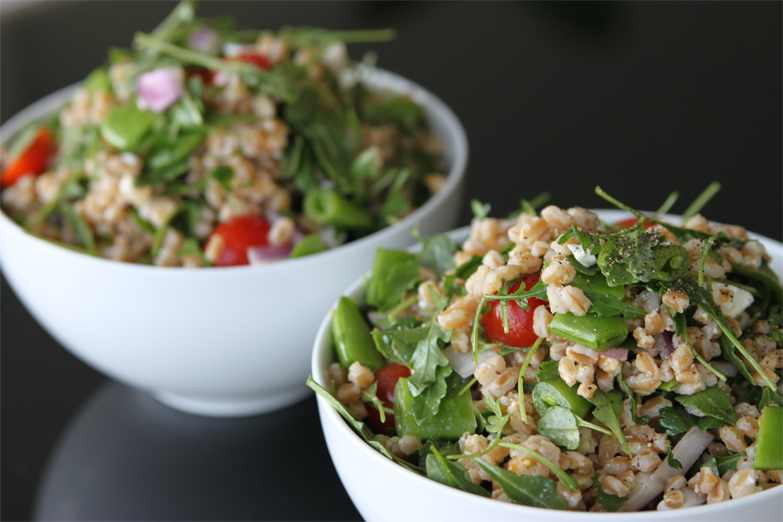
Farro is an ancient grain, but you could use any flavorsome wholegrain in this, preferably one that is a little nutty or chewy in texture, even cooked wholegrain rice. This salad can be served at room temp or cold throughout the week.
Ingredients
- 14 Oz. Farro (Buy Farro Perlato)
- 1/2 Red Onion (Diced)
- 1 Lemon (For Juice)
- 2 Cups Cherry Tomatoes (Halved)
- 2 Cups Snap Peas (Cut into bite size pieces, approximately 3 per pea)
- 4 Oz. Feta (Crumbled)
- 1 Bunch Salad Burnet (Chopped)
- 3 Cups Baby Rocket
- 1 tsp. olive oil
- 1 tsp. red wine vinegar
- 2 Bay Leaves
- 5 Cups Water
- Sea Salt & Fresh Ground Pepper
Direction
- Rinse farro with cold water and drain. Then add to a medium saucepan along with 5 cups of cool water. Add bay leaves along with a pinch of sea salt. Bring to a boil over high heat. Once at a boil, stir then reduce heat to medium-low. Cover and simmer for approximately 20 minutes. The farro should be tender but still have a bit of crunch to it. Drain any excess liquid then fluff with a fork. Place in a large bowl to cool while you prepare the vegetables.
- Wash and dry vegetables, greens, herbs and lemons.
- Dice red onion. Chop salad burnet. Halve cherry tomatoes and cut snap peas. Place to the side.
- Add baby arugula [rocket]and salad burnet to farro and toss. Then add red onion, cherry tomatoes and snap peas. Toss.
- Crumble feta over the salad mixture, add 1 teaspoon of both olive oil and red wine vinegar. Then add the juice of one lemon along with fresh ground pepper. Toss.
References
- https://www.itis.gov/servlet/SingleRpt/SingleRpt?
- http://www.hear.org/pier/species/pyrus_calleryana.htm
- https://npgsweb.ars-grin.gov/gringlobal/taxon/taxonomydetail?
- https://pfaf.org/user/Plant.aspx?
- https://www.wildflower.org/plants/result.php?
- http://www.missouribotanicalgarden.org/PlantFinder/PlantFinderDetails.aspx?
- https://plants.usda.gov/core/profile?
- https://www.invasive.org/browse/subinfo.cfm?
- https://www.cabi.org/isc/datasheet/46188
- https://www.cal-ipc.org/plants/profile/pyrus-calleryana-profile/
- http://www.efloras.org/florataxon.aspx?
- https://texasinvasives.org/plant_database/detail.php?
- http://www.iucngisd.org/gisd/species.php?
- http://www.theplantlist.org/tpl1.1/record/rjp-6009
- https://en.wikipedia.org/wiki/vegetables
- https://gd.eppo.int/taxon/PYUCA
- https://www.illinoiswildflowers.info/savanna/plants/
- https://uses.plantnet-project.org/en/
- https://www.theplantlist.org/tpl1.1/record/
- https://training.ars-grin.gov/gringlobal/taxon/taxonomydetail?
- http://hort.ufl.edu/database/documents/pdf/tree_fact_sheets/
- https://www.illinoiswildflowers.info/trees/plants/callery_pear.htm
- https://www.ncbi.nlm.nih.gov/books/NBK218749/
- https://www.ncbi.nlm.nih.gov/books/NBK551014/
- https://www.ncbi.nlm.nih.gov/books/NBK551727/
- https://www.ncbi.nlm.nih.gov/books/NBK65874/
- https://www.ncbi.nlm.nih.gov/books/NBK304428/
- https://www.ncbi.nlm.nih.gov/books/NBK218759/
- https://www.ncbi.nlm.nih.gov/books/NBK556048/
- https://www.ncbi.nlm.nih.gov/books/NBK218749/
- https://www.niehs.nih.gov/health/topics/agents/vegetables/index.cfm
- https://www.sciencedirect.com/book/9780443062414/vegetable
- https://www.amazon.com/Essential-Oils-Fully-Revised-Updated/dp/1787752291
- https://www.healthbenefitstimes.com/category/herbs-and-spices/
- https://www.frontiersin.org/articles/257193
- https://www.tandfonline.com/toc/tjeo20/current
- https://www.intechopen.com/chapters/68027
- https://onlinelibrary.wiley.com/doi/full/10.1002/ptr.6854
- https://www.nature.com/articles/s41598-020-68823-4
- https://www.cancer.gov/about-cancer/treatment/cam/patient/aromatherapy-pdq
- https://www.researchgate.net/publication/254247133_
- https://link.springer.com/article/10.1365/s10337-010-1680-0
- https://fdc.nal.usda.gov/ndb/foods/show/herb
- https://www.nccih.nih.gov/health/herbsataglance
- https://portal.nifa.usda.gov/web/crisprojectpages/0092887
- https://academic.oup.com/database/article/doi/10.1093/database/bau120
- https://www.cambridge.org/core/journals/weed-science/article/herbicide-effects-of-vegetable/
- https://www.fs.fed.us/wildflowers/ethnobotany/vegetable
- https://www.karger.com/Article/Abstract/501062
- https://en.wikipedia.org/wiki/List_of_plant
- https://en.wikipedia.org/wiki/Types_of_plant_harb
- https://www.britannica.com/topic/
- https://www.planttherapy.com/
- https://academic.oup.com/plphys/article/54/4/560/
- https://www.healthbenefitstimes.com/category/oils/
- https://www.aromaweb.com/essentialoils/default.asp
- https://books.google.com/books/about/Herbs_And_Essential_Oils_Book.html?
- https://books.google.com/books/about/Herbal_herb_for_Health_Beauty.html?id=C_MX9tKpttMC
- https://books.google.com/books/about/Herbal_vegetable_for_Health_Beauty.html?id=C_MX9tKpttMC
- https://www.niehs.nih.gov/health/topics/agents/
- https://www.botanical.com/botanical/mgmh/l/
- https://www.nccih.nih.gov/health/atoz
- https://www.inaturalist.org/taxa
- https://clinicaltrials.gov/ct2/show/NCT02764567
- https://fda.report/Company/Young-Living-Essential-Oils-Lc
- http://www.fao.org/3/ad420e/ad420e.pdf
- https://www.healthywa.wa.gov.au/Articles/A_E/
- https://www.niehs.nih.gov/health/topics/agents/
- https://www.consumerreports.org/health-product-recalls/
- https://www.itis.gov/servlet/SingleRpt/SingleRpt?search_topic=TSN&search_value=25306#nullhttp://davesgarden.com/guides/pf/go/2139/https://npgsweb.ars-grin.gov/gringlobal/taxonomydetail.aspx?id=33026http://www.pfaf.org/user/Plant.aspx?LatinName=Sanguisorba+officinalishttp://www.cabi.org/isc/datasheet/116897http://www.missouribotanicalgarden.org/PlantFinder/PlantFinderDetails.aspx?taxonid=286367&isprofile=0&http://www.floracatalana.net/sanguisorba-officinalis-l-subsp-officinalishttp://www.botanical.com/botanical/mgmh/b/burgre88.htmlhttp://www.theplantlist.org/tpl1.1/record/rjp-1010https://plants.usda.gov/core/profile?symbol=SAOF3https://en.wikipedia.org/wiki/Sanguisorba_officinalishttps://www.nrcs.usda.gov/Internet/FSE_PLANTMATERIALS/publications/idpmspg04840.pdfhttps://obtrandon.files.wordpress.com/2010/05/sanguisorba-officinalis-burnet.pdf