Silene vulgaris commonly known as bladder campion or maidenstears, is actually a perennial plant species of the genus Silene of the pink family (Caryophyllaceae). The plant is native to Europe and western Asia and naturalized throughout southern Australia and in New Zealand. Nowadays it has been introduced in many other regions of the world, being even considered as a weed. Few of the popular common names of the plants are bird’s eggs, bladder campion, blue root, bubble-poppy, cobwell, devil’s rattlebox, maiden’s tears, maidenstears, rattlebox, rattleweed, sea pink, snappery, white bottle, white hen, Bladder Silene, Cowbell, Blaassilene, smllor and Taubenkropf-Leimkraut. According to others, Silene is probably from the Greek σιαλον (sialon), saliva, referring to the gummy exudation on the stems of several species. In Latin, vulgaris means ordinary, common; and vulgaris or vulgare is an epithet frequently appearing in the names of weeds. This species is distinguished from other genus plants by this swollen calyx which is referred to in its common name.
Plant Description
Bladder campion is an upright, short lived, widely branching, deep-rooted semi-evergreen perennial, glabrous rarely pubescent herb that grows about 1 – 3 feet (30.48 cm- 91.44 cm) tall. The plant is found growing in arable land, grassy slopes, sandy and stony pastures, meadows, yards, cultivated lawns, banks, roadsides, rocky cliffs, scrub, woodlands clearings, uncultivated fields, inhabits crops, wood grassy mountains, wasteland, seashores, cracks in waterside rocks, woodland and Mediterranean forest, Hillside meadows, fields, Cultivated fields, old fields, hay fields, gardens, shores and gravel pits. The plant prefers moist humid to dry substrates, stony, clay, gritty loam and sandy soils, relatively poor with a basic pH. The plant has coarse, whitish taproot with numerous, deeply penetrating and widely spreading wiry branches, very persistent (tolerant of cultivation). Stem is 30 – 60 cm high, erect or spreading, smooth, hairless, branched at the base, and light green to whitish with a waxy bloom (fine powdery coating) usually swollen at the nodes. The lower branches sometimes spread horizontally before they ascend.
Leaves
Opposite leaves are up to 2½ inch long and ¾ inch across, sessile against the stems, and pale green to grayish green. They are usually oblanceolate, but sometimes lanceolate or elliptic. Their margins are smooth and slightly ciliate; otherwise the leaves are hairless to sparsely pubescent. They are arranged in an opposite fashion along the length of the stem.
Flower
Upper stems terminate in large panicles of numerous flowers. Each flower is ½-¾ inches across and ¾-1 inches long, consisting of 5 white petals that are deeply cleft (resembling 10 petals), a bladder-like calyx that is pale green to dull pink, 10 exerted stamens, and a pistil. The lobes of the cleft petals are narrowly oblanceolate. Swollen calyx is ovoid, hairless, and about ¾” in length. It has 20 longitudinal veins across its surface that is connected by a reticulated network of smaller veins. Compared to the calyx, the veins are a deeper shade of green or pink. The upper rim of this calyx has 5 broad triangular teeth. While in full bloom, the entire plant has a tendency to lean over to one side because of the weight of the flowers. Flowers are dioecious, which means that individual flowers are either male or female, but only one sex is to be found on any one plant, so both male and female plants must be grown if seed is required. Flowering normally takes place from June to August.
Fruit
Fertile flowers are followed by spherical, thick-walled, many-seeded, yellowish, 1.8-2 cm long capsule with 6 erect teeth. Seeds are normally kidney-shaped, 1.5 mm in diameter, greyish, enclosed in a pod, and covered with rows of bumps.
History
This species might be consumed since ancient times, but the earliest references we have found are from the seventeenth century in Spain and the eighteenth century in France. Cienfuegos, in the second volume of his manuscript work conserved at the Spanish National Library, mentioned its consumption together with other wild vegetables, such as Allium ampeloprasum L., Rumex pulcher L., and Anchusa azurea Mill., particularly important in times of scarcity. Bryant, in his Flora Diaetetica, mentioned this species as one of the better ones, when boiled, for salads, and even proposed that it should be cultivated.
Traditional uses and benefits of Bladder campion
- Plant is said to be emollient and is used in baths or as a fumigant.
- Juice of the plant is used in the treatment of ophthalmia.
- Decoction roots of Silene vulgaris in milk or water are used as an emetic, general antidote in poisoning, against constipation, intestinal pains.
- Infusion is used externally to treat wounds, scabies, itching and various skin conditions.
Culinary Uses
- Young shoots and leaves are consumed raw or cooked.
- Young leaves are sweet and very agreeable in salads.
- Cooked young shoots, harvested when about 5 cm long, have a flavor similar to green peas but with a slight bitterness.
- When pureed it is said to rival the best spinach purees.
- Leaves can also be finely chopped and added to salads.
- Leaves should be used before the plant starts to flower.
- Young shoots and the leaves may be used as food in some countries of the Mediterranean region.
- Tender leaves may be eaten raw in salads.
- Older leaves are usually eaten boiled or fried, sautéed with garlic as well as in omelets.
- Leaves of this plant may be used also as an ingredient in risotto in Italy.
- In Crete locals eat its leaves and tender shoots browned in olive oil.
- In Cyprus it is very widely eaten.
- Leaves are cooked as spinach, eaten raw in salads or made into ravioli filling with ricotta and parmisan cheese.
- Leaves were mainly used to prepare gazpacho viudo (widower gazpacho).
- Tender leaves and stems of this species have been widely consumed, either raw in salads or more frequently cooked, in many Mediterranean countries, such as Spain, France, Italy, Slovenia, Croatia, Bosnia-Herzegovina, Greece.
- It is more frequently eaten after cooking, either as a main vegetable in omelets and as a stuffing for different kind of pies or as an ingredient of other recipes, such as arroz concollejas (rice with bladder campion) or potaje, a typical Spanish dish with stewed chickpeas, beans, rice, and cod, often consumed during Lent.
- In several regions of Italy, it is also used in the elaboration of archaic recipes, such as the pistic of Friuli, the preboggion of Liguria, and the minestrella di Gallicano of Toscana, that are composed of a large number of wild vegetables.
- Other recipes with mixes of wild vegetables that include this species have also been registered in other Mediterranean countries, such as ensalada de matas and herbes bullides in Spain or beqoul in Morocco.
Recipes
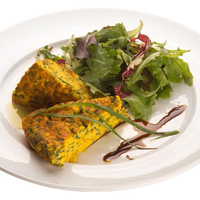
Frittata with bladder campion
Ingredients
- 8 eggs
- 2 bunches bladder campion
- 80 g Parmesan cheese
- 1 garlic clove
- Extra-virgin olive oil
- salt and pepper
- chicory
- traditional balsamic vinegar for the dressing
Directions
- Break the eggs into a large bowl.
- Clean and chop the bladder campion, add to the eggs with the remaining ingredients and beat lightly.
- Heat a little extra-virgin olive oil in a non-stick frying pan and when hot, pour in the mixture, stirring often.
- Cook the frittata until firm, but soft.
- Cut into quarters and serve with a chicory salad and a generous drizzle of traditional balsamic vinegar.
Tagliatelle with clams and bladder campion pesto

Ingredients
- 350g tagliatelle
- 200g clams (or pavarazze)
- 200g bladder campion
- 200g red tomatoes
- Pine kernels
- salt, pepper, garlic, oil
Directions
- Wash and drain the bladder campion.
- In a large bowl, mix together the bladder campion, pine kernels, a pinch of salt, some pepper, a clove of garlic and some oil.
- Blend to obtain a smooth, creamy pesto.
- Cook the tagliatelle in plenty of boiling salted water.
- In the meantime, open the clams in another pan with some oil, garlic and chopped tomatoes.
- Once cooked, drain the pasta and toss in the pan with the clam sauce and fresh bladder campion.
- Place in a serving dish and garnish with the pesto.
Management Strategy
Prevention of seed production is the key to limiting the spread of bladder campion. Starvation through repeated tillage helps control established weed patches.
Tillage
Intensive cultivation or mowing for two seasons is required to starve out bladder campion.
- Pre-seeding tillage: Control weed seedlings that germinate early in the spring with a shallow tillage before or at seeding time.
- Fall tillage: Deep cultivation with a disc will sever the weed roots below the crown and leave the plant in a weakened state for winter.
Rotation
Crop rotation will only suppress bladder campion, not eliminate it. Do not put infested fields into perennial forage production, because this weed will multiply if undisturbed. Cereals offer good competition and allow for post-seeding tillage. Summer fallow is an effective control for this weed, but mowing rather than tillage will lessen the risk of soil erosion. Annual crops cut for green feed allow for deep cultivation in spring and fall or can be cut before the main flush of weed seeds are set.
Seeding
Shallow tillage to destroy emerging shoots and seedlings should be done prior to or at seeding. Seed the cereals 7.5 cm deep if post-seeding tillage is required. Do not seed other crops on infested land.
Mowing
Repeated mowing of small patches of bladder campion in wastelands and perennial crops is laborious but effective.
Other facts
- Root is used as a soap substitute for washing clothes etc.
- Soap is obtained by simmering the root in hot water.
- Flowers used for decoration, in bouquets, fresh or dry.
- This plant was well known by the children of rural areas of Spain and Italy because they used to enjoy playing with the characteristic inflated calyxes, blowing them up on their hands or foreheads.
References
- https://www.itis.gov/servlet/SingleRpt/SingleRpt?
- http://www.hear.org/pier/species/pyrus_calleryana.htm
- https://npgsweb.ars-grin.gov/gringlobal/taxon/taxonomydetail?
- https://pfaf.org/user/Plant.aspx?
- https://www.wildflower.org/plants/result.php?
- http://www.missouribotanicalgarden.org/PlantFinder/PlantFinderDetails.aspx?
- https://plants.usda.gov/core/profile?
- https://www.invasive.org/browse/subinfo.cfm?
- https://www.cabi.org/isc/datasheet/46188
- https://www.cal-ipc.org/plants/profile/pyrus-calleryana-profile/
- http://www.efloras.org/florataxon.aspx?
- https://texasinvasives.org/plant_database/detail.php?
- http://www.iucngisd.org/gisd/species.php?
- http://www.theplantlist.org/tpl1.1/record/rjp-6009
- https://en.wikipedia.org/wiki/vegetables
- https://gd.eppo.int/taxon/PYUCA
- https://www.illinoiswildflowers.info/savanna/plants/
- https://uses.plantnet-project.org/en/
- https://www.theplantlist.org/tpl1.1/record/
- https://training.ars-grin.gov/gringlobal/taxon/taxonomydetail?
- http://hort.ufl.edu/database/documents/pdf/tree_fact_sheets/
- https://www.illinoiswildflowers.info/trees/plants/callery_pear.htm
- https://www.ncbi.nlm.nih.gov/books/NBK218749/
- https://www.ncbi.nlm.nih.gov/books/NBK551014/
- https://www.ncbi.nlm.nih.gov/books/NBK551727/
- https://www.ncbi.nlm.nih.gov/books/NBK65874/
- https://www.ncbi.nlm.nih.gov/books/NBK304428/
- https://www.ncbi.nlm.nih.gov/books/NBK218759/
- https://www.ncbi.nlm.nih.gov/books/NBK556048/
- https://www.ncbi.nlm.nih.gov/books/NBK218749/
- https://www.niehs.nih.gov/health/topics/agents/vegetables/index.cfm
- https://www.sciencedirect.com/book/9780443062414/vegetable
- https://www.amazon.com/Essential-Oils-Fully-Revised-Updated/dp/1787752291
- https://www.healthbenefitstimes.com/category/herbs-and-spices/
- https://www.frontiersin.org/articles/257193
- https://www.tandfonline.com/toc/tjeo20/current
- https://www.intechopen.com/chapters/68027
- https://onlinelibrary.wiley.com/doi/full/10.1002/ptr.6854
- https://www.nature.com/articles/s41598-020-68823-4
- https://www.cancer.gov/about-cancer/treatment/cam/patient/aromatherapy-pdq
- https://www.researchgate.net/publication/254247133_
- https://link.springer.com/article/10.1365/s10337-010-1680-0
- https://fdc.nal.usda.gov/ndb/foods/show/herb
- https://www.nccih.nih.gov/health/herbsataglance
- https://portal.nifa.usda.gov/web/crisprojectpages/0092887
- https://academic.oup.com/database/article/doi/10.1093/database/bau120
- https://www.cambridge.org/core/journals/weed-science/article/herbicide-effects-of-vegetable/
- https://www.fs.fed.us/wildflowers/ethnobotany/vegetable
- https://www.karger.com/Article/Abstract/501062
- https://en.wikipedia.org/wiki/List_of_plant
- https://en.wikipedia.org/wiki/Types_of_plant_harb
- https://www.britannica.com/topic/
- https://www.planttherapy.com/
- https://academic.oup.com/plphys/article/54/4/560/
- https://www.healthbenefitstimes.com/category/oils/
- https://www.aromaweb.com/essentialoils/default.asp
- https://books.google.com/books/about/Herbs_And_Essential_Oils_Book.html?
- https://books.google.com/books/about/Herbal_herb_for_Health_Beauty.html?id=C_MX9tKpttMC
- https://books.google.com/books/about/Herbal_vegetable_for_Health_Beauty.html?id=C_MX9tKpttMC
- https://www.niehs.nih.gov/health/topics/agents/
- https://www.botanical.com/botanical/mgmh/l/
- https://www.nccih.nih.gov/health/atoz
- https://www.inaturalist.org/taxa
- https://clinicaltrials.gov/ct2/show/NCT02764567
- https://fda.report/Company/Young-Living-Essential-Oils-Lc
- http://www.fao.org/3/ad420e/ad420e.pdf
- https://www.healthywa.wa.gov.au/Articles/A_E/
- https://www.niehs.nih.gov/health/topics/agents/
- https://www.consumerreports.org/health-product-recalls/
- https://www.itis.gov/servlet/SingleRpt/SingleRpt?search_topic=TSN&search_value=20142#nullhttps://davesgarden.com/guides/pf/go/2155/https://npgsweb.ars-grin.gov/gringlobal/taxonomydetail.aspx?id=105074https://pfaf.org/user/Plant.aspx?LatinName=Silene+vulgarishttp://www.missouribotanicalgarden.org/PlantFinder/PlantFinderDetails.aspx?taxonid=279058&isprofile=0&http://www.floracatalana.net/silene-vulgaris-moench-garckehttps://plants.usda.gov/core/profile?symbol=SIVUhttp://www.theplantlist.org/tpl1.1/record/kew-2487840https://en.wikipedia.org/wiki/Silene_vulgarishttps://www1.agric.gov.ab.ca/$department/deptdocs.nsf/all/prm2584