Podophyllum peltatum, also known as Mayapple, American mandrake or ground lemon, is actually an herbaceous perennial plant of the Berberidaceae (Barberry) family having umbrella-shaped leaves. The plant is native to the woodlands of the eastern United States and southeastern Canada and has been used medicinally for hundreds of years by 1st Nations peoples to treat constipation, wart removal, rheumatism and liver disorders as well as a laxative. It is presently being studied for its possible treatment of leukemia. Some of the popular common names of the plants are American-mandrake, Indian-apple, Mayapple, Pomme de mai, Wild mandrake, Ground Lemon, Hog Apple, Racoonberry, Duck’s Foot, Hog Apple, Lang-tu, Love Apples, Mandragora, Mandrake, Racoon Berry, Umbrella Plant, Wild Lemon, Devil’s Apple, American May Apple and Bajialian.
Genus name “Podophyllum” is derived from the Greek word, podos, meaning foot, and phyllon, meaning leaf), which refers to an imaginary resemblance of the leaf to an aquatic bird’s foot: therefore, the seldom-used common name of duck’s foot. Peltatum means shield-shaped. The most frequently used common name is May apple and refers to the lemon-shaped fruit that appears after flowering. Another common name is American mandrake. This is confusing because it is not at all related to the European Mandrake- a plant with purple flowers. Nearly all parts of the mayapple are poisonous save for the fruit: once it has turned yellow, the mayapple fruit is safe for human consumption. While not edible, mayapple rhizomes are used for all sorts of medicinal applications. Native Americans valued the rhizome as a cathartic, anti-helmintic, and emetic agent.
Plant description
Mayapple is a winter deciduous herbaceous perennial plant that grows about 30 to 45 cm (11-17 inches) tall. The plant is found growing in rich woods, thickets, pastures, roadsides, damp areas like hillside seeps, meadows, deciduous and open woodlands, forest edges, fields, shores of rivers or lakes, mesic deciduous woodlands, open woodlands, small woodland openings, savannas, and edges of hillside seeps in wooded areas. The plant prefers rich, loamy, moist soil with abundant organic matter. The plant has stout, rounded; succulent, glabrous hairless stems about 1 to 2 feet high which terminate in a palmately divided leaf or sympodially branch to form two leaves with a bud between them. The mayapple reproduces sexually and asexually. It grows rhizomes underground, and new plants grow from the thick rhizomes. Asexual reproduction allows dense local population of clones and costs less.
Leaves
One to two peltately attached leaves are produced on long erect petioles. Vegetative stems usually have a single leaf, whereas flowering stalks produce a pair of leaves originating from either side of the central flower. Leaves are glabrous, circular, umbrella-shaped, with 5 to 9 palmate lobes, and are 6 inches to 12 inches wide with a lustrous, almost oily look, above and somewhat lighter and duller green beneath. Individual lobes are obovate with a tendency to develop a secondary forked lobe at the tip of the primary lobe. Margins may be nearly entire to serrated, or irregularly incised. The overall venation is palmate, but on individual lobes the secondary venation appears pinnate terminating in a Y-shaped division on the lobe. Veins are impressed above and may be lighter colored than the rest of the blade, becoming whitish or light yellowish green at the petiole attachment. Tertiary veins are nearly reticulate; bases of the lobes are often cuneate. Veins are raised beneath; early season growth may have a reddish tint.
Flower
Perfect flowers with six, sometimes more, yellowish-green to gleaming white, obovate to emarginate, overlapping petals form a 1½ inches to 2 inches diameter, broadly cup to saucer-shaped flower with a prominent central pistil surrounded by flattened, oar-shaped, yellow stamens. Stamens may be individual or with pairs subtended by a fused stalk. The fragrant flowers are presented vertically to pendently beneath the foliage. Bloom is in mid- to late spring. Flowers are typically borne at a Y-shaped fork atop a stoutish succulent green to brown stem between a pair of palmately divided leaves that extend above the flower. Flowering normally takes place from May to June.
Fruits
Fertile flowers are followed by oval berries about the size and shape of an egg nearly 2 inches long, with a thick yellow rind. The fruits are initially green turning greenish-yellow and yellow as they mature. The fruits are formed from sexual reproduction for distance dispersal. Each fruit consist of 30-50 small ovoid seeds. It is the flower that shows up in May, not the “apple.” The “apple,” which does not look too much like an actual apple, appears later in summer.
The seeds, leaves, rhizomes and unripe fruit are poisonous; the ripe apple is considered edible raw, considered sweet but slightly acid, better when cooked, but some find it slightly toxic. An allergic reaction from handling the rhizomes can occur in some people sensitive to the compound Podophyllin found in the roots.
Traditional uses and benefits of Mayapple
- Mayapple is a most powerful and useful herbal medicine, exercising an influence on every part of the system and inspiring the glands to healthy action.
- Its greatest power lies in its action on the liver and bowels.
- It is a gastro-intestinal irritant, a powerful hepatic and intestinal stimulant.
- Root is anti-bilious, cathartic, cytostatic, hydragogue and purgative.
- It is, thus, a possible treatment for cancer, and has been used especially in the treatment of ovarian cancer.
- Root is most active medicinally in early spring when it is beginning to shoot.
- Resin, which is obtained from the root, is used in the treatment of warts and has been found to be effective against uterine warts that are sometimes experienced in pregnancy.
- It is also used in the treatment of small-cell carcinoma.
- A homeopathic remedy is obtained from the fresh root, harvested before the fruit is ripe.
- It is used particularly in the treatment of diarrhea.
- They were also used topically for treating warts; etoposide and teniposide two of its derivatives are also used in treating malignant neoplasms.
- Rhizome has been used for a range of medicinal purposes and the boiled poisonous root water was consumed for stomach aches.
- Mayapple is known to be an effective cure for genital warts.
- Mayapple is also an effective treatment for white patches that grow on the tongue, also known as hairy leukoplakia.
- It can easily clear corns.
- It is effective for treating jaundice, fever, syphilis, liver diseases, hearing loss, and even cancer.
- It is also used to ease bowel movement, destroy parasitic worms in the intestine as well as counteract snakebite.
- It is effective as a treatment for gynecologic infections.
- It can also be beneficial for people who are struggling with certain gastrointestinal, liver, and skin problems.
- Chinese herbal medicine used this plant for treating weakness, snakebites and tumors of different kinds.
- American ethnic groups also drank a ferment prepared from the dehydrated and crushed rhizome or tubers of mayapple as a medication to cure worms in the intestines.
- They also used the substance as a remedy for snakebite as also as a laxative to clear bowel movements.
Culinary Uses
- Fruit are raw, cooked or made into jams, jellies, marmalades, pies etc.
- Fruit can also be dried for later use.
- Fruit should only be eaten when it is fully ripe; the unripe fruit is strongly laxative.
- Fruit is very aromatic, and has a peculiar though agreeable flavor.
- Pulp of this fruit can be made into marmalades, jams, jellies and sweet dishes by removing its seeds and covering.
Some Popular Recipes
May apple Jelly
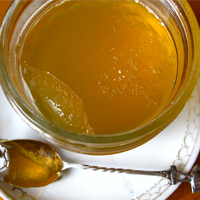
Ingredients
- 1 3/4 cups May apple juice; strained
- 3 1/2 cups sugar
- 1/8 cup lemon juice
- 3 oz. liquid fruit pectin or one dry packet
Directions
- Wash ripe may apples, cut away the stem and blossom ends, and any waste parts.
- Remove seeds. Cut the fruit into pieces and place in a large kettle with water to cover.
- Bring to a boil, and then simmer until May apples are tender, mashing during cooking.
- Strain the juice through cheesecloth or let it drip through a jelly bag.
- To the strained may apple juice, add lemon juice and sugar.
- Bring the mixture to a boil, stirring constantly, and then stir in pectin.
- Again bring to a boil, stirring constantly, and boil hard until the jelly stage is reached.
- Remove jelly from heat, skim, and pour into hot, sterilized jelly glasses.
- Seal at once with hot paraffin or lid in hot bath.
- Double the recipe if you have plenty of May apple juice.
May apple Jam
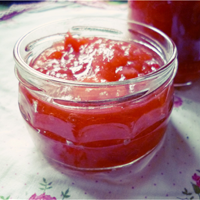
Ingredients
- 5 cups ripe May apple fruit
- 7 cups sugar
- 1/2 cup water
- 1 package pectin
- 1/2 cup lemon juice
- dash of salt
Directions
- Combine may apples, water, and lemon juice.
- Bring to boil, cover over low heat, and simmer for 20 minutes. Stir often.
- Add sugar and bring back to a boil. Boil hard for three minutes.
- Add pectin and salt and boil for one minute. Stir and skim off foam.
- Ladle into sterilized jars, seal with lid or paraffin.
May apple Punch
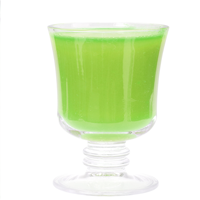
Ingredients
- 3 cups rip May apples fruit
- 1 cup sugar
- 3 pieces of ginger root
- 1 quart ginger ale
Directions
- Cut up May apple and remove seeds.
- Put May apple pieces and ginger root in a saucepan, cover with water and slowly bring to a boil.
- Simmer 25 minutes. Add sugar.
- Set aside to cool but stir occasionally. Pour through sieve and press pulp through mesh.
- Spoon into cups and fill cups with ginger ale.
- Stir and serve depending upon your tastes.
- Some think it tastes like an earthy banana or pawpaw. It makes excellent preserves and drinks. Since woodland creatures like the fruit as well it can be collected just before it is ripe and stored in sawdust until ripe.
Other facts
- An infusion of the boiled leaves has been sprayed on potato plants to protect them from insects.
- Root ooze has been used to soak corn seed prior to planting it out in order to prevent it being eaten by crows or insects.
- Thick roots of this plant help in preventing soil erosion as they keep the soil intact.
Precautions
- Leaves and the roots are very poisonous.
- In excess the fruit can cause colic.
- Whole plant, apart from the ripe fruit, is highly poisonous and should only be used under the supervision of a qualified practitioner.
- It should not be prescribed for pregnant and breastfeeding women.
- In large doses it produces nausea and vomiting, and even inflammation of the stomach and intestines, which has been known to prove fatal
- It is advisable not ingest any part of mayapple as even the edible berries can result in vomiting if taken in excess.
- It is highly valuable in dropsy, biliousness, dyspepsia, liver and other disorders.
- The plant has been known to cause technicolor diarrhea.
References
- https://www.itis.gov/servlet/SingleRpt/SingleRpt?
- http://www.hear.org/pier/species/pyrus_calleryana.htm
- https://npgsweb.ars-grin.gov/gringlobal/taxon/taxonomydetail?
- https://pfaf.org/user/Plant.aspx?
- https://www.wildflower.org/plants/result.php?
- http://www.missouribotanicalgarden.org/PlantFinder/PlantFinderDetails.aspx?
- https://plants.usda.gov/core/profile?
- https://www.invasive.org/browse/subinfo.cfm?
- https://www.cabi.org/isc/datasheet/46188
- https://www.cal-ipc.org/plants/profile/pyrus-calleryana-profile/
- http://www.efloras.org/florataxon.aspx?
- https://texasinvasives.org/plant_database/detail.php?
- http://www.iucngisd.org/gisd/species.php?
- http://www.theplantlist.org/tpl1.1/record/rjp-6009
- https://en.wikipedia.org/wiki/vegetables
- https://gd.eppo.int/taxon/PYUCA
- https://www.illinoiswildflowers.info/savanna/plants/
- https://uses.plantnet-project.org/en/
- https://www.theplantlist.org/tpl1.1/record/
- https://training.ars-grin.gov/gringlobal/taxon/taxonomydetail?
- http://hort.ufl.edu/database/documents/pdf/tree_fact_sheets/
- https://www.illinoiswildflowers.info/trees/plants/callery_pear.htm
- https://www.ncbi.nlm.nih.gov/books/NBK218749/
- https://www.ncbi.nlm.nih.gov/books/NBK551014/
- https://www.ncbi.nlm.nih.gov/books/NBK551727/
- https://www.ncbi.nlm.nih.gov/books/NBK65874/
- https://www.ncbi.nlm.nih.gov/books/NBK304428/
- https://www.ncbi.nlm.nih.gov/books/NBK218759/
- https://www.ncbi.nlm.nih.gov/books/NBK556048/
- https://www.ncbi.nlm.nih.gov/books/NBK218749/
- https://www.niehs.nih.gov/health/topics/agents/vegetables/index.cfm
- https://www.sciencedirect.com/book/9780443062414/vegetable
- https://www.amazon.com/Essential-Oils-Fully-Revised-Updated/dp/1787752291
- https://www.healthbenefitstimes.com/category/herbs-and-spices/
- https://www.frontiersin.org/articles/257193
- https://www.tandfonline.com/toc/tjeo20/current
- https://www.intechopen.com/chapters/68027
- https://onlinelibrary.wiley.com/doi/full/10.1002/ptr.6854
- https://www.nature.com/articles/s41598-020-68823-4
- https://www.cancer.gov/about-cancer/treatment/cam/patient/aromatherapy-pdq
- https://www.researchgate.net/publication/254247133_
- https://link.springer.com/article/10.1365/s10337-010-1680-0
- https://fdc.nal.usda.gov/ndb/foods/show/herb
- https://www.nccih.nih.gov/health/herbsataglance
- https://portal.nifa.usda.gov/web/crisprojectpages/0092887
- https://academic.oup.com/database/article/doi/10.1093/database/bau120
- https://www.cambridge.org/core/journals/weed-science/article/herbicide-effects-of-vegetable/
- https://www.fs.fed.us/wildflowers/ethnobotany/vegetable
- https://www.karger.com/Article/Abstract/501062
- https://en.wikipedia.org/wiki/List_of_plant
- https://en.wikipedia.org/wiki/Types_of_plant_harb
- https://www.britannica.com/topic/
- https://www.planttherapy.com/
- https://academic.oup.com/plphys/article/54/4/560/
- https://www.healthbenefitstimes.com/category/oils/
- https://www.aromaweb.com/essentialoils/default.asp
- https://books.google.com/books/about/Herbs_And_Essential_Oils_Book.html?
- https://books.google.com/books/about/Herbal_herb_for_Health_Beauty.html?id=C_MX9tKpttMC
- https://books.google.com/books/about/Herbal_vegetable_for_Health_Beauty.html?id=C_MX9tKpttMC
- https://www.niehs.nih.gov/health/topics/agents/
- https://www.botanical.com/botanical/mgmh/l/
- https://www.nccih.nih.gov/health/atoz
- https://www.inaturalist.org/taxa
- https://clinicaltrials.gov/ct2/show/NCT02764567
- https://fda.report/Company/Young-Living-Essential-Oils-Lc
- http://www.fao.org/3/ad420e/ad420e.pdf
- https://www.healthywa.wa.gov.au/Articles/A_E/
- https://www.niehs.nih.gov/health/topics/agents/
- https://www.consumerreports.org/health-product-recalls/
- https://www.itis.gov/servlet/SingleRpt/SingleRpt?search_topic=TSN&search_value=38427#nullhttps://davesgarden.com/guides/pf/go/55206/http://www.hear.org/pier/species/sonchus_oleraceus.htmhttps://npgsweb.ars-grin.gov/gringlobal/taxonomydetail.aspx?id=34939https://pfaf.org/user/Plant.aspx?LatinName=Sonchus+oleraceushttps://www.cabi.org/ISC/datasheet/50584http://www.floracatalana.net/sonchus-oleraceus-l-https://botanical.com/botanical/mgmh/s/sowthi71.htmlhttps://plants.usda.gov/core/profile?symbol=SOOLhttp://www.theplantlist.org/tpl1.1/record/gcc-26069https://en.wikipedia.org/wiki/Sonchus_oleraceushttp://www.flowersofindia.net/catalog/slides/Sow%20Thistle.html