Maitake has a circular cluster of wavy caps and grows in shelf-like formations at the base of hardwood and softwood trees. It tends to favor oaks. Resembling a fan-like hen tail, maitake has gray-brown caps and white-cream undersides containing one to three pores. It belongs to the polypore group of mushrooms with their large fruiting bodies. These attractive fungi have an earthy aroma, crunchy texture, and taste similar to hearty game meat. They grow up to three feet wide and can weigh as much as 50 pounds, although most maitake average about 10 pounds. Like other mushrooms, maitake offers beneficial compounds that can improve your health.
Other Name(s):
Champignon Dansant, Champignon des Fous Dansants, Champignon Maitake, Dancing Mushroom, Grifola, Grifola frondosa, Hen of the Woods, Hongo Maitake, King of Mushrooms, Maitake, Monkey’s Bench, Mushroom, Roi des Champignons, Shelf Fungi.
| Maitake Mushroom (Hen of the woods) Quick Facts | |
|---|---|
| Name: | Maitake Mushroom (Hen of the woods) |
| Scientific Name: | Grifola frondosa |
| Origin | Northeast Japan, Europe, Asia, and the eastern side of the North American continent |
| Shapes | Unique, frilly appearance and a delicate texture |
| Taste | Bitter |
| Calories | 22 Kcal./cup |
| Major nutrients | Vitamin B3 (28.81%) Copper (19.56%) Vitamin B2 (13.00%) Vitamin B1 (8.50%) Phosphorus (7.43%) |
| Health benefits | Boosts Immune System, Cancer Prevention, Blood Sugar Control, Weight Loss, Promotes Heart Health and Weight Loss, Lower Blood Pressure |
Grifola frondosa commonly known as Maitake mushroom is actually a polypore mushroom that grows in clusters at the base of trees, particularly oaks. The mushroom is commonly known among English speakers as hen of the woods, hen-of-the-woods, ram’s head and sheep’s head. Maitake actually means dancing mushroom in Japanese and the mushroom is said to have gotten its name after people danced with happiness upon finding it in the wild, such are its incredible healing properties. The mushroom is native to northeast Japan, Europe, Asia, and the eastern side of the North American continent. It grows at the bottom of Oak, Elm, and Maple trees. Few of the popular common names of the mushroom are Huishu hua, king of mushrooms, dancing mushroom, monkey’s bench, shelf fungus, Hen of the Woods, Sheep’s Head, Ram’s Head, Huai Su Gu and cloud mushroom.
Maitake mushrooms have been utilized as both food as well as medication in Asian ethnicities for a lot of hundreds of years, and therefore are referred to as having a rich, natural taste. In North America, fresh as well as dried maitake mushrooms can be found at several supermarkets and also markets, and the extract maitake D-fraction is sold as a health supplement. They may be cooked as well as consumed with lots of foods and may now be discovered as dietary supplements as well as powders. Recent scientific studies are displaying their numerous immune system as well as anticancer advantages.
Plant Description
Maitake mushroom is a perennial fungus that often grows in the same place for a number of years in succession. It occurs most productively in the northeastern regions of the United States, but has been found as far west as Idaho. The plant is mostly found growing on dead or dying trees or stumps, usually around the base. It can also be found growing from submerged, rotting roots. It prefers oaks, though it will also grow on other deciduous hardwoods such as elm, maple, blackgum, and beech. It tends to prefer the boundary between wooded areas and open fields. It can be cultivated and even grown at home, though it typically won’t grow as well as it does in the wild. You can usually find the mushroom during the autumn months. They grow in clusters near the foot of oak trees and can reach 50 cm in base diameter. One bunch can weigh up to 45 kg (100 lbs). Maitake has a rippling, flowery appearance resembling dancing butterflies, hence one of its common names, dancing mushroom.
Maitake Mushroom grows from an underground tuber-like structure known as a sclerotium, about the size of a potato. The fruiting body, occurring as large as 100 cm, is a cluster consisting of multiple grayish-brown caps which are often curled or spoon-shaped, with wavy margins and 2–7 cm broad. The undersurface of each cap bears about one to three pores per millimeter, with the tubes rarely deeper than 3 mm. The milky-white stipe (stalk) has a branchy structure and becomes tough as the mushroom matures. Although maitake mushroom has been used in Japan and China for thousands of years, it has only gained popularity in the United States over the last twenty years. People are praising this mushroom for its promises of health, vitality, and longevity. Since maitake mushroom is a polypore, they have no gills on their undersides and release spores through small pores.
History
Maitake mushrooms have been consumed for 3,000 years and have been valued for most of their legendary properties in China and Japan. Maitake’s scientific name, G. frondosa, is derived from an Italian mushroom name referring to the griffin, a mythological half lion and half eagle beast. Many years ago in Japan, the maitake actually had monetary value and was worth its weight in silver. In the late 1980s, Japanese scientists identified the maitake as more potent than lentinan, shiitake, suehirotake, and kawaratake mushrooms, all of which are used in traditional Asian medicine for immune function enhancement.
Health Benefits of Maitake Mushrooms
Maitake mushrooms have been used as medication in Japan for hundreds of years. They’re traditionally considered to encourage durability. Research on the mushroom’s health advantages started in Japan within the 1980s and is now being followed in the United States. Maitake’s include a polysaccharide (many sugar molecules joined together to create one huge molecule) known as beta-glucan. Listed here are a few health advantages of Maitake mushroom
Boosts Immune System
Maitake mushrooms consist of a good amount of polysaccharide fiber known as beta-glucan which works to activate and increase the creation of particular defense mechanisms cells like macrophages, T-cells, natural killer cells, and neutrophils. These types of cells might help the immune system to work more rapidly as well as efficiently combat illness. This could enhance your resistance against sickness as well as disease, strengthen your body remove cellular wastes, and accelerate recovery from tissue damage.
Heart Health
Beta-glucan in maitake can help reduce your cholesterol, improving artery functionality and overall cardiovascular health to lower your risk for heart disease. The polysaccharides in maitake can reduce LDL (bad) cholesterol without affecting your triglyceride or HDL (good) cholesterol levels.
Cancer Prevention
Maitake mushrooms are extremely popular because of their anti-cancer qualities. They’re abundant with polysaccharides as well as polysaccharide-protein complexes which the body utilizes to build up the immune system. The mushroom’s beta-glucan content works to encourage essential defense mechanisms functions, efficiently activating white blood cells which combat microorganisms that can cause disease, which includes cancer. Maitake mushrooms boost the activity of cells, inducing the manufacture of interleukins along with other lymphokines which have chemo protective effects, slower tumor development, and help to prevent multiplication of cancer.
Blood Sugar Control
Regular intake of maitake mushrooms might manage blood glucose levels as well as blood lipid levels. The polysaccharide compounds which encourage the effectiveness of the immune system may also be efficient at assisting to manage blood pressure levels, glucose, insulin, and lipids. This particular effect is very therapeutic for individuals with diabetes or hypoglycemia. Individuals with Type 2 Diabetes might also take advantage of maitake mushrooms. Researchers have researched a particular, high-molecular polysaccharide in maitake known as the X-fraction. Research results declare that maitake mushrooms can help to eliminate insulin resistance while increasing insulin sensitivity.
Promotes Weight Loss
Intake of maitake mushrooms may help reduce blood pressure levels, lower total levels of cholesterol, and help maintain weight which could all help to encourage heart health. The mushrooms are found to be lower in calories and high in fiber which could boost satiety as well as feelings of fullness. Research by Yokota gave 30 overweight adults everyday doses of maitake mushrooms without changing any other aspects of their diets. At the conclusion of the 2-month research, participants lost around 7 to 13 lbs.
Lower Blood Pressure
Research on animals shows that maitake might help reduce blood pressure in people. One study gave hypertensive rats a 5% maitake mushroom powder and observed a decrease in blood pressure level. Similar results were seen from another study on rats, by which maitake lowered blood pressure from 200 to 115 mm Hg in just 4 hours. In the unpublished trial on humans, eleven patients with hypertension took 500 mg of maitake mushroom pills twice daily. Mean reduction in diastolic blood pressure of around 8 mm Hg along with a mean reduction in systolic blood pressure level of around 14 mm Hg were reported.
Weight Loss
Maitake mushrooms can encourage weight reduction and reduce obesity whenever joined with light exercise. Research on overweight rats fed maitake powder discovered that after 18 weeks, they’d lost weight in comparison with controls. They include no cholesterol, no fats, and therefore are really low carbohydrates. Additionally, the high lean protein content of mushrooms assists burn cholesterol indigestion.
Anti-tumor activities
Research has shown that maitake d-fraction enhances antitumor effects and reduces immune system suppression in mice and “can provide a potential clinical benefit for patients with cancer.” (17)
Furthermore, a human study in 2013 found that oral administration of maitake d-fraction spurred immune function and provided tumor-fighting effects for cancer patients. (18)
Improve Fertility
Polycystic ovary syndrome (PCOS) is when the ovaries overproduce male hormones, which creates small ovarian cysts.
This health condition affects an estimated 5 million women and is one of the leading causes of infertility. (19)
While more studies are needed, there are some promising findings that maitake can induce ovulation in PCOS patients and may be useful as an adjunct therapy for women who failed with clomiphene citrate treatment. (20)
More health Benefits
- An ovary disorder is known as polycystic ovary syndrome (PCOS). Early research shows that taking a specific product (SX-Fraction by Mushroom Wisdom) containing maitake mushroom extract can improve ovulation in women whose periods have stopped due to PCOS. Maitake mushroom does not appear to be as effective as clomiphene for PCOS, but the combination of these two agents seems to be more effective than either agent alone for improving ovulation.
- Cancer.
- HIV/AIDS.
- Chronic fatigue syndrome (CFS).
- Hepatitis.
- Hay fever.
- High blood pressure.
- High cholesterol.
- Weight loss or control.
- Chemotherapy support.
Traditional uses and benefits of maitake Mushroom
- It improves the spleen, assuages stomach ailments, treats hemorrhoids, and calms the mind and nerves.
- It is an anti-diabetic, anti-hypertensive, anti-neoplastic, antiviral, immuno-suppressant, and interferon.
- It is used to treat diabetes, high blood pressure, cholesterol, and obesity.
Ayurvedic Health benefits of Maitake
- Bladder cancer: Drink Maitake infusion twice a day. OR Take Maitake capsules (2000 mg three times a day before meals.)
- Brain tumor: Take 1 tbsp of mushroom Maitake. Add one cup of water in it. Consume it twice daily for five months.
- Pancreatic Cancer: Have Maitake mushroom extract 60 mg per day.
- Immunity Enhancer: Prepare a decoction, made of Maitake, Shiitake, and Reishi mushroom (Take in equal proportion) and one cup of water. Drink it two times a day.
Culinary Uses
- It is delicious in sautés and stir-fries or on its own, cooked in butter.
- Dried maitake can be prepared as a decoction for tea to concentrate its properties.
- It is a tasty addition to broths, along with Chaga, nettle, oat straw, red clover, and reishi, for a mineral-dense infusion that can nourish the immune system.
- Use maitake wherever you would use some other mushroom, like in omelets, kinds of pasta, salads, stir-fries, and pizzas. Toss with olive oil as well as cook these large mushrooms around the grill.
- Use maitake to create a broth soup, like this Roasted Maitake Mushroom in Smoky Tea Broth.
- Use them just as one simple vegetarian burger replacement, as with these Maitake Mushroom Burgers.
- Make them in a star-side dish, just like Maitake Mushrooms roasted with butter and honey.
How to Choose Fresh Maitake Mushrooms at the Store
As with all mushrooms, search for maitake which is firm (not soggy or wilted) and free of spots. Do not buy mushrooms that smell yeasty. Maitakes must have a tight bunch of ruffles, instead of looking loose or even sparse. They might vary from brown to gray.
Purchase whole mushrooms instead of pre-cut to increase their life expectancy. At your home, store maitake in a paper bag (not plastic) within the refrigerator.
Recipes
Maitake Mushroom Burger
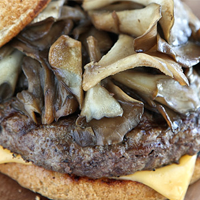
Ingredients
- 1-¼ pound Ground Beef
- ¾ teaspoons Salt
- ⅛ teaspoons Freshly Ground Pepper
- 1 Tablespoon Unsalted Butter
- 1 clove Garlic, Finely Minced
- 8 ounces, weight Maitake Mushrooms Or Other Asian Mushrooms
- 1 teaspoon Soy Sauce
- 1 teaspoon Worcestershire Sauce
- 4 whole Wheat Hamburger Buns
- 4 slices Cheese (Your Choice)
Directions
- In a large bowl, mix together the ground beef, salt, and pepper. Divide the ground beef mixture into 4 equal parts and shape them into patties, about 1-inch thick.
- Prepare a charcoal or gas grill fire. Grill the burger patties for 6-8 minutes total, or until the desired level of doneness. Alternatively, you can cook the burgers in a frying pan on medium-high heat, 8-10 minutes total.
- In the meantime, heat a frying pan with the butter over medium-high heat. When the butter starts bubbling, add the garlic and the mushrooms and sauté for 2 1/2 minutes, or until the mushrooms have softened. Add in the soy sauce and the Worcestershire sauce and continue to cook for another 1 minute.
- Assemble the burgers on the buns with cheese, and top with the sautéed mushrooms.
Maitake Bacon
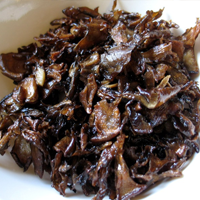
Ingredients
- 1 TB olive oil
- 1 TB toasted sesame oil
- 1 tsp liquid smoke
- 1/2 tsp salt (reduce to 1/4 tsp if you want it less salty)
- 7 oz. fresh maitake mushrooms (can be found in most Asian grocers or at Whole Foods)
- a few pinches of smoked paprika
Direction
- Preheat oven to 350. Line a baking sheet with a Silpat. Set aside.
- In a small bowl, whisk together the olive and sesame oils. Add salt and liquid smoke and whisk again.
- Slice off the base of the mushroom (I used two, 3.5 oz. maitake for this). Discard or reserve and freeze the base for making stock later, if you wish.
- Separate the fragile spoon-shaped petals with your hands into a large bowl. Pour the liquid over the mushrooms and toss well to coat. Transfer to the Silpat and distribute in an even layer.
- Place into the oven to bake for 20 minutes. Remove from the oven, stir around and redistribute into a single layer. Bake for 10 minutes more.
- Remove from the oven and transfer to a paper towel. Sprinkle with a few pinches of smoked paprika, if desired. Once cooled, they will crisp up nicely. Keep at room temperature and serve within the hour.
Cauliflower Steaks with Maitake Mushrooms and Browned Butter-Caper Sauce
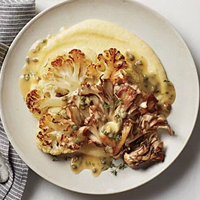
Ingredients
- 2 1/2 tablespoons butter, divided
- 1 1/2 tablespoons canola oil
- 2 garlic cloves, crushed
- 2 cauliflower heads
- 2 maitake mushrooms
- 3/4 teaspoon kosher salt, divided
- 1/2 teaspoon freshly ground black pepper, divided
- 3 cups 1% low-fat milk
- 1/2 cup water
- 2/3 cup quick-cooking polenta
- 3 garlic cloves, thinly sliced
- 1/4 cup dry white wine
- 1/2 cup organic vegetable broth
- 1 1/2 teaspoons all-purpose flour
- 1 tablespoon capers, chopped
- 1 teaspoon fresh lemon juice
- 2 teaspoons thyme leaves
Directions
- Place a jelly-roll pan in the oven. Preheat oven to 450° (leave pan in oven).
- Place 1 1/2 teaspoons butter, oil, and crushed garlic in a small microwave-safe bowl.
- Microwave at MEDIUM (50% power) for 1 minute or until butter melts and garlic is fragrant. Cool slightly; discard garlic.
- Carefully cut 2 (1-inch-thick) steaks vertically from the center of each cauliflower head; reserve remaining cauliflower for another use.
- Carefully trim bottoms of maitakes, keeping the mushroom clumps intact.
- Carefully cut each maitake in half lengthwise. Brush tops of cauliflower steaks with oil mixture.
- Carefully place cauliflower steaks, oiled sides down, on preheated pan; brush tops of steaks with oil mixture.
- Bake at 450° for 14 minutes or until bottoms are browned. Remove pan from oven; carefully turn cauliflower steaks over.
- Gently brush the remaining oil mixture on both sides of maitake steaks; place on pan with cauliflower cut sides down.
- Bake at 450° for 13 minutes or until cauliflower is browned and done. Remove from oven; sprinkle evenly with 1/4 teaspoon salt and 1/4 teaspoon pepper.
- While cauliflower bakes, bring milk and 1/2 cup water to a simmer.
- Gradually add polenta, stirring constantly with a whisk. Cook for 3 minutes or until thick, stirring constantly. Stir in the remaining 1/2 teaspoon salt. Cover and keep warm.
- Melt the remaining 2 tablespoons butter in a medium skillet over medium heat; cook 3 minutes or until browned and very fragrant.
- Add sliced garlic; cook 45 seconds, stirring frequently. Add wine; increase heat to medium-high, and cook 1 minute or until about half of the liquid evaporates.
- Combine broth and flour, stirring with a whisk. Add broth mixture to pan; bring to a boil. Cook 1 minute or until slightly thickened, stirring constantly; stir in capers, juice, thyme, and remaining 1/4 teaspoon pepper.
- Spoon about 3/4 cup polenta on each of the 4 plates.
- Top each serving with 1 cauliflower steak, 1 maitake steak, and about 2 tablespoons sauce.
- Garnish with thyme, if desired.
Serving methods
Maitake mushrooms impart earthy, woody flavor to the recipes. Its fleshy, chewy texture goes well in flavorful savory recipes. Dry sections of maitake can b easily reconstituted by soaking them in lukewarm water for 30 minutes. When the rehydrated maitake becomes plump and fleshy, they can be ready to use in the recipes.
Use them along with their soaking water in soups or sauces.
Here are some serving tips
- In mainland China and Japan, maitake consumption is usually driven by their widely accepted immune-boosting and medicinal properties.
- Maitake mushroom imparts a special woody flavor when used in chicken and meat dishes.
- They can be a great replacement for other foraged mushrooms like oysters, chicken of the woods, etc.
- Sauteed maitake slices can be simply enjoyed as a side dish.
- Maitake sections complement well in soups and sauces and work well with rice, pasta dishes, eggs, tofu, etc.
- Finely sliced maitake can also be tastier in pizza, and potpie preparations.
- Dried maitake powder can be added to enhance the flavor of soups and gravies, minced meat dishes.
SPECIAL PRECAUTIONS
Pregnancy and breast-feeding: There is not enough reliable information about the safety of taking maitake mushrooms if you are pregnant or breastfeeding. Stay on the safe side and avoid use.Diabetes: Maitake mushrooms might lower blood sugar levels. Your diabetes medications might need to be adjusted by your healthcare provider.
Low blood pressure: Maitake mushrooms can lower blood pressure. In theory, taking maitake mushrooms might make blood pressure become too low in people with low blood pressure.
Surgery: Maitake mushrooms might affect blood sugar levels, making blood sugar control difficult during and after surgery. Stop using maitake mushroom at least 2 weeks before a scheduled surgery.
INTERACTIONS
Medications for diabetes (Antidiabetes drugs)Interaction Rating: Moderate Be cautious with this combination.Talk with your health provider.Maitake mushroom might decrease blood sugar. Diabetes medications are also used to lower blood sugar. Taking maitake mushroom along with diabetes medications might cause your blood sugar to go too low. Monitor your blood sugar closely. The dose of your diabetes medication might need to be changed.
Some medications used for diabetes include glimepiride (Amaryl), glyburide (DiaBeta, Glynase PresTab, Micronase), insulin, pioglitazone (Actos), rosiglitazone (Avandia), chlorpropamide (Diabinese), glipizide (Glucotrol), tolbutamide (Orinase), and others.
Medications for high blood pressure (Antihypertensive drugs)Interaction Rating: Moderate Be cautious with this combination. Talk with your health provider.Maitake mushrooms might decrease blood pressure in some people. Taking maitake mushroom along with medications for high blood pressure might cause your blood pressure to go too low.
Some medications for high blood pressure include nifedipine (Adalat, Procardia), verapamil (Calan, Isoptin, Verelan), diltiazem (Cardizem), isradipine (DynaCirc), felodipine (Plendil), amlodipine (Norvasc), and others.
Warfarin (Coumadin)Interaction Rating: Moderate Be cautious with this combination. Talk with your health provider.Maitake mushrooms might increase the blood-thinning effects of warfarin (Coumadin) and potentially increase the chance of bleeding. Your healthcare provider may need to monitor your blood more often if you take maitake mushroom along with warfarin (Coumadin). The dose of your warfarin (Coumadin) medication may need to be changed.
Dosage
With regards to the dosage of maitake mushroom, it is extremely hard to calculate the appropriate amount. The dose depends upon a number of factors such as health, age of the user along other essential health aspects. Just stick to the dosage printed within the label. Remember that even though, this can be a natural product, it ought to still be eaten in a restricted amount. Overdose can result in numerous unwanted effects. From the aspect of disease preparation, 12-25 mg of maitake mushroom extract may be used. For HIV patients, just 20 mg of pure extract in conjunction with 4 grams of whole powder is beneficial to get helpful results. Six grams of whole powder each day may also be taken with no fear of getting unfavorable results.
The appropriate dose of maitake mushroom depends on several factors such as the user’s age, health, and several other conditions. At this time there is not enough scientific information to determine an appropriate range of doses for maitake mushroom. Keep in mind that natural products are not always necessarily safe and dosages can be important. Be sure to follow relevant directions on product labels and consult your pharmacist or physician or other healthcare professional before using.
Safety
The U.S. Food and Drug Administration doesn’t strictly manage herbs and supplements. There isn’t any guarantee of strength, purity, or safety of products, as well as effects can vary. It is best to read product labels. In case you have a clinical situation, or are taking other drugs, herbs, or supplements, you need to consult with a certified health care professional before starting a brand new therapy. Seek advice from a health care professional instantly in case you experience negative effects.
Allergies
Avoid individuals who are hypersensitive or even sensitive to maitake mushroom (Grifola spp.), its parts, or members of the Meripilaceae family. There have been reports of lung inflammation in mushroom farm workers as well as in individuals who were exposed to maitake mushroom spores.
Side Effects and Warnings
- Maitake is probably safe whenever utilized as a food at levels generally present in food, in accordance with traditional use in non-allergic people.
- Maitake is likely to be safe whenever utilized as a medicine in otherwise healthy people. However, info on safety and dosing is restricted.
- Maitake could cause low blood pressure. Caution is recommended in individuals with lower blood pressure or even in those taking drugs or herbs and supplements that lower blood pressure levels.
- Maitake may lower blood glucose levels. Caution is suggested in individuals with diabetes or even low blood sugar, as well as in those taking drugs, herbs, or supplements which affect blood sugar levels. Blood glucose levels might need to be checked by way of a certified healthcare professional, together with a pharmacist, and medicine modifications might be required.
- Maitake might increase the chance of bleeding. Caution is recommended in individuals with bleeding problems or those taking drugs that could boost the chance of bleeding. Dosing adjustments might be required.
- Use cautiously in those who have immune disorders or even are utilizing agents that could affect the immune system. Maitake may affect the immune system.
- Use cautiously in individuals who have skin conditions. Maitake might cause itching as well as a rash.
- Use cautiously in individuals who have stomach problems. Maitake could cause abdominal pain and nausea.
- Use cautiously in people who have musculoskeletal disorders. Maitake could potentially cause joint swelling.
- Avoid in those who are allergic or responsive to maitake mushroom (Grifola spp.), its parts, or members of the Meripilaceae family. There have been reports of lung inflammation in mushroom farm workers as well as in individuals who were exposed to maitake mushroom spores.
- Avoid utilizing in pregnant or even breastfeeding women at levels greater than those commonly present in food, because of limited data.
Pregnancy and Breastfeeding
There are certain deficiencies in the scientific evidence on the medicinal usage of maitake while pregnant or breastfeeding. Maitake is probably safe whenever utilized as a food at levels commonly present in food.
References