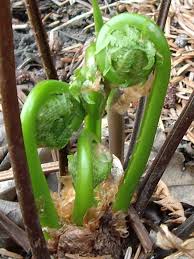
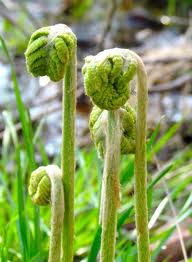
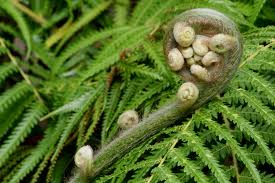
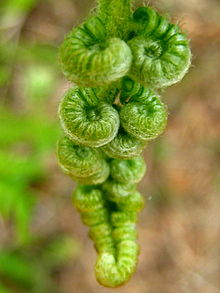
Fiddleheads or fiddlehead greens are the furled fronds of a young fern, harvested for use as a vegetable. Left on the plant, each fiddlehead would unroll into a new frond (circinate vernation). As fiddleheads are harvested early in the season before the frond has opened and reached its full height, they are cut fairly close to the ground.[rx] Fiddleheads have antioxidant activity, are a source of omega-3 and omega-6 fatty acids, and are high in iron and fiber.[rx] Certain varieties of fiddleheads have been shown to be carcinogenic.
The fiddlehead resembles the curled ornamentation (called a scroll) on the end of a stringed instrument, such as a fiddle. It is also called a crozier, after the curved staff used by bishops, which has its origins in the shepherd’s crook.
Other Name(s):
Fiddlehead Fern, Fougère d’Allemagne, Fougère Autruche, Fougère à l’Autruche, Fougère de l’Autruche, Fougère Plume d’Autruche, Garden Fern, Hardy Fern, Helecho de Pluma de Avestruz, Matteuccia struthiopteris, Matteucie Fougère-à-l’Autruche, Osmunda struthiopteris, Ptérétide Noduleuse, Struthioptéride Germanique.
Fiddlehead ferns Quick Facts
Name:
Fiddlehead ferns
Scientific Name:
Matteuccia struthioreris
Colors
Bright green (Leaves)
Shapes
Pinnate or bipinnate, Length: 4 feet (Leaves)
Taste
Unique
Calories
35 Kcal. Kcal./cup
Major nutrients
Copper (35.56%)
Vitamin B3 (31.13%)
Vitamin C (29.56%)
Vitamin A (25.86%)
Manganese (22.17%)
Fiddlehead fern (Matteuccia struthioreris) is a fern in the genus Matteuccia Todaro and the family Dryopteridaceae. It is a perennial plant that thrives in temperate climates and well-drained soils. Fiddlehead fern is also called as Ostrich fern and Shuttlecock fern.
FIDDLEHEAD FERN FACTS
Fiddlehead is the young coiled fern that is vibrant green in color. Fiddleheads are considered to possess a plentiful amount of iron and fiber. They have a coiled head due to which it looks like a fiddle. The taste of Fiddlehead ferns is similar to asparagus and is a good source of Vitamin C and A.
Name
Fiddlehead ferns
Scientific Name
Matteuccia struthioreris
Common/English Name
Ostrich fern, Shuttlecock fern
Plant Growth Habit
Perennial
Growing Climate
Temperate
Soil
Well-drained
Plant Size
Above five feet long
Stem
U shaped grooved on side of the stem
Stalk
Diameter: 4 cm; Height: 10-12 cm
Leaf
Pinnate or bipinnate, bright green, Length: 4 feet
Taste
Unique
Varieties/Types
Ostrich fern
Cinnamon and interrupted Fern
Lady Fern
Bracken Fern
Major Nutritions (Raw)
Copper, Cu 0.32 mg (35.56%)
Vitamin B3 (Niacin) 4.98 mg (31.13%)
Vitamin C (Ascorbic acid) 26.6 mg (29.56%)
Vitamin A, RAE 181 µg (25.86%)
Manganese, Mn 0.51 mg (22.17%)
Iron, Fe 1.31 mg (16.38%)
Vitamin B2 (Riboflavin) 0.21 mg (16.15%)
Phosphorus, P 101 mg (14.43%)
Protein 4.55 g (9.10%) Magnesium, Mg 34 mg (8.10%)
Health Benefits
Assist in growth
Maintains cholesterol health
Treats cancer
Enhance immunity
Anti-inflammatory activity
Treats eye ailments
Bone disorders
Treats anemia
Cures migraines
Digestion
Calories in 1 value (100 gm)Raw
34 Kcal.
Fiddlehead fern Scientific Classification
Scientific Name: Matteuccia struthioreris
Rank
Scientific Name & (Common Name)
Kingdom
Plantae (Plants)
Subkingdom
Tracheobionta (Vascular plants)
Division
Pteridophyta (Ferns)
Class
Filicopsida
Order
Polypodiales
Family
Dryopteridaceae (Wood Fern family)
Genus
Matteuccia Todaro (Ostrich fern)
Synonyms
Matteuccia pensylvanica (Willd.) Raymond
Onoclea pensylvanica (Willd.) Sm.
Pterinodes struthiopteris (L.) Kuntze
Struthiopteris europaea Hornem.
Struthiopteris germanica Willd.
The plant of fiddlehead fern grows about five feet long which possesses a U-shaped grooved on the side of the stem. The leaves are pinnate or bipinnate which is bright green in color and usually 4 feet long. The stalk is about 4 cm in diameter and 10-12 cm in height. The varieties of Fiddlehead ferns are classified as: Ostrich fern, Cinnamon and interrupted Fern, Lady Fern, and Bracken Fern.
History
Canada is a nation that has a history of cultivating fiddleheads. Canadians were connected to this plant that they have fiddlehead themes for lodges and boats. Since the middle ages, fiddlehead ferns were recognized as the regular diet within Australia, Asia, America, and New Zealand.
Nutritional value of Fiddlehead ferns, Raw
Serving Size: 1 Value, 100 g
Calories 34 Kcal.Calories from Fat 3.6 Kcal.
Proximity
Amount
% DV
Water
88.68 g
N/D
Energy
34 Kcal
N/D
Energy
143 kJ
N/D
Protein
4.55 g
9.10%
Total Fat (lipid)
0.4 g
1.14%
Ash
0.83 g
N/D
Carbohydrate
5.54 g
4.26%
Minerals
Amount
% DV
Calcium, Ca
32 mg
3.20%
Iron, Fe
1.31 mg
16.38%
Magnesium, Mg
34 mg
8.10%
Phosphorus, P
101 mg
14.43%
Potassium, K
370 mg
7.87%
Sodium, Na
1 mg
0.07%
Zinc, Zn
0.83 mg
7.55%
Copper, Cu
0.32 mg
35.56%
Manganese, Mn
0.51 mg
22.17%
Vitamins
Amount
% DV
Water-soluble Vitamins
Vitamin B1 (Thiamin)
0.02 mg
1.67%
Vitamin B2 (Riboflavin)
0.21 mg
16.15%
Vitamin B3 (Niacin)
4.98 mg
31.13%
Vitamin C (Ascorbic acid)
26.6 mg
29.56%
Fat-soluble Vitamins
Vitamin A, RAE
181 µg
25.86%
Vitamin A, IU
3617 IU
N/D
Beta Carotene
2040 µg
N/D
Alpha Carotene
261 µg
N/D
*Above mentioned Percent Daily Values (%DVs) are based on 2,000 calorie diet intake. Daily values (DVs) may be different depending upon your daily calorie needs. Mentioned values are recommended by the U.S. Department of Agriculture. They are not rxharun.com recommendations. Calculations are based on average age of 19 to 50 years and weigh 194 lbs. Source: https://ndb.nal.usda.gov/
NUTRITIONAL VALUE
Fiddlehead ferns are rich in nutrients yet low in carbohydrates and fat. The following nutrients can be found in fiddlehead ferns.
Vitamin A: Fresh fronds harvested from fiddlehead ferns are rich in the antioxidant vitamin A. Vitamin A is important because it boosts the body’s immune system, helping to defend it against infection.
Vitamin A also helps to keep your skin and eyes properly moisturized. Vitamin A is essential to improving and maintaining vision and also protecting the body from the degradation of teeth, tissues, muscles, and bones.
Vitamin C: Another antioxidant found in fiddlehead ferns is vitamin C. We all know we need to get enough vitamin C to keep our immune system up and running and to protect against infections. However, vitamin C has several other functions as well, such as decreasing hypertension, facilitating the growth of healthy new tissue to heal wounds, and protecting the eyes from developing cataracts.
Potassium: Fiddlehead ferns are a significant source of potassium, meaning that consuming these fronds can improve your heart health and boost electrolyte functions. Potassium is also beneficial to the health of your muscles, preventing cramping, as well as improving the condition of your bones.
Iron: If you want to boost your red cell production and enjoy iron-rich blood, consider adding fiddlehead ferns to your diet. Along with preventing anemia and its associated symptoms iron also boosts energy, makes sure all the organs in the body are properly oxygenated, and helps regulate body temperature.
Manganese: Manganese is a mineral that encourages the development of enzymes necessary to healthy bone growth, preventing loss of bone density. This is especially important in preventing the development of osteoporosis. Manganese is also important because it helps to regulate metabolism and balance blood sugar levels.
Copper: Copper has several uses, such as serving as a powerful anti-inflammatory, helping alleviate the pain of such inflammatory conditions as arthritis. Copper is essential to a healthy diet because it is vital to healthy growth and development, as well as helps to provide the pigmentation of eyes and hair.
Omega-3: Omega-3 fatty acids are an important part of a balanced diet, as they help protect the body from cancer and Alzheimer’s disease. Omega-3 also improves the condition of skin and hair, boosts the immune system, and reduces inflammation.
Fiddlehead ferns also contain a small amount of the B-complex vitamins niacin, thiamin, and riboflavin.
Health Benefits of Fiddlehead fern
Fiddlehead ferns are used as part of the diet in Asia, Northern France, and Native Americans. It is harvested before the frond is opened. It possesses Vitamin A, a natural anti-oxidant that assists to maintain the mucus membranes and skin integrity.
Assist in growth
Copper is essential for the oxygenation of red blood cells. The low level of copper results in muscle, joint pain, fatigue as well as poor brain function. The studies also show that deficiency of copper can delay growth, low weight, and height and also slow down metabolic activities.
Maintains cholesterol health
Niacin helps to treat or maintain the level of cholesterol. It reduces the chances of cardiovascular disease in those patients with mixed dyslipidemia, a condition in which the triglycerides, plasma cholesterol increases. Niacin is also beneficial for people who have high chances of stroke, heart attack, or other diseases.
The studies show that niacin helps to enhance the good cholesterol level and reduces triglycerides and bad cholesterol.
Treats cancer
The high amount of Vitamin C promotes the drugs which are used in chemotherapy. Vitamin C helps to target the cell which requires the nutrients without harming the normal cells. The research shows that Vitamin C is an effective cancer treatment for lung and ovarian cancer.
Enhance immunity
The research shows that Vitamin C is helpful for those having a weak immune system caused due to stress. As stress is a common condition that is experienced in society, an adequate amount of Vitamin C helps to improve overall health.
Anti-inflammatory activity
Vitamin A eliminates free radicals which damage the cells as well as tissue. It prevents the cells from being overactive that leads to inflammation and food allergies. The intake of Vitamin A helps to reduce the chances of food allergies. It also decreases inflammation which also reduces the chances of neurodegenerative diseases such as Parkinson’s and Alzheimer’s disease.
Treats eye ailments
Vitamin A helps to prevent macular degeneration which may result in blindness. The intake of vitamin C, A, E, copper, and zinc helps to reduce the chances of macular degeneration by about 25 percent. The studies show that Vitamin A eye drops help to treat dry eyes. It also slows down the development of Stargardt’s disease which causes vision loss in the youngsters.
Bone disorders
Manganese with zinc, copper, calcium helps to lower the chances of bone loss in older women who are more prone to weak bones and bone fractures. The deficiency of manganese increases the chances of bone-related ailments. Manganese helps to form the bone regulatory enzymes and hormones which are involved in the process of bone metabolism.
The studies show that the intake of manganese with vitamin D, calcium, copper, zinc, and boron can promote bone mass in women having weak bones which helps to treat osteoporosis naturally.
Treats anemia
The low level of hemoglobin and red blood cells are the cause of anemia because a low amount of oxygen is transported to the cells. Anemia results in a low level of energy, poor immunity, and slow brain function. Most people are suffering from anemia due to a deficiency in iron.
Cures migraines
It is proven that Vitamin B2 is effective to treat migraine headaches. Physicians recommend a 400 mg dose of riboflavin which helps to treat and cure headaches and migraine attacks.
Riboflavin lowers the frequency of migraines, reduces its symptoms as well a pain experienced during migraine.
Digestion
Phosphorus acts as phospholipids which is a component of biological membranes such as nucleic acids and nucleotides. It helps to balance the pH level in the body restricting the excessive alkali or acid compounds.
This assists the digestion process by granting the healthy bacteria to remain in the gut. Phosphorus reduces water retention, diarrhea, bloating which promotes digestion.
How to Eat
In Indonesia, the young fiddleheads are prepared in rich coconut sauce which is spiced with galangal, chili pepper, turmeric leaves, lemongrass, and other spices.
In the Philippines, fiddlehead is used to make a salad along with salted egg slices, tomato, and vinaigrette dressing.
In Garhwal (Uttarakhand), it is consumed as a vegetable.
It is pickled in the form of achaar.
It is cooked as a side vegetable dish usually dried to eat with parathas or Rotis.
Fiddlehead can be consumed boiled, steamed in soups, stir-fried, sautéed, fried, and baked.
Precautions
Fiddleheads should not be consumed raw because it may make the stomach upset and has bitterness until it is cooked.
It may cause food poisoning if it is not prepared, cooked, or stored properly.
The excessive consumption of male fern extract or powder can cause coma, muscular weakness, and problems in the eyes.
Types of Fiddleheads Ferns
Various types of Fiddlehead fern found in the entire world are described below:
1. Ostrich fern
The fiddlehead fern determines the ostrich fern. Ostrich fern is found in Newfoundland, Alaska, British Colombia, South and Northern California, Southern Appalachians, and Midwest.
It grows about 3-6 feet high. Five to nine fronds are organized in a rosette form. Ostrich ferns have spores on brown fronds which are small in comparison to others.
2. Cinnamon and interrupted Fern
Cinnamon fern is usual on sandy soil. It is considered delicious fiddleheads but is slightly harmful.
3. Lady Fern
Lady fern is found in damp conifer and deciduous woodlands. The rosettes possess 3-7 fronds which rise about 2-3 feet high. The groove is running down on the top of the stalk.
4. Bracken Fern
Bracken fern is a typical and huge fern that has a solitary and vertical stem. It is considered as the conventional food in North America. It possesses the powerful carcinogen which is called ptaquiloside which could be destroyed by cooking.
Varieties
The fiddleheads of certain ferns are eaten as a cooked leaf vegetables. The most popular of these are:
Bracken, Pteridium aquilinum, found worldwide (Toxic if not cooked fully)
Ostrich fern, Matteuccia struthiopteris, found in northern regions worldwide, and the central/eastern part of North America (Health Warning)
Lady fern, Athyrium filix-femina, throughout most of the temperate northern hemisphere.
Cinnamon fern or buckhorn fern, Osmunda cinnamomea, found in the eastern parts of North America, although not so palatable as ostrich fern.
Royal fern, Osmunda regalis, found worldwide
Midin, or Stenochlaena palustris, found in Sarawak, where it is prized as a local delicacy[rx][rx]
Zenmai or flowering fern, Osmunda japonica, found in East Asia
Vegetable fern, Athyrium esculentum, found throughout Asia and Oceania
Fiddleheads’ ornamental value makes them very expensive in the temperate regions where they are not abundant.
Uses of Fiddleheads Ferns
Besides cooking, fiddleheads are used as a decorative element in home gardens.
1. Decorative Purpose
Fiddleheads are unique due to their interesting shapes and patterns. Due to its decorative value, it sold at a high costly rate in temperate regions.
2. Fiddlehead Bouquet
Fiddlehead bouquets are quite popular as indications of modern expression.
3. Fiddlehead Designs
The fiddlehead designs and patterns in mittens showpieces are increasingly popular.
4. Fiddlehead Vegetable
Fiddleheads are used like veggies across the world. They should be harvested in the initial phase before the fronds unfurl. Coiled crosiers have a fragile taste.
Fun Facts about Fiddleheads
1. Fiddleheads are highly nutritious, containing vitamins A, C, B1, B2, and B3, along with the minerals manganese, calcium, iron, magnesium, phosphorous, potassium, copper, and zinc. They also contain omega-3 and omega-6 fatty acids.
2. The copper content of fiddleheads is essential in the oxygenation of red blood cells. Because of their copper content, they help the body to reduce fatigue, joint pain, and poor brain function. Low levels of copper can inhibit proper growth and slow metabolic activity.
3. Fiddleheads are rich in vitamin B3, also known as niacin. It is an important factor in maintaining healthy cholesterol levels in the body. As a result, it reduces the risk of cardiovascular diseases like stroke and heart attacks. It also contributes to the production of good cholesterol.
4. Rich in vitamin A, fiddleheads are essential in the elimination of free radicals, which damage tissues and cells. Because of this, fiddleheads reduce the risk of developing Parkinson’s and Alzheimer’s diseases. It is also a factor in ocular health, reducing the risk of the development of Stargardt disease, a malady that causes vision loss in children and macular degeneration in older adults.
5. Fiddleheads spoil rapidly and must be used within a few days of harvesting. After two or three days they begin to lose their elasticity and form a gummy film, which indicates that they are no longer edible. It is best to sautee them in olive oil or butter to retain their crunchy texture, but they can be steamed or boiled. Fiddleheads lend themselves to many recipes and complement many other foods, like mushrooms and artichokes.
Fiddlehead Fern Recipes
The fresh and nutty flavor of curly green fiddleheads will remind you of sweet and mild asparagus. The array of savory dishes, soups and pickles that can be prepared from fiddlehead ferns will surprise food lovers.
Some of the most popular fiddlehead fern recipes cater to the following items
Fiddlehead-Portobello Linguine
Shrimp and Fiddlehead Medley
Fiddlehead Dijon
Sweet Pickled Fiddleheads
Fiddlehead soups
Cream of fiddlehead soup
Sauteed Fiddlehead ferns
Fiddlehead dip
Fiddlehead omelet recipe
Fiddlehead ferns and angel hair pasta
Fiddlehead ferns with brown butter and prosciutto
Side Effects of Fiddleheads
You must always wash fiddlehead ferns as there are ample chances of it being home to germs and microbes.
The presence of enzyme thiaminase in fiddleheads can cause berberi and vitamin B complex deficiency. Therefore it is advisable to consume these plants in small quantities.