

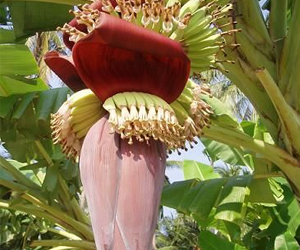
Banana flowers are arranged in clusters (called hands) on the peduncle, the stalk that supports the inflorescence. The female flowers are located near the base of the peduncle and the male ones at the distal end. Each hand of flowers is enfolded by a bract that lifts at anthesis when the flowers have finished developing. Known as banana hearts, banana flowers are loaded with fiber, protein, potassium, calcium, copper, phosphorus, iron, magnesium, and Vitamin E. These pretty flowers can be eaten raw or cooked and added to salads, soups, stir-fries, and herbal teas. Keep going till the bottom to find a healthy stir-fry recipe!
| Banana Flower Quick Facts | |
|---|---|
| Name: | Banana Flower |
| Scientific Name: | Musa Spp. |
| Origin | Southeast Asia – Indo Burma region is considered as the center of origin of banana. |
| Colors | The color of the main bud is red-orange to deep purple. Flowers are white or cream in color |
| Shapes | Teardrop-shaped purple flower at the end of the banana cluster. Flowers are slim, Torpedo-shaped. They’re bunched in circled double rows along with the bloom, with each cluster covered by a thick, waxy petal. |
| Taste | Raw taste starchy and bitter. Cooked flowers taste like artichoke leaves |
| Calories | 51 Kcal./cup |
| Major nutrients | Manganese (2117.39%) Copper (1444.44%) Iron (705.00%) Total dietary Fiber (15.00%) Potassium (11.77%) |
| Health benefits | Curing the infection Overcoming diabetes and anemia Improves lactation, Reduce Free Radical Activity, Menstrual problems and weight loss Boost Mood and Reduce Anxiety Anti-aging power Gastrointestinal health |
Banana flower is inherent to the Andes Mountains of Colombia. The flower is large which grows from the end of the bunch of bananas and has a dark purple-red blossom. The small flowers would be found on the inside part which would turn into the banana. It is starchy and bitter in taste. It is rich in Vitamin C and Vitamin A and can reduce pain. It is included in the diet as a vegetable. The hard husk is found outside of the mature flower. It is also used as an ingredient for noodles and soup. In some countries, it is served as a salad. The fresh banana flowers are eaten raw. In order to avoid the liquid which can leave stains, one should use gloves to cook.
Banana Flower Facts
The banana flower is also known as a banana blossom or a banana heart and it is a drop-shaped purple flower that hangs at the end of a cluster of bananas. Considered an Asian or tropical vegetable, it has a deep crimson color and consists of tightly packed leaves or bracts that wrap around rows of thin stemmed male flowers. It is the inner pale-colored bracts that are used for food dishes. Banana flowers can be sliced and served in meat stews, soups, rice or noodle dishes, and cooked vegetable dishes.
| Name | Banana Flower |
|---|---|
| Scientific Name | Musa Spp. |
| Native | Southeast Asia – Indo Burma region is considered as the center of origin of banana. |
| Common Names | Banana blossom or a banana heart |
| Name in Other Languages | Arabic: Maouz, Maozeh (Lebanese), Mauz, Mazw, Moaz, Mouz, موز Moz (Egypt). Armenian: ադամաթուզ Adamat’uz, բանան. Assamese: Kala(কলা ) Bengali: Kala (কলা ) Burmese: (nghak-pyau:) Hnget pyaw / Nget pyaw, Nget pyo thee, Nga pyaw thee, Nga pyaw phoo (flower). Catalan: Banana (fruit), Bananer, Plàtan (fruit). Chinese: Jiao (Tsiu, Chiu), Shang chao fua ( flower). Czech: Banánovník. Danish: Banan, Bananer, Bananbusk (plant), Banantræ (plant). Dutch: Banaan, Bananen, Banaanboom (plant), Banaanplant, Bananeplant. English: Banana, Banana tree, Banana shrub. Finnish: Banaanit, Banaanirata, Banaanikasvi (plant). French: Banane, Bananes, Bananier (plant), Figue (ingredient, dried fruit – Caribbean-Sea islands). German: Banane, Bananen, Bananenpisang, Bananenstaude (plant). Greek: Banána (Μπανάνα). Gujrati: Kēḷāṁ (કેળાં), Kēḷuṁ (કેળું) Hausa: Ayaba. Hebrew: Bnnwţ (בננות) ,Vananah Bȧná̇náh (בַּנָּנָה) Hindi: Kadali (कदली ), Kela (fruit) (केले ), Kela kaa per (plant) (केले का पेड़ ), Kelaa (fruit) (केला ), Kelaa kaa phuul (Kelaa ka fool / Kere kafool) (flower) (केला का फूल ), Paapraa (पापड़ा) Icelandic: Banani Italian: Banana, Banane, Banano (plant). Japanese: Banana (バナナ), Banana no ki (plant) (バナナの 木), Banana no tsubomi (flower), Bashou (バショウ). Kannada: Kadali (ಕದಳಿ ), Baale (balay) (ಬಾಳೆ ), Baalehannu (Balayhanu) (ಬಾಳೇಹಣ್ಣು), Bāḷehaṇṇu (ಬಾಳೆಹಣ್ಣು), bale kaayi(ಬಳೆ ಕಾಯಿ). Khmer: Cheek nam’vaa, Chec. Korean: Banana (바나나) Panana. vaazha Laotian: Makkuany (ໝາກກ້ວຍ), Mak guy, Kwàyz, Kok khone. Malagasy: Akondro Malay: Pisang, Getang (Indonesia), Jantung pisang (flower), Djantoong (Indonesia). Malayalam: Ma’ūcaṁ( മഊചം), Maoocham (Maaucam), vāḻa (വാഴ) Vaazha, vāḻappaḻaṁ (വാഴപ്പഴം) Vaazhappazham. Marathi: Vēlacī (वेलची) Velachi Nepalese: Bungo (बुङ्गो) Polish: Drzewo bananowe, Bananowca, Bananowiec. Portuguese: Banana, Bananas, Bananeira (plant). Russian: Banan (банан) Serbian: Banana (бана́на) Sinhalese: Kehel, Kehel mal. Slovakian: Bananovec. Slovanian: Banánovník. Spanish: Banana, Platano, Plátanos, Cambur (plant), Banano (plant), Platanero (plant). Swahili: Ndizi, Maso. Swedish: Bananer. Tagalog: Saging (Fruit), Puso (flower), Punong saging (plant). Tamil: Valai tantu (வாழை தண்டு (stem)), வாழை Vaazhai, வாழைபூ Vaazhaipoo (flower), வாழை மரம் (plant), வாழைப்பழம், Vazhei. Telegu: Arati (అరటి), Artipandu(అరటిపండు), Kadala(కదళ ) Thai: กล้วย Kluai / Kluay / Klue / Kluey / Gluai / Glooway / Gkloo ay, Dok kluai (flower), Hua blee (flower). Turkish: Muz. Urdu: کيلا Kelaa (Keyla), كيلا كا پهول Kelaa kaa phuul (flower), کيلا Kelaa, موز Mauz. Vietnamese: Hoa chuối (flower), Bắp chuối (flower), Cây chuối (leaf), Quả chuối (fruit). Yoruba: Ọ̀gẹ̀dẹ̀, Ogede. |
| Fruit Shape & Size | Teardrop shaped purple flower at the end of the banana cluster. Flowers are slim, Torpedo-shaped. They’re bunched in circled double rows along the bloom, with each cluster covered by a thick, waxy petal. |
| Fruit Color | Color of main bud is red-orange to deep purple. Flowers are white or cream color |
| Flavor/Aroma | Nutty flavor |
| Taste | Raw taste starchy and bitter. Cooked flower taste like artichoke leaves |
| Major Nutrition | Manganese, Mn 48.7 mg (2117.39%) Copper, Cu 13 mg (1444.44%) Iron, Fe 56.4 mg (705.00%) Total dietary Fiber 5.7 g (15.00%) Potassium, K 553.3 mg (11.77%) Phosphorus, P 73.3 mg (10.47%) Carbohydrate 9.9 g (7.62%) Vitamin E (alpha-tocopherol) 1.07 mg (7.13%) Calcium, Ca 56 mg (5.60%) Protein 1.6 g (3.20%) Total Fat (lipid) 0.6 g (1.71%) |
| Calories in (100 gm) | 51 K cal |
| Health Benefits |
|
History
The southeast Asians were the first people known to cultivate banana plants. In Malaysia, the prepared blossoms, as well as immature green fruits, are combined and cooked into a curry. The Indonesians slice the fruit and simmer it in coconut milk then serve it as a vegetable. Nowadays Many Asian cultures eat banana blossoms. Blossoms are available fresh (preferred) or canned in Asian grocery stores.
Nutritional value of Banana Blossom
Calories 51 Kcal. Calories from Fat 5.4 Kcal.
| Proximity | Amount | % DV |
|---|---|---|
| Energy | 51 Kcal | N/D |
| Protein | 1.6 g | 3.20% |
| Total Fat (lipid) | 0.6 g | 1.71% |
| Carbohydrate | 9.9 g | 7.62% |
| Total dietary Fiber | 5.7 g | 15.00% |
| Minerals | Amount | % DV |
|---|---|---|
| Calcium, Ca | 56 mg | 5.60% |
| Iron, Fe | 56.4 mg | 705.00% |
| Phosphorus, P | 73.3 mg | 10.47% |
| Potassium, K | 553.3 mg | 11.77% |
| Copper, Cu | 13 mg | 1444.44% |
| Manganese, Mn | 48.7 mg | 2117.39% |
| Vitamins | Amount | % DV |
|---|---|---|
| Fat-soluble Vitamins | ||
| Vitamin E (alpha-tocopherol) | 1.07 mg | 7.13% |
*Above mentioned Percent Daily Values (%DVs) are based on 2,000 calorie diet intake. Daily values (DVs) may be different depending upon your daily calorie needs. Mentioned values are recommended by the U.S. Department of Agriculture. They are not rxharun.com recommendations. Calculations are based on average age of 19 to 50 years and weigh 194 lbs. Source: http://www.anneperera.co.nz/
Health Benefits of Banana Flower
The banana flower serves the health benefits which are as follows
1. Curing the infection
The banana flower has the ability to treat infection because it possesses ethanol flowers which helps to prevent pathogenic bacterial growth. It can cure the wound as well. The extracts of the banana flower help to prevent the growth of malaria parasites.
2. Overcoming diabetes and anemia
Diabetic patients should consume banana flowers either boiled or alone so that it reduces the level of blood sugar and raise the hemoglobin in the body as it is rich in fiber and iron which assists in red blood cell production. The pan should be heated with the oil and put mustard seeds till it crackles, then ½ tsp. of urad dal and channa dal should be added frying till it is brown and then 1/8 cup of cut shallots and curry leaves should be added. The banana flowers which are cut should be added with a tsp. of sambar powder, ¼ tsp. of turmeric powder, and salt. Then it should be cooked by covering. Then it should be fried in a low flame so that the water evaporates fully than a tbsp. of fresh coconut, scrapings should be added and switched off. It works great for diabetic patients.
3. Improves lactation
The breast milk supply is increased for lactating mothers. It helps to cure excessive bleeding, maintains a healthy uterus, restricts constipation during pregnancy, and promotes lactation. It should be combined with other spices to make the good taste. The fresh one should be selected. The recipe for Indian pancakes or adai or dosa is first, 1 cup of rice should be soaked with 1 tbsp. moong dhal, 2 tbsp. urad dhal, 1 tbsp. channa dhal and ¼ cup toor dhal for overnight. The next day, 2 red chilies should be ground with little Coconut, a small piece of Asafoetida, a tsp. of Cumin seeds which should be added to the dal grind after soaking overnight, with the required salt. The cleaned banana flower which is cut should be fried in a little oil and then add to the batter in order to make dosais. This is high in fiber which helps to eliminate pregnancy constipation.
4. Reduce Free Radical Activity
The free radicals lead to various problems. The antioxidant property is possessed in the banana flower. It also treats the health problems like cancer and premature aging. It should be included in health supplements in order to make full use of antioxidant properties.
5. Menstrual problems and weight loss
It increases progesterone which helps to reduce excessive bleeding. ¼ cup of banana flower should be cooked in a little water and salt till it is completely cooked. After it is cooled, in ¼ cup coconut, 2 g. chilies, ½ tsp. cumin seeds should be added to make a thick and fine taste. The coconut mixture should be added to the thick yogurt with the cooked banana flowers and the required salt. Excess bleeding could be treated if this is eaten with rice. As it is rich in fiber and nutrients, it results in weight loss. It soothes the stomach as well. For weight loss, the banana flowers should be added to the salads and soups.
6. the Rich source of Vitamin and minerals
The banana flowers possess Vitamin C, A, E, fiber, and potassium which are the sources of the healthy nutrient.
7. Boost Mood and Reduce Anxiety
It improves mood and lessens anxiety due to the magnesium present in banana flowers. They serve as anti-depressants without side effects.
8. Anti-ageing power
It helps to encounter the free radicals and cure the health issues related to it such as cancer and early aging.
9. Healthy uterus
It helps to prevent uterus problems. To boost the healthy uterus, the banana flowers should be added with turmeric powder, peppercorns, and cumin seeds. The banana flowers should be boiled with minor peppercorns and cumin seeds; ¼ tsp. of turmeric powder and salt till it is half. The uterus problems are eliminated by drinking this decoction.
10. Gastrointestinal health
Banana flowers are rich in soluble and insoluble fiber. A soluble fiber allows the food to pass easily through the digestive tract as it dissolves in water and forms a gel. Insoluble fiber assists the bulk to undigested products as it is not dissolved in water. Both of them boost the healthy digestion and absorption of food.
11. Cancer and Heart disease
Banana flowers are a high source of tannins, acids, flavonoids, and other antioxidants which help to counteract free radicals and eliminate oxidative damage which leads to cancer and heart disease. The banana flower can prevent these conditions.
12. Neural disorders
The free radicals may cause Alzheimer’s and Parkinson’s disease which may be prevented by consuming banana flowers regularly.
How to select
The firm and fresh flowers should be purchased. It should be free from cuts and blemishes, smooth appearance, and be bright. The overlapping of outer leaves should be tight.
How to store
A fresh one should be used. It should be wrapped in transparent plastic, cover in zip lock bags and store it in a refrigerator.
Traditional uses and benefits of banana flower
- The flower is used as a traditional medicine to treat bronchitis, constipation, menstrual cramps, and ulcer problems.
- It boosts mood and reduces anxiety because the banana flowers are having high levels of magnesium.
- It regulates blood pressure.
- Consuming cooked banana flowers with curd is the most efficient way to treat excessive bleeding during menstruation.
- It reduces the bleeding associated with menorrhagia.
- It lowers blood cholesterol and promotes the functional efficiency of kidneys.
How to Cut and Clean Banana Flower
To fully benefit from the health-promoting properties of the banana flower, it is important that you know how to cut and clean it properly. Only then can this food be of real help to you! Therefore, have a look at the related aspects.
- First, smear some mustard oil on the palms to prevent them from getting discolored while you peel the flower.
- Slowly take out each bract and gather the tiny florets.
- Continue doing so till you touch the innermost portion where you will notice a bulb of yellow shade.
- Now take each floret and remove its transparent covering as well as the tiny-sized head.
- Then cut all the florets into small pieces.
- Move the floret pieces into a container having water.
- Put 1 tbsp of yogurt and ½ tsp salt in the container. This will minimize the extent to which the banana flower gets oxidized.
- You can now cook the banana flower.
Culinary uses
- It can be simply chopped and used in salads.
- It can also be added to spinach salads.
- Banana flowers can be used in soups or sliced and added to stir-fries.
- In Thailand, the banana flower is almost always served raw on the side with pad Thai.
- In Indonesian cuisine, banana flowers are mixed with pork and hot sambal, cooked in a section of bamboo, and served at their festivals or wakes.
- It is also served simmered in soup or fried with thin noodles.
- Other Asian and Indian cuisines add the sliced banana flower to meat stews, stir-fries, soups, and rice or noodle combinations.
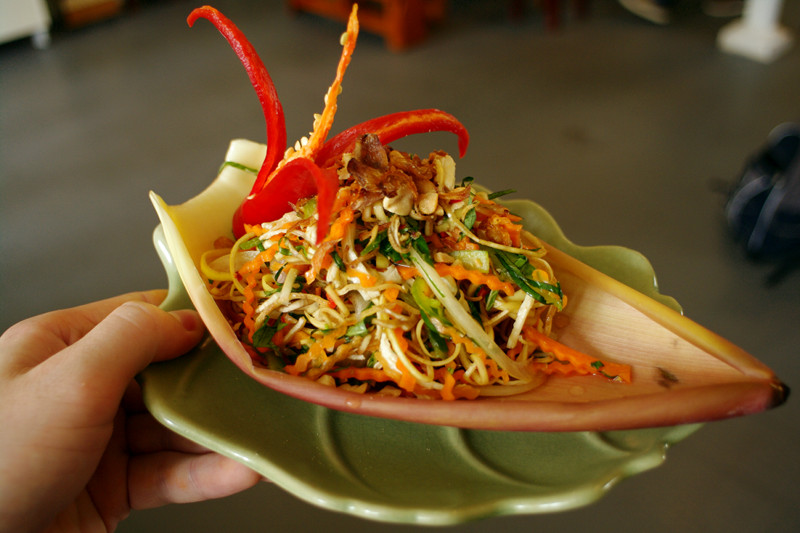
- It is also used in cold salads, with the salad mixture presented to the diner in one of the large purple-red outer bracts.
- In the Philippines, banana flowers are the main ingredient in linabog or labor, a dish made with coconut milk, spices, and dried fish.
Recipe
Banana Blossom Salad
Ingredients:
- 2 banana blossoms
- 1 tablespoon of butter
- 1 spring onion cut fine
- 500 grams shelled and cooked prawns
- 5 tablespoons of roasted almonds or assorted nuts
- 1 teaspoon sour lime juice or even lemon
- Salt and pepper
Method:
- Core and cube the banana flowers as well as immerse them overnight within a bowl of water that consists of a tablespoon of vinegar. Clean and trench well.
- Cook the prawns within the butter together with a pinch of pepper and salt.
- Grind the nuts indelicately so that it forms a lumpy mix, not an even paste.
- Include all the components into a bowl and toss for a minute or even two.
- Chill for 30 minutes and after that garnish along with a mint sprig and serve.
Types of banana flowers
Female flowers
Female banana flowers have a massive style and stigma, and stamens which are usually reduced to staminodes that do not produce pollen. Sometimes the male organs are absent.
The enlarged basal portion which contains the ovules is called the ovary (from the Latin’s ovum, meaning egg).
Together, the ovary, style, and stigma make up the pistil, also called a carpel. In a banana flower, three pistils fuse producing a tri-pistillate ovary, style and stigma.
The stigma is the receptive tip of the carpel, which receives pollen and on which the pollen grain germinates. The stigma is adapted to catch and trap pollen.
The collective term for the parts of the flower that produce ovules and ultimately develop into the fruit and seeds is gynoecium (from the Greek gyne, meaning women’s, and Oikos, meaning house).
Each flower is connected to a cushion of tissue on the peduncle by the pedicel.
The female flowers reach anthesis (the period during which a flower is fully open and functional) before the male flowers.
The ovary of female flowers can be divided into three sections along its length: the subocular, locular, and prolongation zones. These three zones are indistinguishable externally.
The sub-locular section is usually small, carries vascular bundles, and connects the ovary to the pedicel which attaches to the cushion on the peduncle.
The locular section is divided into three chambers or locules that contain the ovules that are embedded in a mucilaginous gel. An ovary may contain 200 to 300 ovules, which in wild species can potentially develop into that many seeds.
When a pollen grain lands on the stigma, it germinates into a pollen tube that is guided down the stylar canal to one of the three locules, where the ovules are located. Each ovule is attached to the central placenta and contains the egg cell and a micropyle, through which the pollen tube enters to fertilize the ovule (see photo).
In wild species, the fruit will contain seeds if the flower was pollinated.
Male flowers
Male banana flowers have a slender style and stigma, and well-developed anthers, which in wild species usually contain pollen. Inedible bananas, the amount of pollen is reduced or absent.
Together, the anther and the filament form a stamen. A male banana flower typically has five stamens. Collectively the stamens form the androecium (from the Greek andr-, meaning man, and oikios, meaning house).
The style, stigma, and male parts of the banana flower are enveloped within a tubular structure formed by the fusion of five petal-like tepals, with a sixth tepal remaining free.
The gynoecium is much smaller than in female flowers. Male flowers do not have ovules but they have nectaries. The quantity of nectar and its sugar concentration is lower than in female flowers. In wild banana species, the nectar attracts pollinators, mainly bats and birds. Edible bananas do not need to be pollinated, but because their flowers still produce nectar they are visited by animals and insects.
The male flowers are contained in the male bud, in which they are arranged in clusters called hands. Each hand is enfolded by a bract that lifts when the flowers have finished developing. Male flowers usually fall to the ground a short time after flowering.
Hermaphrodite flowers
In some wild species, the basal fruit-forming flowers have a functional gynoecium and androecium and can self-fertilize before bract opening if the stigma and anthers are aligned. These flowers are called hermaphrodite or perfect.
The term hermaphrodite has to be used to describe basal flowers in Musa acuminata ssp. banksii3, Musa acuminata var. Chinensis, Musa boman3, Musa hillii5, Musa ingens3, Musa schizocarpa3, and Musa yunnanensis4, but the term may not be referring to the same type of flower in all cases, based on the description or lack thereof.
The ability to self-fertilize is significant because it reduces hybridization and as such contributes to genetic isolation. Norman Simmonds noted that the occurrence of basal female flowers with male fertility may have adaptive significance at the edges of a species’ range as it would bias seed set towards selfing if populations of plants were distant from one another.
Other types of flowers
In some edible bananas, there may be flowers at the point of transition from the basal female to the distal male portion of the inflorescence that does not produce fruit and has a small ovary, although it is larger than in male flowers. These flowers may retain some features of fruit-forming flowers, such as remaining attached to the peduncle. Such flowers are called neuter or intermediate. They are also described in some wild species, where they can be neuter or functionally male.
Size of flowers
Typically, male flowers are about 60% of the size of female flowers, although there can be considerable variation from one species to another (see chart).
The data in the chart are from 39 Musa species or subspecies. Data from banana cultivars are rare since they are usually characterized when the female flowers have already developed into fruit.
Pollination
In wild species of banana, the flowers provide the structure for sexual reproduction, which occurs when pollen produced by the anther of a male flower fertilizes the ovule in a female flower to produce a viable embryo.
First, pollen needs to be transferred to the stigma. Since the female flowers open before the male flowers on the same inflorescence, more than one inflorescence, and a pollinator to collect and deliver the pollen, are essential.
Second, once on the stigma, the pollen grains need to be ‘recognized’ in order to germinate. The tube emerging from a germinated pollen grain responds to chemical signals that guide it down the canal in the center of the style to reach one of the three locules where ovules are located. Further guidance is needed to get a pollen tube to an available ovule to form a viable embryo.
The fertilized ovule containing the viable embryo develops into a seed. This in turn stimulates pulp development around the seeds in the ovary, resulting in seed-bearing banana fruit. In a wild species, a fruit might contain up to 300 seeds.
Pollinators
The nature of the banana inflorescence is that female flowers are separated in space and time from male flowers. In this case, pollinators are essential for seed production.
Since the tepals are not colorful and nectar is abundant, the main pollinators are bats and birds. Banana flowers are visited by numerous species of insects and some animals but these are not involved in pollination.
Parthenocarpic bananas
Inedible bananas, sexual reproduction is rarely successful, with very few if any seeds produced as a consequence of pollination. This failure is multifaceted, due to a greater or lesser extent to a lack of viable pollen, disruption of the pollen pathway through the gynoecium in the female flower, and a lack of viable ovules.
Instead, the fruit of edible bananas develops through vegetative parthenocarpy, with the pulp developing autonomously from tissues on the ovary wall of the female flower without the need for pollination.
References






