
An ONNX refresher 

Patient Tools

Read, save, and share this guide

Use these quick tools to make this medical article easier to read, print, save, or share with a family member.

Patient Mode

Understand this article easily

Switch between simple English and easy Bangla patient notes. This is for education and does not replace a doctor consultation.

ONNX models are flexible, standardized representations of machine learning that allow them to be executed across a gamut of hardware platforms and runtime environments from large-scale cloud-based supercomputers to resource-constrained edge devices such as your web browser and phone. Beyond its graph format, canonically represented using Protobuf,...

For severe symptoms, danger signs, pregnancy, child illness, or sudden worsening, seek urgent medical care.

বাংলা রোগী নোট এখনো যোগ করা হয়নি। পোস্ট এডিটরে “RX Bangla Patient Mode” বক্স থেকে সহজ বাংলা সারাংশ যোগ করুন।

এই তথ্য শিক্ষা ও সচেতনতার জন্য। এটি ডাক্তারি পরীক্ষা, রোগ নির্ণয় বা প্রেসক্রিপশনের বিকল্প নয়।

Article Summary

ONNX models are flexible, standardized representations of machine learning that allow them to be executed across a gamut of hardware platforms and runtime environments from large-scale cloud-based supercomputers to resource-constrained edge devices such as your web browser and phone. Beyond its graph format, canonically represented using Protobuf, ONNX consists of a standard set of primitive operators which are implemented by runtimes and hardware vendors alike. With this...

Key Takeaways

  • This article explains Announcing ONNX Script in simple medical language.
  • This article explains Why are we investing in ONNX Script? in simple medical language.
  • This article explains An end-to-end example in simple medical language.
  • This article explains Iterating and debugging in simple medical language.
Educational health guideWritten for patient understanding and clinical awareness.
Reviewed content workflowUse writer and reviewer profiles for stronger trust.
Emergency safety firstUrgent warning signs are highlighted below.

Seek urgent medical care if you notice

These warning signs are general safety guidance. Local emergency numbers and clinical judgment should always come first.

  • Severe symptoms, breathing difficulty, fainting, confusion, or rapidly worsening illness.
  • New weakness, severe pain, high fever, or symptoms after a serious injury.
  • Any symptom that feels urgent, unusual, or unsafe for the patient.
1

Emergency now

Use emergency care for severe, sudden, rapidly worsening, or life-threatening symptoms.

2

See a doctor

Book a professional medical evaluation if symptoms persist, worsen, recur often, affect daily activities, or occur in a high-risk patient.

3

Learn safely

Use this article to understand possible causes, tests, treatment options, prevention, and questions to ask your clinician.

Before reading

RX Patient Tools

Use these quick guides before reading the article, or return to them when you need help preparing questions for a doctor.

Start here Choose the right pathway for symptoms, reports, medicines, or urgent warning signs. Disease article roadmap Read this topic step by step: meaning, symptoms, warning signs, diagnosis, treatment, prevention, and follow-up. Treatment planner Prepare questions about treatment choices, benefits, risks, side effects, and follow-up. Family & caregiver guide Organize symptoms, reports, medicines, questions, and follow-up safely. Nutrition & diet guide Prepare food, hydration, supplement, and medicine-timing questions safely. Prevention guide Organize risk factors, protective habits, screening, and warning signs. Recovery guide Prepare a safe plan for activity, rehabilitation, warning signs, and follow-up.

ONNX models are flexible, standardized representations of machine learning that allow them to be executed across a gamut of hardware platforms and runtime environments from large-scale cloud-based supercomputers to resource-constrained edge devices such as your web browser and phone.

Beyond its graph format, canonically represented using Protobuf, ONNX consists of a standard set of primitive operators which are implemented by runtimes and hardware vendors alike. With this broad ecosystem in mind, ONNX aims to keep the number of these operators low, encouraging composability through ONNX functions. This is important to reduce the overhead of supporting ONNX.

Typically, machine learning models are developed using higher-level frameworks such as PyTorch and TensorFlow. While these frameworks tend to be productive for iterating on the development of models, the models are not typically deployed to production in this fashion. Instead, they are exported to ONNX by facilities provided by the frameworks, and then optimized for a particular target by tools such as Olive.

Want to dive right into ONNX Script? Check it out on GitHub.

Announcing ONNX Script

ONNX Script is a new open-source library for directly authoring ONNX models in Python with a focus on clean, idiomatic Python syntax and composability through ONNX-native functions. Critically, it is also the foundation upon which we are building the new PyTorch ONNX exporter to support TorchDynamo—the future of PyTorch.

Prior to ONNX Script, authoring ONNX models required deep knowledge of the specification and serialization format itself. While eventually a more convenient helper API was introduced that largely abstracted the serialization format, it still required deep familiarity with ONNX constructs.

ONNX Script takes a new approach by integrating deeply with Python on two fronts:

  1. It provides a strongly typed API for all operators in ONNX (all 186 as of opset 19).1 This allows existing Python tooling, linters, and integrated development environments (IDEs) to provide valuable feedback and enforce correctness.
  2. ONNX Script supports idiomatic Python language constructs to make authoring ONNX more natural, including support for conditionals and loops, binary and unary operators, subscripting, slicing, and more. For example, the expression a + b in Python would translate to the ONNX operator as Add(a, b).

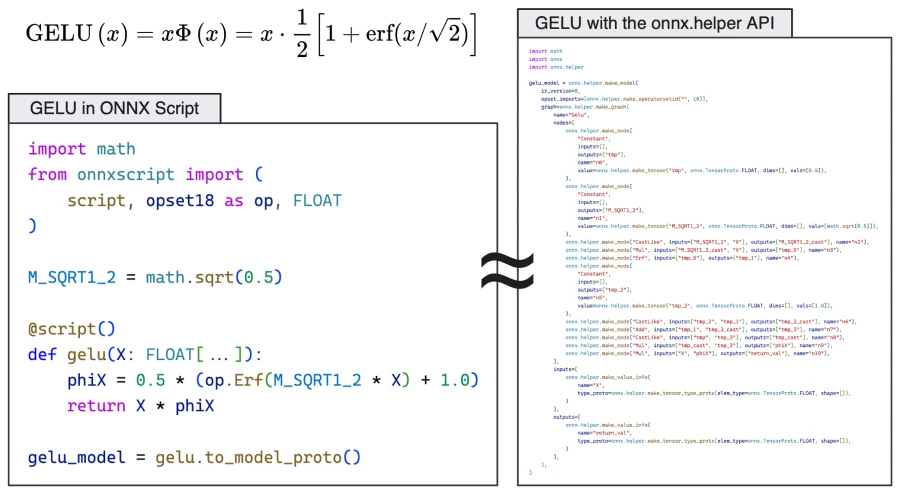
Let’s look at how we might implement GELU using ONNX Script and compare it with onnx.helper API—and to be clear—the examples below produce the same ONNX model. For reference, we’ll use this definition of GELU to guide the ONNX implementations:
An ONNX refresher 

As you can see, ONNX Script emphasizes the familiar readability and productivity of Python while expressing an ONNX model that can be statically reasoned about by existing Python and ONNX tooling.

This also means ONNX comes alive within the context of your existing tooling and development environments, be it debugging in Visual Studio Code or demonstrating concepts in a Jupyter Notebook—ONNX Script integrates naturally.

Why are we investing in ONNX Script?

Much has changed since ONNX support for PyTorch was originally introduced over five years ago in PyTorch 0.3.0. For PyTorch 2.0, TorchDynamo represents the eventual deprecation of TorchScript, which implies a major overhaul of the ONNX exporter is necessary. We are fully embracing this as an opportunity to revisit the fundamentals upon which the exporter is built, and ONNX Script is its new foundation. We began this effort in November 2022 and have worked closely with PyTorch engineers to ensure TorchDynamo is a fully capable starting point for exporting high-fidelity ONNX for years to come.

One of the first streams of work we started was the development of what we call Torchlib, a pure ONNX implementation of the operators in PyTorch—namely Core ATen IR and Prims IR—and of course, these operators are implemented in ONNX Script. This approach greatly simplifies the central responsibility of the exporter as it “just” needs to project FX graph nodes produced by TorchDynamo into ONNX graph nodes, without concerning itself with the implementation details of individual operators.

We will cover the new PyTorch ONNX exporter in a separate post with more depth as PyTorch 2.1 approaches, but for now, the key takeaway is that ONNX Script is pervasive throughout our renewed approach. For those willing to try bold new things, the new exporter is available as a preview in PyTorch nightly via the torch.onnx.dynamo_export API.

By deeply weaving ONNX Script support into the PyTorch ONNX exporter, we have also made it possible to augment PyTorch model code with specialized ONNX functions as custom operators. We introduced initial support for this in the TorchScript exporter starting with PyTorch 1.13 and continue to refine this capability in the new exporter.

An end-to-end example

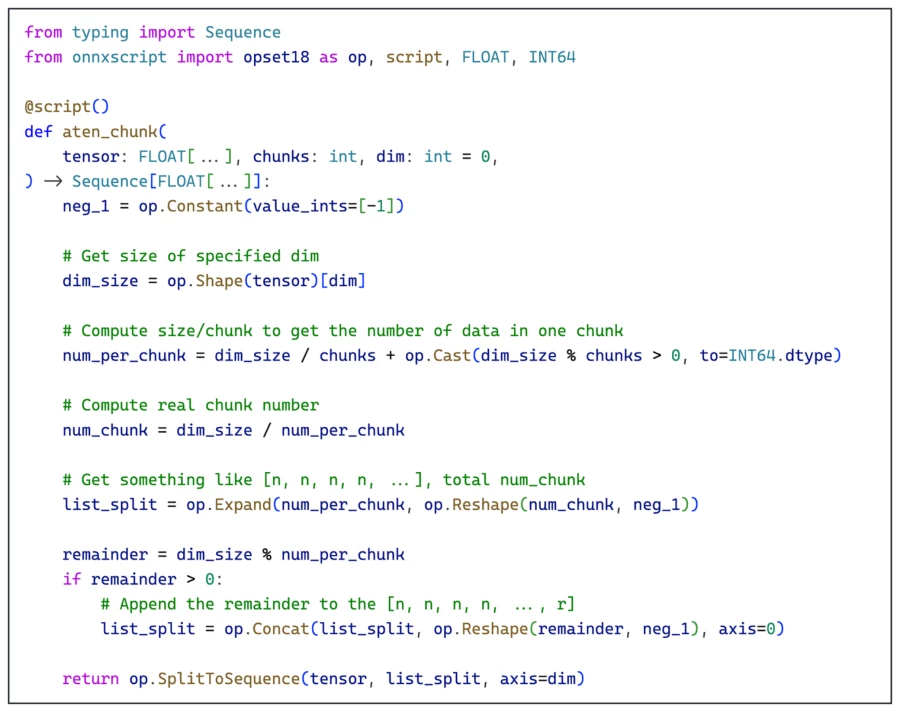
Let’s look at an example slightly more complicated than GELU. In fact, the following example is adapted directly from the new PyTorch ONNX exporter, implementing support for torch.chunk, which attempts to split a tensor into the number of specified chunks.
An ONNX refresher 

We start by importing from onnxscript the ONNX opset we wish to use (version 18 in this case), the @script decorator, and the tensor types of FLOAT and INT64. In ONNX Script, tensor shapes are denoted by subscripting the type, such as FLOAT[2, 10], symbolically such as FLOAT["M", "N"], or FLOAT[...] incase the tensor shape is unknown. Without subscripting (just FLOAT), the type is intended to indicate a scalar (a tensor of rank 0).

Next, we define the aten_chunk function with type annotations and implement the body of the function using both built-in Python syntax and explicit invocations of ONNX operators. The example uses various binary expressions and an if statement, but many other idiomatic Python constructs are also supported.

We also need to define a simple model that calls our ONNX Script function so we can export and verify an end-to-end example:

An ONNX refresher 

This model will simply split the provided tensor into ten tensors, but it also demonstrates that ONNX functions can of course call other ONNX functions, not just built-in ONNX operators.

We’ll now export our ONNX Script model to ONNX and explore it in Netron. Functions decorated with @script allow them to be exported using the to_model_proto function.

An ONNX refresher 

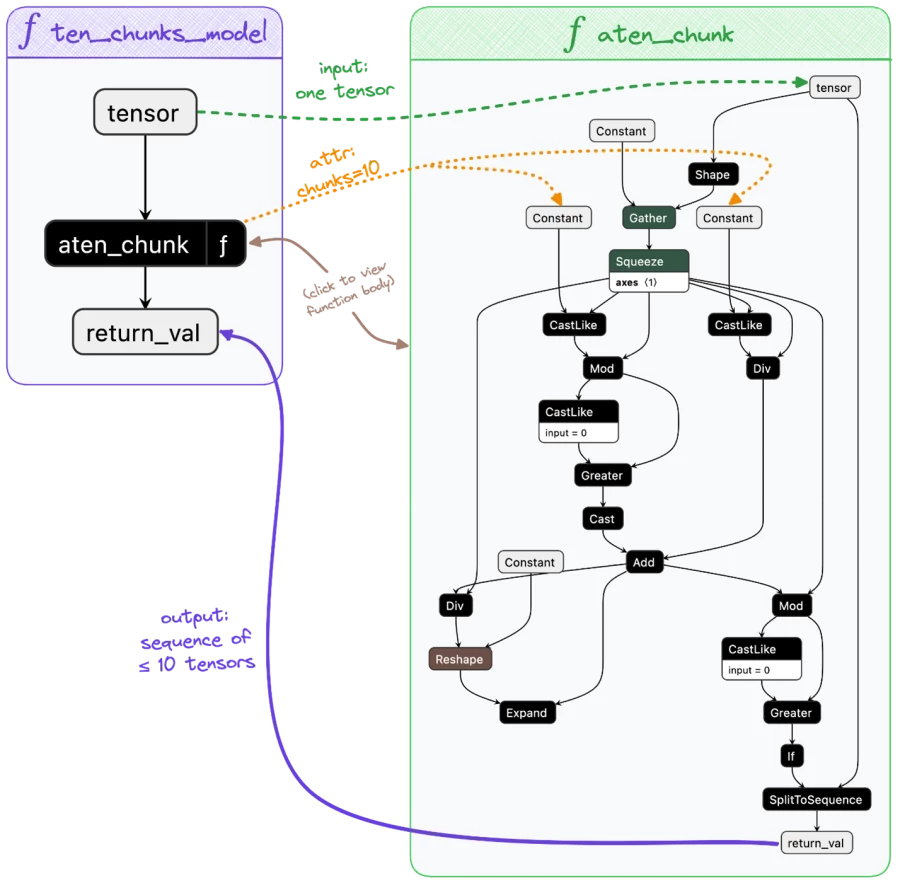
If we open ten_chunks_model.onnx in Netron, we can observe the composability of ONNX functions and how the Python code was translated into an ONNX model.
An ONNX refresher 

The graphs depict our two ONNX functions. We can observe the original input tensor flowing from ten_chunks_model into aten_chunk along with the attribute chunks=10. A sequence of ≤ 10 tensors is returned. As one might expect, functions in ONNX can be defined once and invoked any number of times within a model. Read more about core ONNX concepts.

Iterating and debugging

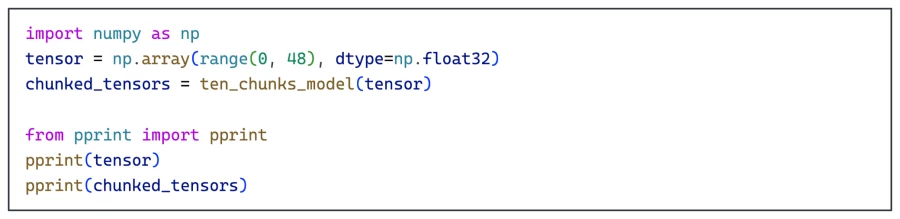
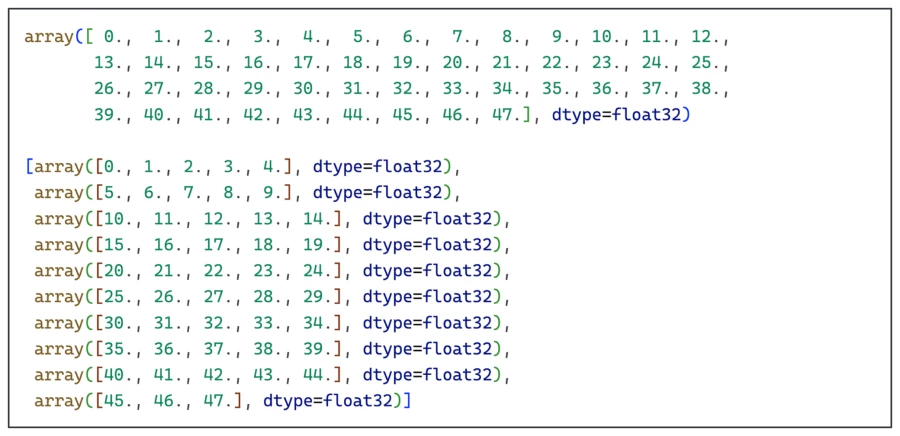
Finally, we should test our model. ONNX Script makes this easy since it provides a mechanism for eagerly evaluating the model through either ONNX Runtime or the new ONNX Reference Evaluator. Of note, ONNX Script has built-in support for NumPy for input and output values to ease the overhead of creating and filling tensors in ONNX.
An ONNX refresher 
An ONNX refresher 

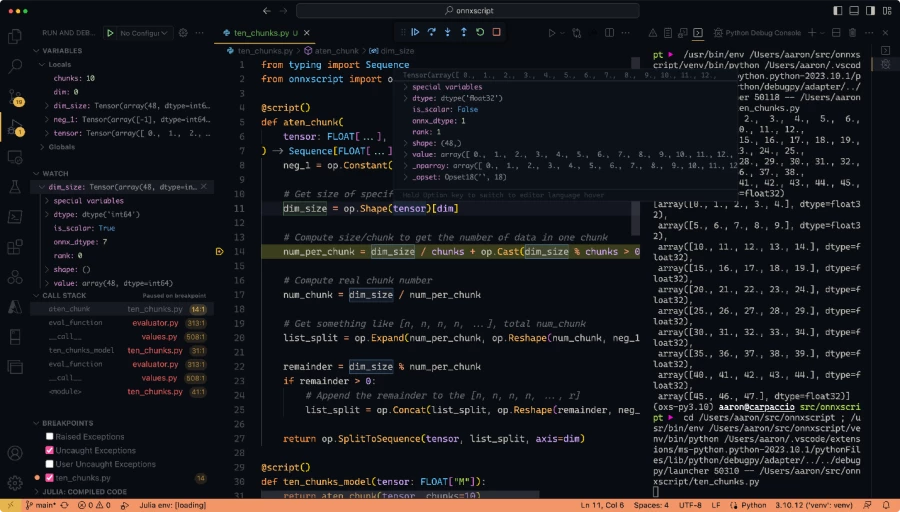
Because ONNX Script’s eager mode evaluates the model on an op-by-op basis, it is conducive to debugging ONNX using standard Python tooling such as pdb directly or through richer IDE and editor integrations provided by Visual Studio and Visual Studio Code.

An ONNX refresher 
A screenshot of Visual Studio Code debugging the model while stopped on a breakpoint to inspect the dim_size variable and call stack.

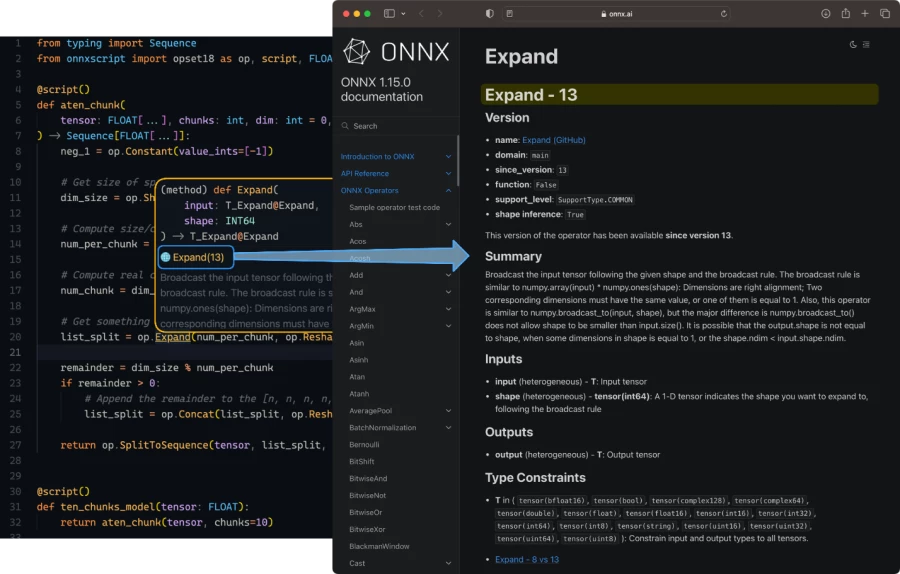
Along with debuggability, IntelliSense support is front-and-center with ONNX Script. We rely heavily on Python type annotations to enforce the correctness of ONNX and to make ONNX more discoverable, including inline documentation on hover tooltips and code completion suggestions. A single click will take you to expanded online documentation in your browser as well.

An ONNX refresher 
A screenshot of Visual Studio Code displaying a hover tooltip for the ONNX Expand operator with inline documentation linking to full online documentation. 

What’s next for ONNX Script?

In summary, ONNX Script offers a new Python-first programming model for authoring ONNX models that integrates with the existing rich ecosystem of Python tooling and environments.

Going forward, we envision ONNX Script as a means for defining and extending ONNX itself. New core operators and higher-order functions that are intended to become part of the ONNX standard could be authored in ONNX Script as well, reducing the time and effort it takes for the standard to evolve. We have proven this is a viable strategy by developing Torchlib, upon which the upcoming PyTorch Dynamo-based ONNX exporter is built.

Over the coming months, we will also support converting ONNX into ONNX Script to enable seamless editing of existing models, which can play a key role in optimization passes, but also allow for maintaining and evolving ONNX models more naturally. We also intend to propose ONNX Script for inclusion directly within the ONNX GitHub organization soon, under the Linux Foundation umbrella.

Doctor visit helper

Prepare before seeing a doctor

A simple rural-patient checklist to help you explain symptoms clearly, ask better questions, and avoid unsafe self-treatment.

Safety note: This is not a prescription or diagnosis. For severe symptoms, pregnancy danger signs, children with serious illness, chest pain, breathing difficulty, stroke-like weakness, or major injury, seek urgent care.

Which doctor may help?

Start with a registered doctor or the nearest qualified health center.

What to tell the doctor

  • Write when the problem started and how it changed.
  • Bring old prescriptions, investigation reports, and current medicines.
  • Write allergies, pregnancy status, diabetes, kidney/liver disease, and major past illnesses.
  • Bring one family member if the patient is weak, elderly, confused, or a child.

Questions to ask

  • What is the most likely cause of my symptoms?
  • Which danger signs mean I should go to hospital quickly?
  • Which tests are necessary now, and which can wait?
  • How should I take medicines safely and what side effects should I watch for?
  • When should I come for follow-up?

Tests to discuss

  • Vital signs: temperature, pulse, blood pressure, oxygen saturation
  • Basic physical examination by a clinician
  • CBC, urine test, blood sugar, or imaging only when clinically needed

Avoid these mistakes

  • Do not use antibiotics, steroid tablets/injections, or strong painkillers without proper medical advice.
  • Do not hide pregnancy, kidney disease, ulcer, allergy, or blood thinner use.
  • Do not delay emergency care when danger signs are present.

Medicine safety and first-aid guide

This section is for patient education only. It does not replace a doctor, pharmacist, or emergency care.

Safe first steps

  • Avoid heavy lifting, sudden bending, and prolonged bed rest.
  • Use comfortable posture and gentle movement as tolerated.
  • Discuss physiotherapy, X-ray, or MRI only when clinically needed.

OTC medicine safety

  • For mild back pain, pain-relief medicine may be discussed with a doctor or pharmacist.
  • Avoid repeated painkiller use if you have kidney disease, stomach ulcer, uncontrolled blood pressure, or are taking blood thinners.

Avoid these mistakes

  • Do not start antibiotics without a proper medical decision.
  • Do not use steroid tablets or injections casually for quick relief.
  • Do not delay emergency care because of home remedies.

Get urgent help if

  • Back pain with leg weakness, numbness around private area, loss of urine/stool control, fever, cancer history, or major injury needs urgent care.
Medicine names, dose, and timing must be decided by a qualified clinician or pharmacist after checking age, pregnancy, allergy, other diseases, and current medicines.

For rural patients and family caregivers

Patient health record and symptom diary

Write your symptoms, medicines already taken, test results, and questions before visiting a doctor. This note stays on your device unless you print or copy it.

Doctor to discuss: Doctor / qualified healthcare provider
Tests to discuss with doctor
  • Basic vital signs: temperature, pulse, blood pressure, oxygen level if needed
  • Relevant blood, urine, imaging, or specialist tests only after clinical assessment
Questions to ask
  • What is the most likely cause of my symptoms?
  • Which warning signs mean I should go to emergency care?
  • Which tests are really needed now?
  • Which medicines are safe for my age, pregnancy status, allergy, kidney/liver/stomach condition, and current medicines?

Emergency warning signs such as chest pain, severe breathing difficulty, sudden weakness, confusion, severe dehydration, major injury, or loss of bladder/bowel control need urgent medical care. Do not wait for online information.

Safe pathway to proper treatment

Care roadmap for: An ONNX refresher 

Use this simple roadmap to understand the next safe steps. It is educational and does not replace examination by a doctor.

Go to emergency care if you notice:
  • Severe or rapidly worsening symptoms
  • Breathing difficulty, chest pain, fainting, confusion, severe weakness, major injury, or severe dehydration
Doctor / service to discuss: Qualified healthcare provider; specialist depends on symptoms and examination.
  1. Step 1

    Check danger signs first

    If danger signs are present, seek emergency care and do not wait for online information.

  2. Step 2

    Record the symptom story

    Write when symptoms started, severity, medicines already taken, allergies, pregnancy status, and test results.

  3. Step 3

    Visit a qualified clinician

    A doctor, nurse, or qualified healthcare provider can examine you and decide which tests or treatment are needed.

  4. Step 4

    Do only useful tests

    Do tests after clinical assessment. Avoid unnecessary tests, random antibiotics, or repeated medicines without diagnosis.

  5. Step 5

    Follow up and return early if worse

    If symptoms worsen, new warning signs appear, or treatment is not helping, return for review quickly.

Rural patient practical tips
  • Take a written symptom diary and all previous prescriptions/test reports.
  • Do not hide medicines already taken, even herbal or over-the-counter medicines.
  • Ask which warning signs mean urgent referral to hospital.

This roadmap is for education. A real diagnosis and treatment plan requires history, examination, and clinical judgment.

RX Patient Help

Ask a health question safely

Write your symptom story. A health professional or site editor can review it before any answer is prepared. This box is not for emergency care.

Emergency first: Severe chest pain, breathing trouble, unconsciousness, stroke signs, severe injury, heavy bleeding, or rapidly worsening symptoms need urgent local medical care now.

Frequently Asked Questions

Announcing ONNX Script ONNX Script is a new open-source library for directly authoring ONNX models in Python with a focus on clean, idiomatic Python syntax and composability through ONNX-native functions. Critically, it is also the foundation upon which we are building the new PyTorch ONNX exporter to support TorchDynamo—the future of PyTorch. Prior to ONNX Script, authoring ONNX models required deep knowledge of the specification and serialization format itself. While eventually a more convenient helper API was introduced that largely abstracted the serialization format, it still required deep familiarity with ONNX constructs. ONNX Script takes a new approach by integrating deeply with Python on two fronts: It provides a strongly typed API for all operators in ONNX (all 186 as of opset 19).1 This allows existing Python tooling, linters, and integrated development environments (IDEs) to provide valuable feedback and enforce correctness. ONNX Script supports idiomatic Python language constructs to make authoring ONNX more natural, including support for conditionals and loops, binary and unary operators, subscripting, slicing, and more. For example, the expression a + b in Python would translate to the ONNX operator as Add(a, b). Let’s look at how we might implement GELU using ONNX Script and compare it with onnx.helper API—and to be clear—the examples below produce the same ONNX model. For reference, we’ll use this definition of GELU to guide the ONNX implementations: As you can see, ONNX Script emphasizes the familiar readability and productivity of Python while expressing an ONNX model that can be statically reasoned about by existing Python and ONNX tooling. This also means ONNX comes alive within the context of your existing tooling and development environments, be it debugging in Visual Studio Code or demonstrating concepts in a Jupyter Notebook—ONNX Script integrates naturally. Why are we investing in ONNX Script?

Much has changed since ONNX support for PyTorch was originally introduced over five years ago in PyTorch 0.3.0. For PyTorch 2.0, TorchDynamo represents the eventual deprecation of TorchScript, which implies a major overhaul of the ONNX exporter is necessary. We are fully embracing this as an opportunity to revisit the fundamentals upon which the exporter is built, and ONNX Script is its new foundation. We began this effort in November 2022 and have worked closely with PyTorch engineers to ensure…

An end-to-end example Let’s look at an example slightly more complicated than GELU. In fact, the following example is adapted directly from the new PyTorch ONNX exporter, implementing support for torch.chunk, which attempts to split a tensor into the number of specified chunks. We start by importing from onnxscript the ONNX opset we wish to use (version 18 in this case), the @script decorator, and the tensor types of FLOAT and INT64. In ONNX Script, tensor shapes are denoted by subscripting the type, such as FLOAT[2, 10], symbolically such as FLOAT["M", "N"], or FLOAT[...] incase the tensor shape is unknown. Without subscripting (just FLOAT), the type is intended to indicate a scalar (a tensor of rank 0). Next, we define the aten_chunk function with type annotations and implement the body of the function using both built-in Python syntax and explicit invocations of ONNX operators. The example uses various binary expressions and an if statement, but many other idiomatic Python constructs are also supported. We also need to define a simple model that calls our ONNX Script function so we can export and verify an end-to-end example: This model will simply split the provided tensor into ten tensors, but it also demonstrates that ONNX functions can of course call other ONNX functions, not just built-in ONNX operators. We’ll now export our ONNX Script model to ONNX and explore it in Netron. Functions decorated with @script allow them to be exported using the to_model_proto function. If we open ten_chunks_model.onnx in Netron, we can observe the composability of ONNX functions and how the Python code was translated into an ONNX model. The graphs depict our two ONNX functions. We can observe the original input tensor flowing from ten_chunks_model into aten_chunk along with the attribute chunks=10. A sequence of ≤ 10 tensors is returned. As one might expect, functions in ONNX can be defined once and invoked any number of times within a model. Read more about core ONNX concepts. Iterating and debugging Finally, we should test our model. ONNX Script makes this easy since it provides a mechanism for eagerly evaluating the model through either ONNX Runtime or the new ONNX Reference Evaluator. Of note, ONNX Script has built-in support for NumPy for input and output values to ease the overhead of creating and filling tensors in ONNX. Because ONNX Script’s eager mode evaluates the model on an op-by-op basis, it is conducive to debugging ONNX using standard Python tooling such as pdb directly or through richer IDE and editor integrations provided by Visual Studio and Visual Studio Code. A screenshot of Visual Studio Code debugging the model while stopped on a breakpoint to inspect the dim_size variable and call stack. Along with debuggability, IntelliSense support is front-and-center with ONNX Script. We rely heavily on Python type annotations to enforce the correctness of ONNX and to make ONNX more discoverable, including inline documentation on hover tooltips and code completion suggestions. A single click will take you to expanded online documentation in your browser as well. A screenshot of Visual Studio Code displaying a hover tooltip for the ONNX Expand operator with inline documentation linking to full online documentation.  What’s next for ONNX Script?
In summary, ONNX Script offers a new Python-first programming model for authoring ONNX models that integrates with the existing rich ecosystem of Python tooling and environments. Going forward, we envision ONNX Script as a means for defining and extending ONNX itself. New core operators and higher-order functions that are intended to become part of the ONNX standard could be authored in ONNX Script as well, reducing the time and effort it takes for the standard to evolve. We have proven…

References

Add references, clinical guidelines, textbooks, journal articles, or trusted medical sources here. You can edit this area from the RX Article Professional Blocks panel.
