
Solanum sessiliflorum, the cocona, is a tropical shrub of the family Solanaceae. The cocoa plant has sturdy branches and huge, serrate and hairy leaves. Cocona closely resembles a number of close relatives, including naranjilla and pseudolulo. It can be distinguished from those plants by its lack of spines. It will hybridize with those and other close relatives. Cocona also lacks the characteristic purple coloring usually seen in the naranjilla. Its flowers resemble large potato flowers, with light green petals. Cocona is harvested in parts of South America around the Amazon rainforest such as Purús Province in eastern Peru.[rx]
The fruit of cocona is a red, orange or yellow edible berry. Cocona is native to the Andean region of South America, where it is occasionally cultivated for human consumption.
Cocona can also be grown as an indoor ornamental plant in temperate climates, but it seems to be quite sensitive to spider mites, so care should be taken not to keep it in too dry air during winter. Like the naranjilla, coconas are highly sensitive to aphids and nematodes. As subtropical plants, they can endure cool weather but will be killed or severely damaged by frost. During summer, it can be grown outside or in a cold greenhouse. When grown from seed, coconut can bear fruit in as little as 9 months, or as long as 24.
Solanum georgicum and Solanum hypochondrium were (and sometimes still are) included in this species, but they are generally treated as distinct today.[rx]
| Cocona Quick Facts | |
|---|---|
| Name: | Cocona |
| Scientific Name: | Solanum sessiliflorum |
| Origin | Andean region of South America |
| Colors | Golden yellow, burnt-orange, orange-red, red to purple-red |
| Shapes | Round or oval fruit, about 10 cm long and 6 cm wide |
| Flesh colors | Yellow |
| Taste | Bitter |
| Health benefits | Beneficial for Detoxification, Weight Reduction, Osteoporosis Prevention, RBC Count Optimization, Energy Stabilization |
Cocona scientifically known as Solanum sessiliflorum is a tropical shrub belonging to the Solanaceae (Potato family) along with tomatoes, potatoes, eggplants. Cocona closely resembles a number of close relatives, including naranjilla and pseudolulo. The plant is native to the Andean region of South America. Cocona is not known in the wild, having been observed only in cultivation in swiddens and surrounds of human abodes in the upper Amazon Basin of southern Colombia, Ecuador, and northern Peru, cultivated sporadically in settlements along with the Amazon and Orinoco River systems of Brazil and Venezuela as far east as Belém. It has been partially domesticated by Amazonian Indians (Piaroas and other native tribes) of the Upper Orinoco Basin in Venezuela. Some of the popular common names of the plant are Cocona, Orinoco Apple, Peach Tomato, Topiro, Orinoko Apple, and Turkey Berry. It is a regionally important domesticated fruit that may have great unrealized potential as a tropical fruit crop. It has long been cultivated in the Amazon area by the Indian population for its fruits, this use has gradually spread and the plant is now grown pantropically.
Cocona Fruit Facts
| Name | Cocona |
|---|---|
| Scientific Name | Solanum sessiliflorum |
| Native | Andean region of South America |
| Common Names | Cocona, Orinoco Apple, Peach Tomato, Topiro, Orinoko Apple, Turkey Berry |
| Name in Other Languages | Brazil : Cocona, Cubiu, Maná, Tomate-De-Indio Columbia : Be-Tá-Ka ( Kubeo ), Cocona, De-Twá, Coconilla, Lulo, Tupiru Dutch: Orinoco-appel English: Orinoco-apple, Cocona, Peach-tomato Esperanto: Kokono (solano) French : Tomate Chauve Souris German: Orinoco-Apfel Guyana : Orinoco Apple Hungarian : Orinoco-Paradicsom Peru : Cocona, Kukush Portuguese: Cubiu, tomate de índio Russian: Kokoha (Кокона) Spanish : Topiro, Cocona, manzana del Orinoco, melocoton del Orinoco, tupiro Swedish : Topiro Ukrainian: Kokoha (Кокона) Venezuela : Pupú, Tupiru |
| Plant Growth Habit | Small, erect, much-branched, prickly, unarmed, ignescent herbaceous, perennial shrub |
| Soil | Thrives in full sun, in soils of medium fertility, on plastisols and sandy soils. It will also grow on poor clayey and calcareous (scarified limestone) soils provided drainage is good |
| Plant Size | About 1–2 m high |
| Stem | Pubescent stems and densely pubescent twigs |
| Leaf | Simple, broadly ovate, 25–45 cm by 20–39 cm, thin-textured, with obtuse to acute apex, asymmetrical truncated base and coarsely dentate margins, with 5–7 major lateral veins, sparsely to densely sericeous on the adaxial surface and borne on pubescent petioles, 4–15 cm long |
| Flower | Inflorescences are extra-axillary, 3–10 cm long, unbranched with short 5 mm peduncle and 6–16 flowers on 2-7 mm pedicels, lowermost 2–5 flowers are usually perfect. Calyx campanulate, tube 4–6.5 mm, lobes ovate, acute-tipped. Corolla 2–3 cm across, white or greenish-white, tube 1–5 mm, lobes ovate to ovate lanceolate and spreading |
| Fruit Shape & Size | 1–3 per inflorescence, 2.5–9.5 cm across, 4–6 locular, globose or ovoid, glabrous |
| Fruit Color | Golden yellow, burnt-orange, orange red, red to purple-red |
| Fruit Skin | Thin, tough |
| Flesh Color | Yellow |
| Seed | Numerous, thin, flat, ovate reinform, 3.2–4 mm long and 2.1– 2.7 mm wide, cream-colored seeds |
| Propagation | Propagated from seeds but it can also be vegetatively propagated by using air layers and cuttings of mature wood which have been reported to root successfully |
| Available Forms | Spicy sauces, juices, nectars, ice-creams, paletas, and desserts |
| Taste | Bitter |
| Health Benefits |
|
| Other facts |
|
| Precautions |
|
Cocona Scientific Classification
Scientific Name: Solanum sessiliflorum
| Rank | Scientific Name & (Common Name) |
|---|---|
| Kingdom | Plantae (Plants) |
| Subkingdom | Tracheobionta (Vascular plants) |
| Infrakingdom | Streptophyta (land plants) |
| Super Division | Spermatophyta (Seed plants) |
| Division | Magnoliophyta (Flowering plants) |
| Sub Division | Spermatophytina (spermatophytes, seed plants, phanérogames) |
| Class | Magnoliopsida (Dicotyledons) |
| Sub Class | Asteridae |
| Super Order | Asteranae |
| Order | Solanales |
| Family | Solanaceae (Potato family) |
| Genus | Solanum L. (nightshade) |
| Species | Solanum sessiliflorum Dunal (cocona) |
| Synonyms |
|
Plant Description
Cocona is a small, erect, much-branched, prickly, unarmed, ignescent herbaceous, perennial shrub that normally grows about 1–2 m high with pubescent stems and densely pubescent twigs. The plant thrives in full sun, in soils of medium fertility, on plastisols and sandy soils. It will also grow on poor clayey and calcareous (scarified limestone) soils provided drainage is good. The stems of cultivated forms are usually unarmed, though they sometimes bear prickles. The shoot and the branches are pubescent. The trunk and the leaves have rarely thorns.
Cocona can also be grown as an indoor ornamental plant in temperate climates, but it seems to be quite sensitive to spider mites, so care should be taken not to keep it in too dry air during winter. Like the naranjilla, coconas are highly sensitive to aphids and nematodes. As subtropical plants, they can endure cool weather but will be killed or severely damaged by frost. During summer, it can be grown outside or in a cold greenhouse. When grown from seed, coconut can bear fruit in as little as 9 months, or as long as 24.
Leaves
Leaves are simple, broadly ovate, 25–45 cm long and 20–39 cm wide, thin-textured, with obtuse to acute apex, asymmetrical truncated base, and coarsely dentate margins, with 5–7 major lateral veins, sparsely to densely sericeous on the adaxial surface and borne on pubescent petioles, 4–15 cm long. These scalloped leaves are downy atop and veined beneath.
Flower
The inflorescence is extra-axillary, 3–10 cm long, unbranched with a short 5 mm peduncle and 6–16 flowers on 2-7 mm pedicels, lowermost 2–5 flowers are usually perfect. The calyx is campanulate, tube 4–6.5 mm, lobes ovate, acute-tipped. Corolla is 2–3 cm across, white or greenish-white, tube 1–5 mm, lobes ovate to ovate-lanceolate and spreading. Stamens are with linear-lanceolate anthers. The ovary is pubescent, cylindrical style and capitates stigma. The flowers resemble the potato flower.
Fruit
Fertile flowers are followed by round or oval fruit, about 10 cm long and 6 cm wide. Before they are ripe, the thin, tough skin of the fruits is covered with hairs just like the peach fruit. After ripening the fruits lose those hairs and are smooth. They are yellow or orange or can get even get red filled with yellow pulp. In the pulp, there are 200 to 8000 creamy colored seeds which are 4 mm long and 2.7 mm wide. The seeds are removed from the pulp and then they are fermented for 2 days in the sun. The fruits can be eaten but they have a bitter taste. The flesh has a mild flavor faintly suggestive of tomato, while the pulp has a pleasant, lime-like acidity. The natives eat the fruits just out of the hand. It can be also eaten as jam or in a salad. Mixed with fruits of S. quitoense it shall taste even better. The natives use S. sessiliflorum sometimes to get rid of head lice.
Nutritional value of Fruit pulp of Cocona Fruit
Calories from Fat 28.35 K cal.
| Proximity | Amount | % DV |
|---|---|---|
| Water | 90.5 g | N/D |
| Total Fat (lipid) | 3.15 g | 9.00% |
| Carbohydrate | 32.1 g | 24.69% |
| Sucrose | 3.8 g | N/D |
| Glucose (dextrose) | 18.4 g | N/D |
| Fructose | 7 g | N/D |
| Starch | 2.87 g | N/D |
| Inositol | Trace g | N/D |
| Minerals | Amount | % DV |
|---|---|---|
| Calcium, Ca | 99 mg | 9.90% |
| Iron, Fe | 2.5 mg | 31.25% |
| Magnesium, Mg | 188 mg | 44.76% |
| Phosphorus, P | 383 mg | 54.71% |
| Zinc, Zn | 1.08 mg | 9.82% |
| Manganese, Mn | 0.64 mg | 27.83% |
| Selenium, Se | 0.13 µg | 0.24% |
| Lipids | Amount | % DV |
|---|---|---|
| Fatty acids, total saturated | g | N/D |
| Myristic acid 14:00(Tetradecanoic acid) | 0.01 g | N/D |
| Palmitic acid 16:00 (Hexadecanoic acid) | 1 g | N/D |
| Stearic acid 18:00 (Octadecanoic acid) | 0.09 g | N/D |
| Lignoceric acid (tetracosanoic acid) 24:00 | 0.01 g | N/D |
| Fatty acids, total monounsaturated | g | N/D |
| Palmitoleic acid 16:1 (hexadecenoic acid) | 0.08 g | N/D |
| Oleic acid 18:1 (octadecenoic acid) | 1.53 g | N/D |
| Fatty acids, total polyunsaturated | g | N/D |
| Linoleic acid 18:2 (octadecadienoic acid) | 0.16 g | N/D |
| Linolenic acid 18:3 (Octadecatrienoic acid) | 0.13 g | N/D |
| Amino acids | Amount | % DV |
|---|---|---|
| Threonine | 0.0228 g | 1.30% |
| Isoleucine | 0.0236 g | 1.41% |
| Leucine | 0.0172 g | 0.47% |
| Lysine | 0.0304 g | 0.91% |
| Methionine | 0.0044 g | N/D |
| Phenylalanine | 0.0608 g | N/D |
| Tyrosine | 0.0076 g | N/D |
| Valine | 0.0256 g | 1.21% |
| Arginine | 0.0348 g | N/D |
| Histidine | 0.0188 g | 1.53% |
| Alanine | 0.0056 g | N/D |
| Aspartic acid | 0.0644 g | N/D |
| Glutamic acid | 0.0748 g | N/D |
| Glycine | 0.0076 g | N/D |
| Proline | 0.012 g | N/D |
| Serine | 0.321 g | N/D |
| Asparagine | 0.3668 g | N/D |
| Glutamine | 0.1728 g | N/D |
| β-Alanine | 0.0216 g | N/D |
| γ-Aminobutyric Acid | 0.298 g | N/D |
| α-Aminobutyric Acid | 0.0016 g | N/D |
| α-Aminobutyric Acid | 0.0004 g | N/D |
| Hydroxylysine | 0.002 g | N/D |
| Biogenic Amines | Amount | % DV |
|---|---|---|
| Taurine | Traces | N/D |
| Ethanolamine | 1.6 g | N/D |
| Ornithine | 3.2 g | N/D |
| Volatile Compounds ( rel peak area %) | Amount | % DV |
|---|---|---|
| 1- Nonanol | 0.68 | N/D |
| Phenylacetaldehyde | 1.28 | N/D |
| (Z)-3- Hexen- 1-ol | 4.23 | N/D |
| 1- Hexanol | 1.62 | N/D |
| Undecane | 0.39 | N/D |
| Methyl salicylate | 8.73 | N/D |
| Safrole | 40.34 | N/D |
| Eugenol | 0.4 | N/D |
| Euganol methyl ether | 1.05 | N/D |
| 1- Dodecanol | 6.09 | N/D |
| Dodecanese | 0.87 | N/D |
| Myristicin | 1.17 | N/D |
| Elemicin | 0.65 | N/D |
| Dodecanoic acid | 0.58 | N/D |
| Spathulenol | 1.19 | N/D |
| Apiole | 2.38 | N/D |
| α-Bisabolol | 0.53 | N/D |
| Guaiazulene | 3.51 | N/D |
| Myristic acid | 0.68 | N/D |
| Palmitic acid | 18.2 | N/D |
| Special Organic Acids | Amount | % DV |
|---|---|---|
| Citric Acid | 14.1 g | N/D |
| Malic Acid | 0.36 g | N/D |
*Above mentioned Percent Daily Values (%DVs) are based on 2,000 calorie diet intake. Daily values (DVs) may be different depending upon your daily calorie needs. Mentioned values are recommended by the U.S. Department of Agriculture. They are not rxharun.com recommendations. Calculations are based on average age of 19 to 50 years and weigh 194 lbs. Source: https://www.researchgate.net/
Health benefits of Cocona
Listed below are some of the popular health benefits of using Cocona fruits
1. Detoxification
Pairing the fact that water-rich Cocona fruits consist of a good amount of fiber that can help in flushing out poisonous substances in the body before they get the chance to damage your well-being in a number of ways. Being rich in fiber, consuming cocoa fruits can also help prevent constipation, hemorrhoids, and even colorectal cancer. The statistical analysis of dietary fiber content showed one modal value in the AIS. In pulp, pectinesterase activity correlated inversely with pectin content. Cubic fruits were significant sources of bioactive compounds, e.g. chlorophylls, flavonoids, and carotenoids, predominantly in the peel and the pulp; soluble functional fibers, e.g. pectin (g/100 g fresh weight), particularly in the green peel (1.00) and the fully ripe pulp (1.12), and other versatile molecules, e.g. ascorbic acid (mg/100 g fresh weight), especially in the fully ripe peel (32.45) and placenta (24.84) and the turning placenta (21.27). Cubic fruits are rich in ascorbic acid and should be included in the human diet. (+)
2. Weight Reduction
Being low in calories and containing practically no fat, cocoa fruits are excellent for people who are trying to lose weight. All the water and fiber they contain make your tummy feel really full, making you forget about getting seconds or snacking. Just make sure that you also make smart food choices and go for an active lifestyle!
3. Osteoporosis Prevention
Cocona fruits consist of calcium, and this is the reason why including them in your diet on a regular basis can help make your bones strong. The risk of osteoporosis increases as people age. By making sure that they eat plenty of calcium-rich foods like Cocona fruits, it can be easier to keep osteoporosis from striking in the future.
4. RBC Count Optimization
Apart from that Cocona fruits also consist of a good amount of iron. Because of this, consuming these tropical berries frequently can help in preventing iron-deficiency anemia, and even reversing it. Cocona fruits are ideal for women who have heavy menstruation and those who are vegetarians as they actually are at higher risk of having iron-deficiency anemia.
5. Energy Stabilization
Cocona fruits are loaded with B vitamins such as niacin and thiamine and this is the reason why consuming them can help give you the energy you need. You see, B vitamins are the ones that help convert food into fuel that your cells require, and in turn allow you to carry out various physical tasks with efficiency.
Traditional uses and benefits of Cocona Fruit
- Cocona is used by the Amazonian Indians to treat diabetes, burns, and skin mycoses and also to lower uric acid and cholesterol levels.
- The powdered seeds are said to be used by Taiwan Indians in lowland Colombia to relieve irritation of the mouth caused by chewing coca.
- Juice is used by native Indians to make the hair bright and the leaves and roots are used as medicine.
- Powdered seeds are used to relieve irritation of the mouth caused by chewing coca.
- Recent studies may specify the possibility of high-cholesterol fighting compounds contained within the fruit.
- Cocona is appreciated for its valuable medicinal properties which include migraine relief.
- It is used as anti-diabetic, anti-venom, scabicide, and hypertension.
- It has also been used as a useful scabicide and for treating burns.
Culinary Uses
- The ripe fruit has a pleasant acidulous flavor liken to citrus.
- They are eaten fresh, peeled, out of hand, or in fruit salads.
- They can be used in cooking, in fish and meat dishes, in making sauces and fillings for pies.
- Cocona is consumed in compotes or cakes as a substitute for apples.
- Cocona is also prized for processing into jam, marmalade, paste, and jelly, and is sometimes pickled or candied.
- Fruit is also made in juice, sweetened with sugar which is a refreshing cool drink in Brazil or other beverages.
- The young leaves are cooked and eaten.
- It can be eaten directly or in salads; used for juice, and to prepare beverages, and is used as a flavoring in cooked dishes.
- Although it has an agreeable flavor, the fruit is not recommended for raw eating but is more usually peeled and used whole for making jams, jellies, preserves, pies, sauces, etc.
- The leaves are cooked and eaten in Brazil.
- They can be picked straight from the shrubs, peeled, and eaten.
- They can be added to salads.
- They can also be added to certain meat stews and fish dishes.
- They can be used as ingredients for making various sauces.
- They can be used as pie fillings.
- They can also be turned into jams, jellies, and preserves.
- They can be made into candies, too.
- They can be pickled to help extend their shelf life.
- They can also be turned into juice or added to smoothies.
Doncella fish Ceviche bathed in Cocona Sauce with Crispy Ginger and Fried Macambo Nuts
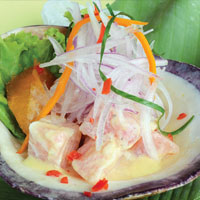
Ingredients
- 200 g Doncella (substitute with good quality white fish)
- 3-4 limes
- 1/2 red onion, medium
- 2 cloves of garlic
- 1 aji charapita pepper (substitute with any small spicy pepper)
- 1 yellow aji pepper (substitute with any small mild pepper)
- 2 cocona fruits (substitute with any small acidic fruit)
- 5 cilantro stalks, leaves only
- 100 g cassava, also known as yuca
- 100 g sweet potato
- 1 lettuce leaf
- A small portion of corn, mild
- 3-5 Mocambo nuts
- Pinches of celery, ginger, sugar, cinnamon, and orange
Directions
- Cover and mix the fish with salt to taste and lime juice, and let sit for 2-3 minutes
- Mix in the rest of the ingredients finely diced and fresh-squeezed orange juice, except lettuce, corn, sweet potato, cassava.
- Use lettuce, corn, sweet potato, cassava as decoration.
References
- https://www.ncbi.nlm.nih.gov/pmc/articles/PMC3649719/
- https://www.ncbi.nlm.nih.gov/pmc/articles/PMC6315720/
- https://www.ncbi.nlm.nih.gov/pmc/articles/PMC3419346/
- https://www.ncbi.nlm.nih.gov/books/NBK11795/
- https://www.ncbi.nlm.nih.gov/pmc/articles/PMC5291486/
- https://fruits.edpsciences.org/articles/fruits/abs/2012/05/fruits120033/fruits120033.html
- http://www.fao.org/3/cb2395en/CB2395EN.pdf
- https://www.fao.org/in-action/inpho/crop-compendium/fruits-vegetables/en/
- https://www.fao.org/3/cb2395en/online/src/html/fruit-and-vegetables.html
- http://www.fao.org/3/cb2395en/CB2395EN.pdf
- https://en.wikipedia.org/wiki/Fruit
- https://en.wikipedia.org/wiki/List_of_food_plants_native_to_the_Americas
- https://en.wikipedia.org/wiki/List_of_culinary_fruits
- https://www.hsph.harvard.edu/nutritionsource/what-should-you-eat/vegetables-and-fruits/
- https://www.betterhealth.vic.gov.au/health/healthyliving/fruit-and-vegetables
- https://www.cdc.gov/healthyweight/healthy_eating/fruits_vegetables.html
- https://www.botanical-online.com/en/botany/fruits-types-characteristics
- https://www.fda.gov/food/laboratory-methods-food/mpm-v-9-fruits-and-fruit-products-v-51-v-78
- https://www.fda.gov/food/food-labeling-nutrition/nutrition-information-raw-fruits-vegetables-and-fish
- https://onlinelibrary.wiley.com/doi/abs/10.1111/mcn.12208
- https://www.cabi.org/isc/datasheet/
- https://www.science.org/
- https://plants.ces.ncsu.edu/plants/
- https://www.sciencedirect.com/topics/agricultural-and-biological-sciences/fruit-vegetable
- https://www.researchgate.net/publication/
- https://www.ams.usda.gov/grades-standards/fruits
- https://www.aphis.usda.gov/aphis/resources/traveler/intl-travel/fruits-vegetables/fruits-vegetables
- https://snaped.fns.usda.gov/seasonal-produce-guide
- https://www.nass.usda.gov/Publications/Highlights/2015/FruitsNutsBerries_AgCensusHighlights.pdf
- https://plants.usda.gov/home/plantProfile?
- https://www.fs.fed.us/wildflowers/ethnobotany/food/nuts.shtml
- https://downloads.usda.library.cornell.edu/usda-esmis/files/zs25x846c/sf269213r/6t054c23t/ncit0521.pdf
- https://agr.wa.gov/departments/business-and-marketing-support/farm-to-school-toolkit/
- https://health.gov/sites/default/files/2020-01/DGA2000.pdf
- https://www.farmers.gov/archived/cfap2/specialty
- https://www.hsph.harvard.edu/nutritionsource/
- https://www.foodsafety.gov/food-safety-charts/food-safety-during-power-outage
- https://clinicaltrials.gov/ct2/show/
- https://botany.org/home/careers-jobs/careers-in-botany/what-is-botany.html
- https://www.healthbenefitstimes.com/category/fruits
- http://www.hear.org/pier/species/
- https://www.itis.gov/servlet/SingleRpt/SingleRpt?
- http://www.theplantlist.org/tpl1.1/record/
- https://www.fs.fed.us/database/feis/plants/tree/
- https://plants.usda.gov/core/profile?symbol=SOSE11
- http://www.theplantlist.org/tpl1.1/record/tro-29600313
- http://tropical.theferns.info/viewtropical.php?id=Solanum+sessiliflorum
- https://en.wikipedia.org/wiki/Solanum_sessiliflorum
- https://gd.eppo.int/taxon/SOLTP
- http://ciatweb.ciat.cgiar.org/ipgri/fruits_from_americas/frutales/Ficha%20Solanum%20sessiliflorum.htm
- http://mgb.cimmyt.org/gringlobal/taxonomydetail.aspx?id=101401
- https://hort.purdue.edu/newcrop/morton/cocona.html
- https://davesgarden.com/guides/pf/go/151804/#b

