

Rubus caesius/The dewberries are a group of species in the genus Rubus, section Rubus, closely related to the blackberries. They are small trailing (rather than upright or high-arching) brambles with aggregate fruits, reminiscent of the raspberry, but are usually purple to black instead of red.
Dewberries are common throughout most of the Northern Hemisphere and are thought of as a beneficial weed. The leaves can be used to make herbal tea, and the berries are edible and taste sweet. They can be eaten raw or used to make cobbler, jam, or pie. Alternatively, they are sometimes referred to as ground berries.
Around March and April, the plants start to grow white flowers that develop into small green berries. The tiny green berries grow red and then a deep purple-blue as they ripen. When the berries are ripe, they are tender and difficult to pick in any quantity without squashing them. The plants do not have upright canes like some other Rubus species but have stems that trail along the ground, putting forth new roots along the length of the stem. The stems are covered with fine spines or stickers. The berries are sweet and, for many, less seedy than blackberries.
| Dewberry Quick Facts | |
|---|---|
| Name: | Dewberry |
| Scientific Name: | Rubus caesius |
| Origin | Europe and Asia from Ireland and Portugal as far east as Xinjiang Province in western China |
| Colors | Green when young turning to deep red and finally dark purple when ripe |
| Shapes | Aggregate of several black, fleshy drupes with a bluish waxy bloom |
| Taste | Sweet |
| Health benefits | Prevents Cancer, Reduce High Blood Pressure, Lower Bad Cholesterol, Ward off Infections, Maintain Healthy Skin, Maintain Sharp Vision, Slow Down Skin Aging, Prevents Constipation, Keep Excess Pounds at Bay, Keep Gums and Teeth Strong |
Rubus caesius is a Eurasian species of dewberry, commonly known as the European dewberry. Just like other dewberries, it is a species of flowering plant in the rose family (Rosaceae), related to the blackberry. The plant is widely distributed across much of Europe and Asia from Ireland and Portugal as far east as Xinjiang Province in western China. It has also become economically naturalized in distributed locations in Argentina, Canada, and the United States. European dewberry, Dewberry, Common Dewberry, blue bramble, and youngberry are a few of the most popular common names of the plant. It is a low-growing perennial and is often heavily armed with prickles. It bears edible fruits that can be eaten raw or baked into cobblers or pies or made into preserves. They are occasionally cultivated but can spread rapidly and are considered to be weeds in many areas.
Plant description
Dewberry is a small low-growing, deciduous shrub that normally grows about 2 m (6 ft. 7 in) tall with biennial stems which die after fruiting in their second year. It sends out long runners which root at the tip to form new plants. Rubus caesius is similar to and often confused with forms of Rubus fruticosus. The plant is found growing in hedgerows, amongst shrubs, in rough dry meadowland, forest margins, copies, rocky broadleaf woods, waterside thickets, roadsides, mid-successional dunes, riverbanks, valleys, ravines, streams, inundated meadows, gardens, and orchards. The plant prefers light, medium, and heavy soils, slightly acidic to basic and well-drained soil. The stems are bluish-grey and sometimes prickly. Cane is 1.5 m tall and 0.5-2 m long, armed with irregular-sized prickles, greenish-yellow to brown, and glabrous to glabrescent.
Leaves
The alternate leaves are hairy above and below. Petioles are 4-6 cm long, armed, and often glandular. The lanceolate stipules are 0.6-1 cm long and 0.2-0.3 cm broad, bearing hairs and marginal glands. The leaves are alternately arranged and trifoliate (rarely five). Each leaflet is thin, broadly ovate to almost round, 4-7 cm long, and 3-7 cm broad, basally round, apically acute, with doubly serrate margins. The blade is somewhat pubescent, lighter green abaxially. The lateral leaflets are nearly sessile, while the terminal leaflets have a 1-2.5 cm long petiolule and are armed and glandular.
Flower
The corymbose inflorescence can be axillary or terminal and bears at least 10 flowers. The terminal inflorescences (up to 14 cm long) are longer and bear more flowers than the axillary inflorescences. The inflorescences are almost perpendicular to the floricanes. The pedicel (1-1.5 cm long) and rachis are pubescent, often glandular, and armed with very small prickles. The broadly lanceolate bracts are pubescent or glandular-pubescent, 0.5-0.8 cm long and 0.1-0.2 cm broad. The perfect, white flowers are up to 6 cm across and have a 5-parted calyx and corolla. The outer surface of the calyx is pubescent and occasionally armed with minute prickles. Sepals are long acuminate, 0.6-0.8 cm long, and 0.3-0.5 cm wide. The white corolla is glabrous, and the obovate petals are basally clawed, 0.8-2 cm long. Stamens are numerous, borne on a hypanthium, relatively shorter than the petals, but often longer than the glabrous pistils. Numerous ovaries are unilocular and bear 2 ovules, of which only one will become a seed, the styles are filiform and stigmas capitate. Flowering normally takes place from June to September.
Fruit
The fruit is a glaucous, bluish-black aggregate of few fleshy drupelets with a bluish waxy bloom. Drupelets are covered by blue cuticula and cannot separate from their fleshy receptacles readily. The drupe is approximately 1 cm in diameter, and nearly round. The drupelets are irregular-sized, and each contains one seed. Each fruit consist of not more than 20 drupelets. The single drupelet is composed of three layers: external: thin exocarp, medium: fleshy mesocarp, and internal: hard endocarp. Each drupelet has one hard seed inside. The reticulate seeds are rather hard and heavy (0.37 g), and are 2.2-3.2 mm long and 1.3-2 mm wide. The seed coat is composed of three layers: exotesta, mesotesta and internal endotesta.
Health benefits of Dewberry
Dewberry has low calories and consists of vitamins A and C, some protein, magnesium, zinc, copper. Let’s check out some of the impressive benefits offered by dewberries
1. Prevents Cancer
Including dewberries in your diet on a regular basis may help prevent cancer from striking. All of the antioxidants they contain help reduce oxidative stress, something that is often blamed for cancer development.
2. Reduce High Blood Pressure
Doctors say that the reduction of bad cholesterol can help lower blood pressure. But since dewberries have good amounts of potassium, too, their high blood pressure-lowering properties are considerably increased.
3. Lower Bad Cholesterol
Because of loads of antioxidants present in dewberries, regularly consuming them can help in lowering the levels of bad cholesterol in the blood. As a result, the arteries can be kept from ending up clogged.
4. Ward off Infections
One of the numerous minerals present in dewberries is zinc. Since this nutrient is significant for stimulating some of the cells of your immune system, your risk of having an infection like the cold or flu can be noticeably lowered.
5. Healthy Skin
Vitamin C present in dewberries is a well-known immune booster. Vitamin C is also respected for its capability to promote the healing of wounds as well as various problems regarding the skin.
6. Cure Eye problems
Vitamin A found sufficiently in dewberries is quite beneficial for curing eye problems. Eye specialists say that this nutrient is mainly vital for keeping the vision 20/20, and also in warding off all sorts of eye diseases that can lead to loss of vision.
7. Slow Down Skin Aging
Beauty-conscious individuals who like to stay looking young forever should consume dewberries frequently. That’s due to the fact that their vitamin C content is important for the production of collagen that delays the formation of wrinkles.
8. Prevents Constipation
If you are suffering from constipation, dewberry is one of the best options for curing them. It is a wonderful idea for you to include more dewberries in your diet. Because of their fiber and water content, the removal of waste products in the colon can be facilitated.
9. Keep Excess Pounds at Bay
Since fiber in dewberries is heavy on the stomach, consuming these blackberry look-alike can help ward off cravings and hunger pangs, thus helping to make those excess pounds go away or from creeping in.
10. Keep Gums and Teeth Strong
Vitamin C found in dewberries is also necessitated by the gums for it to remain healthy. This results in much tougher teeth that are able to resist cavities. So if you want to keep your smile intact, regularly snack on dewberries.
Traditional uses and benefits of Dewberry
- The fruits are used to increase the appetite and for digestive and respiratory tract health.
- Leaves and roots can be made into tea, extracts, or an infusion to treat stomach problems such as ulcers and gastritis, and kidney stones.
- Decoction obtained from the leaves stems, and fruits, in addition to the ailments already mentioned, can promote women’s reproductive health during menopause and to treat cystitis, diabetes, bacterial infections such as pyelitis, skin fungal infections, and hair loss.
- Herbal remedies, including dewberry, are used for the treatment of hemorrhoids in Turkey.
- Honey produced from Rubus caesius is very effective in healing gastric disorders.
Culinary Uses
- Fruit can be consumed raw or cooked.
- A delicious flavor, it is considered to be superior to blackcurrants though the fruit is rather small and consists of just a few drupes.
- Fruit can be used for making jellies, preserves etc.
- Fresh or dried leaves are used as a tea substitute.
Dewberry Syrup
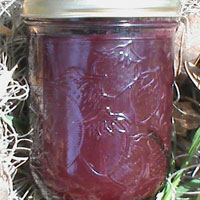
Ingredients
- 2 cups dewberries
- ¼ cup honey (raw, local honey is best if you have access to it)
- 1 teaspoon lemon juice
- 1 teaspoon vanilla extract
Instructions
- Wash the berries in cool water, and mash them to the desired texture. Mash them lightly if you prefer some whole berries in the finished syrup, or mash them more vigorously if you prefer a smoother texture.
- Place berries in a saucepan on the stove, and mix in honey and lemon juice. Bring the mixture to a boil; then reduce the heat to low and continue to cook for 5 minutes.
- Remove from heat and stir in the vanilla extract. The syrup will thicken a bit as it cools, but if it thickens too much, you can thin it with a little more lemon juice or water.
Dewberry and Apple Puff Pastry Tarts
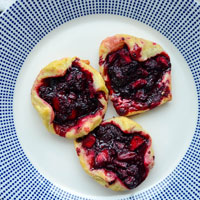
Ingredients
- 275 g dewberries or blackberries
- 250 g puff pastry
- 1 small apple ( 85 g) preferably a sweet/tart variety, e.g. Ashmead’s Kernel
- 25 g raw sugar (2 tbsp.) plus a little more for sprinkling
- 1 small sprig of fresh rosemary
Instructions
- Preheat your oven to 400° F (200° C).
- Cover a baking tray in parchment paper and place in the freezer to chill.
- Place a saucepan over low heat. Add the dewberries, apples, sugar, and rosemary into a saucepan, stir gently over low heat until well-softened. Remove from heat and set aside.
- Roll out the puff pastry until it’s fairly thin, about 8 x 8 inches (20×20 cm), and cut into squares, 16 equal 2×2 inches ( 5×5 cm) squares. Place on the chilled baking tray.
- Strain the juice from the fruit/sugar/rosemary mixture and set it aside. Place a spoonful of the mixture in the center of each pastry square. Bake for 10 minutes, or until the pastry is golden and flaky.
- While the pastry is baking, return the reserved juice to the saucepan and boil gently on the stovetop. Once the syrup is thickened and reduced by about half, set it aside to cool.
- Sprinkle the finished pastries with a little extra sugar, then place them under a hot broiler for about 45-60 seconds (keeping a close eye on it) to crisp the pastry and caramelize the sugars a little.
- Spoon some of the thickened syrup over the centers of the finished pastries. Set aside to cool, and serve either warm or at room temperature.
Dewberry Bread Pudding
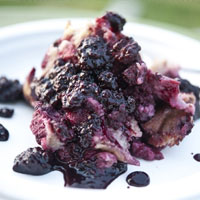
Ingredients
- For the pudding:
- 1 tablespoon butter
- About 10 cups sweet bread/3.5 small loaves stale is okay!
- 8 cups dewberries
- 5 cups sugar
- 2 cups milk
- 1 cup cream
- 7 eggs
- 1/2 teaspoon salt
- 1 teaspoon cinnamon
For the sauce:
- 8 cups dewberries
- 2 cups sugar
- 1/2 cup brandy
Instructions
- Preheat the oven to 350 degrees F. Grease a 13 x 9 baking dish with butter.
- Tear the bread by hand into large pieces and place layers into the baking dish, alternating with the berries so that they are evenly distributed.
- In a large bowl, combine the milk, cream, sugar, eggs, salt, and cinnamon and whisk together. Pour over the bread in the baking dish and evenly distribute. Press with a spatula all over the surface so that the bread soaks up the liquid evenly.
- Place in the oven and cook for 75 minutes.
- Meanwhile, make the sauce by adding the berries and sugar into a large saucepot over medium heat. Bring to a low simmer, stirring often until the berries break down to a jam consistency. Cook for about 1 1/2 hours and in the last 30 minutes add the brandy.
- Serve a scoop of the bread pudding while still warm with the dewberry sauce drizzled on top. Add a scoop of your favorite ice cream as well if you please.
Lemon Dewberry Muffins

Ingredients
- 2/3 cup all-purpose flour
- 2/3 cup whole wheat flour
- 2 tsp. baking powder
- 1/2 tsp. baking soda
- 1/2 cup sugar
- Pinch of salt
- Zest of 1 lemon
- 2 tbsp. butter, melted and cooled
- 1/4 cup plain Greek yogurt
- Juice of 1 lemon
- 1/4 tsp. lemon extract
- 1/2 cup milk
- 1 large egg
- 1 1/2 cups dewberries (or black-, rasp- or blueberries)
Instructions
- Preheat oven to 400 degrees. In a bowl, combine flours, baking powder, soda, sugar, salt and lemon zest. In another bowl, whisk together butter, yogurt, lemon juice, extract, milk and egg.
- Pour the wet ingredients into the dry and mix until just combined. Stir in the berries. Tip: to prevent the berries from all sinking to the bottom of the muffins, toss them in a little bit of flour before adding them to the batter.
- Fill 12 lined or greased muffin cups evenly with batter.
- Bake 20-25 minutes until the tops are golden and a toothpick inserted into a muffin comes out clean.
References


