

Feijoa, (Acca sellowiana), also called pineapple guava or guavasteen, a small evergreen tree of the myrtle family (Myrtaceae), related to the guava. It is native to southern Brazil, Paraguay, Uruguay, and parts of Argentina and is cultivated in mild dry climates for its sweet fruit.
Feijoa sellowianais a species of flowering plant in the myrtle family, Myrtaceae. It is native to the highlands of southern Brazil, eastern Paraguay, Uruguay, northern Argentina, and Colombia.[rx] It is widely cultivated as an ornamental tree and for its fruit. Common names include feijoa or, pineapple guava and guavasteen, although it is not a true guava.[rx] It is an evergreen shrub or small tree, 1–7 meters (3.3–23.0 ft) in height.
| Feijoa Quick Facts | |
|---|---|
| Name: | Feijoa |
| Scientific Name: | Acca sellowiana |
| Origin | Brazil, South America |
| Colors | Lime-green |
| Shapes | Oval shape Length: 1-3 Inches Diameter: 0.5-2 Inches |
| Flesh colors | Jelly in the center, surrounded by cream-colored flesh |
| Taste | The mixture of pineapple, guava, and strawberry; quince and lemon |
| Calories | 148 Kcal./cup |
| Major nutrients | Vitamin C (88.78%) Total dietary Fiber (41.05%) Carbohydrate (28.43%) Vitamin B9 (14.00%) Vitamin B6 (12.54%) |
| Health benefits | Treat inflammatory bowel disease, Prevent bacteria, Lower inflammation, Cancer prevention, Prevent constipation |
The Feijoa (Acca Sellowiana) is a tree native to Brazil, South America, which is an evergreen, perennial shrub, and small tree classified in the plant family Myrtaceae. Feijoa is commercially valuable and is cultivated in New Zealand and California. This plant is usually grown for its sweet and aromatic fruits. The plant has pale gray bark with greenish-gray leaves. Feijoa plant has lived for more than 45 years. There are 21 varieties of Feijoa such as Apollo, Choiceana, Coolidge, Edenvale Improved Coolidge, Edenvale Late, and so on.
Feijoa or pineapple guava also called guavasteen, pineapple guava or New Zealand Banana. It has got various names such as Feijoa in Japanese, fair in Hindi, Fei Yue Guo in Chinese, feykhoa in Russian, Ananasguave, or Feijoa in Dutch. The fruit is oval in shape and about the size of a chicken’s egg which is about 1 to 3 inches in length and 0.5 – 2 inches in diameter. They have lime green waxy skin, jelly textured seed pulp which is encircled by soft and cream-colored flesh. The fruit has a tart and a strongly sweet aromatic flavor. The taste of the fruit is like the combination of strawberry, guava, and pineapple or lemon or quince. The texture of the peel is rough and thin. The fruit weighs about 50 g. Feijoa is available during the autumn season. When the fruit got ripen, it drops from the tree or is picked from the tree directly.
100 g of Feijoa contains 61 kilo calories. According to USAD major nutrients contain in this fruit are Vitamin C 32.9 mg. (36.56%), Total dietary fiber 6.4 mg.(16.84%), Carbohydrate 15.21 mg.(11.70%), Vitamin B9 23 µg. (5.75%), Vitamin B6 (Pyridoxine) 0.067 mg.(5.15%), Vitamin B5 0.233 mg (4.66%), Copper 0.036 mg (4.00%).
History of Feijoa
This fruit was named after Joam da Silva feijoa who is a Brazilian botanist. This fruit was collected by the German explorer named Freidrich Yellow in Southern Brazil in 1815. It was introduced in French in 1890 by the botanist and horticulturist named Dr. Edouard Andre. It was introduced in New Zealand in the 1920s.
Plant
Feijoa is an evergreen tree that is much branched growing from 1 to 5 meters high having reddish-grey bark and a cylindrical trunk that appears to be rough and flaky. The tree bears elliptical to ovate leaves which are shortly petiolate, opposite having entire margin and obtuse apex rounded at the base. Leaves measure 3 to 8 cm long, 2 to 4 cm wide. The upper surface is glossy and dark green and the lower surface is tomentose and silvery-white. The tree bears attractive flowers in pinkish-red color. Flowers are solitary in the lowest two or four-leaf axils and measure 3 to 4 cm across. Petals are broadly elliptic to spoon-shaped, reflexed and whitish having a red center. There are numerous stamens measuring 2.5 cm long having yellow anthers. Flowers are then replaced by oblong to ovoid fruit measuring 5 to 8 cm by 3 to 6 cm diameter. The texture of the skin differs from smooth to rough enclosing a thick and white, sweet to subacid flesh. The translucent pulp is enclosed with numerous small seeds in oblong shape. The climate preferred by the Feijoa tree is mild summers and cool winters to bear fruit.
Fruit
Fruit measuring 5 to 8 cm long by 3 to 6 cm diameter, is oblong to ovoid in shape having persistent calyx segments complied to apex. It has waxy skin in blue or grayish-green or dull blue to green color. The texture of the skin varies from rough to smooth. The fruit possesses long-lasting perfume. The flesh of the fruit is white, thick, granular, and translucent which is enclosed with seeds. The taste resembles the combination of guava and pineapple or strawberry and pineapple. There are about 20 to 40 small seeds in oblong shape which is hardly noticeable.
Nutritional value of Feijoa, raw
Calories 148 Kcal. Calories from Fat 9.18 Kcal.
| Proximity | Amount | % DV |
|---|---|---|
| Water | 202.37 g | N/D |
| Energy | 148 Kcal | N/D |
| Energy | 617 kJ | N/D |
| Protein | 1.73 g | 3.46% |
| Total Fat (lipid) | 1.02 g | 2.91% |
| Ash | 0.92 g | N/D |
| Carbohydrate | 36.96 g | 28.43% |
| Total dietary Fiber | 15.6 g | 41.05% |
| Total Sugars | 19.93 g | N/D |
| Sucrose | 7.12 g | N/D |
| Glucose (dextrose) | 5.64 g | N/D |
| Fructose | 7.17 g | N/D |
| Minerals | Amount | % DV |
|---|---|---|
| Calcium, Ca | 41 mg | 4.10% |
| Iron, Fe | 0.34 mg | 4.25% |
| Magnesium, Mg | 22 mg | 5.24% |
| Phosphorus, P | 46 mg | 6.57% |
| Potassium, K | 418 mg | 8.89% |
| Sodium, Na | 7 mg | 0.47% |
| Zinc, Zn | 0.15 mg | 1.36% |
| Copper, Cu | 0.087 mg | 9.67% |
| Manganese, Mn | 0.204 mg | 8.87% |
| Vitamins | Amount | % DV |
|---|---|---|
| Water-soluble Vitamins | ||
| Vitamin B1 (Thiamin) | 0.015 mg | 1.25% |
| Vitamin B2 (Riboflavin) | 0.044 mg | 3.38% |
| Vitamin B3 (Niacin) | 0.717 mg | 4.48% |
| Vitamin B5 (Pantothenic acid) | 0.566 mg | 11.32% |
| Vitamin B6 (Pyridoxine) | 0.163 mg | 12.54% |
| Vitamin B9 (Folate) | 56 µg | 14.00% |
| Folic Acid | 0 µg | N/D |
| Folate, food | 56 µg | N/D |
| Folate, DEF | 56 µg | N/D |
| Vitamin C (Ascorbic acid) | 79.9 mg | 88.78% |
| Fat-soluble Vitamins | ||
| Vitamin A, IU | 15 IU | N/D |
| Beta Carotene | 5 µg | N/D |
| Beta Cryptoxanthin | 7 µg | N/D |
| Lycopene | 12 µg | 0.24% |
| Lutein + zeaxanthin | 66 µg | N/D |
| Vitamin E (alpha-tocopherol) | 0.39 mg | 2.60% |
| Tocopherol, gamma | 0.07 mg | N/D |
| Vitamin K (phylloquinone) | 8.5 µg | 7.08% |
| Lipids | Amount | % DV |
|---|---|---|
| Fatty acids, total saturated | 0.253 g | N/D |
| capric acid 10:00 (decanoic acid) | 0.007 g | N/D |
| Lauric acid (dodecanoic acid) 12:00 | 0.002 g | N/D |
| Myristic acid 14:00(Tetradecanoic acid) | 0.007 g | N/D |
| Palmitic acid 16:00 (Hexadecanoic acid) | 0.182 g | N/D |
| Stearic acid 18:00 (Octadecanoic acid) | 0.034 g | N/D |
| Arachidic acid 20:00 (Eicosanoic acid) | 0.007 g | N/D |
| Fatty acids, total monounsaturated | 0.136 g | N/D |
| Oleic acid 18:1 (octadecenoic acid) | 0.136 g | N/D |
| 18:1 c | 0.136 g | N/D |
| Fatty acids, total polyunsaturated | 0.33 g | N/D |
| Linoleic acid 18:2 (octadecadienoic acid) | 0.26 g | N/D |
| 18:2 n-6 c,c | 0.26 g | N/D |
| 18:3 undifferentiated | 0.07 g | N/D |
| 18:3 n-3 c,c,c (ALA) | 0.07 g | N/D |
| Amino acids | Amount | % DV |
|---|---|---|
| Tryptophan | 0.017 g | 3.86% |
| Threonine | 0.046 g | 2.61% |
| Isoleucine | 0.046 g | 2.75% |
| Leucine | 0.068 g | 1.84% |
| Lysine | 0.092 g | 2.75% |
| Methionine | 0.017 g | N/D |
| Cystine | 0.017 g | N/D |
| Phenylalanine | 0.046 g | N/D |
| Tyrosine | 0.022 g | N/D |
| Valine | 0.046 g | 2.18% |
| Arginine | 0.046 g | N/D |
| Histidine | 0.022 g | 1.79% |
| Alanine | 0.092 g | N/D |
| Aspartic acid | 0.182 g | N/D |
| Glutamic acid | 0.321 g | N/D |
| Glycine | 0.068 g | N/D |
| Proline | 0.046 g | N/D |
| Serine | 0.068 g | N/D |
*Above mentioned Percent Daily Values (%DVs) are based on 2,000 calorie diet intake. Daily values (DVs) may be different depending upon your daily calorie needs. Mentioned values are recommended by the U.S. Department of Agriculture. They are not rxharun.com recommendations. Calculations are based on average age of 19 to 50 years and weigh 194 lbs. Source: https://ndb.nal.usda.gov/
Health Benefits of Feijoa
Botanically known as Acca sellowiana, this plant is native to regions of South America including Brazil, Argentina, and Colombia. Besides its sweet fruit, it is also cultivated for ornamental purposes. Fruit is ellipsoid in shape and is green in color. Due to the impressive supply of nutrients and unique flavor, it is used for various culinary applications and is also used as an ingredient in desserts, smoothies, chutneys, cocktails, and stewed fruit dishes. Feijoa provides numerous health benefits such as improvement in digestion, assist weight loss, boosting the immune system, lowering cholesterol levels, decreasing blood pressure, increasing bone strength, balancing metabolism, optimizing uptake of nutrients, regulating blood sugar levels, and stimulating cognitive function.
- Treat inflammatory bowel disease
Usually, Crohn’s disease and ulcerative colitis are referred to as inflammatory bowel disease. Crohn’s disease affects all digestive systems whereas ulcerative colitis affects large intestines. The investigation shows the capability of hydrophilic feijoa fraction for modulation of autophagy by TLR2 with the use of IBD cell lines. Results show that extracts of Feijoa are effective to manage inflammatory bowel disease in patients.
- Prevent bacteria
The antibacterial activities were evaluated of an aqueous extract from Feijoa fruit. The extract was tested against Gram-positive and Gram-negative bacteria with the use of broth dilution test on whole blood leukocytes of humans and isolated neutrophils which is based on chemiluminescence assay. Experiment shows that an extract helps to inhibit the growth of bacteria. Results show that Feijoa possesses antibacterial properties which are used to counteract bacteria.
- Lower inflammation
The juice extracted from Feijoa is used to ascertain anti-inflammatory activities with the use of a carrageenan-induced paw edema test. In vitro test is involved to find out the effects on the release of superoxide anion from neutrophils in human blood. The juice was analyzed with the use of the high-performance liquid chromatography method. It identifies chemical compounds such as quercetin, eriocitrin, syringic acid, ellagic acid, pyrocatechol, gallic acid, catechin, rutin, and eriodictyol. Results showed meaningful anti-inflammatory activity in fruit juice that helps to inhibit neutrophils basal activity in all experiments. It lowered edema significantly and inhibits O2 production during experiments which makes sure the anti-inflammatory effect of Feijoa juice.
- Cancer prevention
The extract of Feijoa exhibited anti-cancer activities on hematological and solid cancer cells. It is observed that the extract did not have toxic effects on normal myeloid progenitors that suggesting that the extract of Feijoa possesses tumor-selective activities. The purification, fractionation, and analyses of the extract showed flavone as an active component. Results showed that flavone is an active principle and the extract of Feijoa possesses anti-cancer activities.
- Prevent constipation
Dietary fiber is well-known for its ability to provide relief from constipation. An average person requires half of the dietary fiber regularly. Women under 50 years of age should intake 25 grams of fiber per day and about 38 grams for men. For children, the recommended intake of dietary fiber is 14 g/1000 Kcal. One Feijoa provides ¼ of the daily requirement of dietary fiber. Fiber is essential for our good gut bacteria. When those bacteria are healthy and strong then nutrients in food could be absorbed properly. In addition, healthy gut bacteria help to protect the lining of the gut wall.
- Heart health
Feijoa has a high content of Vitamin C which is associated with the prevention of flu and colds. Antioxidants found in Feijoa assist to eliminate free radicals from the blood. It lowers oxidative stress inlining of arteries. Inflammation oxidation is the main cause for atherosclerosis, heart disease, and the buildup of plaques. Feijoa has healthy amounts of potassium which is known as electrolytes that assist in the regulation of muscle functions in the body. Potassium influence the smooth function of muscles which allows arteries dilation as well as contraction as needed. Potassium plays a vital role in the inflowing of blood.
- Mood enhancer
The study shows that an extract of Feijoa showed an antidepressant effect in mice. Feijoa has a high content of folate which is helpful in treating depression. The deficiency of folate is associated with increased chances of depression. Folate helps to neutralize metabolites known as homocysteine. It activates homocysteine which could interfere with hormones such as serotonin that assist in the regulation of mood and have become a target of most pharmaceutical antidepressants.
- Immune function
Feijoa possesses antimicrobial and antibacterial properties. It contains adequate amounts of minerals and vitamins so its regular consumption provides a boost to the immune system. Vitamin C assists in the stimulation of white blood cells production which acts as the first line of defense of the body. It also contains antioxidant that helps to eliminate free radicals. A single serving of Feijoa provides more than 50% daily recommended vitamin C.
- Regulation of blood pressure
Foods with high content of potassium are vital for people suffering from high blood pressure. They have high chances of cardiovascular disease, strokes, and atherosclerosis. Potassium acts as a vasodilator which helps to lower tension in blood vessels as well as arteries and also eases the strain on the cardiovascular system.
- Promote metabolism
Vitamin B is essential for the overall body functions and metabolic activities such as synthesizing red blood cells and proteins, stimulating nervous system function, directing hormone production, and generating energy within cells. Favorably, Feijoa has balanced levels of vitamin B.
Types of Feijoa
You will discover five kinds of feijoa fruit generally known as of yet.
- Feijoa Apollo
- Feijoa Opal Star
- Feijoa Gemini
- Feijoa Pounamu
- Feijoa Kakapo
1. Feijoa Apollo
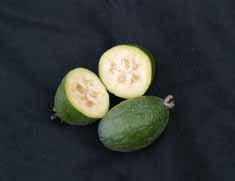
This is usually a huge fruit, along with pretty rough skin. Ellipsoid to Obovoid in form.
- Gentle fragrant and also sweet in flavor.
- Flat consistency flesh and incredibly juicy.
- Medium to higher flesh content.
- Moderately self-fertile.
- Upright in development, lively habit.
- Sometimes exceeding beyond export grades in large fruit.
- Mid-season for the fruit was (March – April)
2. Feijoa Opal Star
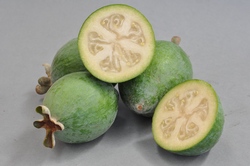
Fruit is moderate to big in dimensions, Oblong to obovoid in shape.
- Smooth dark green skin in nature.
- Smooth succulent fruit
- Flesh content moderate to low
- Soft flavor.
- Upright spreading growth whilst young developing in a powerful compact tree.
- Good fruit set.
- Late fruiting months are (April – May)
3. Feijoa Gemini
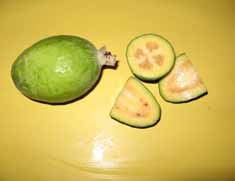
Small to medium-sized fruit, obovoid.
- Smooth dark green skin in nature.
- Medium flesh content.
- Strong taste.
- Upright dispersal habit.
- High fruit set.
- Early fruiting months (Feb- March).
4. Feijoa Pounamu
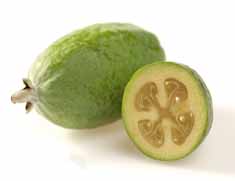
Extremely Medium-sized fruit, obovoid in form.
- Smooth dark green skin.
- The flesh is sleek, succulent, and also enjoyable taste.
- Pulp content medium.
- Mild taste.
- Upright distributing habit reasonably energetic tree.
- High fruit set
- Early fruiting season (Feb- March)
5. Feijoa Kakapo
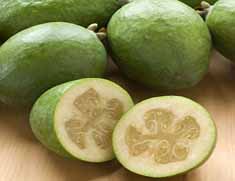
Feijoa Kakapo
Medium-sized fruit, obovoid in shape.
- Rough green skin.
- Smooth juicy flesh packed with taste.
- Medium pulp content.
- Medium energetic good open tree.
- Medium healthy good open tree.
- Moderate fruit set.
- Mid-season fruiting (March – April)
Traditional uses
- In native countries, Feijoa is used to treat thyroid gland diseases due to the high content of iodine.
- The tea prepared from fruit and flowers is helpful for treating diarrhea and dysentery.
- In Paraguay, crushed flowers are applied to mild burns, rashes, stings, insect bites, and itchy as well as inflamed areas.
- Lotions prepared from flowers are useful to ease sunburn.
- The fruit slices are used in the form of poultice.
- It is also useful for treating pyelonephritis, atherosclerosis, and cardiovascular diseases.
- Because of the higher Vitamin C content in feijoa, it is usually utilized like a kitchen cure to heal the common cold, and fever.
- The fruit is usually recommended to be eaten by individuals struggling with blood pressure. level irregularity. It will help in regularizing the blood pressure level.
- It is considered that frequent usage of feijoa helps prevent cancer.
Precautions
- Consume it in moderate amounts.
- Allergic people should avoid it.
- People with health problems should consult the doctor for use.
How to Eat
- The ripe fruits are consumed raw.
- Add the flesh in salads or cook it in stews, puddings, pies, cakes, pastries, and tarts.
- It is used as a vital ingredient in chutney.
- Made the fruit into paste, jams, sauces, jellies, preserves in syrup, crystallized fruits, and liqueur.
- Use the flesh in smoothies, ice cream, yogurt, soft drinks.
- Made the fruits into wine, cider and infuse it in vodka.
- Though bitter, the fruit peel could be consumed.
- The edible flower is consumed raw or added to salads.
- Fruits and flowers are used to make tea.
- In New Zealand, stew it in a pot with sugar and then serve it hot with vanilla ice cream.
- Add it to confectionary in cakes and muffins.
- Use it for preparing jellies, puree, chutneys, jams, sorbet, and juices.
- It could be used in recipes as a substitute for apples.
- In Brazil, Fejioa is used as preserves.
- Cook dried Feijoa in stews and curries.
- Feijoa wine, or perhaps feijoa juice tinctured in vodka, gin, and other cocktails as well as mocktails create an excellent delicious, and yummy drink.
- Feijoa is additionally utilized in fruit salad along with other deserts.
Other Facts
- The name Feijoa was entitled after Joao da Silva Feijo, a Brazilian botanist who developed varieties of feijoas.
- This fruit is known as pineapple guava in California.
- Flowers have white petals tinged with purple on an inner side and grow individually or in clusters. It possesses both types of reproductive organs.
- Flowers attract bees and birds which are responsible for pollination.
- The tree produces fruit 3 to 5 years after planting.
- It could be propagated by cuttings, seeds, layering, and grafting.
More about Feijoa
You can recognize a feijoa fruit by its blue/green skin that varies in texture from smooth to coarse. Additionally, feijoas are oval in shape and are approximately one inch to 3 1/2 inches in length. Even though you shouldn’t consume the skin of the feijoa fruit raw, you may utilize it just as one component in preserves. Whenever you cut into a feijoa, you will notice thicker, succulent flesh which is possibly light yellow or even white in color. Furthermore, roughly thirty seeds can be found inside the flesh. These kinds of seeds are extremely tiny and could be consumed combined with the flesh. The feijoa fruit can also be recognized for its aromatic as well as long-lasting fragrance. You can buy feijoas at bigger grocery store chains and also at niche or even premium vegetable and fruit stores. When choosing a feijoa, ensure that the fruit produces a pleasing fragrance and, whenever squashed, is almost soft to the touch. Once bought, make use of your feijoa as quickly as possible since you can keep a ripe feijoa in your house for just as much as 3 days. You should also chill ripe feijoas.
Because feijoas have got a distinctive flavor, they’re generally utilized in fruit salad recipes which call for a particularly sweet flavor. They’re also utilized just as one component in puddings and also pies, and therefore are superb whenever utilized to create jams and also jellies. Particular commercial manufacturers also have mixed feijoas together with black teas to make a satisfying mouthwatering fruit tea. Feijoas may also be consumed raw, so long as you initially eliminate the external skin. You may also create a quality-tasting fruit juice through the feijoa. Due to their fairly sweet flavor, feijoas provide a nutritious alternative to many other more caloric or even fatty sweet desserts and snacks. Feijoas likewise have a tasty option to the more traditional and common fruits utilized in numerous recipes. Due to these reasons, it really is worth tinkering with this fruit in cooking to discover its numerous varied factors.
Feijoa Uses
Feijoa fruit discovers its place in the kitchen area, dining room table, as well as in the dressing unit. Discover its distinct uses below:
Personal Care Uses
- Feijoa extract can be used in several personal care products due to its nutritional contents.
- A pulp of feijoa together with the seeds is utilized like a natural Exfoliant on skin.
References





