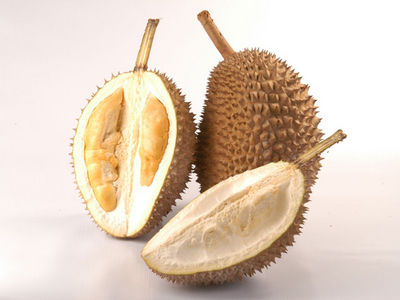
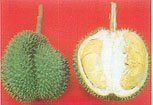
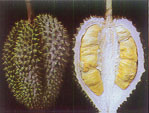
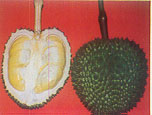
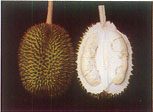
Durian, exotic fruit native to Malaysia and Indonesia is considered to be the ‘king of all fruits in South East Asia. It is believed to have originated in Borneo and Sumatra, and today besides Malaysia it is also found growing in Thailand, Southern Philippines, New Guinea, India, Sri Lanka, Vietnam, and other Asian countries. Today, Thailand exports more Durian than any other country. Durian is a part of the Bombacaceae family, and this term ‘Durian’ is common for the tree, as well as the fruit. Durian fruit facts are intriguing and quite amusing as well. Durian is famous for its extremely delicious taste, peculiar appearance, and offensive odor. The tree starts to bear fruit four to five years after planting. A seasonal fruit, durian lasts typically from June to August, coinciding with the season of other tropical fruits such as mango, mangosteen, and jackfruit. Durian is a perennial plant that can survive 80 to 150 years in the wild. Durian is considered to ‘taste like heaven and smell like hell’.
Durians Quick Facts
Name:
Durians
Scientific Name:
Durio zibethinus
Origin
Native to southeast Asia
Colors
Green to yellowish-brown
Shapes
Ovoid or ovoid oblong to nearly around 30 cm (12 in) lengthy as well as 15 cm (6 in) in diameter
Flesh colors
Creamy-yellow to saffron color bulbs depending upon the species.
Digestive aid, Sexual dysfunction, Bone health, Promotes healthy teeth and gums, Blood pressure and cardiovascular health, Cancer prevention, Promotes healthy pregnancy, Anti-aging, Anemia, Helps relieve migraine, Insomnia, Helps in curing jaundice
Durian fruit scientifically called Durio zibethinus is also known as the king of fruits. It is an exotic fruit that is native to Southeast Asia. Besides Malaysia, it is also found growing in Thailand, Sri Lanka, Southern Philippines, Vietnam, New Guinea, India, and other Asian countries. Today, Thailand exports more Durian than any other country. Durian has been savored in Southeastern Asia since prehistoric times, however, they have been known to the Western part of the globe for only the past 600 years. Durian is a part of the Bombacaceae family in the genus, Durio, a large family of plant species that also include a few interesting relatives like hibiscus, okra, etc., and the term ‘Durian’ is common for the tree, as well as the fruit. Durian fruit facts are intriguing and quite amusing as well.
DURIANS FACTS
Name
Durians
Scientific Name
Durio zibethinus
Native
Native to southeast Asia
Common/English Name
Civet-Cat Fruit Tree, Civet Fruit, Common Durian, Durian, Kampong Durian.
Name in Other Languages
Vietnamese: Sau Rieng Borneo: Catu, Swedish: Durio Norwegian: Durian Chinese: Liu Lian Slovenian: Durian Malaysia: Durian (General) Danish: Durian Japanese: Durian Thai: Thurian German: Durianbaum Indonesia: Dereyan (Aceh, Sumatra) Spanish: Durión Khmer: Thureen Dutch: Doerian Korean: Du Ri An Eastonian: Harilik Durianipuu Portuguese: Durião Czech: Durian Cibetkový Philippines: Durio Burmese: Du-Yin Finnish: Durio Laotian: Thourien
Plant Growth Habit
Large, evergreen, perennial tree
Growing Climate
Thrives in a hot, humid, and wet climate
Soil
Durian prefers a well-drained, fertile loamy soil rich in organic matter. It is intolerant of waterlogging which will cause destructive fungal root and trunk rot diseases.
Plant Size
25–40 m tall with a bole diameter of 50–120 cm
Bark
Short straight rough, dark brown peeling bark
Leaf
Alternate, petiolate (1.5–3 cm long) simple, oblong-lanceolate, or elliptic-obovate, 15–25 cm by 5–9 cm wide, entire margin, obtuse or rounded base, and acuminate apex, the adaxial surface is dark green, glossy, glabrous, and abaxial surface with coppery brown hairy scales.
Flower
Flowers are creamy-white, perfect, odorous, borne on 4–7 cm long pedicels with an outer epicalyx splitting into 4 segments and a saccate calyx with 3–5 pointed, concave lobes 2–3 cm high, pubescent and golden bronze; 5 nectaries situated at the base of the calyx; petals are spatulate, 3.5–5 cm long, becoming reflexed; stamens are white, joined at the lower half forming 5 distinct phalanges at the upper half, each phalange with 10–12 stamens bearing reniform anthers which dehisces by a slit.
Fruit Shape & Size
5-loculicidal capsule varies greatly in size and shape, generally ovoid or ovoid oblong to nearly around 30 cm (12 in) lengthy as well as 15 cm (6 in) in diameter,
Fruit Color
Green to yellowish-brown
Fruit Weight
One to four kilograms (two to seven lb)
Flesh Color
Creamy-yellow to saffron color bulbs depending upon the species.
Flavor/Aroma
sharply aromatic smell
Taste
Strongly exotic taste
Seed
Chestnut-brown, plump enclosed by the thick, sweet, creamy, pulpy aril which varies in color from white, cream, yellow to golden yellow.
Season
June until August
Varieties/Types
Udang Merah
D 600
Penang 15 D 177
Labu D 163
Hati Merah
Isi Merah
Raja Kunyit
Amy Yip
Lipan Kuning
Kulit Hijau
Chanel
Mon Thong
Alcon Fancy
Arancio
Atabrine
Duyaya
GD 69
Lacson Uno
Mamer
Puyat
Major Nutrition
Vitamin B1 (Thiamin) 0.909 mg (75.75%)
Vitamin B6 (Pyridoxine) 0.768 mg (59.08%)
Copper, Cu 0.503 mg (55.89%)
Vitamin C (Ascorbic acid) 47.9 mg (53.22%)
Carbohydrate 65.83 g (50.64%)
Vitamin B2 (Riboflavin) 0.486 mg (37.38%)
Total Fat (lipid) 12.95 g (37.00%)
Manganese, Mn 0.79 mg (34.35%)
Total dietary Fiber 9.2 g (24.21%)
Potassium, K 1059 mg (22.53%)
Vitamin B9 (Folate) 87 µg (21.75%)
Magnesium, Mg 73 mg (17.38%)
Vitamin B3 (Niacin) 2.61 mg (16.31%)
Phosphorus, P 95 mg (13.57%)
Iron, Fe 1.04 mg (13.00%)
Vitamin B5 (Pantothenic acid) 0.559 mg (11.18%)
Health Benefits
Digestive aid
Sexual dysfunction
Bone health
Promotes healthy teeth and gums
Blood pressure and cardiovascular health
Cancer prevention
Promotes healthy pregnancy
Anti-aging
Anemia
Helps relieve migraine
Insomnia
Helps in curing jaundice
Calories in 1 cup (243 gm)
357 Kcal
Durians Scientific Classification
Scientific Name: Durio zibethinus
Rank
Scientific Name & (Common Name)
Kingdom
Plantae (Plants)
Subkingdom
Tracheobionta (Vascular plants)
Infrakingdom
Streptophyta (Land plants)
Superdivision
Spermatophyta (Seed plants)
Division
Magnoliophyta (Flowering plants)
Class
Magnoliopsida (Dicotyledons)
Subclass
Dilleniidae
Superorder
Rosanae
Order
Malvales
Family
Bombacaceae (Kapok-tree family)
Genus
Durio Adanson (Durio)
Species
Durio zibethinus Murray (Durian)
Synonyms
Durio acuminatissimus Merr
Durio stercoraceus Noronha
The name “durian” is derived from the Malay-Indonesian languages word for duri or “spike”, a reference to the numerous spike protuberances of the fruit, together with the noun-building suffix -an. Durian is characteristic for its large size, strong odor, and formidable thorn-covered husk. The durian is somewhat similar in appearance to the jackfruit, an unrelated species. Apart from Durian, it is also known as Civet-Cat Fruit Tree, Civet Fruit, Common Durian, Durian, Kampong Durian. Durian is a perennial plant that can survive 80 to 150 years in the wild. Durian is considered to ‘taste like heaven and smell like hell’.
Plant
Durian is a large, evergreen, perennial tree growing to 25–40 m tall with a bole diameter of 50–120 cm, a short straight rough, dark brown peeling bark, and irregular dense or open canopy. It thrives well in a hot, humid, and wet climate and is normally found growing in well-drained, fertile loamy soil rich in organic matter. It is intolerant of waterlogging which will cause destructive fungal root and trunk rot diseases. Leaves are alternate, petiolate (1.5–3 cm long) simple, oblong-lanceolate, or elliptic-obovate, 15–25 cm by 5–9 cm wide, entire margin, obtuse or rounded base, and acuminate apex, the adaxial surface is the dark green, glossy, glabrous and abaxial surface with coppery brown hairy scales. Flowers are creamy-white, perfect, odorous, borne on 4–7 cm long pedicels with an outer epicalyx splitting into 4 segments and a saccate calyx with 3–5 pointed, concave lobes 2–3 cm high, pubescent and golden bronze; 5 nectaries situated at the base of the calyx; petals are spatulate, 3.5–5 cm long, becoming reflexed; stamens are white, joined at the lower half forming 5 distinct phalanges at the upper half, each phalange with 10–12 stamens bearing reniform anthers which dehisces by a slit.
Climate and site selection
Durian (Thurian) is usually an exotic fruit from the Bombacaceae family in the order Malvales. Durian develops effectively in damp situations (75-80% humidity) with rainfall in between 1,600 as well as 4,000 ml per year, as well as the average temperature in between 24 and 30°c. Durian favors a loamy soil type that has a pH between 5.0 and 6.5. It will take an exotic environment and won’t develop well in areas over 3000 feet altitude.
Water
In site selection, the availability of water is essential simply because durian needs water all the year. Pick a site that is close to the river, canal, natural pond, shallow well, or any other water resource which could supply adequate water throughout the dry season. It is very important not to utilize water with a salt content exceeding beyond 0.02% because this can be a reason for the leaf curse as well as durian may possibly die. Additionally, it is essential to pick a site that will never flood. If durian is produced in low areas, it needs to be grown on ridges to prevent flooding. Flooding for several days will certainly eliminate the trees. Excessive water additionally encourages the growth of illnesses just like root as well as stem rot.
Soil type
In high land, pick a loamy sand soil that could hold sufficient water. Sandy soils are certainly not appropriate mainly because they will not hold water. If durian is grown within exotic soil it’s important to have sufficient water accessible. Clay is generally too acid therefore it is essential to enhance the soil with the addition of lime just before planting. A proper soil needs to be good ventilating, loose as well as deep along with the depth of soil surface a minimum of 1.5 to 2.0 meters.
Temperature
An optimum temperature for durian growth is between 24 and 30°C. Durian will not likely endure too cold weather; durian leaf will fall if the temperature drops down below 6-7°C. Durian has an excellent blooming if temperatures are 14-16°C for 5-7 days.
Air humidity
Durian requires high humidity of the air, about 75-80%. Lower humidity would be the reason for the leaf curse. The environment could be enhanced by shading or even by showering water within the orchards. Also growing banana plants between the durian will assist you to improve air humidity. However, excessive moisture throughout the rainy season will certainly promote root as well as stem rot. This implies that controlling the moisture at optimum levels is essential in the protection against illnesses.
Rain
Durian favors lots of rain and can develop effectively in areas along with 1,600 to 4,000 mm per year. Throughout the blooming stage, rain could be unhealthy since it is the reason for eliminating as well as flower falling. Additionally, maturing fruits might be broken when it’s raining too much.
Wind
Heavy wind may damage durian trees, simply by splitting branches or perhaps falling of trees. In the flowering as well as the fruiting stage, wind may cause flowers and fruits to drop off. In areas with plenty of wind, it’s important to plant windbreaks just like bamboo.
Fruit
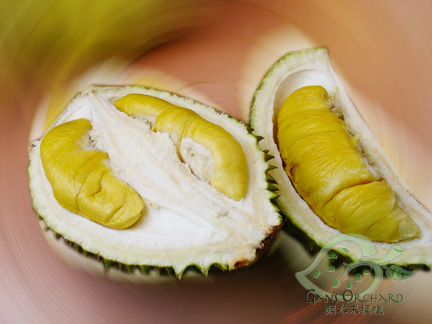
Dubbed as the “king of fruit”, durian is famous for its extremely delicious taste, peculiar appearance, and offensive odor. Durians vary greatly in shape and size, generally ovoid or ovoid oblong to nearly around 30 cm (12 in) lengthy as well as 15 cm (6 in) in diameter and normally weighs one to four kilograms (two to seven lb.). They are green to yellowish-brown colored. The flesh is usually creamy-yellow to saffron color bulbs depending upon the species. They have a sharply aromatic smell and strongly exotic taste. The flesh or pulp of durian can be consumed at various stages of ripeness and is used as a flavoring agent in a wide variety of culinary and sweet preparations in Southeast Asian cuisines. Seeds are chestnut-brown, plump and the number of seeds per locule or segment varies from 0- (2–4) – 6, and the seeds are enclosed by the thick, sweet, creamy, pulpy aril which varies in color from white, cream, yellow to golden yellow. The seeds include a boring taste similar to jackfruit seeds. The tree starts to bear fruit four to five years after planting. A seasonal fruit, durian lasts typically from June to August, according to the season of other tropical fruits such as mango, mangosteen, and jackfruit. Durian is one of the amazing exotic fruit which ‘taste like heaven and smell like hell’.
History
Durian is considered to have originated from Southeast Asia. It is found wild or semi-wild in South Tenasserim, Lower Burma, and around villages in peninsular Malaya. Wild durian trees are still found in Borneo and Sumatra. Borneo is the center of diversity for Durio species. Durian is normally grown along roads or in commercial orchards in Thailand, Laos, Kampuchea, Vietnam Malaysia, Brunei, Indonesia, and the Philippines. Durian is also cultivated from south-eastern India and Ceylon to New Guinea, and the Pacific Islands, Hawaii, Honduras, the Antilles, and Zanzibar in Africa. In Australia, it is cultivated northern Australia around Darwin in the Northern Territory and from Tully to Cairns in Queensland. Today due to its amazing taste and wonderful appearance it is grown throughout the world.
Nutritional Value
Apart from their strongly exotic taste, durian is a good source of nutrients, vitamins and minerals. Consuming 243 gram of durian offers 0.909 mg of Vitamin B1, 0.768 mg of Vitamin B6, 0.503 mg of Copper,47.9 mg of Vitamin C, 65.83 g of Carbohydrate, 0.486 mg of Vitamin B2, 12.95 g of Total Fat, 0.79 mg of Manganese and 9.2 g of Total Dietary Fiber.
Nutritional value of Durian, raw or frozen
Serving Size: 1 Cup, 243 g
Calories 357 Kcal.Calories from Fat 116.55 Kcal.
Proximity
Amount
% DV
Water
157.93 g
N/D
Energy
357 Kcal
N/D
Energy
1494 kJ
N/D
Protein
3.57 g
7.14%
Total Fat (lipid)
12.95 g
37.00%
Ash
2.72 g
N/D
Carbohydrate
65.83 g
50.64%
Total dietary Fiber
9.2 g
24.21%
Minerals
Amount
% DV
Calcium, Ca
15 mg
1.50%
Iron, Fe
1.04 mg
13.00%
Magnesium, Mg
73 mg
17.38%
Phosphorus, P
95 mg
13.57%
Potassium, K
1059 mg
22.53%
Sodium, Na
5 mg
0.33%
Zinc, Zn
0.68 mg
6.18%
Copper, Cu
0.503 mg
55.89%
Manganese, Mn
0.79 mg
34.35%
Vitamins
Amount
% DV
Water-soluble Vitamins
Vitamin B1 (Thiamin)
0.909 mg
75.75%
Vitamin B2 (Riboflavin)
0.486 mg
37.38%
Vitamin B3 (Niacin)
2.61 mg
16.31%
Vitamin B5 (Pantothenic acid)
0.559 mg
11.18%
Vitamin B6 (Pyridoxine)
0.768 mg
59.08%
Vitamin B9 (Folate)
87 µg
21.75%
Folate, food
87 µg
N/D
Vitamin C (Ascorbic acid)
47.9 mg
53.22%
Fat-soluble Vitamins
Vitamin A, RAE
5 µg
0.71%
Vitamin A, IU
107 IU
N/D
Beta Carotene
56 µg
N/D
Alpha Carotene
15 µg
N/D
*Above mentioned Percent Daily Values (%DVs) are based on 2,000 calorie diet intake. Daily values (DVs) may be different depending upon your daily calorie needs. Mentioned values are recommended by the U.S. Department of Agriculture. They are not rxharun.com recommendations. Calculations are based on average age of 19 to 50 years and weigh 194 lbs. Source: https://ndb.nal.usda.gov/
Health benefits of Durians
Durian is really a fruit which is extremely popular with lots of individuals, like an aromatic smell as well as the taste is scrumptious and also fairly sweet. Durian can also be an appropriate food choice, simply because durian has numerous health advantages. Advantages are obtained not just from the flesh alone, but in addition from the skin as well as leaves. Many believe that durian fruit may cause sickness. Without a doubt, the opinion just isn’t completely incorrect, simply because consuming durian can easily improve blood pressure levels and high cholesterol levels.
Durian health benefits are mostly due to its huge amount of phytonutrients, protein, and antioxidants. It is naturally rich in potassium, fiber, iron, vitamin C, and vitamin B complex. The king of fruits is exceptional for improving muscle strength, reducing blood pressure, and improving bowel movements and skin health. It also supports the nervous and immune systems and improves the formation of red blood cells. Listed below are some of the popular health benefits of Durian fruit:
1. Digestive aid
Like many “meaty” fruits, Durian contains high levels of dietary fiber, which are actually essential for the normal function of multiple systems in the body, most particularly the digestive system.
Fiber stimulates peristaltic motion and the secretion of digestive and gastric juices, further easing the entire process. By reducing conditions like constipation and blockage in the intestines, conditions like bloating, excess flatulence, heartburn, cramps, and indigestion can be reduced, as well as serious conditions like colorectal cancer. Much of the fiber in durian is insoluble fiber, which also lowers the frequency of diarrhea for people with loose stool.
Apart from that fiber helps to reduce the amount of cholesterol in the blood by scraping LDL cholesterol out of the body and rapidly removing it before it can do any damage to the cardiovascular system in the form of plaque buildup.(1)
2. Sexual dysfunction
Several types of research have recently been conducted to evaluate the potential of durian meat to act as an aphrodisiac. The result shows the probability to produce intensified sexual libido and stamina, and also decrease the chances of infertility in men and women, and increase sperm motility. All in all, it is an aphrodisiac in every sense of the word!(2)
3. Bone health
Durian is one of the wonderful sources of copper, magnesium, manganese, and potassium, all of which play an important role in developing and sustaining bone strength and durability. Apart from that potassium also increases the effectiveness of nutrient uptake by the cells, so it maximizes how many beneficial minerals the body takes in, also benefiting bone health. These essential minerals help to prevent the development of osteoporosis for patients of any age!(3)
4. Promotes healthy teeth and gums
A single serving of durian consists of 95 mg of phosphorus which is actually 13.57% of the daily recommended value. Even though calcium is amongst the best-known nutrition for healthy gums and teeth, calcium is not able to build teeth without phosphorus. So include durian in your regular diet as it is loaded with phosphorus, calcium as well as other essential minerals which are essential for the normal functioning of the body.
5. Blood pressure and cardiovascular health
As we have mentioned earlier, durian is a rich source of potassium, and since potassium is such an integral part of the salt and fluid balance throughout the cells of the body, potassium levels also dictate blood pressure. When plenty of potassium is present, the blood vessels can relax, decreasing the stress on the cardiovascular system, and reducing the chances of developing conditions like atherosclerosis, heart attacks, and strokes. Reduced stress on the veins and arteries also increases oxygenated blood flow to the brain, and researchers have shown that potassium levels can therefore help boost cognitive function and memory, decreasing the risk of developing Alzheimer’s and dementia!
6. Cancer prevention
As mentioned previously, durian has a wealth of vitamins, nutrients, and organic chemicals that function as antioxidants. In the battle against cancer, free radicals are vitally important, because, during cell metabolism, there are byproducts created, called free radicals. These free radicals help to destroy the DNA of regular cells and convert them to cancer cells, which can then metastasize or form fatal, tumorous growths. All of the antioxidants that reduce oxidative stress on the organs of the body are bonuses to the immune system, and durian is packed with them, including vitamin-C, vitamin-B complex, and vitamin E, as well as phytonutrients that battle cancerous cells.(4)
7. Promotes healthy pregnancy
Durian is packed with folate, one of many must-have nutrients for pregnant as well as intending to become pregnant women. Folate is significant for regular tissue growth as well as protects against brain as well as spine trouble for the developing baby.
8. Anti-aging
In traditional, herbal medicine, durian was often hailed as a tool to battle aging, and is one of the main reasons why people call it the “king of fruits”. It turns out that durian has a wide variety of antioxidant properties stemming from its vitamin and organic chemical makeups that vigorously reduce the number of free radicals in the body. Consuming an excessive amount of durian can seriously boost your body’s capability to eliminate those free radicals, thus decreasing the chances of premature aging and delaying the appearance of symptoms such as wrinkles, age spots, macular degeneration, hair loss, tooth loosening, arthritis, cancer, and heart disease. Consume a sufficient amount of durian, and you can feel, look, and act younger than you have in years!(5)
9. Anemia
Durian has many different minerals inside of it, but there are high levels of folic acid within durian as well, which is an essential component in the production of red blood cells. Also, durian is a good source of iron and copper, two other essential components of red blood cells; once RBC production is back to normal, then symptoms of anemia will vanish, which include indigestion, migraines, fatigue, anxiety, and cognitive malfunction.(6)
10. Helps relieve migraine
Are you suffering from migraine headaches? Regular consumption of durian may help relieve the pain sensation. Riboflavin is yet another B vitamin present in durian which will help and is also utilized to cure migraine headache.
11. Insomnia
Durian consists of a good amount of tryptophan, the organic chemical closely related to falling asleep after Thanksgiving since it is found in massive amounts in turkey. By including tryptophan in your diet, it enters your brain, is converted to serotonin, which induces a feeling of relaxation and happiness. The excess serotonin then releases melatonin into the bloodstream, which causes the body to feel tired, and eventually pass out. If you suffer from insomnia, have a few pieces of durian before you try to fall asleep and see the results for yourself!
12. Helps in curing jaundice
Jaundice, also known as icterus, is a yellowish or greenish pigmentation of the skin and whites of the eyes due to high bilirubin levels. It is one of the dangerous illnesses which are spreading throughout the world. A preparation from the roots and leaves of durian has typically been utilized as medicine for the treatment of several types of fevers as well as jaundice. So regular use of preparation from the roots and leaves of durian is recommended for curing Jaundice.
Along With this Nutrition in Durian Fruit, you can anticipate obtaining these types of Advantages:
Normalizes blood glucose levels
Sustains healthy thyroid gland
Assists safeguard from nausea
Decreases skin rashes
Retains Hair color
Aids in preventing dizziness
Helps in avoiding hearing problems
Supports healthy reproduction
Enhances nerve function
Increases muscle function
Decreases confusion
Decreases frustration
Lowers exhaustion
Reduces possibility of heart disease
Decreases possibility of hypertension
Boosts exercise ability
Increases wound healing
Stops cells from damages
Enhances Defense mechanisms
Lowers Chances of several Cancers
Enhances Iron assimilation
Enhances Lung health
Helps prevent from repeated colds
Protects from repeated infections
Supports Brain Function
Decreases Chance of Heart attack
Safeguards from homocysteine build-up
Helps safeguard from dermatitis
May possibly decrease seizures
May well Improve appetite
Decreases Tingling in Legs
Supports Cardiovascular function
Safeguards Cells from Oxygen Damage
Decreases Sensitivity to Light
Enhances Skin around eyes
Decreases Oral Sores and Cracks
Decreases skin peeling around the nose
Helps Good Vision
Helps Cells Production
Types of Durian
In reality, there are lots of varieties/types of durian on the planet. These types of plants are regularly found in Asia, and particularly within Indonesia, Thailand as well as Malaysia. From about 30 current varieties of durian, 20 varieties are normally found in Indonesia. In Wikipedia pointed out that a number of excellent cultivars on the planet and also have high quality are:
Udang Merah (Ang Hae) D 175
Udang Merah is within a lengthy oval skin shape and contains shorter thorns. Its delicate as well as good consistency along with its fairly sweet as well as foamy taste of thick and also yellow flesh tends to make this durian among the most scrumptious durians!
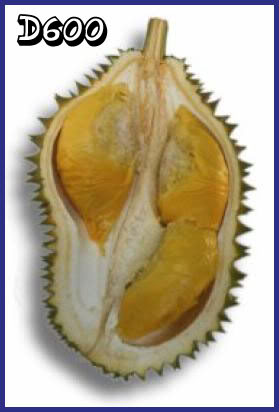
D 600
If you want a somewhat sour taste but creamy as well as sweet, D 500 would be the solution! Even though its consistency is rough, its mouth-watering thicker, as well as yellow-colored gold flesh, won’t ever turn you down! This particular durian is within a medium-sized of yellow-colored green skin.
Penang 15 D 177
Penang 15 D 177 flavor is creamy as well as scrumptious of fine consistency. In case you found a lengthy oval-shaped as well as golden colored husk together with short and also well-defined thorns of skin, it is primarily the kind of durian!
Labu D 163
Labu D 163 is within a medium-sized as well as the long oval shape of the skin. Its stable, as well as yellow flesh provides you with a gentle as well as a high-quality taste of sweet as well as creamy. Delicious enough to attract you!
Hati Merah (Ang Jin)
Together with the shape of the heart, this kind of durian is gentle as well as creamy in texture and yes it is included with delightfully sweet as well as creamy taste as well! The flesh is very large as well as thick that you simply don’t need to desire much more.
Isi Merah (Ang Bak) D 164
This particular medium-sized of long oval-shaped durian is good as well as rich and creamy in flavor and it’s also in the soft as well as the quality texture of flesh. Isi Merah is definitely an appealing yet attractive fruit of yellow and medium-thick flesh.
Raja Kunyit
Oblong in shape, along with yellow-colored gold flesh is Raja Kunyit. In spite of its limited as well as razor-sharp thorns, it comes with an appealing fairly sweet, rich as well as aromatic taste of soft, shiny as well as creamy consistency!
Amy Yip
Amy Yip hides its prosperous as well as fairly sweet flavor beneath the circular shape skin of long thorns. You will discover scrumptious 1-4 cloves for each pod within too!
Lipan Kuning
Taste of fairly sweet, rich, and creamy brings together along with the fine texture of the type of durian surely will tempt you so much! This particular durian is known as Lipan Kuning and it’s also in the oblong form of a medium-sized as well as greenish-brown husk skin.
Kulit Hijau
Nearly much like Lips Kuning, Kulit Hijau flavor is abundant, fairly sweet as well as rich, and creamy however the flesh is a bit hard as well as yellow-colored white in color.
Chanee
This particular cultivar is definitely an intro from Thailand. The fruit is ovoid along with a wide, obtuse tip as well as weighs about from 2 to 4 kg. The flesh is thicker, golden yellow, fairly sweet and it has a gentle fragrance. The delicious part is 32%.
Mon Thong
Generally known as ‘Golden Pillow,’ this particular cultivar can also be from Thailand. With a weight of from Two to five kg, the fruit is somewhat spear-like having a pointed tip. The flesh is thicker, golden yellow, sweet and it has a light fragrance. The delicious portion is 30%.
Alcon Fancy
The fruit with this local cultivar is spherical, weighing about 0.5 to 1.5 kg. The flesh is canary yellow, fairly sweet and it has a somewhat sour taste, and also moderate fragrance. The delicious part is 34%.
Arancillo
An additional local cultivar, the fruit is ovoid, weighing about 0.65 to 2.0 kg. The flesh is actually mimosa yellow, firm, fairly sweet as well as creamy, and it has a gentle fragrance. The passable part is 38%.
Atabrine
A nearby selection, this cultivar has ellipsoidal fruit, weighing from to 3 kg. The flesh is maple, yellow-colored, fairly sweet, as well as extremely glutinous along with a somewhat nasty flavor. The passable part is 25%.
Duyaya This particular neighborhood cultivar has got oblong fruit, weighing from 2 to 4 kg. The flesh is thicker, vibrant yellow, fairly sweet, as well as has a gentle fragrance. The delicious part is 32%.
GD 69
The fruit of the local cultivar is obovate and enormous, weighing about 2-2.5 kg. The flesh is yellow-orange, firm, thick, and it has a moderate fragrance. The passable part is 45%
Lacson Uno
This particular local cultivar possesses obovate and enormous fruit, weighing about 3-4 kg. The flesh is yellow-colored, firm as well as fairly sweet and it has a moderate fragrance. The delicious part is 38%.
Mamer
This really is an additional nearby cultivar. The fruit is ellipsoidal and also weighs about Two to three kg. The flesh is barium yellow, fairly sweet as well as glutinous. The delicious percentage is 25%.
Puyat
This kind of local cultivar’s fruit is very large as well as cylindrical, weighing about 2-4 kg. The flesh is chrome yellow, firm, fairly sweet and buttery, and it has a gentle fragrance. The delicious part is 40%.
How to Eat
Durian is often named the ‘King of Fruit’ and its fruit is much prized and relished for its sweet highly nutritious, edible pulpy aril which is eaten fresh.
The pulp can be kept frozen for several months by quick freezing to sub-zero temperatures then thawed and eaten.
Some even eat the raw pulp as an accompaniment with rice.
Durian is also processed into a wide assortment of edible delectable which include ice-cream, sherbets, smoothies, pulut durian, cappuccinos, yule logs, milkshakes, ice kacang, pengat durian, tempoyak, cakes, jam or Sri kaya, agar-agar durian, kueh dodol, bunch durian, lempuk and other Nyonya preparations like apong balik.
Tempoyak can be eaten either cooked or uncooked, is normally eaten with rice, and can also be used for making curry.
Pulp is used for moon-cake fillings, pastries, buns, traditional Malay candy, sweets, and biscuits.
Malaysians make both sugared and salted preserves from durian.
When durian is minced with salt, onions, and vinegar, it is called a border.
Popular durian recipes in Indonesia include dodol durian, kolak durian, sri kaya durian, es telur durian, es santan durian, wajik durian and pepes bunga durian kadupandak.
In Sumatra, a traditional dish is ikan brakes which is fish cooked in a durian-based sauce.
Another Sumatran specialty is sambal tempoyak, made from the fermented durian pulp, coconut milk, and a collection of spicy sambal.
Javanese prepare the pulp as a sauce to be served with rice; they blend the minced pulp with minced onion, salt, and diluted vinegar as a kind of relish; and they add half-ripe arils to certain dishes.
Pulp is fermented in earthen jars, sometimes smoked, and eaten as a special side dish in Palembang, Sumatra, and Java.
Blocks of durian paste are sold in the markets in Thailand.
Durian paste is made from arils of over-ripe fruit.
Thai people use the pulp, glutinous rice, and coconut cream in making a popular dessert.
Arils are made into a preserved confection called Arthurian kuan and durian chips which are on sale in supermarkets throughout the year.
Durian chips are made from immature, unripe aril.
Durian powder is made from fully mature but unripe pulp and is used as essence in coconut milk, ice cream, cookies, biscuits, candy beverages, and other products requiring durian flavor including toothpaste for durian fanciers.
Durian arils are canned in syrup for export.
A pulp of unripe fruit is boiled whole and consumed as a vegetable.
Petals of durian flowers are consumed in the Batak provinces of Indonesia and in East Malaysia where it is used in curries.
Durian seeds, which are the size of chestnuts, can be eaten after they are boiled, roasted, or fried in coconut oil.
Seeds are sliced thin and cooked with sugar as confectionery or the slice seeds are dried or baked in coconut oil with spices and eaten with rijsttafel in Java.
Rijsttafel is an elaborate Javanese meal that consists of rice and various food dishes: curried meats, fish, chicken, vegetables, fruits, relishes, pickles, sauces, condiments, nuts, eggs, and etc.
Young tender leaves and shoots are occasionally cooked as greens.
Other Traditional uses and benefits of Durian
Durian has some medicinal uses in traditional medicine in Southeast Asia.
Durian is considered a general tonic.
Fruit is believed to be an aphrodisiac, an abortifacient, and to improve menstruation.
Decoction of the leaves and roots was prescribed as an antipyretic in Peninsular Malaysia.
Juice of fresh leaves had been used as an ingredient in a lotion for fevers and the roots were used for treating fever, either pulverized or rubbed on the body or as a decoction.
Leaf juice was applied to the head of a fever patient.
A traditional Malay prescription for fever reported drinking the boiled decoction of the roots of Hibiscus Rosa Sinensis, Nephelium longan, Durio zibethinus, Nephelium mutabile, and Artocarpus integrifolia, and boiling the leaves of all of these species and using as a poultice.
Another traditional treatment for fever was to bathe the patient’s head for several days with water containing crushed leaf extracts of Curculigo latifolia, Gleichenia linearis, Nephelium lappaceum, and Durio zibethinus.
Leaves were employed in medicinal baths for people with jaundice.
Decoctions of the leaves and fruits were applied to swellings and skin diseases.
Ash of the burned hull was taken after childbirth.
Pulpy flesh was said to be anti-helminthic and to serve as a vermifuge.
Fruit hulls had been used externally for treating skin ailments in Java.
Other Facts
The sapwood is white, the heartwood light red-brown, and soft, coarse, not durable nor termite-resistant.
It is used for masts and interiors of huts in Peninsular Malaysia.
Durian rind extracts have been found to be suitable for the preparation of granules and to have desirous binding properties for the manufacture of tablets.
Empty rinds are used in Indonesia as a source of fuel; in the Moluccas islands (Maluku), the husk of the durian fruit is used as fuel to smoke fish.
Ashes of the fruit hull have been used in Patani in Thailand and in Pekan, Pahang for making silk white and as lye with other dyes.
Selection and storage
The durian fruit is indigenous to Southeast Asia. It really is purchased from markets all around the Asian world and is particularly brought in in the USA as well as Europe. Individuals have variations in choices relating to ripeness, although some just like somewhat ripened, sour flavored durians while some might prefer to treasure over-ripened. Generally, ripe fruit which falls from the tree is gathered and set to trade. Within the store, select a durian fruit along with a firm stalk. Exterior their native habitat, it really is one of several costly fruits; a number of its types just like D24 (Sultan) is in popular demand as well as requires a high price. The fruit may also be kept in the fridge for a couple of days.
Caution
Even though the nutrition valuation of durian is extremely higher, individuals shouldn’t consume it exceedingly. The excessive consumption of durian may cause our bodies hot, as well as plentiful nutrition, cannot be totally soaked up through the body. Due to a great deal of sugar, the unnecessary consumption of durian may also worsen the signs and symptoms of the sufferers along with diabetic issues. Therefore, people should consume durian in the correct amount in order to take advantage of plentiful nutrition found in durian just like calcium and phosphorus.
Durian fruit, whenever coupled with alcohol, can easily bring about negative effects just like powerful gastro spasms as well as intense unwanted gas.
People struggling with high blood pressure levels as well as expecting mothers shouldn’t eat durian as the seeds are usually poisonous naturally and may lead to difficulty breathing.
In fact, consuming 100 grams of durian was sufficient. Simply because, in 100 grams of it, have been fairly much more nutrients we get.
How to Eat Durian
Consuming durian fruit is not an excellent issue as ripe ones fall in time and could somewhat crack whenever falling especially the big ones. Simply by inserting a knife into this type of crack, it may be opened up effortlessly. Inside are about five parts as well as in each one of these, a number of seeds can be viewed engrossed in a fleshy as well as vibrantly compared to custard. Whenever durian is consumed instantly on falling, the nipping odor is endurable along the flavor is pleasant as well as beneficial. Usually, place the seedless durian flesh within a bowl and place it within the deep freeze for some time just before consuming. Durian fruit could be combined with numerous tastes to improve its flavor as well as a wide selection of local recipes. Additionally, there are durian sweets around in case you don’t desire it raw, and also the specific taste stays along with it. Its seed may also be consumed soon after it’s cooked just like the boiled seeds of jackfruit.
Cooking Tips
Durian is utilized to taste a multitude of fairly sweet food, just like conventional Malay candy, ice kachang, dodol, rose biscuits, and so on. Additionally, it is utilized for preparing ice cream, milkshakes, Yule logs as well as cappuccino.