

Black Raspberry/Rubus occidentalis is a species of Rubus native to eastern North America. Its common name black raspberry is shared with other closely related species. Other names occasionally used include bear’s eye blackberry, black cap, blackcap raspberry, and scotch cap.
Rubus occidentalis is a deciduous shrub growing to 2 to 3 meters (6.6 to 9.8 ft) tall.[rx] The leaves are pinnate, with five leaflets on leaves, strong-growing stems in their first year, and three leaflets on leaves on flowering branchlets. The flowers are distinct in having long, slender sepals 6 to 8 millimeters (0.24 to 0.31 in) long, more than twice as long as the petals. The round-shaped fruit is a 12-to-15-millimeter (0.47 to 0.59 in) diameter aggregation of drupelets; it is edible and has a high content of anthocyanins and ellagic acid.[rx][rx] Long stems also called canes to grow up to 1.8 meters (5.9 ft) in length, usually forming an arch shape, but sometimes upright. Canes have curved, sharp thorns, while immature canes are unbranched and have a whitish bloom.[rx]
The black raspberry is related to the red raspberry Rubus idaeus and Rubus strigosus, sharing the white underside of leaves,[rx] and fruit that readily detaches from the carpel.[rx]
| Black Raspberry Quick Facts | |
|---|---|
| Name: | Black Raspberry |
| Scientific Name: | Rubus occidentalis |
| Origin | East and central North America |
| Colors | Yellowish white to red and purplish-black when ripe |
| Shapes | Round-shaped fruit is a 12–15 mm diameter aggregation of drupelet |
| Taste | Sweet and slightly tart |
| Health benefits | Builds the immune system, Health of eyes, Blood pressure, Improves cardiovascular issues, Weight loss, Anti-cancer |
Botanically classified as Rubus occidentalis, Black raspberries are occasionally referred to as Blackcaps. They are a mostly self-fruiting brambleberry and are members of the family, Rosaceae along with strawberries and blackberries. The plant is indigenous to East and central North America: New Brunswick to Minnesota, south to Georgia, west to Nebraska, and Colorado. Other Popular common names of the plant are American Black Raspberry, Blackcap, Black Raspberry, Purple Raspberry, Scotch Cap, Framboise Noire, Framboise Sauvage, Framboisier Noir, Framboisier de Virginie, Frambuesa Negra, Ronce, Ronce d’Occident, Ronce Occidentale, Rubus occidentalis, Thimbleberry and Virginia Raspberry. Its common name black raspberry is shared with the closely related western American species Rubus leucodermis. They should not be confused with blackberries, as they are a much smaller berry with a delicate texture and slightly higher sugar content. Black raspberries are super foods that have been shown to slow the growth of certain cancers.
Plant Description
Black Raspberry is an arching, erect, deciduous, armed shrub that grows about 2–3 m tall with stems rooting at the tips. The plant is found growing in openings in deciduous woodlands, woodland borders, savannas, thickets, fence rows, overgrown vacant lots, power-line clearances in wooded areas, and partially shaded areas along with buildings. The plant thrives best on deep, rich, well-drained, sandy-loam soils well supplied with organic matter and with high moisture-holding capacity.
Stem
Stems are round and have prickles, which are thorn-like structures that originate from the epidermis of the stem. There is usually a white, powdery substance called a bloom on the stem. The stems, or canes, are generally arching or rambling. Twigs are reddish-purple, terete, glaucous; eglandular, sparsely bristly with straight or hooked, stout prickles that is wider at the base.
Leaves
Leaves are alternate, palmately compound, 3–5 foliate. Leaflets are ovate to ovate-lanceolate, 5–19 cm long by 3.8– 8.9 cm wide. They are glabrous above and densely white tomentose beneath. They are rounded to sub-cordate at base and margins doubly serrate with occasional shallow lobes. Petiole and rachis have many stout prickles.
Flower & Fruits
The white flowers of the black raspberry have five petals and five sepals with several stamens and many pistils. Flowers are distinct in having long, slender sepals 6–8 mm long, more than twice as long as the petals. Each pollinates pistil turns into a fruitlet on the receptacle. This type of fruit is called aggregate fruit. Fruits are round-shaped and are a 12–15 mm diameter clump of drupelets. It is edible and has a high content of anthocyanins and ellagic acid. Fruit are yellowish-white to red and purplish-black when ripe.
They have a hollow center and the typical conical shape but are normally smaller than other colored raspberries. An occasional white bloom appears on the berries’ surface but easily wipes away. Their deep purple almost black pigmentation is occasionally scattered with a touch of red. They are often more tart than sweet and have a slight note of earth in their flavoring. Once ripe, they have a highly perishable shelf-life. Its delicious fruit is commonly used for making jam and pie, as well as providing cover and food for many species of animals.
Life span
While the roots of Rubus occidentalis are perennial the shoots are biennial. First-year the shoot grows and the following year the shoot will produce flowers and fruit. Plant reproduces sexually, its seeds being distributed by animals that have eaten the fruits. The branches can take root as well producing new plants.
Health benefits of Black Raspberry
The fruit of black raspberries is a fine source of antioxidants, but it is the leaves and roots of the plant that are mostly used in herbal medicine. Leaves and root bark are astringent in nature and are used to treat incontinence, diarrhea, dysentery, and other bowel complaints. Roots have been used in the treatment of gonorrhea, coughs, and toothaches. Leaf Tea is sometimes used to remedy sores, ulcers, and boils. Listed below are some of the popular health benefits of using black raspberry
1. Anti-cancer
Scientific research has shown that black raspberries blocked the growth as well as the development of breast, prostate, colon, and oral cancer. Black raspberries were also confirmed to be successful at treating Barrett’s esophagus. In a research, 20 patients who suffered from Barrett’s esophagus were provided with freeze-dried black raspberries and a result showed an increase in markers of detoxification along with oxidative stress that showed a proven reduction as well.
2. Weight loss
In case if you are trying to lose weight, you may check out the nutritional values of black raspberries. A cupful of black raspberries consists of only 60 calories; they have only two grams of protein and are high in fiber. Whenever you eat foods that are rich in fiber they will keep you fuller for longer. They are just about fat-free and have no cholesterol. They will increase your energy levels which in turn will raise your metabolism. This will help you burn off the foods that you are eating so they don’t get stored as fat.
3. Improves cardiovascular issues
Black raspberries have been found to improve endothelial function in those who were at high risk for heart disease. Research carried out in South Korea proved the effects of the black raspberry extract on a short-term basis. Black raspberries help to maintain and repair the vascular system. Of the 51 patients, those that received the black raspberries realized an increase in the circulation of the endothelial progenitor cells and reduced the risk of cardiovascular issues in people with metabolic syndrome.
4. Blood pressure
The journal called Nutrition published the results of a study that followed 45 people who were pre-hypertensive. The first group took a daily capsule of dried black raspberry powder that was equivalent to 1500 mg of black raspberries each day. The next group took a capsule of dried black raspberry powder that was a little stronger; it equaled 2500 mg of black raspberries. The last group was given a placebo. At the end of eight weeks, the group that took the higher dosage realized a significant reduction in their systolic blood pressure. This result has proven that Regular use of black raspberry is quite beneficial for those who are suffering from high blood pressure issues.
5. Health of eyes
Black raspberries consist of a huge amount of Anthocyanins, which are proven to help promote and maintain the health of your eyes. Black raspberry consists of more anthocyanins as compared to wild blueberries. Some other popular benefits of these berries are improved night vision, extra circulation through the capillaries of the retina, decreased chances of retinopathy in patients with diabetes, and a safeguard against macular degeneration.
6. Builds the immune system
Black raspberries are brimming with antioxidants, minerals, and polyphenols that all work together to boost, and build, the immune system. Antioxidant properties help the immune system by killing off the free radicals that can come about through normal everyday occurrences as well as exposure to environments that have a questionable background.
Traditional uses and benefits of Black Raspberry
- Black raspberry root tea was also part of the traditional pharmacopeia for the treatment of hemorrhaging and hemophilia.
- Blackberry tea was mixed with whiskey to expel gas in South USA.
- Juice of raspberry fruits was used to flavor medicines.
- Tea from the roots treats stomach aches in Kiowa and Apache Indians.
- Roots are cathartic.
- Decoction of the roots has been used as a remedy for gonorrhea, diarrhea, and dysentery.
- Root has been chewed in the treatment of coughs and toothache.
- An infusion of the roots has been used as a wash for sore eyes.
- Root has been used, combined with Hypericum spp, to treat the early stages of consumption.
- Decoction of the roots, stems, and leaves has been used to treat whooping cough.
- Leaves are highly astringent.
- A decoction is used in the treatment of bowel complaints.
- Tea made from the leaves is administered as a wash for old and foul sores, ulcers, and boils.
- An infusion of the astringent root bark is used in the treatment of diarrhea and dysentery.
- Decoction of the roots, stems, and leaves has been used in the treatment of whooping cough.
Culinary Uses
- Black raspberries are eaten raw, cooked, dried, frozen, or made into purées and juices or processed as colorants.
- They are very versatile and can be made into a wide array of food preparations and recipes.
- They are outstanding for jam, jellies, sauces, and preserves.
- They can be used in bread, cakes, cookies, pastries, pudding, pies, tarts, flan, soufflés, pancakes, waffles, soups, salads, salsa, raspberry vinaigrette, and eaten in ice-cream, yogurt, sorbets, sherberts, and slushes.
- Some popular common recipes using raspberry are fondue-cheesecake, chocolate raspberry streusel squares, and chocolate raspberry cheesecake.
- Pancakes and waffles go well with raspberry syrup.
- Black raspberries can be processed into refreshing beverages, syrup, mead, wine, and liquor.
- Raspberry sac-mead is sweet alcoholic liquor popular in Poland and is made of fermented honey, water, and often with spices and black raspberries.
- Two well-known liqueurs predominantly based on black raspberry fruit include France’s Chambord Liqueur Royale de France and South Korea’s various manufacturers of B okbunja.
- B okbunja is made from Korean black raspberries and contains 15% alcohol and is considered by many to be especially good for sexual stamina.
- Young black raspberry shoots are eaten raw or cooked like rhubarb.
- They are harvested as they emerge through the soil in the spring, and whilst they are still tender, and then peeled.
- Tea is made from the leaves and another from the bark of the root.
Dosing considerations for Black Raspberry
An appropriate dose of black raspberry for use as treatment depends on several factors such as the user’s age, health, and several other conditions. At this time there is not enough scientific information to determine a suitable range of doses for black raspberry. Keep in mind that natural products are not always necessarily safe and dosages can be important. Be sure to follow appropriate directions on product labels and consult your pharmacist or physician or other healthcare professional before using.
Other Facts
- Purple to dull blue dye is obtained from the fruit.
- The plant is used as a disease resistance source against the spur-blight disease of the leaves.
- Crossing of R. idaeus × R. occidentalis establishes very fruitful hybrids, which usually are called R. × neglectus Peck.
Relationship with other species
Non-human
Black raspberry fruit and other parts of the plant are consumed and enjoyed by many mammals such as black bears, rodents, and birds. It has been recorded to be eaten by 150 bird and mammal species.
Humans
Black raspberry is a tasty treat for humans and used for jams, pies, cakes, and many other foods. The fruit can also be used to make dyes. Leaves and roots are said to have medicinal purposes and were used by many groups of Native Americans for various ailments.
Pests
Common pests of Rubus occidentalis are various fungi and various insects that feed on the leaves and sap.
Recipe
Black Raspberry Cobbler
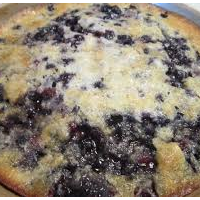
Ingredients
- 3 -4 cups fresh black raspberries
- 1⁄4 cup sugar
- 1 teaspoon cornstarch
- 6 tablespoons butter
- 1 cup sugar
- 2 cups flour
- 1 teaspoon salt
- 2 teaspoons baking powder
- 1 cup milk
- 1 dash sugar, on top
Direction
- In a bowl combine the 1/4 cup sugar and cornstarch. Then mix in the berries. Place the berries in a 13 x 9 baking pan.
- In another bowl cream butter and sugar. Add in flour, salt, baking powder, and milk.
- Spoon the batter over top of the berries, using a spatula to smooth it out.
- Sprinkle a little bit of sugar on top. Bake at 350 for 40-45 minutes.
References





